
I first saw the stretch of water known as the ‘South China Sea’ when I was a child. My family went on holiday to the East Coast of Peninsula Malaysia. Travel wasn’t the same in those days – it was a huge adventure. We visited the states coloured purple, green and yellow on the map and I have vivid memories of the ‘South China Sea’. It seemed to always be there: blue and gently lapping on sunny mornings, dark and roiling when the storms came.
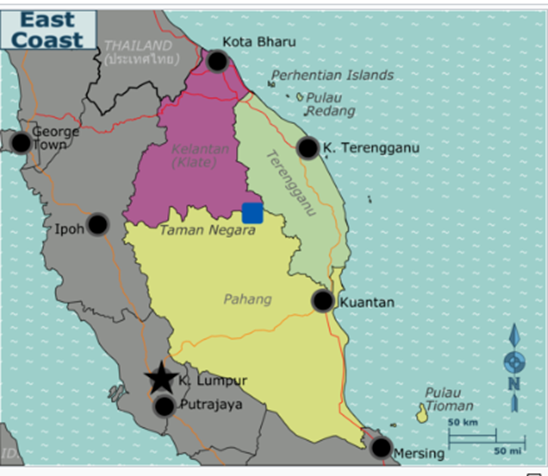
(Source: https://en.wikivoyage.org/wiki/East_Coast_(Malaysia))
That trip was memorable for another reason. One night, after following a guide by torchlight for what felt like miles, I saw giant turtles with leathery backs on an isolated part of the coast. Those amazing turtles were clambering onto Malaysia’s pristine sands to lay their eggs! Almost at once, their eggs were removed. I was fascinated; at the same time I felt sorry for the poor mother turtles. I’m sure they sensed what was happening.
The ‘South China Sea’ brought more than giant turtles: it also brought people. Among these were my ancestors, some of who arrived from southern China in rickety boats.
They did not call the water that had brought them the ‘South China Sea’. In Chinese, the same stretch of water is actually known as the ‘South Sea’ (南海), meaning the sea south of the Chinese mainland.
As a child, it never occurred to me to ask why a sea on Malaysia’s eastern coast should be named after China. If you look at a map, you’ll see that the ‘South China Sea’ is really a Southeast Asian sea: it flows across Southeast Asia, eventually reaching southern China and Taiwan. But the bulk of this sea is not in North Asia.

Source: https://en.wikipedia.org/wiki/South_China_Sea
Rather, it unfurls on the shores of Vietnam, the Philippines, Indonesia, Brunei, Singapore and, as I saw for myself, Malaysia. It swaddles the southern tip of Peninsula Malaysia, linking up with the Straits of Malacca. A more appropriate name for the ‘South China Sea’ might actually be the Southeast Asian Sea.
For me the Southeast Asian Sea isn’t just any sea: I saw it as a child, I stepped into its waters and I smelled it. It carried my ancestors and sustained others. It has given me a trove of memories. What happens in this sea matters to me. And rather a lot has been happening.
Did you know that China has claimed large parts of the Southeast Asian Sea for itself? The excuse China uses is ‘historical rights’.
The logic runs something like this: Chinese seamen ‘discovered’ reefs and islands in the Southeast Asian Sea 2,000 years ago and claimed them for China. Ever since, China has allegedly ruled over these islands. Because China claims to have governed godforsaken boulders in the middle of nowhere continuously, it also claims to own these islands and reefs. China has even created whole new islands where none existed before. It goes without saying that China owns the adjacent waters, too (and presumably, all the resources that go with them, and maybe even those turtles).
I am oversimplifying. The legal arguments are more sophisticated – you would hardly expect less from the Communist Party. For a detailed legal summary, you can see this link. But the sophisticated legal arguments really boil down to the above.
In the narrative above, the peoples of Southeast Asia are conspicuously absent. Imperial China regarded Southeast Asians as ‘southern barbarians’, as I learned when I reviewed a fascinating non-fiction book called ‘Writing the South Seas’ for the Asian Review of Books. It’s no surprise that Southeast Asians were excluded from considerations of power. Barbarians are to be civilised – they’re not capable of ‘discovering’ their own islands.
Imperial China may no longer exist, but a pattern of dominance, once established, is hard to dislodge. Attitudes die hard.
China has built islands in the Southeast Asian Sea on a scale never seen before, threatened other nations’ ships and confronted their aircraft. These are not the actions of a friendly state. Today’s China is no longer the benign Imperial China of days past, a country content with merely receiving tributes from Southeast Asia’s rulers.
Southeast Asians must unite. Otherwise, what’s the point of the Association of South East Asian Nations (ASEAN)?
Achieving unity in the region may be easier said than done; like Europeans, we have a chequered history of squabbling, but we should at least try to come together. The Southeast Asian Sea lies mainly in Southeast Asia. That’s where its resources belong and that’s where its resources should stay. Granted, we have to share these among us – but Southeast Asia has a long tradition of sharing.
Thank goodness there are signs of unity coming, slowly but surely. We can do it, we have to do it. There is no other way.
Giant turtles were not seen in Malaysia for decades, but they have apparently returned. Despite adversity and precarious numbers, the turtles have come back to reclaim their sea and shores. We need to do the same. We must reclaim our sea, our reefs, our islands and our shores. Before it’s too late.



 Window into Other Worlds