Category Archives: Identity

What Great-Grandmother Taught Me about Economics

Hang a banker a week until the others improve.” These extraordinary words were uttered by Ken Livingstone, formerly London’s mayor, in a speech in February this year.

His words clearly incite hate, but in the West of today, hating bankers and business, especially big business, seems perfectly acceptable. Livingstone is far from alone. “Outrage over £13 billion lavished on bonuses for bankers while the rest of us struggle to make ends meet,” screamed the MailOnline on 20 September.

With such righteous indignation, it was hardly surprising that two poets, Alice Oswald and John Kinsella, withdrew from the TS Eliot prize on the grounds of its ‘tainted’ sponsorship. The money for the prize was to come from investment firm Aurum, which manages funds of hedge funds. “The business of Aurum does not sit well with my personal politics and ethics”, said Mr. Kinsella, who described hedge funds as being “at the very pointy end of capitalism.” Fair enough. It is laudable to stand up for what you believe in. I only hope Mr. Kinsella never plans to retire, because his pension fund, if he has one, is likely to have exposure to hedge funds (or to mutual funds which employ hedge fund techniques).

Into this charged atmosphere, it would be interesting to see the response to my début novel in which private entrepreneurship is celebrated. My protagonist Chye Hoon fully embraces capitalism, because it offers her and her family opportunities. In colonial Malaya, there is no other lifeline, no entitlement: life is what you make of it. Chye Hoon cannot even read or write but this doesn’t deter her, because she can count. She starts a business in Malaya in 1910, making and selling the delicacies with which she has grown up – the Nyonya kueh of her childhood. On the first morning, Chye Hoon stands in her kitchen inhaling the smells of steaming coconut milk and pandanus leaves, and she knows she will make money.

This she proceeds to do – very successfully. Bahh, you may say. Your book is fiction. Maybe, but my protagonist is based on my great grandmother, who personified the traits of many overseas Chinese. We are the descendants of those who dared leave China. There are plenty of rags-to-riches stories from among us, and all are true. (When I say rags, I mean literally rags. Here is one of many photographs of newly-arrived immigrants at the Chinatown Heritage Centre in Singapore, an excellent museum.) 

Great-Grandmother shared the absolute determination of her Chinese ancestors to succeed. She might even have taught Gordon Brown a thing or two. Ipoh, where she lived, was a mining town, its fortunes tied to tin. And the price of tin, Great-Grandmother knew, went up and down. She understood intuitively that there would be good years as well as bad. If she had heard anyone say, as the former Chancellor did in his pre-budget report of 1999, “Under this Government, Britain will not return to the boom and bust of the past”, she would have exclaimed, Malaysian style, “What? He crazy ah?”

In the good years, Great-Grandmother worked and saved, to prepare for the bad years that were always just round the corner. In the bad years she worked just as hard, but saved less. There was no point complaining, and no one to complain to. Great-Grandmother lived in a world in which no safety net existed: there was no unemployment benefit, no healthcare, or pension. She provided for herself and her children, all nine of them.

At some point Great-Grandmother made enough money, and was approached by others for loans. That was when she became a money-lender in Ipoh. My own protagonist Chye Hoon also becomes a money-lender in my novel. Chye Hoon discovers an under-served niche (women), and her activities play a vital role in the growth of micro-enterprise in her town. In writing about how Chye Hoon builds her business, I drew from twenty years of experience as a banker and entrepreneur. 

Business is about survival, and growth. Always, you have to make sure you survive, no matter how large your business. This is the stuff of life. It’s what I write about in my novel. In the anti-capitalist discourse of today, we sometimes forget that businesses serve needs. As does banking.

Make no mistake: Great-Grandmother’s enterprise may have been small, but she was as keen on profit as any large corporation. Without profit, she could not have survived; our family wouldn’t be here, and I wouldn’t be completing a novel.

As I read some of the headlines in the West today, I can’t help thinking about her. Her golden rules were simple: work your butt off, save like crazy, and take advantage of every opportunity. Oh, and don’t borrow. This last was ironic, given her money-lending activities.

But perhaps a dose of such conservatism has its uses. At the last count, Britain’s households held £1.4 trillion of personal debt. This means that the average amount owed by each person in the UK represents 117% of average earnings.

Some people say this level of debt doesn’t matter (BBC News: The Truth about the UK’s Debt). Perhaps, but surely having less debt could do no harm.

In any case, are bankers solely responsible for the debt mountain? The facts speak for themselves: personal debt climbed during the go-go years between 1997 and 2007.  Loans were given too freely then, but no banker forced anyone to take a loan under duress. Somewhere in the narrative of entitlement, personal responsibility has got lost.

My novel goes against that grain. It is about identity and loss of culture yes, but it is also a story of personal responsibility, and the power we have as individuals. In this time of crisis, it offers a message of hope. Against all odds, a woman faces the Great Depression of the 1930s on her own, with no help whatsoever. She succeeds on her own terms. We can too.
3 Comments

Filed under Identity, Malaysia, Novel

An Open Letter to my Malay Friends and Anyone Who Cares Where Malaysia is Going

August 31 is Malaysia’s Independence (Merdeka) Day. On this day fifty five years ago, the Union Jack was lowered for the last time and a new country was born.

Malaysia (then called Malaya). 

She was to be a powerful narrative for multiculturalism. A place where many races – Malay, Chinese, Indian, Eurasian, Orang Asli (native indigenous people) – would live together, work together, as one, to move the country beyond the shadow of colonisation.

Malaysia remains a powerful idea. It’s one I believe in. But it has gone badly wrong. That’s why today, I’m writing this open letter to my Malay family and friends. I believe Malaysia is fast reaching a crossroad; where it goes next will be determined by you, my dear Malay friends. And where Malaysia goes is important to the world – because it remains one of the more tolerant Muslim countries.

First though, I want to say a big thank you. On this Merdeka day, I want to thank you, my Malay family and friends, and all fellow-Malaysians of Malay descent, for your historic generosity. Your ancestors welcomed mine when they arrived. You have shared the land with us, and this in turn, gave us opportunities we wouldn’t have had on mainland China. You provided us safe refuge from the turmoil of China. When I learn what happened there in the past century, I am so grateful my ancestors left. And that they found shelter in the beautiful land now called Malaysia.

My Malay friends, your own ancestors came from other places. They knew what it was like to be strangers in a new country. They treated my ancestors with that gracious hospitality which I myself have experienced countless times. All this I acknowledge, and thank you for.

But now I need to move on to something else: why I left Malaysia, and why I won’t be returning any time soon.

You may already know that 2 out of 10 Malaysian graduates live outside Malaysia. This is an astonishing fact for a middle-income country like Malaysia. It was revealed in a detailed study on Malaysia’s brain drain, carried out by the World Bank.

My Malay family and friends, do you not care about this exodus of talent? This isn’t just an abstract number: in our family, half those of my generation live abroad. We are the graduates this World Bank report identifies. We compete happily in the world economy and have no need to return.

Perhaps, my Malay friends, you think the brain drain irrelevant, since most of the people who have left are of Chinese and Indian descent? Certainly, this is what many Malays think, as Nurul Izzah Anwar, daughter of Anwar Ibrahim, has alluded to. (If you haven’t heard her speak, I recommend you watch this youtube clip. The opening is in Malay; the rest in English). 

“For me,” she says, “one Malaysian regardless of race, who has left the country…is a loss to us. They should be here celebrating, to improve the economy. I detest many people trying to singularly find out whether they are Malays, Chinese or Indians.”

My sentiments entirely. This fixation on race, race, race, in Malaysia is strangling the country. Yes, 88% of the one million Malaysians estimated to be living abroad are of Chinese and Indian descent. So what? My Malay friends, I ask you: does our race matter more than the fact that we have taken our talents elsewhere?

Yet, should I expect anything else? How could any Malaysian not be fixated on race, when you, my Malay family and friends, are accorded ‘special’ rights solely because of your race and religion?

Imagine if the United States had given ‘special’ privileges to the Pilgrim Fathers and Mothers and their descendants. Special rights to land, schools, gold mines and everything else – all because they sailed first; yes, just imagine! This is exactly what your special rights equate to. If the US had adopted such a policy, do you think it would have turned into a magnet for talent and skills?

Tell anyone about a Malaysian university reserved for people with ‘special’ privileges based on race, and you will see the reaction. What? People stare in disbelief. You must be kidding!

I’m not. And there have been demonstrations against opening the institute up to other Malaysians. Yet, Malaysians are so used to these oddities that we don’t bat an eyelid. We no longer notice the strange ideas plaguing our country.

Your ‘special’ rights, my Malay family and friends, alienate me. They make me feel unwelcome, unwanted and second-class. They are why I left. They are also why I won’t be back. Rights are a zero-sum game: for you to have more rights, others must necessarily have fewer. TalentCorp (the agency set up to attract Malaysians back) completely misses the point.

And when I see the culture of entitlement your ‘special’ privileges have led to, and the increasingly racist rhetoric this culture generates, I fear for Malaysia. Outrageous remarks are now commonplace, as former US ambassador John R. Malott outlined in his Feb 8 2011 op-ed in the Wall Street Journal.

Malaysia has once again been called Tanah Melayu (Malay Land). Malay Land was given airtime by none other than Mahathir Mohamed, former Prime Minister and rabble-rouser extraordinaire, who is himself from a family with Indian immigrants. Malay Land is more than just a name. His is a supremacist concept: a land for Malays, where Malays will be Lords, everyone else their subjects.

Some people say Mahathir no longer matters, but actually he does. I feel less welcome now in Malaysia than at any time in the past. The attitudes of Malay Land are creeping in, and Malay Land is completely the opposite of Malaysia. Malay Land excludes, while Malaysia embraces and includes – a country for all races.

My Malay family and friends, which is it you want: Malay Land, or Malaysia? You cannot have both; you must choose.

On this Merdeka Day, I urge you to think about that choice. Because you, my dear Malay friends, are the only people who can truly change the direction Malaysia takes. Know that we, your fellow-Malaysians who have voted with our feet, are rooting for Malaysia. We are no traitors. 68% of the Malaysians abroad who were surveyed by the World Bank expressed a strong sense of patriotism/attachment to Malaysia. I am among this 68%. I may have been away for thirty three years, but Malaysia continues to be in my dreams. I left with regret, and I stay away with sadness. I hope Malaysia will prevail. Assalamualaikum.

The above blog-post was published in its entirety, but without video or links, on Malaysia Kini on August 31 2012 (http://www.malaysiakini.com/letters/207623).

33 Comments

Filed under Cultural Identity, Identity, Malaysia

In Search of Great-Grandmother’s Name

I don’t know my great-grandmother’s name.

When I began writing my novel, I tried to find out what it was. I didn’t need her name to write my story, but I was curious. I knew she was a devout Buddhist who prayed at the Siamese Temple in Tambun Road, Ipoh, so my first stop was the temple, where I hoped to find Great-Grandmother’s ashes. As a Buddhist, she would have been cremated, and I reasoned that if I could find the urn containing her ashes, I would learn what her name was.

The picture below shows what the Siamese Temple on Tambun Road looks like today: a set of beautiful buildings with elaborate roofs built around a serene courtyard.  Its architecture is typical of a temple, with a large airy central room serving as the main shrine hall and adjacent buildings housing the wooden tablets set up in memory of the deceased. (In case you’ve never seen a Buddhist tablet, here are examples below. They are the red oblong objects standing vertically side by side, some adorned with photographs of the deceased. Like Christian tombstones, the tablets can be elaborate.)

I visited the Siamese Temple with my aunt and uncle, and it remains thankfully smaller than other temples, which meant fewer tablets to examine. Nonetheless we spent a good half hour making sure we hadn’t missed Great-Grandmother.

To no avail, for it turned out her ashes lay elsewhere.

My search took us next to the Sam Poh Tong (Temple), the second oldest Chinese temple built inside the famous limestone caves surrounding Ipoh (see my blog-post My Ipoh). One of my aunts told me Great-Grandmother had been cremated there, so my uncle and I went straight to see the temple caretaker. He was a middle-aged man who sat all day in his cave office with a notebook, cooled by a whirring table fan which stirred the air from the hills.

The caretaker’s first question was what Great-Grandmother’s name was. When we told him we didn’t know, he looked at us through narrowed eyes.

“Hmmm…then, very hard,” he said.

When our faces fell, the caretaker added, “But, maybe possible from the year of her birth.”

Unfortunately we didn’t know the year of her birth, just the exact date of her death. I proudly passed this information on, and was surprised when it didn’t impress the caretaker.

“That, no use,” he declared.

How could the date of her death not help? I wondered aloud. Didn’t they keep records?

The caretaker looked at me as if I were mad. There were records, but not dating as far back as 1941. Didn’t I know how many cremations there had been since? “Come”, he said, “I show you.”

He led us down steps, past a murky green pond at the front in which turtles floated languidly, half dead from the Malaysian heat. On we went, towards a brick shelter which stood on its own in the middle of nowhere.

“In there-lah”, the caretaker said, pointing to the windowless hut. It wasn’t lit, so the man kindly brought an electric lamp which he hooked up. Then, wishing us luck, he left.

We went inside a dark musky room crammed eerily full of the ashes of the long-dead. It was clearly the room for the untended, and I felt the goose-bumps rise on my skin even though I’m not superstitious. The room was cold and damp and stacked from floor to ceiling with clay urns which glared at us from atop the wooden shelves. Amid the shadows cast by our dim yellow light, the urns looked identical. They were dusty, fusty, as decayed and faded as the building which held them, but some of the vessels still retained a haunting beauty; the Chinese writing on their bodies stood out, as if they could never be erased despite the evident lack of care. We searched for an hour, but my uncle and I failed to find Great-Grandmother. It was obviously not to be, at least not that time.

——————

How is it that I don’t know Great-Grandmother’s name?

In previous generations, people didn’t address anyone older by her or his name. This is a bit like ‘Mum’ and ‘Dad’ in Western culture, except that the Chinese had forms of address for many other relatives (at one time, probably for every relative).

For example, the woman who inspired my novel was actually my mother’s grandmother, or in Chinese, my Big Maternal Grandmother. In Chinese, it is important whether a person is related to you maternally or paternally; traditional forms of address are as specific as that. They were intended not only as public demonstrations of respect – from the young towards the old – but were also a means of conveying the exact blood relationships between parties, so that any listener would understand the ties at once and have no need to ask embarrassing questions.

To give another example, my mother has five brothers, one half-brother and one half-sister. Her second brother is therefore my Second Maternal Uncle. When I was a child therefore, I always addressed him as ‘Yee Kow’ in Cantonese: ‘yee’ meaning ‘second’, while ‘kow’ is the word for ‘Maternal Uncle’. Anyone who heard me would then have known exactly how we were related. It’s like hearing an echo: you open your mouth to speak and what bounces back are your exact blood relationship, which family generation you belong to and your status within the family.

Similarly to ‘maternal uncle’, there are Chinese words for maternal great-grandfathers, maternal great-grandmothers, maternal grandfathers, and so on…everyone down the line, all the way to maternal uncles and maternal aunts. And then, there is a whole other set of words – for your father’s relations. I don’t know when this strict hierarchical custom began. (If you do, please write and tell me.) I suspect Confucius, though I can’t be sure. Such hierarchy must have served a useful purpose at some point, but by the time I came along, the downsides were only too obvious.

One of these is that no one can tell me my great grandmother’s name. There are still people alive today who remember her, but none of them ever heard her called by her name. She came from a generation which expected to be addressed as ‘Big Madam’ or ‘Big Sir’, even by strangers. And Big Maternal Grandmother, in her role as a leading female entrepreneur in her town, demanded and received, justifiably, the respect that was her due. As a result, her real name remains a mystery.

——————

For a Western reader, the traditional Chinese form of address may actually be a saving grace. All of the characters in my novel address their older relatives according to their familial relationship, such as ‘Big Brother’ or ‘Second Sister’. This relieves the reader of the need to remember a great many Chinese names (see my blog-post What’s in a Chinese Name?). Alas, traditional forms of address were used only for people who were older; those who were peers or younger were called by name (which still means a healthy dose of Chinese names in my story).

——————

How did my great grandmother end up in the room for the untended dead? This, sadly, is one of the results of our cultural loss. Big Maternal Grandmother sent her sons to a leading mission school, where they learnt to speak English and adopted Western culture. Her sons also took on the religion of the West, Christianity, or alternatively, became non-religious. Only the wife of her third son – my Third Maternal Grandaunt – remained a Buddhist, and it therefore fell on this good woman to look after Great-Grandmother’s urn and ashes. When Third Maternal Grandaunt passed away, Great-Grandmother’s urn stopped being tended. It has since lain at the Sam Poh Temple, cast into a dark room with other unloved urns. 

Of course, our story isn’t just about cultural loss; my family bears responsibility too. One of her sons could have taken the trouble to re-learn Buddhist rituals and to look after Great-Grandmother’s ashes, as she would no doubt have wanted. This isn’t as straight-forward as it sounds; unless you’re exposed to Buddhist rituals, you wouldn’t know what to do. In any event, no one took the trouble, and I feel sad when I think of it. It’s enough to spur me to continue trying to discover her name. Is there a Malaysian equivalent to the No. 1 Ladies’ Detective Agency? If so, I would like to hire this formidable detective.

5 Comments

Filed under Cultural Identity, Identity, Malaysia, Research

Lost Cells 2: Chinaman, Englishman and the Malaysian-Chinese Divide

“Chinaman!”

I remember the first time I heard the word. It was more a cry really, a shout which came back in a dream, stirring the depths of my memory.

I wonder what the word conjures up for you. Does it evoke an image? I would love to know. Please click below to answer a simple question.

Thank you for sharing your experience.

—————

It was the tone in which ‘Chinaman’ was said which must have caught my attention, because I began to ask questions. The adults around me squirmed, and then became evasive as they pretended that ‘Chinaman’ was an innocuous word. They told me it referred to a man from China, in the same way that ‘Englishman’ referred to a man from England.

But they were lying.

‘Chinaman’ had a ring to it; the word shook the dust, as if phlegm were being expelled. No one said ‘Englishman’ in the same way, or ‘Frenchman’, or any other word which contained the name of a country.

As I grew up, I learnt its many connotations.

Uncouth.

Lower class.

Untrustworthy.

Dirty.

Greedy.

Rude.

Slitty-eyed ugly.

No wonder the adults had been ambiguous. There is nothing attractive in the descriptions above, and they must have been embarrassed at having to explain themselves. Every one of them was of Chinese ethnicity, and I wonder what they could have been thinking. If you were Chinese – a Chinaman or a Chinawoman – what did you have to tell yourself in order to be able to spit out ‘Chinaman’, a word loaded with implications, so easily? How did you deal with the confusion which must have lurked somewhere inside your head and your heart?

—————

As I held the contradictions inside, I veered between shame and outsized pride. There were moments when I shuddered, disgusted at my association with a race of coarse, yellow-skinned peasants who spat on the street and spiced each meal with slurping and burping. How could I have come from the same stock? There was no escaping genetics, but I sometimes pretended I could. I had to make these ‘Chinamen’ separate from me.

—————

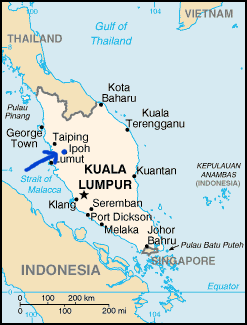
Before I came into the world, my grandfather and granduncles did the same. They were born in Malaya in the early 1900s, a time when China was fast declining while Britain’s star remained in the ascent. My great-grandfather Chin Choon Sam was a first-generation Chinese immigrant who married a Nyonya woman, my legendarily fierce great-grandmother. When my great-grandfather settled in Ipoh (see map and blog-post My Ipoh), he raised a second family, as was common with Chinese immigrants of the time who had left families behind in China. We know little about his first family other than that he had a China-born son, who often visited his half-siblings in Malaya.

His two families were raised very differently, however. With the onslaught of British colonisation, his Malayan sons were educated in English – at the Anglo-Chinese School in Ipoh. This is one of Malaysia’s most famous schools and among the first to be founded by missionaries (as detailed in my blog-post Smart Girls don’t find Husbands?!). My grandfather and granduncles learnt to speak and write fluently in English; they wore Western clothes, adopted healthy doses of British manners, and converted to Christianity. In contrast, their China-born half-brother, having been schooled in China, spoke only Chinese and was more comfortable with traditional Chinese customs.

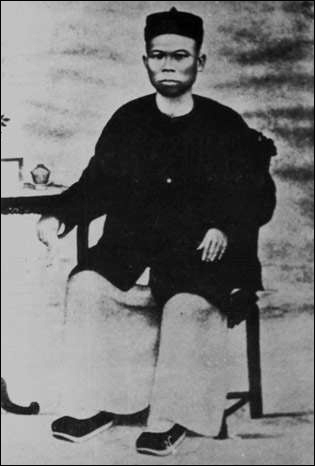
It was perhaps inevitable that my grandfather and granduncles thought themselves superior to this ‘Chinaman’ among them. We have no photographs of my China-born granduncle; whenever I try to imagine what he looked like, all I can see is a man with a brown face, clad in a Mandarin suit, his hair covered by a cloth cap or a hard conical hat. This, I realise, is simply an image of a Chinaman I have picked up somewhere along the way, a picture not unlike that well-known photograph of Yap Ah Loy, the founder of Kuala Lumpur (see map), Malaysia’s capital city.

I wonder what my Westernised grandfather and granduncles must have thought as they sat with the supposedly flesh-and-blood intruder inside their home. Perhaps choice words came into their minds?

Uncouth.          Lower class.   Untrustworthy.

My aunt who remembers the visitor from China confirmed the disdain with which my China-born granduncle was treated. “Like a second-class citizen!”

The poor man eventually decided his prospects would be better in his native country and returned there for good. I only hope life wasn’t too harsh for him after the Communists came to power.

—————

My family’s story was not atypical. In the decades when Malaysians looked up to the West and regarded English as superior, Malaysians of Chinese descent who came from English-speaking homes looked down on their Chinese-speaking compatriots. (Of course, all Malaysian-Chinese speak both English and Chinese to some extent; what I’m referring to is our primary preference, our modus operandi: the language in which we feel the most comfortable and which shapes how we behave in this world.)

For a long time, we English-speaking Malaysian-Chinese walked with a swagger. Our compatriots felt our condescension, as I was reminded by a Malaysian-Chinese friend from a Chinese-speaking background. She herself attended a Chinese language primary school before continuing to one of the former mission schools for her secondary education.

There, she met Malaysian-Chinese students from English-speaking homes. It was then that she felt the subtle divide which separated her from her English-speaking peers. Nothing was ever said and no one was openly rude, but she knew she was perceived as a lesser person: less wealthy, more ulu (market Malay for backward), not as well-dressed. In the canteen, social segregation took place; English and Chinese speakers usually sat in separate groups. Segregation continued inside the classroom, because in Malaysia, students are streamed according to ability and in general, English-speaking students achieved better examination results.

For my friend, what she felt palpably from one day to another drove her. She wanted to prove to her English-speaking classmates that she was their equal. She has succeeded admirably in this goal; after university in Australia, she worked for a multinational company and now lives a global lifestyle. Years later when she recounted her story, I could still hear the anguish in her voice. My friend’s success has come at a price though: she has now forgotten her Mandarin.

—————

This is largely in the past. With the rise of China, social perceptions have changed. Malaysians no longer look to the West in the same way, and Malaysian-Chinese now prefer their children to be educated in Chinese (for political reasons which I will not discuss here).

In this brave new world, even the word ‘Chinaman’ has lost some of its sting. But a shifting state of affairs always brings its own challenges. A recent review in the UK’s Guardian paper  brought home to me what some of these may be. The reviews was of the much-acclaimed novel Chinaman which is about, of all things, cricket.

Here’s what it said. “A Chinaman in cricket is a particular delivery, a slower ball designed to fool the batsman into thinking it will bounce in the opposite direction to the one it does. It also, in Sri Lankan argot, is a term indicating gullibility.”

Guile and gullibility, juxtaposed effortlessly over one another. This tells me that there are people – perhaps many – who fear and loathe the Chinese (us Chinese?) at the same time. (I rewrote that last sentence repeatedly and still couldn’t decide which phrase to use. Who do I stand with here? Do people regard me in the same way as they do the mainland Chinese? Do they fear us too but would never say so openly?) Their fear and loathing may well increase as China continues to ascend, as it surely will. And while this happens, we overseas Chinese will have to continually reassess our relationship with the land our ancestors once graced, as well as with each other, whether or not we wish to.

5 Comments

Filed under Cultural Identity, Identity, Malaysia

Lost Cells 1: the Cultural Challenge of being Overseas Chinese

I was born on a starless night in Singapore, one among fifty seven million people of Chinese descent to have been born outside of mainland China.

According to my Mandarin teacher, some overseas Chinese were at one time referred to as ‘same cells’ by our fellow-Chinese on the mainland. This sobriquet applied to those in Hong Kong and Macao, the idea being that they were all part of one body, one organism. As for the rest of us, we presumably floated too far away to qualify for ‘sameness’. Like lost cells, we’ve become disentangled from the mother organism and are now drifting aimlessly through space.

I rather like this idea. The term ‘lost cells’ conjures up amoeba-like objects from biology lessons. I imagine blobs with malleable membranes, expanding and contracting as they skim across a vast ocean.

It has sometimes been lonely being a lost cell. China always loomed, but I couldn’t have told you what it signified. When I eventually spoke to other overseas Chinese, I discovered I was far from alone. No matter where our homes were – be they in Jamaica or Australia – we all grappled with what being overseas Chinese meant.

How did this vast ancestral land of ours, with its millennia of culture, fit into our lives?

—————

Of course, we Chinese are a practical people. Nothing as nebulous as existential angst could ever stop us in the day-to-day business of simply getting on. To quote the legendary investor Jim Rogers: “By one count, the overseas Chinese together make up the third largest economy in the world.”

I found this statistic truly staggering. Imagine placing all fifty seven million of us – you if you’re an overseas Chinese, me, my family, friends and acquaintances – onto the same land. Our collective effort, according to Jim Rogers – from the businesses we owned, the work we did, the things we made – would create a powerhouse third only to America and Japan (the top two at the time) in terms of output.

(If you haven’t heard of Jim Rogers, he once worked with George Soros, retired early and then rode around the globe on his motorcycle. The above quote is taken from his book Hot Commodities, a terrific read for anyone interested in investing in commodities.)

Rogers’ statistic surprised me, but it also made me strangely proud. It spoke to me about core Chinese values: hard work, family, education. Because he was talking about far-flung Chinese, it said other things too. I thought of the way many of our ancestors had arrived in unknown places from an impoverished China, with nothing other than the clothes on their backs and the few dollars in their pockets. That they had built new lives out of so very little told me they must have had courage, a gift for adapting, and gritty determination.

Against such odds, overseas Chinese have been conspicuously successful. This is especially true in South-East Asia where most of us live.  

Alas, our success has not made for an easy relationship with the other peoples of the region. It certainly didn’t make my quest for identity any easier.

—————

The search for identity permeates my novel. Its main character is a Nyonya woman who claims a meaningful role for herself within her own culture. With the arrival of the British in Malaya, great change comes, and my heroine struggles as her culture is eroded by new Chinese immigrants and relentless Westernisation. She eventually understands there are things she cannot change; what she can change requires courage, and the confronting of bruising reality.

—————

When I was growing up, I never felt especially Chinese. Thrust into the three cultures of Malaysia – Chinese, Malay and Indian – all heavily spiced by Western influence, I became accustomed to what is now called a ‘multicultural’ society early on.

Unlike friends who can remember astonishing details, I have few childhood memories. The big events I recall were the colourful weddings, of which there were many, all involving copious amounts of food and drink; also Chinese New Year celebrations, which I looked forward to because children received red packets (ang bao) with money inside. I was always excited by a red packet. Before peeling the envelope open, I would caress its sleeves to feel what coins it contained. Envelopes with no coins were the best, because those contained bank notes.

None of what we celebrated made me feel any allegiance to China though. I didn’t even like fireworks, that staple of Chinese New Year celebrations. Whenever my family gathered to light long thin sticks or bunches of red crackers which popped like machine-guns, I cowered inside the house.

“You know we Chinese invented fireworks,” my father once told me, as if this indicated a genetic predisposition to enjoying thunderous explosions.

As I became older, it was clear there were other ways in which I wasn’t typically Chinese; in my bluntness for example, and my tendency to call a spade a spade, which even straight-talking Dutch friends find difficult. Also, while I don’t deliberately seek conflict, I don’t go out of my way to avoid them. If things need to be said, I will say them, regardless of the consequences and even at the risk of conflict. This is quite un-Chinese. It’s un-Asian too; where I come from, talking without mentioning indelicate truths has been elevated to an art form.

Such etiquette works, but only if everyone is equally attuned to fine nuances. My mother once thought she had told me something when in reality she had not – her reference to a gay relative was so oblique, I had no clue what she meant.

Such restraint has passed me by. Who knows why? Perhaps it’s my Nyonya heritage coming alive, or simply the result of decadent Western influence. I can’t help thinking though, what a pity so much is left unsaid by us all. So much holding back of words, thoughts, feeling…while every passing moment masks our and life’s fragility.

—————

In the run-up to the Beijing Olympics in 2008, I felt truly Chinese for the first time.

It was the virulent criticism of China beforehand which spurred this ‘quasi-patriotism’ in me. Not a day passed in the spring of 2008 when we in the UK didn’t hear about the air quality in Beijing (poor), Chinese policies in Tibet (oppressive), and other tit-bits such as scenes of the Chinese countryside (full of tanned peasants with crooked teeth, decaying houses and filth). In other words, the usual Western media fare when reporting on a developing country.

When British troublemakers unfurled the Tibetan flag at one of Beijing’s iconic towers, I became indignant. Not because I support Communism or think China blameless or disagree with the right to protest, but because the manner of this protest smacked of Western neo-colonialism. It showed no sensitivity to ‘face’, an important part of life in Asia. It took no account of how far China has come in the last thirty years, or how it became what it is today. China had to work damned hard for its moment of glory and no Westerner has any right to take it away. I felt personally affronted, as if I had been slapped on both cheeks.

Fortunately, we were avenged. Watching the opening ceremony live on television with colleagues, I remember very clearly my burning pride at the jaw-dropping spectacle. The grandeur, feats of coordination, and the unfurling of blocks of our history, made my heart full. It made me think of visiting the land my ancestors had come from.

—————

My first trip to China took place in 2011. It was actually instigated by my Russian partner, who had already been three times. I on the other hand, remained nervous. It seemed such a large undertaking, so fraught with meaning.

At the time, my Mandarin teacher, an overseas Chinese woman from Singapore, had just lost her job in London and was reluctantly considering two employment offers from China. “I don’t want to go,” she said. Her statement made my ears prick up. “Why?” I asked. “I don’t understand the mainlanders,” she confided. “And the toilets are terrible. Make sure you have loo roll with you.”

As if that weren’t enough, she added, “Oh, be careful when you go shopping. They’ll fleece you.”

From her description, I expected the worst, and was pleasantly surprised when I loved Shanghai. I was struck by how clean the city was; the floors of every metro station gleamed. Though my Mandarin teacher was right about taking loo roll, toilets were generally fine where we went, better than their Malaysian equivalent (see my blog-post Truly Malaysia: The Wetness of Toilets).

More importantly, I blended in. No one towered over me. I looked like everyone else, which made me feel strangely at home. According to my partner, twenty four hours was all it took for my ‘veneer’ of British politeness to rub off. By the second day, I behaved like a local and happily jumped queues. 

Despite this, I was also aware of being different. For a start, I hardly speak Mandarin. Yet even if I did, I don’t think it would have changed anything. The mainlanders eyed me cautiously and I did the same, as if we knew we shared a heritage but our experiences had diverged too long ago for collective memory to matter. China may be my ancestral land, but it is definitely not my homeland. Like a lost cell which had thrived elsewhere, I knew then that China wouldn’t be my destiny.

To be continued

14 Comments

Filed under Cultural Identity, Identity, Novel

Smart Girls don’t find Husbands?!

The first day I went to school, a Methodist kindergarten, I cried. My mother stood outside watching for a few hours, but I knew she would leave at some point and I dreaded the moment. Nonetheless, when the teacher asked whether any of us knew the song ‘Ten Little Indian Boys,’ I put up my hand. Drying tears, I opened my mouth to sing.

“One little two little three little Indians, four little five little six…”

I became so carried away that when I finished, I repeated the song in reverse, but the teacher told me I had done enough.

That was how my educational adventure began – with a humble rendition of a children’s song. I was not to know that this karaoke debut, full of fear and trembling, would one day lead me to the spires of Oxford University.

—————

While growing up, I was fortunate to have an enlightened mother who emphasised the value of education. The girls in my novel aren’t so lucky. They live in an era when education for girls is deemed unimportant or ignored altogether. Even my feisty Nyonya matriarch struggles with sending her daughters to school. She fears that education would make them too clever to be appreciated by men.  Below is an excerpt:

COPYRIGHT SIAK CHIN YOKE 2012 (from Spirit of Kueh, my unpublished novel)

I wanted to send them to school but at the same time, was concerned not to damage their ability to find husbands, instinctively knowing that men didn’t like wives who were cleverer than they. Even my beloved Peng Choon, wonderful husband that he was, liked to think of himself as being the smarter of us two, which for the sake of peace, I of course allowed. He would make comments, “Ai-yahh! That is rubbish-lah! You talk just like a woman!” in a particular tone, as if talking like a woman were such a terrible affliction.

COPYRIGHT SIAK CHIN YOKE 2012

Attitudes may not have changed as much as we like to think. Even while I was at school, one or two of the older girls warned me that it would be hard to find a man prepared to ‘put up’ with my brains. Therefore, they suggested I play down my intelligence, just a little. How many girls have been told the same thing, I wonder? To dumb ourselves down for the sake of boys?

—————

The matriarch in my novel eventually sends her daughters to the Anglo Chinese Girls’ School in Ipoh, where they thrive. The school, now called the Methodist Girls’ School (see photograph), happens to be my alma mater. It is also the school which my mother and her mother before her attended.

I have fond memories of the place. I remember our old wooden desks, always badly scratched, with doodles all over, sometimes with the marks of penknives etched into them. We had a desk each, and a wooden chair on which we sat for five hours and forty minutes every day, facing a succession of teachers who would come in to teach us different subjects.

Presumably to ensure that we girls would become good homemakers, we were forced to take Domestic Science. It was a subject I loathed. We learnt sewing, the different types of stitches, cooking and I can’t remember what else. Because Domestic Science didn’t have to count towards my end-of-term mark, I would do as little as I could get away with. Once, I actually failed the subject. That proved too shameful; the next term, I made sure I scraped through. Still, I learnt nothing, not even how to sew a button. (If I need a button sewn now, I take the garment to a tailor.)

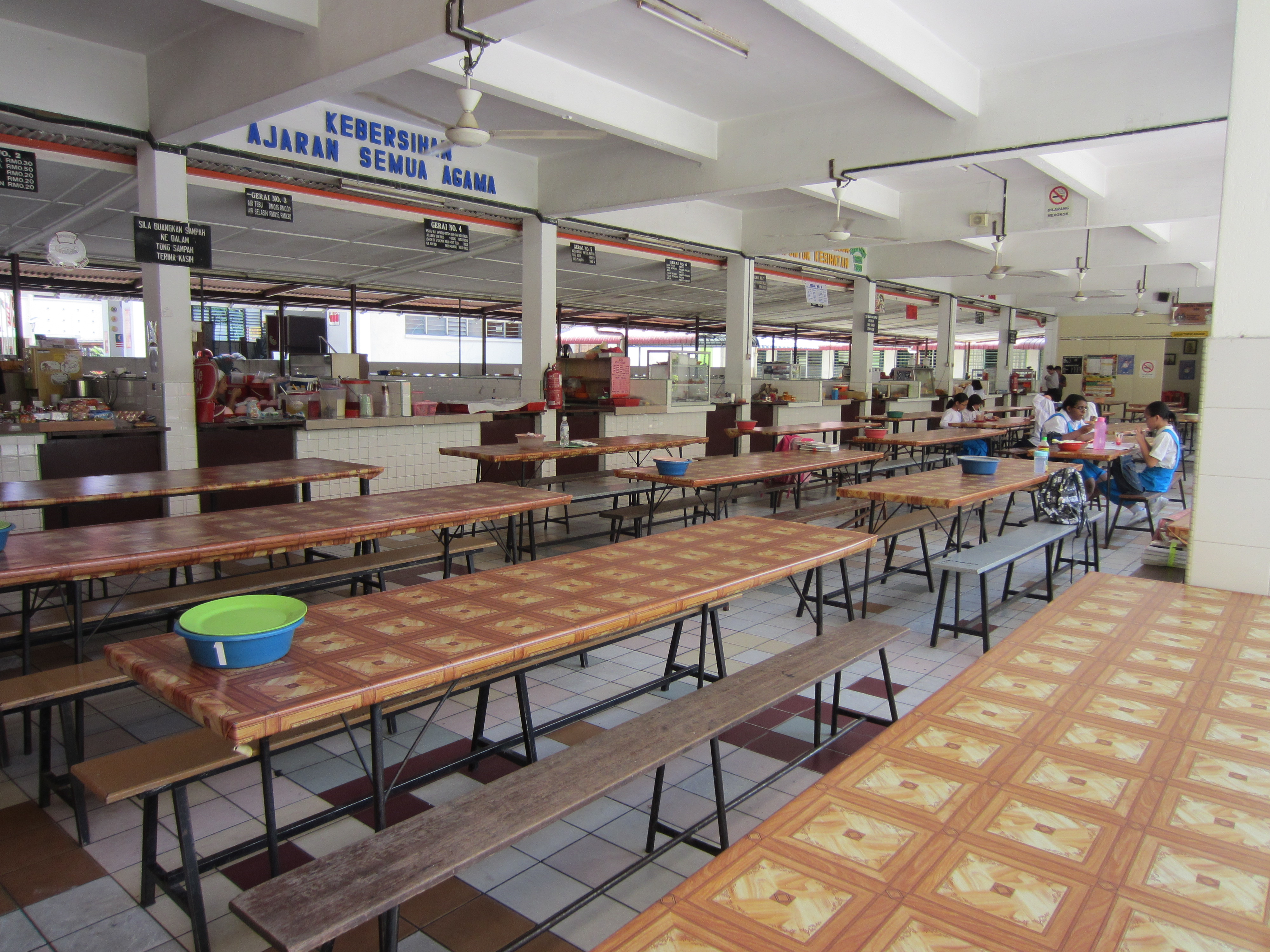
My best memory is the canteen. It served food which, living in England today, I would kill for. Fried noodles, rice dishes, steaming laksa, juicy tropical fruit. During a twenty-minute break, we would devour our food while sitting on benches in a large open-air area, under the cool of ceiling fans (see photograph).   

Our facilities would have struck many in the West as ‘basic’ for a leading school. Yet, we had everything we needed: laboratories, a library, a single set of courts for netball or badminton, an open-air performance hall, and a playing field where we had to do timed runs of six hundred metres in the heat once a term.

Whatever we may have lacked, we more than made up for in attitude and spirit. All of us wanted to do well. Amongst my classmates, it was assumed we would go to university and graduate with a degree.

When I arrived at a private school in England, the opposite was true: facilities were better, but ambition and desire to learn were in scarce evidence. To be honest, I was stunned. My new classmates thought they did well if they passed O-levels in five or six subjects, whereas the norm in Malaysia at the time was nine or ten subjects. And it didn’t occur to my English peers that A-grades were there for a reason: to be attained.

It was only after reaching British shores that I appreciated what Malaysian education had given me. I discovered I had a solid base from which to build, so solid that the transition to England proved seamless, the lessons easy.

I cannot thank my Malaysian teachers enough for all that they taught me. When I say that, I’m not referring to what they explained from our textbooks. Rather, I mean the values they carried within, which seeped into the air to mould us into the people we eventually became. I’m grateful also to my former classmates, for the unique spirit they helped us engender. Unconstrained by expectations of who we would one day be, we accepted each other as we were then: pimply adolescents still unsure of ourselves, burning with hope for the future. We competed hard, but we also played hard. That easy mix of friendly competition, can-do and fun warms my heart whenever I remember those times.

We had a good life. And we probably appreciate it even more now.

—————

The story of my Malaysian school started, ironically, in the country in which I now live, with an English vicar.

In July 1895, the Reverend William Horley was already in Singapore. From there, he was sent by the Methodist Mission to the-then frontier mining town of Ipoh, his remit being to open a school. Reverend Horley was, by all accounts, an energetic man. Five days after reaching Ipoh, he began teaching a class of boys in a small rented Malay house with a thatched (attap) roof. When girls started arriving, he taught them as well. This was how my alma mater started.

The thirst for learning among the local population was great, and classes of both boys and girls grew quickly. Reverend Horley literally had jungle cleared before arranging for buildings to be constructed. The buildings were financed not by the colonial government but mainly by wealthy Chinese entrepreneurs. Hence their names Anglo Chinese School Ipoh, or more affectionately, ACS Ipoh, and Anglo Chinese Girls’ School. ACS Ipoh went on to become one of Malaysia’s top boys’ schools. You can read the story here.

As for the girls, their school was located within the grounds of ACS until a separate piece of land was bought and a school constructed for them. (The schools remain twinned; at seventeen years of age, the young women move to the boys’ school to continue in the sixth form.)

Whenever I hear this story, I am filled with awe. I imagine the men and the elephants they would have driven. I smell their sweat as they haul trees in thick jungle, clearing the land so that our schools could be built. I think too, of the progressive Chinese entrepreneurs who gave Reverend Horley the funds. Without them, our schools might never have risen from the ground.

Of course, Reverend Horley and his fellow-missionaries didn’t do the physical work themselves: they hired local help. Nonetheless, they would have had to put up with the vagaries of the tropics: the mosquitoes and insects, the inhospitable climate, the uncertainty of how their efforts would be received. It is true that they arrived to ‘convert the natives’. Yet, this didn’t stop them from teaching children of all races and religions.

Many generations of Malaysians have passed through both the Anglo Chinese School and its sister Methodist Girls’ School (formerly called the Anglo Chinese Girls’ School) in Ipoh. We owe a debt to Reverend Horley and the men and women like him, who braved unknown climes to teach us.

I have acknowledged this by including missionary characters in my novel and depicting the vital role they played in education. Because the timeframe fits, I even imagine meetings between my Nyonya matriarch and the Reverend William Horley himself. This is an intriguing possibility: on the one hand, a fierce Nyonya who is sceptical of British rule, on the other, a genial, larger than life English missionary. I hope you will read my novel to find out what happens.

Meanwhile, on 1 August this year, it will have been a hundred years since the foundation stone for the grand buildings by which ACS Ipoh is known, was laid. Undeterred by the fears Nyonya matriarchs would once have had, I’ve donated a small sum to encourage the girls onwards. It is to be awarded as a prize to the best sixth-form pupil in Physics, if she is a young woman, or to the top sixth-form pupil, also if she is a young woman. Even better if there are two winners (in which case, the prize will be doubled)!

Leave a comment

Filed under Cultural Identity, Identity, Malaysia, Novel

The Miracle of Writing

“Do you write when the inspiration takes you?” you ask. No, I say, I write every day, whether inspired or not. Otherwise, I’d never finish my novel. You look surprised. It’s obviously not what you expected to hear.

I am perhaps fortunate, I add. Some people say they find it hard to begin writing. I have no such problem. I simply sit in front of my machine, and write. Just like with this blog-post.

The act of searching for words, of putting them together to form sentences, does something to my whole being. When I write, it’s not just my brain which is engaged – it’s also my heart. I see what my characters see, feel what they feel. Writing awakens my soul.

With each word comes a new idea. Or a memory long cast aside. Often, the thoughts and ideas and memories appear in random order, yet there are nebulous connections between them, strange pathways I can use or store as I wish. Sometimes, it’s not a thought I tap into, but the reservoir of emotion I know is there. The act of striking little black keys on a silver board unleashes a side of my psyche that has been kept in check for many years and can’t wait to be let out.  

It isn’t always so. In everyday life, I often can’t find the words. But when I write, I inevitably find the words. Even if it takes half a year.


The words sometimes come in dreams. I have only ever remembered a handful of dreams, yet I’m conscious of writing parts of my novel when I sleep. Or of adding to and subtracting from it, as I’m doing now. I will wake up with the exact phrase I had been searching for, which happened to come while I was still asleep. It’s uncanny.


I’ve known for a long time that I have some sort of talent for creative fiction. When I was nine, I was runner-up in a national essay competition in Malaysia (in the English language). There were only two submissions from my school: mine and a classmate’s. We both wrote about tragedy; my essay was about a girl who survives a plane crash, his about two children who are involved in a boat accident with their father. Mine was pure fiction, inspired by the tale of the survivors of a plane crash in the Andes. My classmate’s story, on the other hand, was based on his first-hand experience of surviving a terrible boat accident in which he watched his father drown while trying to save him and his sister. I still remember the title of his essay – Labyrinth of Fear. I handed my story in and thought no more about it. To my amazement, I was named runner-up nationally while my classmate was left without a prize. I felt embarrassed at the result. How could a made-up story trump real-life experience?

I thought of giving my classmate the trophy I won, but something held me back. 


As I grew up, I put story-writing away. There were too many other things in life. I continued to write, but only articles full of facts and figures. In the early years, they had titles like ‘The Quasiparticle Lifetime at the Mobility Edge’; later on, they described companies and the different elements of capital that could fund them. My pieces were lengthy tomes which required grammatically correct sentences, proper syntax and punctuation, but which had neither soul nor heart. In them, the equations and facts were more important than the writing. Yet, it was my words which stood out. Colleagues would comment on how well I wrote. I acknowledged their praise before promptly moving on. There were still too many other things I wanted to do.


Somewhere inside though, I must have stored all the words I have ever heard in my life. Because when the moment came, I was able to retrieve them.      


It started on a low day. Months after my final chemo session, I felt desperate. My hair had come back, but my energy hadn’t. What is life, I asked myself, without energy? When you lack the energy to move, life passes by in slow grinding motion. I slept, woke, read, went back to sleep, woke again, listened to the birds in the study, returned to sleep. Always, sleep overcame me, as if I had never slept before chemo and would never sleep enough again afterwards.

I couldn’t understand why it was so hard to regain my footing. My body had survived the ravages of illness and of drugs, and I was supposed to be well. Yet, I felt far from any state of equilibrium. “Why don’t you write?” my counsellor at MacMillan Cancer Support suggested.   

Reluctantly, I began. I felt all of the inertia which writers speak about, the resistance to sitting down with a blank page. It was a beautifully sunny autumn afternoon. I made endless cups of tea before carrying my laptop into the dining room where I wouldn’t be disturbed by the chirping of birds. I had only a vague idea what I would write about. Just start, my editor friend had said. So I did. I embarked on a short story involving four students who shared a house in a university town.

And then an extraordinary thing happened: I became immersed in the world of my characters. When I next went to the gym, I found myself imagining the scene to come, tweaking words in my head. I couldn’t wait to get back to my story.

In the fifth decade of my life, I finally experienced that cliché known as the creative spark. With every word I wrote, I felt my body becoming stronger. I commenced on a novel that had long lain dormant, and by the time I had written three chapters, was a rejuvenated person. Writing became as natural as breathing. No longer could I sit back in this life and not write. I now have to write to live, and to suffer all the consequences of this art in their full-blown form.


Ichtyandr is a young boy who needs a life-saving operation to survive. His father, a surgeon, implants a set of gills onto his lungs. Thereafter, Ichtyandr is able to live in both water and on land, but he must keep this a secret from his friends in Argentina where he has his home. He moves surreptitiously between two worlds: one full of beaches and open fields, the other a silent world in which the only sound is the gurgling of his breath.

Invented by Alexandr Belyayev, Russia’s equivalent of Jules Verne, Ichtyandr appeared in the novel Amphibian Man in 1928. I often feel like Ichtyandr as I scurry between the folds of my imagination and the vast terrace of day-to-day existence. My real life is quiet, while the world my characters inhabit is full of noise, and bustle, and people…always so many people everywhere. It is also full of food – that central plank of Malaysian identity – and I’m constantly hungry when I write. I smell the garlic and lemongrass being pounded in a grey granite pestle-and-mortar, see the juicy roasted ducks hanging on spits. Unwittingly, like one of Pavlov’s dogs, I will taste the saliva in my mouth. “What to do lah?” as one of my characters would say. “Of course must eat!”


Sometimes, being in two worlds or even three makes me schizophrenic. I can understand why writers become cranky. It forces me to look at Malaysia and at myself in a new light. I often imagine the characters in my novel as they would have moved around Ipoh, the tin mining town in which my story is set, a hundred years ago.

They were all alive then, going about their lives in rickshaws. If they could see Ipoh today, they would be astonished by the changes. There are many things I think they would love, and also much that would make them sad, as I am sad.

But sadness is not what I wish to dwell on here. Rather, I want to describe the sheer exhilaration of being able to tell the story I’ve kept inside my head all these years. I make up characters and sometimes I kill them; I find the words, thread them into sentences, move paragraphs around.

All this I do, so that I can guide my reader into a world that once was, down the very street she or he may still live on.

“You write and you erase. And you call this a profession?” says Nicole Kraus in her novel Great House.

No, I don’t call it a profession. I call it a miracle. And I’m thankful I have the vitality to share in this miracle, however imperfect my participation may be.

4 Comments

Filed under Identity, Malaysia, Novel, Writing

What’s in a Chinese Name?

清玉

The above is my Chinese name. They were the first, and for a long time, the only, Chinese characters I knew how to write. The character on the left means ‘Pure’, while the one on the right means ‘Jade’. Together, they make Pure Jade, the meaning of my Chinese name.

Jade is a type of precious stone. I’m sure you’ve seen it on rings, or in Asia, carved into images of deities, dragons and other mythical creatures. I loved the idea of Pure Jade. When I was a child, the sight of pieces of emerald-coloured stone on fingers always evoked a special feeling in my heart.

Until last year, I thought jade only came in green. Then, when we were in Shanghai, we saw Pi Xiu, a mythical creature with the head of a dragon, the paws of a lion and an apparently voracious appetite for silver and gold.

Pi Xiu only eats treasure; he never releases any, since he lacks an anus (such a wonderful creation, so characteristically Chinese…). Our Pi Xiu is in solid jade, brown from head to his non-existent bottom, and extremely heavy. He gives new meaning to the word ‘lug’. Finally, I knew what it felt like to lift Pure Jade in my hands.

Now for the trickier bit: how to say Pure Jade in Chinese. How you say my name depends on whether you’re speaking Mandarin or one of the many Chinese dialects. The same written character can be said many different ways. Because my father is Cantonese, my name was officially transliterated using the Cantonese form. In Cantonese, Pure Jade is more or less said as ‘Chin Yoke’, which is how my name appears on my birth certificate. But because transliteration is only approximate, my name could also have been written ‘Ching Yoke’, ‘Cheng Yoke’, or even ‘Chin Yook’.

You can just imagine the fun our British rulers had with our names before Malaysia’s independence. Some people ended up with official names which were nothing like what they should have been. Fortunately, this didn’t happen to me, as I was born after independence and my Chinese name was properly spelt.

The point to note though is that there are two parts to my Chinese name. My name is Chin Yoke, not Chin on its own, or Yoke on its own. If you called me just Chin, it would be like having Yin without the Yang – one half would be missing. That is true for all traditional Chinese names. (Though there seems to be a recent fad among the mainland Chinese of giving their children just one name, so that their surnames have to be tagged on. For example, the tennis player Li Na. Li is her surname, Na is her name. But having just one ‘particle’ is bizarre for a Chinese name, which I assume is why she’s known as Li Na. Otherwise the yin-yang principle would break down).

The example of Li Na illustrates perfectly where our surnames should be placed: before our names. This may seem strange, but once I explain the principle, you’ll understand why we do it this way. As a rule, we Chinese try to ‘home’ in on details gradually, starting with the bigger picture. The result is a logic all of our own and which generally confounds everyone else.

Take for example, the writing of an address on an envelope. If you were to hand the envelope to a courier for delivery, the first thing the person would want to know is: to which country? Therefore in a Chinese address, the country is written first. After the country, the courier will ask about the province, then the town, followed by the street, and finally the house or building number and if relevant, the apartment number. (Actually, if you look at it this way, conventional Western practice appears quite odd.)

The same principle of ‘homing’ in applies also to our surnames and names: your surname is far more important – it identifies the clan to which you belong; therefore, your surname comes first. Your name only identifies you. Let’s face it, we’re not that significant in the large scheme of the world. This is why our names follow our surnames.

In my case, my surname is the character for ‘Stone’ (see below), pronounced ‘Sek’ in Cantonese and transliterated into English either as ‘Sek’ or ‘Siak’.

My surname happens to appear on my birth certificate as Siak, therefore my full Chinese name is Siak Chin Yoke.

I’ve never been called by my Chinese name, which is a pity, since I like the sound of Chin Yoke. The trouble with using it where I live in Europe is that people wouldn’t have a clue what to do if I told them my name was Siak Chin Yoke. The first question they’d ask is, er, which one is your surname? And then, they’d start calling me Chin.

It always makes me wonder whenever anyone does that. I know there are many Western names for which such abbreviation is possible, but shortening is by no means a universal rule. For example, if someone told you her name was Pauline – which has two syllables – you wouldn’t immediately ask whether you could call her Paul, would you? Why do it just because my name happens to sound Oriental?

The path of least resistance being easier, for the moment I stick to the Western name I was also given at birth, Selina, for daily use. Because it’s a Western name, it’s written in the order Westerners are used to, with the name before the surname. Therefore, if we combine my English and Chinese names together, you get the full name on my birth certificate – Selina Siak Chin Yoke.

This giving of English names to Chinese children is a relatively recent fashion. The characters in my Malayan novel – set between 1878 and 1941 – certainly wouldn’t have had English names. And I haven’t given them artificially simple names to make reading supposedly ‘easier’ for a Western audience. I think Chinese names are already straight-forward, since they tend to be short. Chin Yoke, for example. Hardly difficult, is it?

Where it gets trickier is that the Chinese liked being able to identify the generation to which a person belonged. Therefore in Chinese families, the children have names which may sound very similar, but aren’t. For example, if I had a sister, a possible name for her could have been Chin Fah. The first parts of our names would then be Chin, so that everyone would know we were related and of the same generation.

That’s all very well if there are just the two of you. But in the old days, people had large families. We’re talking ten or more children. That’s what we have in my novel. Which explains why, when my partner read the first draft, she wondered aloud whether I was deliberately trying to confuse my readers. “Why do you have names that all sound alike?” she asked. Then, in despair, she added, “Your names are so hard to remember!”

I looked at her in astonishment. To put this in context, my partner is Russian. Let me repeat: she’s Russian. Question: have you ever tried to pronounce an entire Russian name from start to finish including the part in the middle they call the patronymic? And our names are hard to remember?? Please. I reminded her of what I’d had to do while ploughing through War & Peace, how I was forced to flip backwards constantly to see who was who. Even that didn’t always work, since Russians often use pet names. This means that a man can appear as Alexandr somewhere, mutate paragraphs later into Sacha and you’re supposed to know that it’s the same person. (No offence to the Russians and Russian speakers reading this blog. Except that you’re not allowed to complain about our names being hard to remember. At least ours are short and don’t mysteriously mutate.)

Back to my novel. I promise I’m not deliberately trying to confuse anyone. And I do try to help my readers to the extent possible. But there’s no avoiding Chinese and Malay names, and for this I make no apology.

The increasing attempts at ‘Westernising’ Chinese names has also had unintended consequences. When I was growing up, everyone used the traditional format for writing their names, placing surname first, and then their name. So we could tell at once what someone’s surname was. Now, many people of Chinese descent have adopted the Western convention when writing their Chinese names. This has sometimes been through necessity (as for Twitter handles) and sometimes through choice – to make it easier for everyone else. The trouble is that it makes it harder now, even for us Chinese, to tell which the surname is and which the name is. For instance, the name Lai Weng Yip could be parsed in one of two ways, with either Lai being the surname, or Yip being the surname. Which is it, my partner asks? I shrug. Could be either, I tell her, since Lai is a Chinese surname, as is Yip. Indeed, Weng Yip could be a name, and so could Lai Weng. With globalisation, it looks like we’ve all become confused. Aren’t Chinese names fun?

9 Comments

Filed under Cultural Identity, Identity, Malaysia, Novel

How to be a Good Daughter-in-Law

I had the good fortune of speaking to Malaysian writer Lee Su Kim during my recent trip. What that has to do with being a good daughter-in-law will be revealed in good time…

With Lee Su Kim, I share a fascination of things Nyonya and a love of reading and writing. She started writing long before I did, and has had several books published. Su Kim also happens to be a founder member of the Peranakan Baba Nyonya Association of Kuala Lumpur and Selangor, and its first woman President. Demonstrating true grit, Su Kim very kindly called me up despite being on her way to see a doctor!

Being a Nyonya herself, it’s not surprising that Malaysian as well as Nyonya themes run through her work. The fact that I heard about Su Kim at all was purely down to luck. My aunt happened to attend the launch last year of her latest book – a lovely collection of short stories entitled Kebaya Tales, published by Marshall Cavendish.

As I worked my way through the book, I realised how much I enjoyed reading it, which was why I set out to contact her. I could see how much of herself Su Kim has put into Kebaya Tales – the book comes across as a labour of love. In addition to stories, she has included personal mementoes: family photographs, shots of the vintage kebayas – the beautifully embroidered blouses in diaphanous material worn by Malay women and Nyonyas – which she inherited from her mother, as well as pictures of the beaded slippers for which Nyonyas are famous. All of these help make her culture come alive to a reader with no previous knowledge of what Nyonya means.

On the subject of beaded slippers, when I was last in Malacca, I bought two pairs of these. (As an aside, Malacca was at one point an important port; see map below to understand its strategic position.


Which also explains why it is one of Malaysia’s most historical towns and has a large Nyonya population). 

To get back to the famous beaded slippers, here’s a photograph of the pair which I gave my partner.

You may not be able to see them, but the top of the shoe comprises tiny beads in many colours. The beads are patiently threaded together to create the flowers and butterflies which adorn the black background, itself made up of the same tiny beads. The smaller the beads (which this shoe happens to have), the greater the expertise required, and the greater the patience demanded. At one time, beading was considered a required skill for a Nyonya, one on which a potential daughter-in-law could expect to be severely judged.

As for the stories in Kebaya Tales, Lee Su Kim succeeded in drawing me in and sometimes, in shocking me. Her tales contain unexpected and occasionally disturbing twists, but she invariably managed to weave in some or other aspect of Malaysia. A few stories touch on folklore, others on parts of our history which remain unresolved, such as what happened during the war years, yet others contain unspoken beliefs which permeate our culture.

However, you don’t need to be a Malaysia expert, because the stories provide easy reading. The collection is also totally self-contained; Su Kim even included brief notes about the Nyonyas as well as ample commentary about their kebayas and sarongs.

What, you may ask, does any of this have to do with being a good daughter-in-law? The answer is that in addition to the mementoes I mentioned above, Kebaya Tales is interspersed with fragments of idioms and poetry. The following ditty, itself taken from a book by another Malaysian writer, caught my eye:

HOW TO BE A GOOD DAUGHTER-IN-LAW

Dried bean curd, sweetened buns,

To be a good daughter-in-law, know your manners,

Go to bed late, get up early,

Comb your hair, powder your face, dab on rouge,

Enter a room holding a needle,

Go to the main hall and wash the crockery,

Praise your elder and younger brothers-in-law,

Your parents in turn will be praised for your good upbringing.

Hokkien ditty, reprinted in Kebaya Tales, taken from the book Of Comb, Powder and Rouge by Yeap Joo Kim 1992, published in Singapore by Lee Teng Lay Pte Ltd

I re-read the ditty above many times, always laughing. It amused me to see how miserably I would have failed! Based on the above criteria, I make a lousy daughter-in-law. Praise be to the Heavens.

4 Comments

Filed under Cultural Identity, Identity, Malaysia, Nyonya, Writing

Snapshots – 5: Where is Home?

Home is a place where people understand what they see when they look at you, because when they look at you, they are seeing a reflection of themselves. In a foreign land, this doesn’t happen. In a foreign land, the people become confused by something as simple as your cheekbones. What sort of cheekbones are those, you see them silently wondering, as they scrutinise you with friendly curiosity?

My earliest memories are of my parents, of devouring the leg of a roasted duck, and the dark expanse of Malaysian sky overhead with its shimmering stars. It is warm, and I feel safe. I run around the garden singing Twinkle, Twinkle, Little Star, the first song I ever learnt. I look up at the sky and wonder how far the stars really are, if I can ever visit one of those stars.


The voices were already there.          “Dengan itu pendatang-pendatang Cina yang mulanya menetap di Melaka…” “With that, the Chinese newcomers who at first settled in Malacca…”

“…perubahan yang paling nyata dalam kehidupan orang Melayu ialah kemasukan secara beramai-ramai pendatang-pendatang Cina.” “…the most notable change in the lives of the Malays was the mass influx of Chinese newcomers.”

(Quotes from ‘The Malay Dilemma’ by Mahathir Mohamad, a book banned in Malaysia until he became Prime Minister).

 The voices haunted us.


In Malaysia, no one is confused when they see me. They can tell at once that I’m Chinese, and not a Muslim. These are the simple facts about my life which mark me out, as if I wore a yellow star on my head.


Her name was Puan Asny (Mrs Asny). For me, she is forever in her thirties, this Malay teacher with curly black hair, a long face and thin lips that curved into the most welcoming of smiles. She came from a village house near Ipoh, but it was at the Methodist Primary School in Petaling Jaya where she taught me. Though the images have become fuzzy with time, the kindness Puan Asny brought into her classroom has lingered inside of me, never to be forgotten. 

Puan Asny didn’t cover her head with the Muslim headscarf (tudung). None of my friends or their mothers did. The only person at my mission school who wore the tudung was a religious woman with bad breath who taught us the Arabic alphabet. I tell you this to make you aware that things haven’t always been the way they are today, in the home I once had.

I was in Standard Six when Puan Asny became my teacher, old enough to understand what the voices were saying. “The government’s policies aren’t fair,” I said one day. “But Selina,” Puan Asny said, looking at me with her large brown eyes which in my mind, were tinged with green. “The Malays are not like the Chinese. They need help.” We disagreed animatedly, she and I, but that didn’t stop our mutual respect.

Once, after my family moved back to Ipoh and I had left the school, my mother took me to wish Puan Asny a happy Hari Raya Puasa (the end of the fasting month) at her family’s village home. She was so happy to see us that she let out a scream, while I too rushed eagerly forward. We went inside to be received by her family, who enveloped us within their warmth. The memory of that feeling, that warmth, has stayed somewhere in my head as well as my heart.

The next year, I left for England and never saw Puan Asny again.


When I left Malaysia, part of my soul stayed behind, the part which I am only now beginning to rediscover. It creeps up on me at unexpected moments, giving succour to the Malayan family story I am busy polishing.


The voices have since become louder and more insidious. “Orang Cina cuma tumpang disini sahaja.” “The Chinese are only squatting here.” (Remarks made by Ahmad Ismail, Malay politician, at an open meeting on 23 August 2008, as reported by Li Weihua of the Guang Ming Daily).

The politician was banned from his political party for three years, but rank-and-file members received him as a hero, even awarding him a traditional Malay dagger.  


Learning how to be at home in a country which doesn’t welcome you is an art for which I lack the patience. Perhaps if I had no choice, it would be different. I would then, like my compatriots, pretend not to care, and learn somehow to block out the chattering voices. As it is, I hear their high-pitched whispers everywhere. 

Sekiranya tidak puas hati, pelajar Cina disuruh balik ke Beijing, Cina, atau pun Sekolah Foon Yew.  Beliau mengatakan pelajar-pelajar Cina tidak diperlukan. Bagi pelajar India, tali sembahyang yang diikat dipergelangan tangan dan leher pelajar India ianampak seakan anjing dan beliau mengatakan hanya anjing akan mengikat seperti itu.”

“In case of dissatisfaction, Chinese students were told to go back to Beijing, China, or to the Foon Yew School. She said that Chinese students are not needed. As for Indian students, the prayer strings they wear around their wrists and neck make them look like dogs and she said that only dogs would be tied in that way.”

(Taken from a police report on remarks made by a Malay headmistress during morning assembly at a multi-racial school in Johore, Malaysia, on 12 August 2010).

The headmistress was never dismissed, only transferred to another school.


To stay or to go, that was once the question. To stay put or to go back, that is now a question. If I go back, which part of me will I regain? If I don’t, which part of me will remain lost? 

Kerana Malaysia ialah tanahairku. Because Malaysia is my homeland (usual translation), my soil and water (literal translation), land which nourishes my soul (own poetic translation).

(Taken from personal notes which I jotted down during a recent visit to Malaysia, February 2012)

Below, I share an excerpt from my unpublished novel.

I had loved Ipoh’s hills from the moment I set eyes on them. On cool rain-soaked afternoons when everything outside smelt fresh, the trees covering the hills became so dark, they looked almost black, as if that were the only way they could retain the moisture from the heavens. Light mist would occasionally drift in, its white veil like the strokes of a brush on a perfect Chinese painting. On hot mornings, I could see the exposed rock more clearly and would marvel at the shapes which had been created …narrow pendants stretching down like long teardrops along the sides of many cliffs…and in the opposite direction, fat mounds that rose up from beneath, seemingly without effort…sculpted by years of the rain and wind which lashed down over the Kinta Valley.”

COPYRIGHT SIAK CHIN YOKE 2012


Is it possible to feel at home in a country which doesn’t want you? Yes, but only because you know it so well that it’s like an old shoe, wrapping itself around the contours of your feet and carrying you effortlessly onto familiar terrain. To survive as a non-Malay in Malaysia today, you must bury yourself in concrete to block out the echoing voices.

 “Orang Cina Malaysia, apa lagi yang anda mahu?...Berikut adalah senarai 10 orang terkaya di Malaysia. 1. Robert Kuok Hock Nien…10. Tan Sri Vincent Tan Chee Yioun.”

“Chinese of Malaysia, what more do you want?…The following is a list of the 10 richest people in Malaysia…(a list follows of whom 8 are Chinese, 1 Indian and 1 Malay)”

(Extract from an article by a Malay journalist in the Malay newspaper Utusan Malaysia dated 28 April 2010)


Can I block out the hissing whispers? I ask myself this repeatedly, and wonder about the cost of such effort. Where is home?

6 Comments

Filed under Cultural Identity, Identity, Malaysia