Tag Archives: Taiwan

Ruminations on Heritage 5: Who Owns the South Sea?

I first saw the stretch of water known as the ‘South China Sea’ when I was a child. My family went on holiday to the East Coast of Peninsula Malaysia. Travel wasn’t the same in those days – it was a huge adventure. We visited the states coloured purple, green and yellow on the map and I have vivid memories of the ‘South China Sea’. It seemed to always be there: blue and gently lapping on sunny mornings, dark and roiling when the storms came.
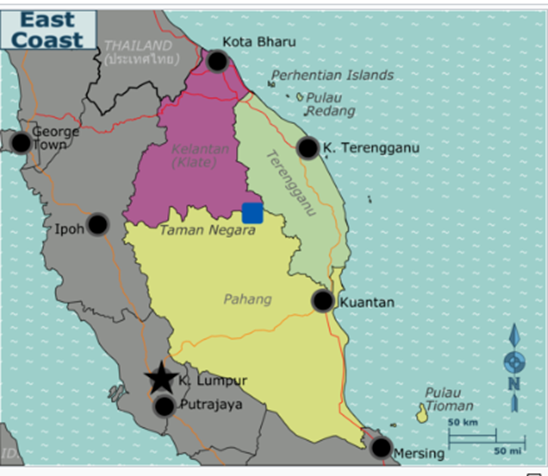
(Source: https://en.wikivoyage.org/wiki/East_Coast_(Malaysia))

That trip was memorable for another reason. One night, after following a guide by torchlight for what felt like miles, I saw giant turtles with leathery backs on an isolated part of the coast. Those amazing turtles were clambering onto Malaysia’s pristine sands to lay their eggs! Almost at once, their eggs were removed. I was fascinated; at the same time I felt sorry for the poor mother turtles. I’m sure they sensed what was happening.

The ‘South China Sea’ brought more than giant turtles: it also brought people. Among these were my ancestors, some of who arrived from southern China in rickety boats.

They did not call the water that had brought them the ‘South China Sea’. In Chinese, the same stretch of water is actually known as the ‘South Sea’ (南海), meaning the sea south of the Chinese mainland.

As a child, it never occurred to me to ask why a sea on Malaysia’s eastern coast should be named after China. If you look at a map, you’ll see that the ‘South China Sea’ is really a Southeast Asian sea: it flows across Southeast Asia, eventually reaching southern China and Taiwan. But the bulk of this sea is not in North Asia.

 Source:  https://en.wikipedia.org/wiki/South_China_Sea

Rather, it unfurls on the shores of Vietnam, the Philippines, Indonesia, Brunei, Singapore and, as I saw for myself, Malaysia. It swaddles the southern tip of Peninsula Malaysia, linking up with the Straits of Malacca. A more appropriate name for the ‘South China Sea’ might actually be the Southeast Asian Sea.

For me the Southeast Asian Sea isn’t just any sea: I saw it as a child, I stepped into its waters and I smelled it. It carried my ancestors and sustained others. It has given me a trove of memories. What happens in this sea matters to me. And rather a lot has been happening.

Did you know that China has claimed large parts of the Southeast Asian Sea for itself? The excuse China uses is ‘historical rights’.

The logic runs something like this: Chinese seamen ‘discovered’ reefs and islands in the Southeast Asian Sea 2,000 years ago and claimed them for China. Ever since, China has allegedly ruled over these islands. Because China claims to have governed godforsaken boulders in the middle of nowhere continuously, it also claims to own these islands and reefs. China has even created whole new islands where none existed before. It goes without saying that China owns the adjacent waters, too (and presumably, all the resources that go with them, and maybe even those turtles).

I am oversimplifying. The legal arguments are more sophisticated – you would hardly expect less from the Communist Party. For a detailed legal summary, you can see this link. But the sophisticated legal arguments really boil down to the above.

In the narrative above, the peoples of Southeast Asia are conspicuously absent. Imperial China regarded Southeast Asians as ‘southern barbarians’, as I learned when I reviewed a fascinating non-fiction book called ‘Writing the South Seas’ for the Asian Review of Books. It’s no surprise that Southeast Asians were excluded from considerations of power. Barbarians are to be civilised – they’re not capable of ‘discovering’ their own islands.

Imperial China may no longer exist, but a pattern of dominance, once established, is hard to dislodge. Attitudes die hard.

China has built islands in the Southeast Asian Sea on a scale never seen before, threatened other nations’ ships and confronted their aircraft. These are not the actions of a friendly state. Today’s China is no longer the benign Imperial China of days past, a country content with merely receiving tributes from Southeast Asia’s rulers.

Southeast Asians must unite. Otherwise, what’s the point of the Association of South East Asian Nations (ASEAN)?

Achieving unity in the region may be easier said than done; like Europeans, we have a chequered history of squabbling, but we should at least try to come together. The Southeast Asian Sea lies mainly in Southeast Asia. That’s where its resources belong and that’s where its resources should stay. Granted, we have to share these among us – but Southeast Asia has a long tradition of sharing.

Thank goodness there are signs of unity coming, slowly but surely. We can do it, we have to do it. There is no other way.

Giant turtles were not seen in Malaysia for decades, but they have apparently returned. Despite adversity and precarious numbers, the turtles have come back to reclaim their sea and shores. We need to do the same. We must reclaim our sea, our reefs, our islands and our shores. Before it’s too late.

Leave a comment

Filed under China, Colonisation, Cultural Identity, Malaysia, Politics, Southeast Asia

Ruminations on Heritage 4: Why I Want to Visit Taiwan

A friend just asked what I thought of Nancy Pelosi’s trip to Taiwan. My reply was succinct:

‘Of course she should have gone. F*** the Communist Party.’

I haven’t always been so clear. For years, I felt a misplaced sense of loyalty towards China, a sentiment that trickled in by osmosis from the adults around me. My father, especially, believes all things Chinese to be superior. This, despite the fact that he was born and raised in Malaysia, lives in the US and has only visited China once.

He is far from alone. Whenever I point out inconvenient truths, many relatives and friends of Malaysian-Chinese descent choose to remain silent.

Take the issue of sexism. My paternal grandparents were immigrants to Malaysia from China, where the idea that you need to have a boy-child is so ingrained that after three girls in a row, they became desperate. They gave away the third girl in the belief that a sacrifice was needed. The gods had to be appeased, and along came my father. His parents did not seem to care who they gave their daughter to – she ended up in an impoverished family living a life I can scarcely imagine. All because she was a girl.

Such behaviour is just plain illogical.

Yet, even the most Westernised of my family members prefer to overlook this. They revert instead to talking about the awful things that happen to girls and women elsewhere, as if a thousand other wrongs make a right.

Or they say, ‘Ah, but things have changed.’

Indeed, there are now tens of millions more ‘missing Chinese women’ – the girl babies who were abandoned, given away or simply murdered (see chart below from a BBC article) when the one-child policy came into force. Disparities usually become less acute as a country gets wealthier. Not so in China: the richer China grew, the more distorted its gender ratio became – a first on our planet. 

The men on the Central Politburo’s Standing Committee must have been delighted. More boys! This Standing Committee is a subset of the Communist Party’s Central Politburo and comprises just seven members – an elite amongst the elite. China’s Standing Committee has never had a woman. Not one since 1949: you can see the dour male faces for yourself by clicking individually on the links.

In Party hierarchy the Standing Committee is all-powerful; who would dare accuse any of them of sexual impropriety? Only a tennis star, it seems: Peng Shuai, and look what happened to her. Corralled, censored, silenced and now missing. The man she accused was a member of the Standing Committee from 2012 to 2017. No wonder she’s gone from the public eye.

Taiwan, with which I started, is an altogether different country. This series of islands located off China’s south eastern coast has been self-governing since 1949. Taiwan has evolved into a functioning democracy with genuinely contested elections. It allows dissent. Governments change. It has passed progressive laws. As mentioned previously, if I so chose, I could marry my girlfriend there legally.

Where Taiwan Lies

For years, friends who have been to Taiwan have extolled its scenic beauty and its food, especially the Japanese cuisine I adore. Taiwan used to be a Japanese colony – amazing Japanese food this is among the legacies.

In past decades, a distinct Taiwanese identity has also  emerged. A growing number of its citizens apparently don’t regard themselves as Chinese but as purely Taiwanese, an identity

not based on race or blood but… on the sentiments that we are a country with democracy, freedom, human rights and the rule of law, and we can participate in the political decision-making.

There is something to learn from them. Heritage is an anchor, but heritage should not shackle us. It must surely be possible for us as Asians to be proud and at the same time, critical. If we can’t criticise, how will anything improve? We may even need to reject aspects of our heritage en-route to forging something new.

Of course, sentiments like these can only be expressed by people who live in countries where freedom is enshrined.

Taiwan is no renegade province owned by mainland China. It’s a separate, independent and very real country, one we should all visit – and not because Nancy Pelosi went.

Part 5 to follow

1 Comment

Filed under Cultural Identity, Identity, Modern Life, Politics

Ruminations on Heritage 3: It’s Just Not Asian!

When I first came out as gay, my parents blamed England. If only they had not sent me to boarding school, ‘this’ would not have happened. It’s just not Asian!

I never asked which part wasn’t Asian. Did they mean:   

  • Being attracted to someone of the same sex?
  • Telling a fundamental truth that made others uncomfortable?
  • Daring to think outside the box?    

This took place in the mid-1980s. It would be tempting to believe that the whole world has changed since.

The map below shows the countries (in red) in which homosexuality remains illegal. There’s a very large mass of grey – not the case before – so, indeed, there has been progress. But we are nowhere near an egalitarian utopia. The Russian Federation, for instance, is hardly an oasis. Neither is China.

Source: Human Dignity Trust

Earlier this year, mainland censors erased a lesbian plot-line from the sitcom ‘Friends’. No lesbians for the mainland! Just what is the Communist Party so afraid of? Obviously, merely hearing about lesbians on TV could give Chinese women ideas. Hardly a vote of confidence in their men.

One of the other countries in red is Malaysia. It has a Muslim majority and homosexuality is illegal. I still have relatives there, one of whom is gay. He isn’t a Muslim. He has lived in Malaysia all his life. He has also been in the closet his entire life.

An early memory I have is of waking one morning to be told that this particular relation had been in a terrible road accident. When I saw the photographs, I was shocked. To describe his car as a wreck would be an understatement – it was crushed. If you looked at photos alone, you would have assumed its occupant well dead.

Apparently, the accident was his fault. My relative had come out of a junction and was hit by a bus (if my recollection serves me right). Everyone was amazed he survived the catastrophe. At the same time, they could not fathom what he was doing in that part of town. I remember the adults around me shaking their heads, asking repeatedly: what was he doing there at that hour?

Years later, he told me. He had been meeting a man.

The revelation brought lightning clarity. Disjointed memories fell into place. Finally, I understood. I felt like Archimedes with his Eureka moment. When my relative swung his car out of that junction, his mind was occupied.

Obviously, such an accident could have happened anywhere. But if this relation of mine had been able to meet a man the same way he was encouraged to date women, he is unlikely to have been skulking off to a clandestine encounter in the early hours of dawn.

I have a gay cousin who did the same: he went around surreptitiously – until his parents accused him of being a drug addict! It took a dramatic argument for him to come clean with them. That story, at least, has a good ending. My cousin lives happily with his partner and has done so for years.

Not the case of my car-crash relative, whose sexual orientation is an open secret. Granted, he is loved by the family. This makes him fortunate. Nonetheless, can you imagine the amount of sniggering he has had to endure, what it must be like living within a culture where you’re asked ‘Are you married?’ within minutes of meeting someone?

As we celebrate Pride month, I thought it time to shine a light into the closet. It looks to me like a dank, dark place. I can’t imagine living in it, or how great the mental toll must be.

I’ve often heard that ‘we in Asia have our own way of doing things’ – we don’t need to talk about them. Some people believe there are things better left unsaid. No doubt they also think I should not be writing this blog-post. But ‘ways of doing things’ evolve. Chinese women used to bind their feet: should we return to that practice? Of course not – no culture is beyond universal human values. If we find it hard to say the word ‘gay’, it’s because we still associate shame with gayness. The dictum ‘we have our own way of doing things’ is no more than a convenient cover. It allows uncomfortable topics to be avoided.

Fortunately, some changes have come; in Asia, Taiwan has led the way. The island nation legalised same-sex marriage on 17 May, 2019. Contrast that with China’s censorship of the Friends’ sit-com lesbian plot-line. Taiwan’s marriage equality is one of many reasons why it is not China – and whether Taiwan belongs with the mainland is, in my view, debatable.

All those years ago when my parents blamed England, they had a point. England did not make me gay, obviously, but it has given me a confidence, freedom and happiness I would not have enjoyed otherwise. Here I can live openly without having to hide; here I stand without fear, knowing that I am protected by law.

This freedom is indescribably precious. In a poignant moment a few years ago, my ex-wife and I welcomed a visitor from Dagestan. When he realised that he was the guest of two women who were married to each other, he was in awe. Without any hesitation whatsoever he proclaimed:

‘Today I have met people who truly are free.’

Part 4 to follow

Leave a comment

Filed under England, Identity, Malaysia, Modern Life