Category Archives: England

The Great, the Good and the Immigrant

Given the pace of news these days, you may already have forgotten the story of the illegal Ethiopian immigrant. A week after landing on the Kent coast, the man tried to kiss a fourteen-year-old girl. She was minding her own business on a park bench, eating pizza with a friend; up stepped the illegal immigrant, one of 39,294 small boat arrivals to the United Kingdom to date in 2025 – and the year isn’t over yet. 

When the girl protested her age, the man told her age that ‘did not matter’. He said he wanted to have a baby with her and another one with her friend. He touched the girl’s thigh; for good measure, he also touched up an adult woman who tried to intervene. 

In court, he insisted that he was not an animal. Maybe, but he is clearly a man who thinks he has the right to touch any girl or woman without her consent. That’s evidently what men get away with in Ethiopia. To my knowledge, he has never expressed remorse; he was sorry only that his actions caused protests against his fellow-illegal immigrants

Political liberals may be annoyed by the term illegal immigrants. Democracy is a fine thing, but if we can’t label objects and persons by their proper nouns, we’ll never get to the heart of any issue. And if we can’t get to the heart of this issue, we don’t have a hope in hell of solving it. 

Incredibly, there are people in Britain who don’t even think we have an immigration problem. They must be living on another planet (or the Shetlands). As our brave Home Secretary, Shabana Mahmood, said when introducing her immigration reforms on 17 November 2025:

This country will always offer sanctuary to those fleeing danger. But we must also acknowledge that the world has changed, and our asylum system has not changed.

Exactly. The UN conventions governing refugees were drawn up in 1951. 1951, imagine! Can you seriously expect a charter established when the world was such a different place to still be fit for purpose in 2025? 

Actually, we don’t need to go back that far. England has changed dramatically since I arrived for school 46 years ago in 1979. When I landed at Heathrow Airport, Margaret Thatcher had only just been elected and Britain, having endured a Winter of Discontent, was still reeling from the ignominy of being bailed out (in 1976) by the International Monetary Fund

Life then was sedate and quintessentially British. Tea remained the drink of choice; shops closed at 5 pm and telephones were coin-operated. There were rules. People expected these to be respected. To someone from a former British colony, things looked different yet also vaguely familiar. 

The Malaysian education system which produced me was based on the old British system and I settled in easily enough. I stayed on, first as a university undergraduate and then as a research student on a Physics Ph.D. programme. For my entire first decade in the United Kingdom, I was here on a student visa, which meant I could not work. 

In that era, it was a badge of honour for British Ph.D. students, especially those in the humanities, to dawdle over their theses. People commonly took 5, 8 or even more than 10 years writing up. I did not have that luxury: as a foreign student, I was not eligible for a student grant and I’d had to win special funding for my Ph.D. degree. The funding – from Southampton University – lasted 3 years, not a day longer. As my third postgraduate year kicked in, I knew I would have to write up my thesis and look for a job at the same time.

There was no Internet back then. To research career options, I headed to the University’s Careers Service, where I spoke to the Careers Officer. He made many helpful suggestions. I followed them all up, spending hours carefully parsing through corporate brochures, then honing my slim CV and crafting cover letters. Students in my time were expected to know how to write formal letters. Interviews, when you got one, were face-to-face. 

I applied to dozens of firms. All of them turned me down without even an interview. They told me that the Home Office would never grant a work permit to an entry-level employee. My Ph.D. (in Theoretical Physics) didn’t mean a thing if the work could be done by a native or a European.

My only hope was an academic job. Meanwhile the clock was ticking; if I didn’t get a move-on, time would run out on my student visa. I had to pull my research results together and write them up into a coherent whole. And I had to do this not knowing which country I would end up in or how I was going to earn a living.

Malaysia was my Plan B. As a Malaysian passport holder, I could (and can) always return there. There were only three problems: I have the wrong ethnicity (Malaysian-Chinese), the wrong religion (non-Muslim) and the wrong sexual orientation (considered haram). Even today, homosexuality is illegal in Malaysia. For someone who has tasted freedom, life in the closet is hard to contemplate.

At almost the last minute, a research fellowship at St Catherine’s College, Oxford, came up. Oxbridge fellowships are prestigious and highly competitive. But I had no connection to the University and was surprised to be shortlisted for an interview. When I walked into St Catherine’s for the very first time, it felt somewhat intimidating. I was grilled by a panel of five. You can feel when an interview is going well – and I sensed it going very well. The College offered me the job at once. What they wanted me to do was so arcane that I doubt if anyone in the Home Office understood my full job description. In those days the British government actually controlled immigration. 

That’s no longer the case. Now, alongside a legal but woefully lax official system of immigration is a black market on Tik Tok. Small boats are big business. Just look at the advertisement below.
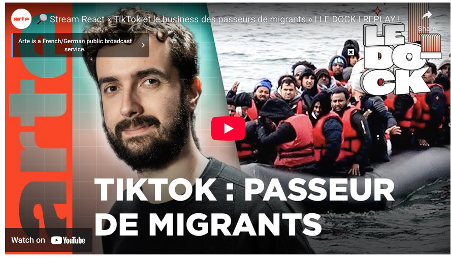
The image comes from Global Initiative, but you can find plenty of others. Facebook, Snapchat and Instagram are all crime-enablers; the rage, however, is apparently Tik Tok. Small boat ads are so well-documented, even the BBC has mentioned them

People-smugglers know their target audience. They price their offerings appropriately and deploy creative tactics: for instance, giving price discounts to customers who help with social media marketing. Small boat customers, like customers of legal services, shop around before choosing their preferred country and preferred smuggler. 

This is what the Home Secretary meant when she said: 

Huge numbers are on the move. While some are refugees, others are economic migrants seeking to use and abuse our asylum system 

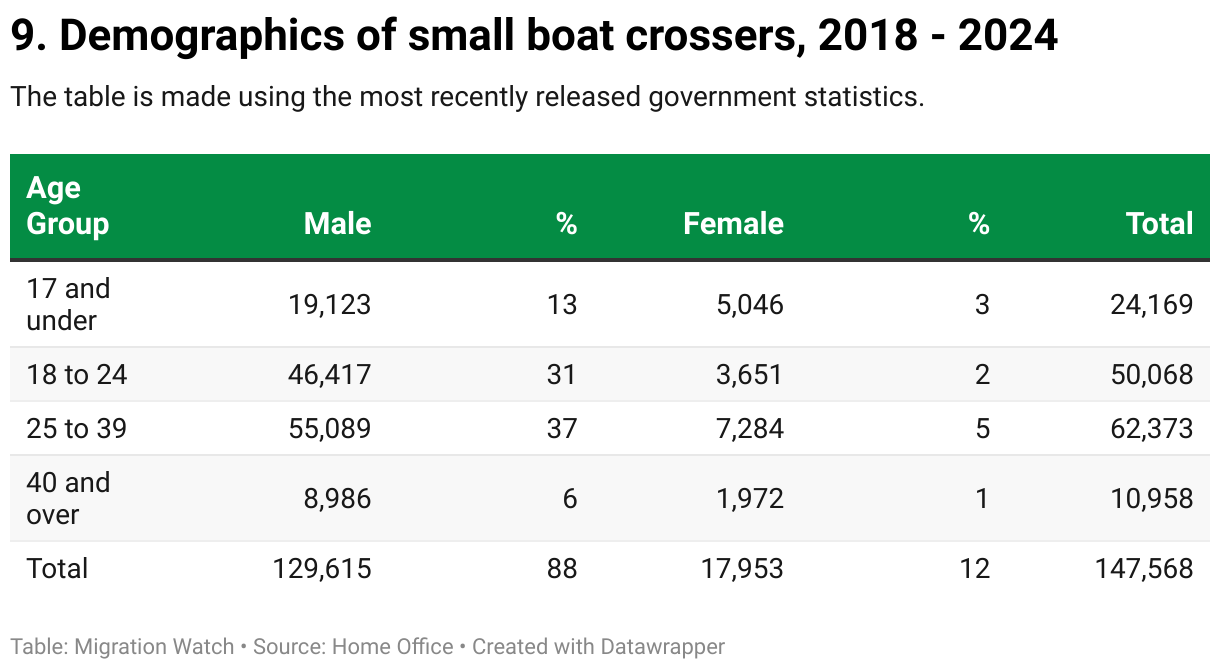
88% of arrivals on rubber dinghies are male (see data below, taken from Migration Watch UK, Source: the Home Office). And yet, in most parts of the world, it’s women who are more likely to face persecution simply because we have XX chromosomes; historically, groups genuinely fleeing danger have been evenly split by gender. No matter how you view the world, the extreme gender skew of small boat arrivals should be a red flag.
The mix of source countries changes from year to year; in 2024 the men came mainly from Afghanistan, Syria, Iran, Vietnam, Eritrea, Sudan and Iraq (source: Migration Watch UK). Granted, these countries are all poor, but can you really call someone who has chosen to leave poverty and a Communist regime (Vietnam) or poverty and the rule of mullahs (Iran) a refugee? 

And if they really are in the grave danger they claim to be in, why not just stop in the first safe country; why cross so many more borders and crown their risk by jumping into a rubber boat? 

As Shabana Mahmood said:

‘… even genuine refugees are passing through other safe countries searching for the most attractive place to seek refuge.

When Hitler was gassing Jews in Germany, the few Jews who managed to escape were relieved to be somewhere safe; they did not shop around on apps looking for ‘better’ countries. If you’re already in a safe country, be that Italy, France or Belgium, and you keep crossing borders and then climb into a dinghy, that act of deliberately putting yourself in more danger (and in some cases, your children, too) should surely disqualify you from gaining asylum in Britain.

Some will argue that only desperate people would put themselves in deliberate danger; therefore, they deserve our empathy and compassion. My counter-argument is that there are now plenty of legal immigration routes into Britain (many more than in my day), but if you know you would not qualify legally, you look for illegal means. 

In other words, small boat customers know very well that they’re breaking laws. If someone knowingly breaks the law before they even get to Britain, why should we expect them to obey our laws once they’re here? The simple answer is: we can’t.

Denmark was the first European country to collect data about its immigrant population. What the Danes have found is that foreigners are over-represented in Danish criminal convictions relative to their population size. 

Put simply, if 15 out of every 100 people in the population are immigrants, then, all things being equal, you would naively expect 15 out of every 100 criminals convicted to be immigrants. In 2023, 15 out of every 100 people in Denmark were immigrants. But immigrants made up 25 out of every 100 people convicted of crimes. 

The same over-representation of foreigners in Danish criminal convictions was found in 2022, 2021 and every single year for which the data was available – going all the way back to 2014, when data was first collected.

I can already hear objections. ‘This simply means that Denmark is a racist country. You’re more likely to be convicted of crime if you’re a foreigner!’ 

Not so fast. Danish data also suggests that not all immigrants are equal. Immigrants to Denmark from the Philippines, Indonesia, China, India and Argentina are less likely than locals to be convicted of crime. Bottom of the criminal list is Japan: the Japanese in Denmark are incredibly law-abiding. To sum up, not all immigrants to Denmark cause problems: only those from the Middle East and North Africa. Alas for Britain, these have been our main source countries in recent years.

Until liberals are prepared to concede that there just might be bad immigrants, debate around immigration will remain toxic. Pro-immigration Brits behave as if they stand on hallowed ground. They claim to be against ‘racism and fascism’; by implication, if you dare question immigration, you must be racist, fascist, ignorant and evil.

The slogans haven’t changed since I was at university 40 years ago. Slogans have always been cheap; in the age of instant social media, they are especially cheap. Where was the anti-racist, anti-fascist brigade when a Jewish economics lecturer in London was hounded inside his lecture hall? Professor Ben-Gad, himself an immigrant – but a highly-educated immigrant, not the sort usually favoured by the great and the good of the left – was threatened with beheading by masked pro-Gaza supporters. This happened in central London, not some godforsaken ISIS territory; if we don’t want beheadings and hand-chopping to become acceptable in Britain, we need honest dialogue in this country. 

Not all immigrants are equal. Not all immigrants are good. And not all immigrants want to integrate.

For the record, I’m not against immigration, but I am absolutely 110% against uncontrolled, unfettered immigration. I played by the rules. The immigrants I know – and I know plenty – have also played by the rules, jumping through hoops (not into rubber boats) to ensure that we obeyed the laws of this country. Some of the rules themselves have become tougher for legal immigrants, thanks to their widespread abuse by people who don’t care about rules. How is it fair on those of us who have obeyed every law, to watch people clearly exploiting loopholes and be allowed to exploit them? Those who turn up in Kent when their countries are clearly not at war; those whose asylum applications are rejected but who stay anyway, supported by our taxes, often for years, while they appeal and re-appeal: how is any of this fair?

To quote Mahmood once again:

‘…we have a proper problem and it is our moral duty to fix it. Our asylum system is broken. The breaking of that asylum system is causing huge division across our whole country, and it is a moral mission for me to resolve that division across our country.’

Her reforms are a start. Personally, I don’t think they go far enough. She hasn’t even begun to tackle the problems in our legal immigration system. But Shabana Mahmood is to be lauded because no one else has had the balls to do even as much as she has.

I, an immigrant, support her efforts. I don’t want illegal men here. And I know I’m not the only one.

Leave a comment

Filed under England, Life, Modern Life, Uncategorized, United Kingdom

Ruminations On Heritage 6: The Point of No Return

In February 2022, the woman who was then Malaysia’s Deputy Minister for Women and Family advised husbands to calm wayward wives by beating them ‘lightly’. The politician, Siti Zailah, remains a Member of Parliament. This is the sort of country I come from.  

When flight MH-17 was shot down in 2014 by a Russian missile, Malaysia’s flourishing Islamists, including the same Siti Zailah, blamed Malaysia Airlines. Allah’s wrath had apparently been incurred by the alcohol the airline continues to serve. His anger was further stoked by those sexy stewardesses parading in form-hugging kebaya blouses and skirts. The Malaysians who believe this are in the minority, but they’re allowed to make an awful lot of noise. This is the sort of country I come from.

On the things that really matter – religious extremism, endemic corruption, nepotism, cronyism and most of all, Malaysia’s entrenched racism – its leaders have been conspicuously silent. This is exactly the sort of country I come from.

A long time ago – May 13, 1969, to be precise – so-called ‘racial riots’ occurred just after a set of important elections. Most of the people killed were Malaysians of Chinese ethnicity. I remember it as a period of curfews, shop closures and adults walking in fear. When grown-ups are scared, kids get scared, too.

Afterwards, a new Prime Minister took over and a suite of racist policies, euphemistically called the New Economic Policy, was instigated. Such massive changes should have warranted close examination – as would have happened in any proper democracy.

Not Malaysia. For the next thirty years, we were told not to breathe the words ‘May 13’, as if just hearing the words would cause Malaysians to become hot and bothered and start attacking one another with parangs and krises. And like sheep, we obeyed! That, too, is the sort of country I come from.

Until those pivotal elections of 1969, there was real democracy. The largest political party, the United Malays National Organisation or UMNO, realised it could lose elections. Losing elections meant losing power and UMNO was determined not to lose power. Under the camouflage of ‘addressing racial inequality’, its leaders set about dismantling democracy, but we were too blind and naïve to notice.

That was so long ago, I hear you say: why does it matter anymore?

It matters because our present is shaped by the past. Truth matters.

Has any attempt been made by any Malaysian government since 1969 to find out the whole truth about May 13, 1969? Of course not. Until there is truth, how can there be reconciliation?

UMNO proceeded to rule until 2018. Think of it! Hegemony from 1957 to 2018 – a total of 61 years! Six decades are more than enough time to corrupt the entire country from the bottom up and dumb it down from the top to the very roots. The dumbing-down has been nothing short of phenomenal.

Earlier this year, in my home state of Perak, a woman seeking treatment at a public hospital was told off for her attire! Imagine the scenario: you need help, you go to a hospital and before anything else, the doctor lectures you about your clothes.

Here was the response from the chair of the state’s health committee:

‘If you go to a government department, there should be decorum. … If you go to a temple, there’s also no signboard, but we know we cannot wear short skirts there. It’s an unwritten understanding.’

The guy actually compared a temple to a hospital, even though a temple is a place of worship that you visit voluntarily, while a hospital IS NOT a place of worship and you go there normally under duress. His was a wonderful example of cow sense (with grave apologies to cows).

It reminded me of the last time I renewed my passport. I went to Perak’s Urban Transformation Centre (UTC) in Ipoh and the passport officer refused to serve me because I was wearing a T shirt and Bermuda shorts. My shorts were perfectly respectable – but not respectable enough, it seems, if you’re a Muslim-Malay passport officer. In Malaysia, the job of a civil servant is no longer limited to paperwork: it’s also his role to judge what you wear. He told me to come back with a sarong or trousers that would ‘cover my knees’.

The only surprise is that he didn’t also complain about my bare elbows. This will change, no doubt: Malaysia’s home-grown, Taliban-inclining political party, called Parti Islam Se-Malaysia or PAS for short, will see to that.

PAS was a fringe party when I left. It is now flying high, with more seats in Malaysia’s parliament than ever before. The politician I’ve already mentioned, Siti Zailah, is a member of PAS – a shining example of their intellectual quality.

On that same trip, on the very day my passport was renewed, I was asked by a Malaysian-Chinese businessman why I did not live there. What was it I had in England that I could not find in my land of origin?

I gave no answer, not because I didn’t know, but because the answer is so complicated that I did not know where to begin. How do you explain to someone who has never lived in a liberal democracy what it’s like to live in a country that isn’t corrupt from top to bottom, where you can trust the courts, the press isn’t muzzled, there is civic discourse and crucially, where I am equal to everyone else under the laws of the land?

The man who asked the question is obviously happy living under Ketuanan Melayu (Malay lordship). I wouldn’t be happy. And since I have a choice about where I live, I can’t see any reason to go back.

An estimated 1.8 million Malaysians live outside Malaysia (population 34 million in 2023). At least half of my classmates from secondary school and many members of my family have left. That’s a huge brain drain for any country, especially one still in development mode.

When Malaysia’s current Prime Minister, Anwar Ibrahim, visited New York recently, he was asked what he would do about this talent bleed. He gave an astonishingly lame reply about ‘enhancing incentives’.

The idea that money alone would bring us back is laughable. Financial incentives have been available to tempt Malaysians back since 2011 and only 2,500 overseas Malaysians have taken them up (Source: video below by Mariam Mokhtar), roughly 0.138% of the diaspora.

A charitable view is that Anwar just doesn’t get it. Perhaps he genuinely believes that tax breaks on luxury cars and tax breaks on just about everything else would be enough to bring us back. I will speak only for myself here, but I’d like to say it loudly and clearly: what I have in England is freedom, and this freedom is priceless.

Since freedom is a nebulous concept, an example might help. If I wrote an op-ed on the subject ‘Is Charles the King of all Britons, or does he represent the interests only of white Britons?’, I’m confident it would be accepted by a broadsheet publication here. But if I wrote an op-ed entitled ‘Is Malaysia’s King (Agong) really the King of all Malaysians, or does he favour the Malay race?’, would the official Malaysian press dare touch it?

The difference is that England goes out of its way to accommodate different viewpoints and to protect the rights of minority groups. In my adopted country I am equal by law and can rely on a judicial system I trust. No economic incentive is going to make me give this up.

Going back to Anwar Ibrahim (and his limp solutions for Malaysia’s brain drain), a less charitable view is that he actually understands what’s at stake and fears the consequences. What would Malaysia look like if all 1.8 million of us went back?

Some of us would surely join the brave Malaysians who’re still speaking up against the things its politicians don’t have the guts to discuss. We would be vocal, certainly. UMNO wouldn’t like that, and it’s unclear whether Anwar would be all that keen, either.

I once told myself that when Malaysia abolishes bumiputera rights, I will go back, at least for a time, in order to give something of myself to the country I came from. I now know this is a pipe dream. Bumiputera rights won’t be abolished anytime soon. But it took the break enforced by COVID for me to see the light.

Finally, after forty four years away, I’ve given up on Malaysia. Perhaps some immigrants reach this point, when both they and the country they left behind have changed so irrevocably that there’s no turning back.

Giving up on a dream is never easy. Part of me is angry, but mostly, I’m sad. We have all lost; even those who think they’ve gained have actually lost.

We lost the spirit of Malaysia and in losing that precious spirit we squandered the chance to build a truly great nation.

And for what? So that a small group could cling to power while enriching itself and its cronies.

I won’t be returning, but I will support the Malaysians still fighting for a better tomorrow. One of these is the writer Mariam Mokhtar. We don’t know one another; I’ve only enjoyed her articles from afar. As she describes below, her writing has been deemed so incendiary that the slavish Malaysian press won’t publish her.

That hasn’t stopped Mariam. She launched her own news platform and now makes videos, too. I discovered them while carrying out research for this blog-post and I find her analysis always spot-on. 

If you’re interested in what took place during May 13, 1969, I would recommend the book May 13 by Dr. Kua Kia Soong, director of Suaram (short for Suara Rakyat Malaysia, or Voices of the People of Malaysia). He wrote it by piecing together extracts from documents that were only declassified after thirty years. When his book came out in 2007, some Malaysian politicians wanted it banned – which is reason enough to read it.

Walau pun saya berada jauh, Malaysia tetap di hati.

3 Comments

Filed under England, Malaysia, Politics, United Kingdom

Ruminations on Heritage 3: It’s Just Not Asian!

When I first came out as gay, my parents blamed England. If only they had not sent me to boarding school, ‘this’ would not have happened. It’s just not Asian!

I never asked which part wasn’t Asian. Did they mean:   

  • Being attracted to someone of the same sex?
  • Telling a fundamental truth that made others uncomfortable?
  • Daring to think outside the box?    

This took place in the mid-1980s. It would be tempting to believe that the whole world has changed since.

The map below shows the countries (in red) in which homosexuality remains illegal. There’s a very large mass of grey – not the case before – so, indeed, there has been progress. But we are nowhere near an egalitarian utopia. The Russian Federation, for instance, is hardly an oasis. Neither is China.

Source: Human Dignity Trust

Earlier this year, mainland censors erased a lesbian plot-line from the sitcom ‘Friends’. No lesbians for the mainland! Just what is the Communist Party so afraid of? Obviously, merely hearing about lesbians on TV could give Chinese women ideas. Hardly a vote of confidence in their men.

One of the other countries in red is Malaysia. It has a Muslim majority and homosexuality is illegal. I still have relatives there, one of whom is gay. He isn’t a Muslim. He has lived in Malaysia all his life. He has also been in the closet his entire life.

An early memory I have is of waking one morning to be told that this particular relation had been in a terrible road accident. When I saw the photographs, I was shocked. To describe his car as a wreck would be an understatement – it was crushed. If you looked at photos alone, you would have assumed its occupant well dead.

Apparently, the accident was his fault. My relative had come out of a junction and was hit by a bus (if my recollection serves me right). Everyone was amazed he survived the catastrophe. At the same time, they could not fathom what he was doing in that part of town. I remember the adults around me shaking their heads, asking repeatedly: what was he doing there at that hour?

Years later, he told me. He had been meeting a man.

The revelation brought lightning clarity. Disjointed memories fell into place. Finally, I understood. I felt like Archimedes with his Eureka moment. When my relative swung his car out of that junction, his mind was occupied.

Obviously, such an accident could have happened anywhere. But if this relation of mine had been able to meet a man the same way he was encouraged to date women, he is unlikely to have been skulking off to a clandestine encounter in the early hours of dawn.

I have a gay cousin who did the same: he went around surreptitiously – until his parents accused him of being a drug addict! It took a dramatic argument for him to come clean with them. That story, at least, has a good ending. My cousin lives happily with his partner and has done so for years.

Not the case of my car-crash relative, whose sexual orientation is an open secret. Granted, he is loved by the family. This makes him fortunate. Nonetheless, can you imagine the amount of sniggering he has had to endure, what it must be like living within a culture where you’re asked ‘Are you married?’ within minutes of meeting someone?

As we celebrate Pride month, I thought it time to shine a light into the closet. It looks to me like a dank, dark place. I can’t imagine living in it, or how great the mental toll must be.

I’ve often heard that ‘we in Asia have our own way of doing things’ – we don’t need to talk about them. Some people believe there are things better left unsaid. No doubt they also think I should not be writing this blog-post. But ‘ways of doing things’ evolve. Chinese women used to bind their feet: should we return to that practice? Of course not – no culture is beyond universal human values. If we find it hard to say the word ‘gay’, it’s because we still associate shame with gayness. The dictum ‘we have our own way of doing things’ is no more than a convenient cover. It allows uncomfortable topics to be avoided.

Fortunately, some changes have come; in Asia, Taiwan has led the way. The island nation legalised same-sex marriage on 17 May, 2019. Contrast that with China’s censorship of the Friends’ sit-com lesbian plot-line. Taiwan’s marriage equality is one of many reasons why it is not China – and whether Taiwan belongs with the mainland is, in my view, debatable.

All those years ago when my parents blamed England, they had a point. England did not make me gay, obviously, but it has given me a confidence, freedom and happiness I would not have enjoyed otherwise. Here I can live openly without having to hide; here I stand without fear, knowing that I am protected by law.

This freedom is indescribably precious. In a poignant moment a few years ago, my ex-wife and I welcomed a visitor from Dagestan. When he realised that he was the guest of two women who were married to each other, he was in awe. Without any hesitation whatsoever he proclaimed:

‘Today I have met people who truly are free.’

Part 4 to follow

Leave a comment

Filed under England, Identity, Malaysia, Modern Life

Ruminations On Heritage 2: What A Truly Multicultural Democracy Looks Like

My country of origin, Malaysia, loves selling itself as the multicultural haven that it really isn’t. My adopted land, on the other hand, just gets on with it. England is showing the world what a truly multiracial, multicultural democracy looks like.

At the start of the pandemic, we were treated to daily press briefings. The first session was hosted by the Prime Minister and his medical advisors. Thereafter, other Cabinet members presented briefings.

The parade of Secretaries and Ministers is evidence of just how far Britain has come. By now you will likely have heard of Rishi Sunak, Chancellor of the Exchequer, and Priti Patel, the Home Secretary. Both are descendants of first-generation Indian immigrants from East Africa. The former Vaccines Minister Nadhim Zahawi, who was tasked with rolling out the UK’s very successful vaccines programme, is himself a first-generation immigrant. Here he is giving one of those briefings. Zahawi is now the Education Secretary.

In England, politicians from ethnic minority groups aren’t just relegated to the side-lines, the way they are in Malaysia. Below are a few of England’s current Cabinet members.

Health Secretary: Sajid Javid;

Business Secretary: Kwasi Kwarteng;

COP26 President: Alok Sharma

In ‘Malaysia, Truly Asia’, there is virtually no ethnic diversity within a government that continues to be dominated by race-based political parties. By ‘race-based political party’, I mean a political party run along sectarian lines which admits full members from only one particular racial group.

Yes, you read that right. This may be 2022, but you still have to be Malay (or bumiputera) to be a full member of the ruling United Malays’ National Organisation (UMNO). In principle I am allowed to join, but only as part of an associated group following orders (as per Clauses 4.1.2 and 4.3 of UMNO’s Constitution). Unwanted, unwelcome, second-class: the same way I’d be treated if I lived in Malaysia.

Excerpt from UMNO’s Constitution

There is also that damp squib known as the Malaysian Chinese Association (MCA), which supposedly represents Chinese interests. Not to be outdone, Indians have the Malaysian Indian Congress (MIC).

The idea that you need to be a certain race to gain full membership of anything should be illegal. It has no place in today’s world. But race (and religion) are expedient tools for power. And the politics they nurture thrives on a self-fulfilling loop of tribalism. Nastiness is repeated ad infinitum, the audience become inured and tribalism ends up infecting a nation.

I discovered this when Sajid Javid was named Home Secretary in 2018. My phone pinged with messages. Some Malaysian family members were worried. ‘You now have a Muslim Home Secretary! London’s mayor is also a Muslim!’

Yes, and???

It transpired that a tonne of What’sApp videos were doing the rounds. One listed the British cities with Muslim mayors (hundreds, apparently). Another video purported to show a road somewhere in England being taken over by Muslim men bowed in Friday prayer. Yet another displayed Buckingham Palace. The Palace, it seemed, was going to be turned into a mosque. I wonder if someone has told Her Majesty. She is celebrating an unprecedented seventieth year as monarch and may have other plans for her home.

A few salient points are in order. First of all, a politician like Sajid Javid reached his position on merit – he was not favoured by positive discrimination. Secondly, he is a member of the Conservative Party which, whether or not you like it, is fully open to all races and faiths. Thirdly, he serves all Britons, not just British Muslims.

When a group of Asian male paedophiles was convicted of grooming white girls in Huddersfield for sex, Javid was brave enough to call a spade a spade. He described the men as ‘sick Asian paedophiles’ and commissioned research to investigate cultural connections. Here’s an excerpt of his comments:

…the sad truth is that if you look at recent high-profile convictions of gang-based child sexual exploitation, there is a majority of people that come from Pakistani heritage backgrounds – that’s plain for everyone to see. What I’ve said is that we, in trying to deal with this, trying to turn this round, we must look at all factors and we must not be too sensitive and shy away or be oversensitive.”

Spot on.

What Javid said and the way he said it is one of the fruits of freedom. Real democracy is sometimes messy. But after the storm comes sunshine. You are able to look at your own culture with clearer eyes. You can speak hard truths without feeling defensive.

Part 3 to follow.

2 Comments

Filed under Cultural Identity, England, Identity, Malaysia, Modern Life, Politics, United Kingdom

The Long Crawl

I sincerely hope this blog-post find you healthy, fit and sane. If 2021 were on offer as a free trial, I would end mine right now.

Thankfully, there are glimmers of hope. Vaccines are on their way.

I can hardly wait. Yet in recent days I have found myself having conversations I never expected. Family and friends often disagree with me, but I did not expect to have to convince them about vaccines. Here are some of what I’ve heard:

This virus is so new!

‘I don’t know what’s in the vaccine.

‘The vaccine might make me ill.

‘Vaccines can be dangerous.

‘I’m not sick and I may not get Covid-19, why should I get vaccinated?

Well! Where to start?

Look, I’m no expert – my Ph.D. is in Theoretical Physics, not Epidemiology. But I do understand scientific principles and I can parse statistics. In 1999 when I was diagnosed with a brain tumour, I learned everything I could about my particular type of tumour and grilled the surgeon. I mean, he was about to drill into my skull; you’d want to know exactly what he was going to do, wouldn’t you?

The more I learned, the clearer it became that the benefits of surgery far outweighed the risks. To be honest, I did not have a choice. I’m fully aware that if it weren’t for Western medical technology, I would have died. So I guess that would make me a little biased.

With that little disclaimer out of the way, let me start with the statement:

‘This virus is so new!’

It’s true this virus is new, but coronaviruses as a group are not. This is important: it means that researchers have been studying viruses similar to the one causing Covid-19 for many years. The vaccines on the block were not just invented in the last nine months.

For instance, you’ve heard of SARS, right? The letters stand for Severe Acute Respiratory Syndrome, better known as avian flu. SARS also originated in China and was caused by a type of coronavirus. That was way back in 2003. Then came MERS, or Middle East Respiratory Syndrome (camel flu), caused by yet another coronavirus. The point is that research into these kinds of viruses has been taking place for decades. And some of that accumulated knowledge has gone into the vaccines being produced.

‘I don’t know what’s in the vaccine.’

The good news is that if you really wanted to know, you could find out. Here are some of the contents of the Pfizer-BioNTech vaccine that was approved in the UK on 2 December 2020: mRNA and lipids, including 4-hydroxybutyl)azanediyl)bis(hexane-6,1-diyl)bis (ALC-3015). Gobbledygook to me, but great if it helps you.

On the other hand, I found that reminding myself how vaccines actually work was reassuring. Which brings me to

‘The vaccine might make me ill.’

Ironically, if you do feel ill after vaccination, that’s a sign your body is reacting the way it should.

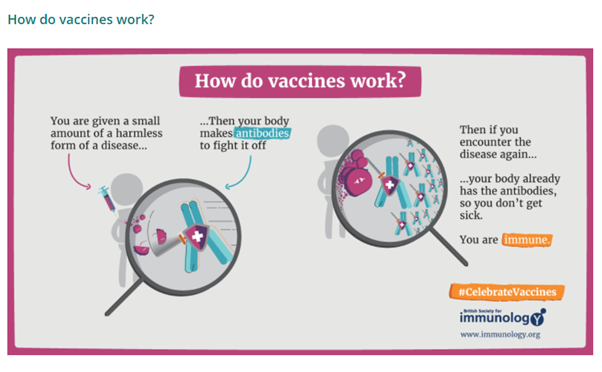
Here’s the basic idea: your body is injected with a small amount of the virus against which you are going to be inoculated, so that it starts creating the antibodies you need.

The diagram above is taken from the British Society of Immunology’s website and is the best I’ve found to summarise the vaccination process.

So let’s say we want to inoculate you against polio. When you’re injected with a small amount of the polio virus, the antibody production process is kick-started. If your body were subsequently invaded by polio, it would already have been primed for battle.

The concept behind vaccination is incredibly simple. It’s not new. And if vaccination did not work, diseases like polio would not have been largely eradicated in the world.

But the idea of injecting a virus into your body, albeit in a controlled fashion, could sound like voodoo. This may be why the following notion has gained currency:

‘Vaccines can be dangerous.’

In this context I cannot ignore the efforts of a disgraced doctor called Andrew Wakefield. This guy falsely claimed a link between the measles, mumps and rubella (MMR) vaccine and autism. To my knowledge no one ever managed to replicate his results.

This last point is crucial. A fundamental principle of experimental science is that an experiment must be repeatable. No other professional scientist ever replicated Wakefield’s results, which means his results have never been tested. There is no credible evidence of the link he claimed. Wakefield was stripped of his medical licence.

Yet this did not prevent MMR vaccination rates from plummeting (and incidence rates from rising). Infamy has not stopped Wakefield from becoming a cause célèbre in fact-free zones on the Internet. And we know how many such zones there are. Some people even believe that Covid-19 is a hoax created by governments to lock us up.

Anti-vaccine and anti-masking demonstrations have taken place all the way from London to Spokane in Washington State, on the West Coast of the USA. Half the population of France on BFMTV have said they would either not take the vaccine or accept it only reluctantly.

All of the above worries me. Ignorance is far more dangerous than any vaccine could be. Thanks to social media, opinions proliferate, and people seem to believe they can hold opinions about absolutely anything, even ‘facts’. In the Cambridge Dictionary a fact is

something that is known to have happened or to existespecially something for which proof exists, or about which there is information.

Here’s a fact: the Earth is round. In olden times people did not believe this – they thought that if they travelled far enough, they’d fall off the edge.

But we have now seen Earth from space. There are photographs to prove it. The one below (famously known as the Blue Marble) was taken from Apollo 17 in 1972. Are you still allowed an opinion on whether the Earth is round?

I suppose you don’t have to believe the evidence. Those of us fortunate enough to live in properly-functioning democracies have the freedom to choose our beliefs.

With freedom comes responsibility. Our beliefs have consequences. So let me come to

‘I’m not sick and I may not get Covid-19, why should I get vaccinated?

Because there is no guarantee that you won’t get sick. If you’re offered the vaccine but refuse it and you then get sick, who should pay for your medical care?

Vaccines alone are not cast-iron guarantees. There’s still a small chance you may not be protected. In addition, vaccines aren’t suitable for everyone. And those of us who are vaccinated could still be carriers. We would need to remain vigilant.

But vaccines represent our best hope. They are the first step in our long crawl back to normality. I, for one, am holding my breath.

Leave a comment

Filed under Corona Virus, England, Lockdown, Modern Life, United Kingdom

Good Things Come Out of Bad

Crisis forges character. Facing adversity changes us. Sometimes we rise to the occasion and get stronger, other times life overwhelms us; either way, we do not stay the same.

On March 20 2020 when Boris Johnson announced the closure of pubs, restaurants and gyms, life took a surreal turn, just as it did when I was diagnosed with a brain tumour many years prior. Circumstances were different, yet in some ways also the same. There were things beyond my control, but I had a choice in how I reacted.

My tumour was a haemangioblastoma: non-malignant, innocuous even. It was no more than a kidney-shaped bean inside my cerebellum, the lower half of the brain where motor functions reside. The tumour did not and would not have spread, but it caused a cyst – a bubble of liquid – to form around it. The cyst grew. By the time I saw a neurosurgeon, the bubble filled a third of my cerebellum. That’s how I knew it was there: the cyst had begun impinging on my brainstem.

I spent a weekend wishing I were in a dream, that the person who was me was actually someone else. And then I sprang into action. The moment I took charge – to the extent I could – marked the start of my recovery.

This experience was a test run for the future, except I did not know it. I made limited changes to my life.

Ten years later, almost to the day of my brain tumour diagnosis, I faced death again. This time I had cancer, breast cancer, which is relatively common. Still, there is no way to sugar-coat the moment I heard the news. Cancer was something that happened to others; I honestly did not think it would happen to me.

Good things eventually come out of bad. While stuck in a post-chemo depression, I started writing. It was an act of desperation: I never imagined I would emerge profoundly changed and happier, living life with passion.

Good things will also come out of COVID-19, even if we can’t see them all yet. Some positives are already obvious. There’s less pollution, for one thing. And Britain is enjoying a renewed sense of unity. Brexit broke this country; it has taken a virus to remind us that we have more in common than we have differences. That alone is amazing.

On a personal note, this pandemic has helped me resolve key issues around my identity. During the first week of Britain’s lockdown, when Matt Hancock, the Health Secretary, put out a call for 250,000 volunteers to help the National Health Service (NHS) I registered at once. I did not even need to think.

My place is here. Finally I know where home is.

I no longer feel torn. Between Britain, where I’ve lived most of my life, Malaysia, which remains in my dreams, and America, where I have family, friends and a literary agent. Thanks to a virus that emerged – ironically – from the land some of my ancestors came from, I understand what it means to be home. Isn’t that extraordinary?

I am exactly where I should be. To know that is a blessing.

The past two Thursdays, cheers rang out along the United Kingdom’s many streets for the key workers of this country: those in the NHS, in social care, in pharmacies, supermarkets and schools (now online). We saluted them right across the country. The moments were so poignant that I cried. I clapped, too, and for good measure, banged on a pot. The entire street was out. A neighbour blew a short tune on the saxophone.

This scourge afflicting us will be defeated. We will come out the other side. When we emerge, what will we see of ourselves?

I want to be able to look back and know that I acted as courageously, thoughtfully and compassionately as I could have. I want to know that I reached out where I could, gave comfort when I could, did all that I could to help.

Some of these same sentiments were summarised by New York State’s Governor, Andrew Cuomo, whose daily briefings have become must-watch events in an America clamouring for intelligent leadership. Here are a few of his words:

‘Ten years from now you’ll be talking about today to your children or your grandchildren, and you’ll shed a tear because you will remember the lives lost, and you’ll remember the faces and you’ll remember their names and you’ll remember how hard we worked and that we still lost loved ones. And you’ll shed a tear and you should because it will be sad, but you will also be proud. You’ll be proud of what you did. You’ll be proud that you showed up.’

It’s not for me to prescribe what anyone else should do. For myself, I know how tenuous life is; to squander this opportunity would be unforgivable. That is why I’m showing up.

But I’m also keeping well and trying to stay sane. Please do the same. Keep well, stay safe. We will get through this.

Leave a comment

Filed under Cultural Identity, England, Identity, Modern Life, Politics, United Kingdom

Thank You, Britain

I’m aware that I’ve been away from this blog for a while. Rest assured, I’ve been busy. Some folks, I know, are expecting news about my next book. I hope to be able to tell you more in the coming year. For the moment I’d like to come out on this blog, this time as a Brexit supporter. A friend warned me, ‘Be careful. You don’t want to alienate anyone.’

Extreme polarization is one of the challenges of our time. As a country, we used to be able to disagree with one another and remain civil, but in recent years discourse has turned toxic. Attitudes have hardened. ‘You’re wrong! I’m right.’ That’s very much the prevailing tone. I sincerely hope that readers of this blog will allow more subtlety than that.

I don’t intend to explain why I voted the way I did. It was a gut-wrenching decision, one which I took very seriously, not least because we were told it would be a ‘once-in-a-lifetime’ vote.

I discussed the issues with friends from whom I thought I might get insights not otherwise available, including a senior peer in the House of Lords. I made sure I listened to both sides of the argument. This wasn’t easy, since most of the people I know wanted the UK to Remain within the EU.

Days before the Referendum on 23 June, 2016, I grabbed two sheets of paper. One sheet was for Remain, the second for Leave. I drew a line down the middle of each sheet and listed arguments in favour of Leaving and the arguments in favour of Remaining. Pros and cons, in other words, pros on the left and cons on the right.

It appears that Boris Johnson did the same in even greater detail, going so far as to write an entire pro-Remain article. The existence of such an article is supposedly evidence of his being a two-faced so-and-so. You can criticise the guy for many things; on this point, however, he was doing no more than what writers often do: playing around with points of view. I did it because I could not see how else I would reach a decision. I took one side of the argument, slept with it for a night or two and then took the other side of the argument and slept with that, too.

My doubts persisted to the very end. Nonetheless, I think that listing those bullet points was a worthwhile exercise. There’s always more than one side to any story, and if we are to heal as a nation, we’ve got to be able to see the other side, too.

Since the Referendum result, it has been scary coming out as a Leave supporter. In fact, I would go so far as to say that coming out as a Brexiter has been scarier than coming out as gay. I was naïve the first time. I was at a cocktail party in a staunchly Remain household and could literally feel the hackles rising. I thought I’d get beaten up. After that, I kept my mouth shut.

Leave voters have been stereotyped as stupid, ignorant, racist, xenophobic, little Englanders. I’m none of those things. This absurdly simplistic depiction gained traction across the pond, too. A snippet in the New Yorker magazine from September celebrated a Lebanese street artist who came to Clerkenwell, London, to create graffiti. She sprayed ‘No to Brexit!’ and ‘No to borders!’ on a wall, as if wishing to Leave the EU is tantamount to withdrawing from the world (and as if the benefits of wholly porous borders are self-evident).

Implicit in the popular narrative is the unspoken juxtaposition of good, black or brown immigrants on one side, against bigoted, racist white natives on the other. Ergo, I the underdog immigrant, am necessarily in the right, whereas you, if you’re a native white Brit are presumed to be bigoted, especially if you have the audacity to question immigration policy (as Labour supporter Gillian Duffy did with Gordon Brown in 2010).

Reality is more nuanced. I have lived far longer in England than I ever did in my native Malaysia, and I reject the above caricatures. 17.4 million people – 52% of Referendum voters  – chose to leave the EU. The majority of this country is not racist. On the contrary, I have found England to be an incredibly tolerant, open place.

Have I faced racism? Of course. But those incidents pale in comparison with the overwhelming kindness and generosity I’ve also encountered. Moreover, racism is a two-way street. Immigrants are racist, too (and that’s before we even get to their sexism and homophobia).

Some may say that I’m blaming immigrants. I’m not, though how we behave matters. If we don’t bother integrating, acceptance becomes harder. Let’s take language. Most immigrants speak English, yes, but many do so rather poorly; some, after years, continue making basic errors. I find this wholly unacceptable. We have obligations as immigrants, the most basic being to learn the language of our host nation properly.

I went to the opposite extreme. Coming from a former British colony, I already spoke English well, but I did not initially have the British accent I have now. I acquired it through conscious effort. No one needs to do that – you don’t have to sound like the Queen to be accepted. For me, though, it was an important marker of belonging.

Many people – especially my white socialist British friends – like to castigate this country as cold and selfish. Jo Swinson, who led the Liberal Democrats, Britain’s third political party, until she lost her seat last week, said after being booted out: ‘I still believe that we as a country can be warm and generous, inclusive and open’, which implies that it isn’t. I disagree. I believe Britain is already that warm and generous, inclusive and open place.

This is why so many immigrants come. If Britain is so terrible, why do you think we come, and we stay, too?

I’d like to do something that’s not often done: to take this opportunity to thank my adopted country for the wonderful chances it has given me, chances I would never have had in Malaysia.

Thanks to Britain, I was able to gain a university place fairly and squarely, with ethnicity not being a primary consideration (as it is in Malaysia) and only the strength of my brain mattering. I went into examination halls secure in the knowledge that I would not be marked down because of my race or others marked up because of theirs and that if I worked, I could achieve anything.

Thanks to Britain, I’ve been able to express political ideas and opinions without fear of official recrimination. Only those who have lived under oppression can truly understand how amazing this is.

Thanks to Britain, I know what it feels like to have my vote count. This is a priceless freedom, one which too many Westerners take for granted.

Thanks to Britain, I don’t have to lie about who I am. I can live openly with a woman, even marry her, and have this right protected by law.

Thanks to Britain, I know that profound social change for the better is possible – because I’ve participated in it, seen it and experienced it for myself.

There’s no question that England has made me the person I am today. I will always owe her a huge debt. Too often, we immigrants are quick to complain and slow to thank. In my own small way, I’d like to rectify that here. Thank you, Britain.

4 Comments

Filed under England, Identity, Modern Life, Politics, United Kingdom