Tag Archives: Straits of Malacca

Ruminations on Heritage 5: Who Owns the South Sea?

I first saw the stretch of water known as the ‘South China Sea’ when I was a child. My family went on holiday to the East Coast of Peninsula Malaysia. Travel wasn’t the same in those days – it was a huge adventure. We visited the states coloured purple, green and yellow on the map and I have vivid memories of the ‘South China Sea’. It seemed to always be there: blue and gently lapping on sunny mornings, dark and roiling when the storms came.
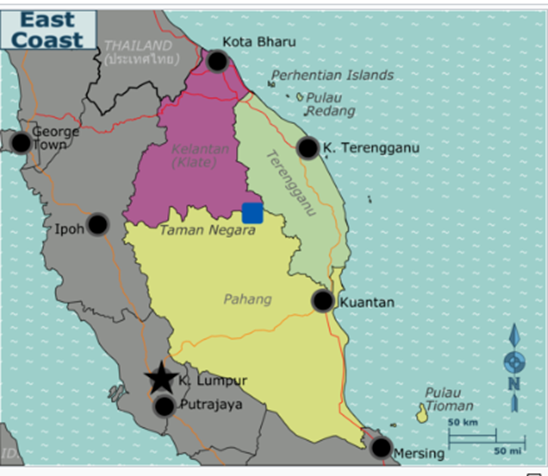
(Source: https://en.wikivoyage.org/wiki/East_Coast_(Malaysia))

That trip was memorable for another reason. One night, after following a guide by torchlight for what felt like miles, I saw giant turtles with leathery backs on an isolated part of the coast. Those amazing turtles were clambering onto Malaysia’s pristine sands to lay their eggs! Almost at once, their eggs were removed. I was fascinated; at the same time I felt sorry for the poor mother turtles. I’m sure they sensed what was happening.

The ‘South China Sea’ brought more than giant turtles: it also brought people. Among these were my ancestors, some of who arrived from southern China in rickety boats.

They did not call the water that had brought them the ‘South China Sea’. In Chinese, the same stretch of water is actually known as the ‘South Sea’ (南海), meaning the sea south of the Chinese mainland.

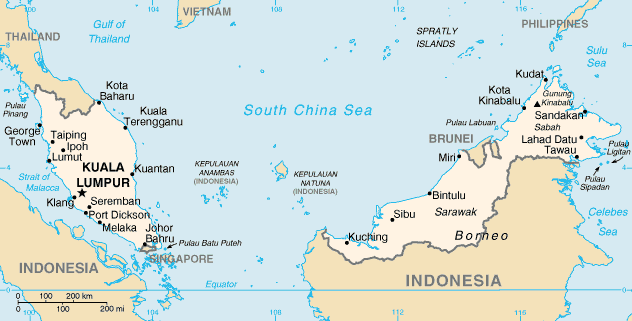
As a child, it never occurred to me to ask why a sea on Malaysia’s eastern coast should be named after China. If you look at a map, you’ll see that the ‘South China Sea’ is really a Southeast Asian sea: it flows across Southeast Asia, eventually reaching southern China and Taiwan. But the bulk of this sea is not in North Asia.

 Source:  https://en.wikipedia.org/wiki/South_China_Sea

Rather, it unfurls on the shores of Vietnam, the Philippines, Indonesia, Brunei, Singapore and, as I saw for myself, Malaysia. It swaddles the southern tip of Peninsula Malaysia, linking up with the Straits of Malacca. A more appropriate name for the ‘South China Sea’ might actually be the Southeast Asian Sea.

For me the Southeast Asian Sea isn’t just any sea: I saw it as a child, I stepped into its waters and I smelled it. It carried my ancestors and sustained others. It has given me a trove of memories. What happens in this sea matters to me. And rather a lot has been happening.

Did you know that China has claimed large parts of the Southeast Asian Sea for itself? The excuse China uses is ‘historical rights’.

The logic runs something like this: Chinese seamen ‘discovered’ reefs and islands in the Southeast Asian Sea 2,000 years ago and claimed them for China. Ever since, China has allegedly ruled over these islands. Because China claims to have governed godforsaken boulders in the middle of nowhere continuously, it also claims to own these islands and reefs. China has even created whole new islands where none existed before. It goes without saying that China owns the adjacent waters, too (and presumably, all the resources that go with them, and maybe even those turtles).

I am oversimplifying. The legal arguments are more sophisticated – you would hardly expect less from the Communist Party. For a detailed legal summary, you can see this link. But the sophisticated legal arguments really boil down to the above.

In the narrative above, the peoples of Southeast Asia are conspicuously absent. Imperial China regarded Southeast Asians as ‘southern barbarians’, as I learned when I reviewed a fascinating non-fiction book called ‘Writing the South Seas’ for the Asian Review of Books. It’s no surprise that Southeast Asians were excluded from considerations of power. Barbarians are to be civilised – they’re not capable of ‘discovering’ their own islands.

Imperial China may no longer exist, but a pattern of dominance, once established, is hard to dislodge. Attitudes die hard.

China has built islands in the Southeast Asian Sea on a scale never seen before, threatened other nations’ ships and confronted their aircraft. These are not the actions of a friendly state. Today’s China is no longer the benign Imperial China of days past, a country content with merely receiving tributes from Southeast Asia’s rulers.

Southeast Asians must unite. Otherwise, what’s the point of the Association of South East Asian Nations (ASEAN)?

Achieving unity in the region may be easier said than done; like Europeans, we have a chequered history of squabbling, but we should at least try to come together. The Southeast Asian Sea lies mainly in Southeast Asia. That’s where its resources belong and that’s where its resources should stay. Granted, we have to share these among us – but Southeast Asia has a long tradition of sharing.

Thank goodness there are signs of unity coming, slowly but surely. We can do it, we have to do it. There is no other way.

Giant turtles were not seen in Malaysia for decades, but they have apparently returned. Despite adversity and precarious numbers, the turtles have come back to reclaim their sea and shores. We need to do the same. We must reclaim our sea, our reefs, our islands and our shores. Before it’s too late.
Leave a comment

Filed under China, Colonisation, Cultural Identity, Malaysia, Politics, Southeast Asia

Power, Remorse & Redemption: in Three Acts

This Friday, August 31, will mark the 61st anniversary of Malaysia’s freedom from colonisation. For the first time in years, there is a revival of hope in my homeland.

It was inevitable that I spent part of this summer reflecting on what happened on May 9, when Malaysia went to the polls. We now know that Malaysians made history that day (see What Malaysia Means). UMNO, which stands for United Malays National Organisation, the political party that had ruled the country for 61 years, was finally booted out of office. The opposition coalition, led by former Prime Minister Dr. Mahathir Mohamad, won against all odds. His age – 93 years – is what Western journalists have focused on, but this is the least of it. What happened was astonishing, a rare victory for democracy and justice in today’s world.

As with many things Malaysian, the full story is dramatic and complicated. It began long before 2018. The tale is worth telling, though, for it bears the hallmarks of great fiction: power, intrigue, grit and remorse, forgiveness and possibly, just possibly, redemption.

But how to tell it to non-Malaysians in such a way that they will understand and enjoy? This article is my attempt.  Between now and August 31, I will lay out Power, Remorse & Redemption in Three Acts here on my blog.

To understand the stunning firsts and reversals that took place on May 9, we must go back to another May, to a day that’s etched in the psyche of every Malaysian. May 13, 1969. On that day, the Malaysia of my childhood fell apart. Thus begins Act I.

May 13: Spontaneous Combustion or Arson?

I was only four when my father rushed home one afternoon. I remember his ashen face and gruff voice. He told my mother to switch on the radio, muttering a word I’d not heard till then: curfew. The broadcaster confirmed that a curfew had been declared. There were riots and fighting on Kuala Lumpur’s streets. My father’s descriptions were more graphic. He said that Malay men with sword-like knives had set fire to Chinese shop-houses.

Over the next few days fear permeated our house. It was the first time that I learnt to be suspicious of other races. Until then I’d thought of our Malay and Indian neighbours as people like us except that they wore interesting clothes and ate spicy food. May 13 destroyed this innocence. The crying shame is that many Malaysians have mixed lineage. Multiculturalism should have been a pillar of our country’s richness; instead, for the next 49 years, it became a political weapon.

To understand why Malaysia is naturally multiracial, you only have to look at a map. To the west of Peninsula Malaysia lies a narrow and sheltered stretch of water: the Straits of Malacca. In the days when pirates roamed the seas, seasonal winds brought adventurers from East and North, West and South. Ships invariably ended up docking in Malaysia.

File:My-map.png

They came from everywhere. From neighbouring countries like Indonesia and Thailand and from farther afield too: China, India, even Arabia and Armenia. Some of these traders settled. Malaysia is a paradise: peaceful, sunny and well-fed by rain, its very air exuding the promise of an easy life. Surrounding waters teem with fish; a seed only has to drop for it to grow.

European powers eventually arrived, first the Portuguese, then the Dutch and finally the British. It was the latter who recognised Malaysia’s potential. After gaining control of the country in the 19th century, Britain began developing the tin mines and rubber estates which would make the mother country rich. In a letter published in the London Review of Books on March 6 2014, Robert Lemkin, an Oxford-based filmmaker, wrote this about Malaysia:

‘In 1946 the colony’s rubber and tin industries brought the UK Treasury $118 million; the rest of the empire altogether yielded only a further $37 million. Without Malaya, the post-war British welfare state would have been unthinkable.’

Malaysia, then called Malaya, was the British Empire’s crown jewel. To develop their new industries, the colonials needed labour. They set about importing vast numbers of Chinese and Indian indentured labourers. Chinese and Indian populations had already settled naturally, but British policies changed Malaysia’s demographics overnight. The result is a rainbow country today with three main races: Malay (67%), Chinese (25%) and Indian (7%).

Many people confuse ‘Malaysian’ with ‘Malay’. Malaysian is the nationality, Malay the race. You can be Malaysian without being Malay, just as you can be British without being English.

For Malaysians of mixed heritage like me, of whom there are many, the crude classification above cannot properly reflect our roots. I fall under ‘Chinese’, but my great-grandmother had Malay lineage. And the many Malays I know with Chinese mothers or grandmothers are categorised merely as ‘Malay’. In reality Malaysians are a potpourri of Malay, Chinese, Indian and lots more. There were also indigenous tribes already in situ – the Orang Asli or ‘original people’ – the true natives of Malaysia, who are aggregated as ‘Malay’ in the above statistics.

Race is a lightning rod in Malaysia. It has been easy to use race to keep Malaysians apart because our political parties have traditionally been run along communal lines. What’s astonishing is that many still are – in 2018. You must be Malay to join UMNO, which is why it’s called the United Malays National Organisation. I would not be allowed into UMNO, though I’m eligible to join the Malaysian Chinese Association, MCA. Indians can join the Malaysian Indian Congress, MIC. This system of apartheid is crazy, but when you grow up with it you don’t see this. It’s such an accepted fact in Malaysia that even some of the newest political parties are race-based.

As a consequence of May 13, race ignited in the Malaysian consciousness – for all the wrong reasons. When race is used as a weapon, it’s a sign that someone’s power is being threatened. This was precisely the case in Malaysia.

On May 10 1969, a general election had been held – Malaysia’s third. The political line-up included three non-racial parties that were all part of the opposition. Anyone could join those parties, but their members were mainly ethnic Chinese and Indians, their supporters people like my parents, who were delighted by the results. The ruling alliance led by UMNO retained power but garnered only 44% of the vote, and lost its majority in three of Malaysia’s wealthiest states (as well as one on the east coast). Crucially, UMNO lost the two-thirds parliamentary majority that had allowed it to change Malaysia’s constitution at will.

But even more than the above, it was the lessons on race that terrified UMNO. In 1969, two of the multi-racial parties in the opposition fielded Malay candidates who were elected into office. This was a first; until then politics in Malaysia had been solidly communal. The results showed that a substantial minority of Malaysians were already prepared – in 1969 – to herald in a less racist country. It was equally clear that Malaysians wanted a real opposition, not toothless puppets. There was the promise of stronger democracy. Foreign correspondents praised Malaysia’s democratic process, predicting more efficient governance in future.

What happened next would change the above premise. It was a watershed moment.

The official explanation for the May 13 riots is that they were a ‘spontaneous’ outburst, the result of simmering tensions in a multiracial society. But a cursory glance at Malaysia’s 1969 election results will tell you that UMNO’s hegemony was being challenged.

Unsurprisingly, May 13 has not been properly discussed within Malaysia. No one has been called to account. There has been neither truth nor reconciliation, only avoidance. Official documents remained classified for 30 years. When I was growing up May 13 was the spectre we were not allowed to mention publicly, lest racial riots ‘flare up again’. It took this article for me to understand the significance of Malaysia’s 1969 elections.

A Malaysian social scientist, Kua Kia Soong, after a painstaking analysis of declassified documents, concluded that May 13 was no spontaneous outburst. ‘There was a plan to unleash this racial violence’. He adds:

Nor does it necessarily follow that there will be conflict when different ethnic communities coexist, as is implied in pluralist analyses. The role of the state has to be analysed in the particular historical conjuncture.

(May 13, published by Suaram Komunikasi in 2007)

His analysis makes sense in light of what happened next. The UMNO-led government initiated policies that would seal UMNO’s position in the Malaysian political landscape. UMNO would rein in Malaysian democracy. Malaysia lost; UMNO gained.

It’s worth remembering that UMNO was formed first and foremost as a freedom movement. Its initial raison d’être was to rid the country of British rule. In this it was ferociously effective. But freedom movements don’t necessarily make good governments, as we have seen across the Commonwealth.

UMNO’s internal politics paved the way for the rise of the man known as Dr. Mahathir Mohamad, who would muzzle the press and dismantle institutional checks and balances. In so doing, he systematically destroyed Malaysia’s fabric, whether or not he intended to.

The fact that millions of Malaysians young and old came together 49 years later, also in the month of May, to support the same Dr. Mahathir and his new allies, is remarkable. I was among the many doing so, something I never imagined would happen.

(to be continued)

8 Comments

Filed under Cultural Identity, Identity, Malaysia, Politics