Category Archives: Modern Life

The Great, the Good and the Immigrant

Given the pace of news these days, you may already have forgotten the story of the illegal Ethiopian immigrant. A week after landing on the Kent coast, the man tried to kiss a fourteen-year-old girl. She was minding her own business on a park bench, eating pizza with a friend; up stepped the illegal immigrant, one of 39,294 small boat arrivals to the United Kingdom to date in 2025 – and the year isn’t over yet. 

When the girl protested her age, the man told her age that ‘did not matter’. He said he wanted to have a baby with her and another one with her friend. He touched the girl’s thigh; for good measure, he also touched up an adult woman who tried to intervene. 

In court, he insisted that he was not an animal. Maybe, but he is clearly a man who thinks he has the right to touch any girl or woman without her consent. That’s evidently what men get away with in Ethiopia. To my knowledge, he has never expressed remorse; he was sorry only that his actions caused protests against his fellow-illegal immigrants

Political liberals may be annoyed by the term illegal immigrants. Democracy is a fine thing, but if we can’t label objects and persons by their proper nouns, we’ll never get to the heart of any issue. And if we can’t get to the heart of this issue, we don’t have a hope in hell of solving it. 

Incredibly, there are people in Britain who don’t even think we have an immigration problem. They must be living on another planet (or the Shetlands). As our brave Home Secretary, Shabana Mahmood, said when introducing her immigration reforms on 17 November 2025:

This country will always offer sanctuary to those fleeing danger. But we must also acknowledge that the world has changed, and our asylum system has not changed.

Exactly. The UN conventions governing refugees were drawn up in 1951. 1951, imagine! Can you seriously expect a charter established when the world was such a different place to still be fit for purpose in 2025? 

Actually, we don’t need to go back that far. England has changed dramatically since I arrived for school 46 years ago in 1979. When I landed at Heathrow Airport, Margaret Thatcher had only just been elected and Britain, having endured a Winter of Discontent, was still reeling from the ignominy of being bailed out (in 1976) by the International Monetary Fund

Life then was sedate and quintessentially British. Tea remained the drink of choice; shops closed at 5 pm and telephones were coin-operated. There were rules. People expected these to be respected. To someone from a former British colony, things looked different yet also vaguely familiar. 

The Malaysian education system which produced me was based on the old British system and I settled in easily enough. I stayed on, first as a university undergraduate and then as a research student on a Physics Ph.D. programme. For my entire first decade in the United Kingdom, I was here on a student visa, which meant I could not work. 

In that era, it was a badge of honour for British Ph.D. students, especially those in the humanities, to dawdle over their theses. People commonly took 5, 8 or even more than 10 years writing up. I did not have that luxury: as a foreign student, I was not eligible for a student grant and I’d had to win special funding for my Ph.D. degree. The funding – from Southampton University – lasted 3 years, not a day longer. As my third postgraduate year kicked in, I knew I would have to write up my thesis and look for a job at the same time.

There was no Internet back then. To research career options, I headed to the University’s Careers Service, where I spoke to the Careers Officer. He made many helpful suggestions. I followed them all up, spending hours carefully parsing through corporate brochures, then honing my slim CV and crafting cover letters. Students in my time were expected to know how to write formal letters. Interviews, when you got one, were face-to-face. 

I applied to dozens of firms. All of them turned me down without even an interview. They told me that the Home Office would never grant a work permit to an entry-level employee. My Ph.D. (in Theoretical Physics) didn’t mean a thing if the work could be done by a native or a European.

My only hope was an academic job. Meanwhile the clock was ticking; if I didn’t get a move-on, time would run out on my student visa. I had to pull my research results together and write them up into a coherent whole. And I had to do this not knowing which country I would end up in or how I was going to earn a living.

Malaysia was my Plan B. As a Malaysian passport holder, I could (and can) always return there. There were only three problems: I have the wrong ethnicity (Malaysian-Chinese), the wrong religion (non-Muslim) and the wrong sexual orientation (considered haram). Even today, homosexuality is illegal in Malaysia. For someone who has tasted freedom, life in the closet is hard to contemplate.

At almost the last minute, a research fellowship at St Catherine’s College, Oxford, came up. Oxbridge fellowships are prestigious and highly competitive. But I had no connection to the University and was surprised to be shortlisted for an interview. When I walked into St Catherine’s for the very first time, it felt somewhat intimidating. I was grilled by a panel of five. You can feel when an interview is going well – and I sensed it going very well. The College offered me the job at once. What they wanted me to do was so arcane that I doubt if anyone in the Home Office understood my full job description. In those days the British government actually controlled immigration. 

That’s no longer the case. Now, alongside a legal but woefully lax official system of immigration is a black market on Tik Tok. Small boats are big business. Just look at the advertisement below.
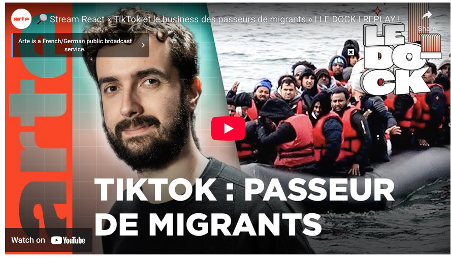
The image comes from Global Initiative, but you can find plenty of others. Facebook, Snapchat and Instagram are all crime-enablers; the rage, however, is apparently Tik Tok. Small boat ads are so well-documented, even the BBC has mentioned them

People-smugglers know their target audience. They price their offerings appropriately and deploy creative tactics: for instance, giving price discounts to customers who help with social media marketing. Small boat customers, like customers of legal services, shop around before choosing their preferred country and preferred smuggler. 

This is what the Home Secretary meant when she said: 

Huge numbers are on the move. While some are refugees, others are economic migrants seeking to use and abuse our asylum system 

88% of arrivals on rubber dinghies are male (see data below, taken from Migration Watch UK, Source: the Home Office). And yet, in most parts of the world, it’s women who are more likely to face persecution simply because we have XX chromosomes; historically, groups genuinely fleeing danger have been evenly split by gender. No matter how you view the world, the extreme gender skew of small boat arrivals should be a red flag.
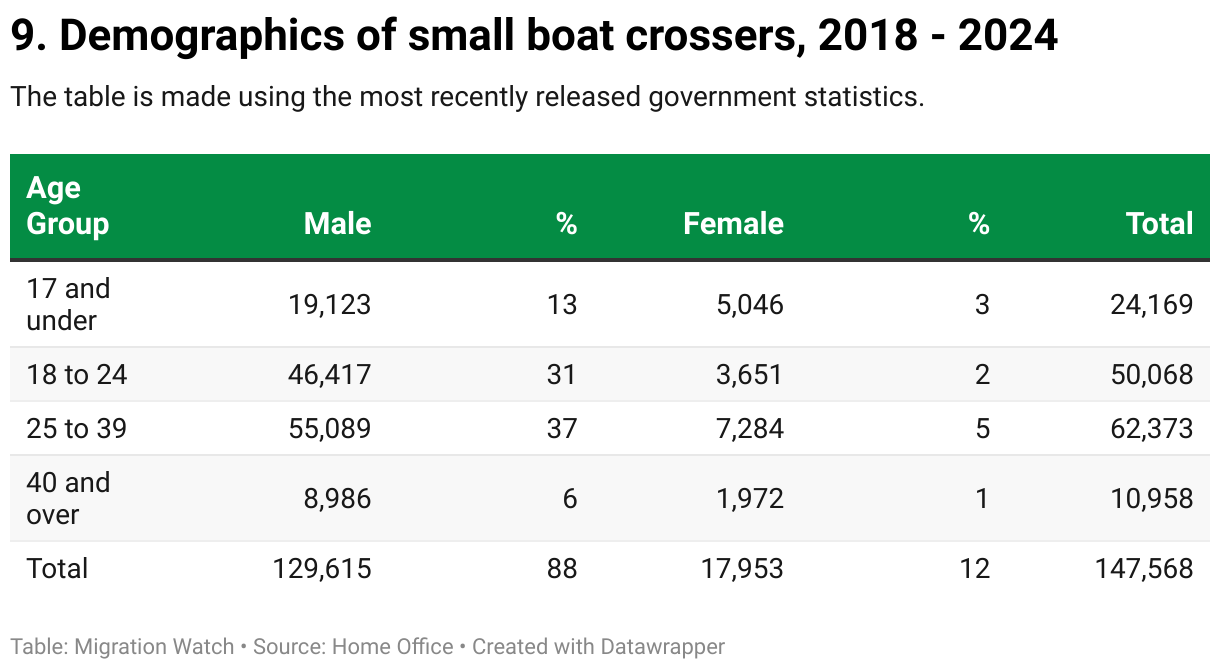
The mix of source countries changes from year to year; in 2024 the men came mainly from Afghanistan, Syria, Iran, Vietnam, Eritrea, Sudan and Iraq (source: Migration Watch UK). Granted, these countries are all poor, but can you really call someone who has chosen to leave poverty and a Communist regime (Vietnam) or poverty and the rule of mullahs (Iran) a refugee? 

And if they really are in the grave danger they claim to be in, why not just stop in the first safe country; why cross so many more borders and crown their risk by jumping into a rubber boat? 

As Shabana Mahmood said:

‘… even genuine refugees are passing through other safe countries searching for the most attractive place to seek refuge.

When Hitler was gassing Jews in Germany, the few Jews who managed to escape were relieved to be somewhere safe; they did not shop around on apps looking for ‘better’ countries. If you’re already in a safe country, be that Italy, France or Belgium, and you keep crossing borders and then climb into a dinghy, that act of deliberately putting yourself in more danger (and in some cases, your children, too) should surely disqualify you from gaining asylum in Britain.

Some will argue that only desperate people would put themselves in deliberate danger; therefore, they deserve our empathy and compassion. My counter-argument is that there are now plenty of legal immigration routes into Britain (many more than in my day), but if you know you would not qualify legally, you look for illegal means. 

In other words, small boat customers know very well that they’re breaking laws. If someone knowingly breaks the law before they even get to Britain, why should we expect them to obey our laws once they’re here? The simple answer is: we can’t.

Denmark was the first European country to collect data about its immigrant population. What the Danes have found is that foreigners are over-represented in Danish criminal convictions relative to their population size. 

Put simply, if 15 out of every 100 people in the population are immigrants, then, all things being equal, you would naively expect 15 out of every 100 criminals convicted to be immigrants. In 2023, 15 out of every 100 people in Denmark were immigrants. But immigrants made up 25 out of every 100 people convicted of crimes. 

The same over-representation of foreigners in Danish criminal convictions was found in 2022, 2021 and every single year for which the data was available – going all the way back to 2014, when data was first collected.

I can already hear objections. ‘This simply means that Denmark is a racist country. You’re more likely to be convicted of crime if you’re a foreigner!’ 

Not so fast. Danish data also suggests that not all immigrants are equal. Immigrants to Denmark from the Philippines, Indonesia, China, India and Argentina are less likely than locals to be convicted of crime. Bottom of the criminal list is Japan: the Japanese in Denmark are incredibly law-abiding. To sum up, not all immigrants to Denmark cause problems: only those from the Middle East and North Africa. Alas for Britain, these have been our main source countries in recent years.

Until liberals are prepared to concede that there just might be bad immigrants, debate around immigration will remain toxic. Pro-immigration Brits behave as if they stand on hallowed ground. They claim to be against ‘racism and fascism’; by implication, if you dare question immigration, you must be racist, fascist, ignorant and evil.

The slogans haven’t changed since I was at university 40 years ago. Slogans have always been cheap; in the age of instant social media, they are especially cheap. Where was the anti-racist, anti-fascist brigade when a Jewish economics lecturer in London was hounded inside his lecture hall? Professor Ben-Gad, himself an immigrant – but a highly-educated immigrant, not the sort usually favoured by the great and the good of the left – was threatened with beheading by masked pro-Gaza supporters. This happened in central London, not some godforsaken ISIS territory; if we don’t want beheadings and hand-chopping to become acceptable in Britain, we need honest dialogue in this country. 

Not all immigrants are equal. Not all immigrants are good. And not all immigrants want to integrate.

For the record, I’m not against immigration, but I am absolutely 110% against uncontrolled, unfettered immigration. I played by the rules. The immigrants I know – and I know plenty – have also played by the rules, jumping through hoops (not into rubber boats) to ensure that we obeyed the laws of this country. Some of the rules themselves have become tougher for legal immigrants, thanks to their widespread abuse by people who don’t care about rules. How is it fair on those of us who have obeyed every law, to watch people clearly exploiting loopholes and be allowed to exploit them? Those who turn up in Kent when their countries are clearly not at war; those whose asylum applications are rejected but who stay anyway, supported by our taxes, often for years, while they appeal and re-appeal: how is any of this fair?

To quote Mahmood once again:

‘…we have a proper problem and it is our moral duty to fix it. Our asylum system is broken. The breaking of that asylum system is causing huge division across our whole country, and it is a moral mission for me to resolve that division across our country.’

Her reforms are a start. Personally, I don’t think they go far enough. She hasn’t even begun to tackle the problems in our legal immigration system. But Shabana Mahmood is to be lauded because no one else has had the balls to do even as much as she has.

I, an immigrant, support her efforts. I don’t want illegal men here. And I know I’m not the only one.
Leave a comment

Filed under England, Life, Modern Life, Uncategorized, United Kingdom

I Am Woman

Like many people in Britain, I was horrified by the violence at pro-transgender demonstrations last weekend.

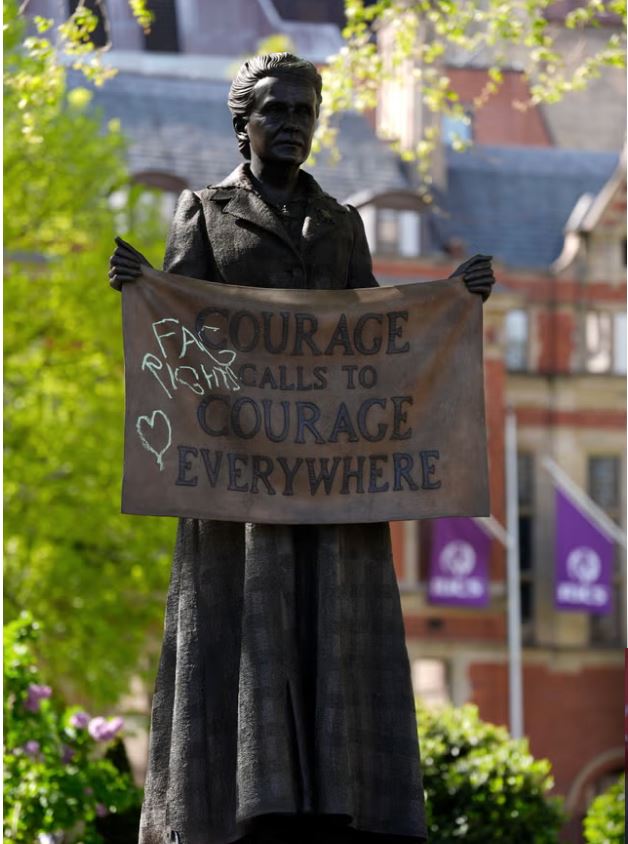
Admittedly, we face issues we’ve not had to deal with before. For instance, I would not want a fully transitioned transgender woman to be placed into a male prison, where she would be vulnerable to attack. At the same time I do not want a man who still has a beard and balls to be in any female ward of any National Health Service hospital. These are challenges, and they won’t be solved by defacing statues.

As a writer, I’m naturally interested in language. Many demonstrators on Saturday carried placards with the words ‘cis woman’. I didn’t even know what that meant until a male gay friend used it. This same guy, let’s call him X, had a habit of insulting other men with another ‘c’ word. When I pointed out to X that he was misusing the word – he was talking about men, after all, not women – he said, ‘Ah, but c— just sounds so much worse.’

The casual sexism X displayed is so common, most people don’t even notice. But the sneer gave him away.

If you haven’t heard of ‘cis woman’, don’t worry – it’s really not worth knowing. The term is used by loud-mouthed transgendered activists and their supporters to describe biologically-born women like me, known to everyone else simply as ‘women’. The fact that I even have to talk about ‘biological women’ is proof of how insane parts of the world (mainly in the West, it must be said) have become.

That’s why judges had to get involved. What better use is there of the UK’s Supreme Court members’ time than to rule on what ‘woman’ means? On April 16 2025 they issued their unanimous conclusion: ‘sex’ under the country’s Equality Act of 2010 refers to biological sex. So, there is such a thing as biology after all.

I did not need a court to tell me. I had my first period at 13.

I’ve suffered from the cramps that come with them – that’s biology. I could have given birth naturally to a child – thanks to my biology. Chemotherapy, having saved my life, induced early menopause – also biology.

My experience of life and that of any transgendered woman are surely different. Saying this in no way denigrates either one of us.

Let me be clear: I respect the desire of anyone to change his or her biological sex. Every single person should be able to live life to the full. But please don’t tell me that a boy who goes through puberty as male, who is therefore socialised as a man, and then transitions to becoming female, is the same as me.

Indeed, difference is the essence of diversity. According to the Cambridge English Dictionary, diversity means the condition or fact of being different or varied. Isn’t the whole point to accept and celebrate our differences? Silly me, that’s what I thought.

Instead, mobs are trying to erase our differences. They forget that you cannot celebrate differences without first acknowledging they exist. It’s ironic that the people who shout loudest about diversity are the ones least able to countenance any utterance with which they disagree.

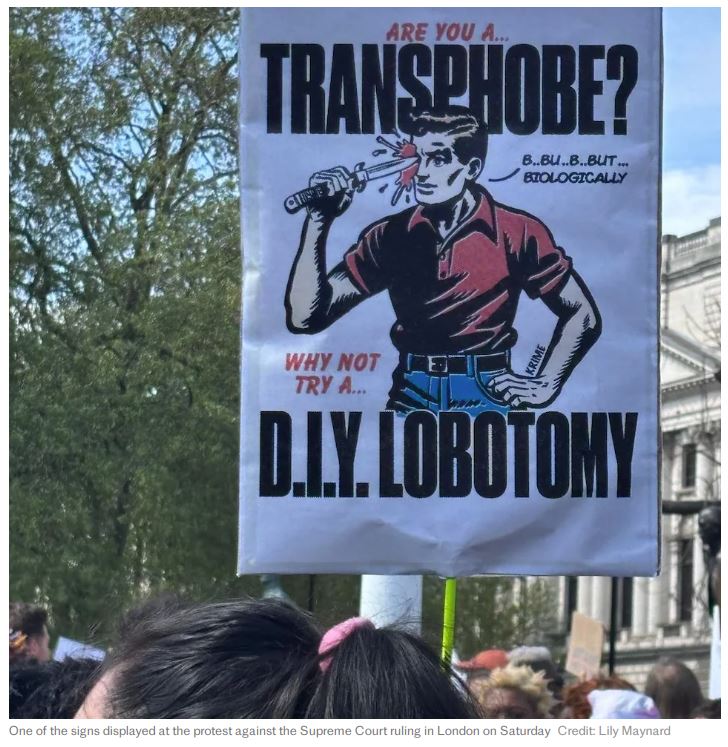
Until now, I assumed my activist days were past. But the sight of Millicent Fawcett’s statue being defaced in London changed that. And the image below galvanised me.

A lobotomy – are you serious?

Looking back in history, such vitriol should not surprise us. Whenever women have stood up and demanded rights, there has been a backlash. Always. This isn’t the first time we’ve been called names and it won’t be the last.

Women are used to fighting. We had to fight to be legally recognised as our own persons (a battle which remains unfinished, as an American history professor discovered when she tried to get a mortgage).

We had to fight for access to education, and then for access to equal education. We had to fight for the right to vote.

And now, once again, we have to fight to protect women-only spaces. Somehow, the thought of spaces from which they’re barred seems to make male stomachs churn.

I learned this first-hand when I helped establish a women’s disco in Southampton in the mid-1980s. We were ridiculed – ‘No men? Hahaha! It’ll never last!’ Except, it did; our little disco grew and was so successful that it continued for decades after I’d left town. I never imagined we would one day have to have the same battle for space, only, in a world so changed that a man can simply say he’s a woman and the law would allow him to walk right in.

This cannot be right. Incredible as this may sound, it has been the way the Equality Act has been interpreted. Worse, Stonewall, an organisation I used to support, led the charge, effectively silencing dissent. Well-meaning folks who were too scared to object fell in line and helped to conflate ‘inclusivity’ with ‘anything goes’.

It’s hardly surprising, then, that a female patient on a NHS ward was raped by a transgendered woman. Most people don’t even know this took place because the hospital covered it up, telling police that rape could not have taken place because ‘there were no men on the ward’. The incident was only revealed in the House of Lords when Baroness Nicholson of Winterbourne spoke during a debate about why we must not lose single-sex wards.

It’s astonishing to me that no public figure has asked why we hear a lot more about transgendered women than transgendered men. Could biology possibly play a role? Hmm, let’s see… Transgendered women were born boys; transgendered men were born girls; and we all remember that old chestnut, don’t we, of how boys will be boys?

Guess what… boys are boys, and the profiled activists on transgender rights websites are overwhelmingly transgender women, not men (see this and this). If one side shouts more loudly than the other, what we end up with, surely, is… the same old bias.

Another legitimate question is: why has ‘T’ been lumped with ‘LG and B’?  I’ve never wanted to be a man; how did the Lesbian, Gay & Bisexual movement, of which I was once a proud member, turn into a wi-fi code? LGBTQA+++; don’t blink, lest another letter gets added.

Because politicians of all stripes have colluded with this nonsense, virulent misogyny has been allowed to fester. At the Labour Party conference in September 2021, Kier Starmer famously replied that it was ‘not right to say that only women have a cervix’.

P-LEASE. And I’m the one who should get a lobotomy?

Not only is his cowardice an insult to women, it’s also a disservice to transgendered men and women. They deserve clarity, not spineless prevarication.

We need everyone, especially politicians, to stand up for the vision of the pluralistic society we wish to see, a country which seeks to accommodate different groups, but which also does not permit a free-for-all. Transgender men and women make up no more than 0.55% of the UK’s population (even this minuscule proportion is thought to be an overestimate) and while they must be supported and protected, it is not right that their protection should come at the expense of women who make up half the population (51%).

People seem to think that the story ends with last week’s Supreme Court ruling. I’m not sure. I recognise contempt when I see it. And last weekend what I saw was pure contempt.

I wasn’t angry before, I now am. How dare you call me names I never chose! In recent days I’ve signed up to the LGB Alliance and Sex Matters . Goddamit, we will not let you walk all over us. I want to say this loudly and clearly.

We are Women. You were born by One of Us. We’re not going anywhere. Get over it.

Leave a comment

Filed under Identity, Modern Life, Politics, United Kingdom

Ruminations on Heritage 4: Why I Want to Visit Taiwan

A friend just asked what I thought of Nancy Pelosi’s trip to Taiwan. My reply was succinct:

‘Of course she should have gone. F*** the Communist Party.’

I haven’t always been so clear. For years, I felt a misplaced sense of loyalty towards China, a sentiment that trickled in by osmosis from the adults around me. My father, especially, believes all things Chinese to be superior. This, despite the fact that he was born and raised in Malaysia, lives in the US and has only visited China once.

He is far from alone. Whenever I point out inconvenient truths, many relatives and friends of Malaysian-Chinese descent choose to remain silent.

Take the issue of sexism. My paternal grandparents were immigrants to Malaysia from China, where the idea that you need to have a boy-child is so ingrained that after three girls in a row, they became desperate. They gave away the third girl in the belief that a sacrifice was needed. The gods had to be appeased, and along came my father. His parents did not seem to care who they gave their daughter to – she ended up in an impoverished family living a life I can scarcely imagine. All because she was a girl.

Such behaviour is just plain illogical.

Yet, even the most Westernised of my family members prefer to overlook this. They revert instead to talking about the awful things that happen to girls and women elsewhere, as if a thousand other wrongs make a right.

Or they say, ‘Ah, but things have changed.’

Indeed, there are now tens of millions more ‘missing Chinese women’ – the girl babies who were abandoned, given away or simply murdered (see chart below from a BBC article) when the one-child policy came into force. Disparities usually become less acute as a country gets wealthier. Not so in China: the richer China grew, the more distorted its gender ratio became – a first on our planet. 

The men on the Central Politburo’s Standing Committee must have been delighted. More boys! This Standing Committee is a subset of the Communist Party’s Central Politburo and comprises just seven members – an elite amongst the elite. China’s Standing Committee has never had a woman. Not one since 1949: you can see the dour male faces for yourself by clicking individually on the links.

In Party hierarchy the Standing Committee is all-powerful; who would dare accuse any of them of sexual impropriety? Only a tennis star, it seems: Peng Shuai, and look what happened to her. Corralled, censored, silenced and now missing. The man she accused was a member of the Standing Committee from 2012 to 2017. No wonder she’s gone from the public eye.

Taiwan, with which I started, is an altogether different country. This series of islands located off China’s south eastern coast has been self-governing since 1949. Taiwan has evolved into a functioning democracy with genuinely contested elections. It allows dissent. Governments change. It has passed progressive laws. As mentioned previously, if I so chose, I could marry my girlfriend there legally.

Where Taiwan Lies

For years, friends who have been to Taiwan have extolled its scenic beauty and its food, especially the Japanese cuisine I adore. Taiwan used to be a Japanese colony – amazing Japanese food this is among the legacies.

In past decades, a distinct Taiwanese identity has also  emerged. A growing number of its citizens apparently don’t regard themselves as Chinese but as purely Taiwanese, an identity

not based on race or blood but… on the sentiments that we are a country with democracy, freedom, human rights and the rule of law, and we can participate in the political decision-making.

There is something to learn from them. Heritage is an anchor, but heritage should not shackle us. It must surely be possible for us as Asians to be proud and at the same time, critical. If we can’t criticise, how will anything improve? We may even need to reject aspects of our heritage en-route to forging something new.

Of course, sentiments like these can only be expressed by people who live in countries where freedom is enshrined.

Taiwan is no renegade province owned by mainland China. It’s a separate, independent and very real country, one we should all visit – and not because Nancy Pelosi went.

Part 5 to follow

1 Comment

Filed under Cultural Identity, Identity, Modern Life, Politics

Ruminations on Heritage 3: It’s Just Not Asian!

When I first came out as gay, my parents blamed England. If only they had not sent me to boarding school, ‘this’ would not have happened. It’s just not Asian!

I never asked which part wasn’t Asian. Did they mean:   

  • Being attracted to someone of the same sex?
  • Telling a fundamental truth that made others uncomfortable?
  • Daring to think outside the box?    

This took place in the mid-1980s. It would be tempting to believe that the whole world has changed since.

The map below shows the countries (in red) in which homosexuality remains illegal. There’s a very large mass of grey – not the case before – so, indeed, there has been progress. But we are nowhere near an egalitarian utopia. The Russian Federation, for instance, is hardly an oasis. Neither is China.

Source: Human Dignity Trust

Earlier this year, mainland censors erased a lesbian plot-line from the sitcom ‘Friends’. No lesbians for the mainland! Just what is the Communist Party so afraid of? Obviously, merely hearing about lesbians on TV could give Chinese women ideas. Hardly a vote of confidence in their men.

One of the other countries in red is Malaysia. It has a Muslim majority and homosexuality is illegal. I still have relatives there, one of whom is gay. He isn’t a Muslim. He has lived in Malaysia all his life. He has also been in the closet his entire life.

An early memory I have is of waking one morning to be told that this particular relation had been in a terrible road accident. When I saw the photographs, I was shocked. To describe his car as a wreck would be an understatement – it was crushed. If you looked at photos alone, you would have assumed its occupant well dead.

Apparently, the accident was his fault. My relative had come out of a junction and was hit by a bus (if my recollection serves me right). Everyone was amazed he survived the catastrophe. At the same time, they could not fathom what he was doing in that part of town. I remember the adults around me shaking their heads, asking repeatedly: what was he doing there at that hour?

Years later, he told me. He had been meeting a man.

The revelation brought lightning clarity. Disjointed memories fell into place. Finally, I understood. I felt like Archimedes with his Eureka moment. When my relative swung his car out of that junction, his mind was occupied.

Obviously, such an accident could have happened anywhere. But if this relation of mine had been able to meet a man the same way he was encouraged to date women, he is unlikely to have been skulking off to a clandestine encounter in the early hours of dawn.

I have a gay cousin who did the same: he went around surreptitiously – until his parents accused him of being a drug addict! It took a dramatic argument for him to come clean with them. That story, at least, has a good ending. My cousin lives happily with his partner and has done so for years.

Not the case of my car-crash relative, whose sexual orientation is an open secret. Granted, he is loved by the family. This makes him fortunate. Nonetheless, can you imagine the amount of sniggering he has had to endure, what it must be like living within a culture where you’re asked ‘Are you married?’ within minutes of meeting someone?

As we celebrate Pride month, I thought it time to shine a light into the closet. It looks to me like a dank, dark place. I can’t imagine living in it, or how great the mental toll must be.

I’ve often heard that ‘we in Asia have our own way of doing things’ – we don’t need to talk about them. Some people believe there are things better left unsaid. No doubt they also think I should not be writing this blog-post. But ‘ways of doing things’ evolve. Chinese women used to bind their feet: should we return to that practice? Of course not – no culture is beyond universal human values. If we find it hard to say the word ‘gay’, it’s because we still associate shame with gayness. The dictum ‘we have our own way of doing things’ is no more than a convenient cover. It allows uncomfortable topics to be avoided.

Fortunately, some changes have come; in Asia, Taiwan has led the way. The island nation legalised same-sex marriage on 17 May, 2019. Contrast that with China’s censorship of the Friends’ sit-com lesbian plot-line. Taiwan’s marriage equality is one of many reasons why it is not China – and whether Taiwan belongs with the mainland is, in my view, debatable.

All those years ago when my parents blamed England, they had a point. England did not make me gay, obviously, but it has given me a confidence, freedom and happiness I would not have enjoyed otherwise. Here I can live openly without having to hide; here I stand without fear, knowing that I am protected by law.

This freedom is indescribably precious. In a poignant moment a few years ago, my ex-wife and I welcomed a visitor from Dagestan. When he realised that he was the guest of two women who were married to each other, he was in awe. Without any hesitation whatsoever he proclaimed:

‘Today I have met people who truly are free.’

Part 4 to follow

Leave a comment

Filed under England, Identity, Malaysia, Modern Life

Ruminations On Heritage 2: What A Truly Multicultural Democracy Looks Like

My country of origin, Malaysia, loves selling itself as the multicultural haven that it really isn’t. My adopted land, on the other hand, just gets on with it. England is showing the world what a truly multiracial, multicultural democracy looks like.

At the start of the pandemic, we were treated to daily press briefings. The first session was hosted by the Prime Minister and his medical advisors. Thereafter, other Cabinet members presented briefings.

The parade of Secretaries and Ministers is evidence of just how far Britain has come. By now you will likely have heard of Rishi Sunak, Chancellor of the Exchequer, and Priti Patel, the Home Secretary. Both are descendants of first-generation Indian immigrants from East Africa. The former Vaccines Minister Nadhim Zahawi, who was tasked with rolling out the UK’s very successful vaccines programme, is himself a first-generation immigrant. Here he is giving one of those briefings. Zahawi is now the Education Secretary.

In England, politicians from ethnic minority groups aren’t just relegated to the side-lines, the way they are in Malaysia. Below are a few of England’s current Cabinet members.

Health Secretary: Sajid Javid;

Business Secretary: Kwasi Kwarteng;

COP26 President: Alok Sharma

In ‘Malaysia, Truly Asia’, there is virtually no ethnic diversity within a government that continues to be dominated by race-based political parties. By ‘race-based political party’, I mean a political party run along sectarian lines which admits full members from only one particular racial group.

Yes, you read that right. This may be 2022, but you still have to be Malay (or bumiputera) to be a full member of the ruling United Malays’ National Organisation (UMNO). In principle I am allowed to join, but only as part of an associated group following orders (as per Clauses 4.1.2 and 4.3 of UMNO’s Constitution). Unwanted, unwelcome, second-class: the same way I’d be treated if I lived in Malaysia.

Excerpt from UMNO’s Constitution

There is also that damp squib known as the Malaysian Chinese Association (MCA), which supposedly represents Chinese interests. Not to be outdone, Indians have the Malaysian Indian Congress (MIC).

The idea that you need to be a certain race to gain full membership of anything should be illegal. It has no place in today’s world. But race (and religion) are expedient tools for power. And the politics they nurture thrives on a self-fulfilling loop of tribalism. Nastiness is repeated ad infinitum, the audience become inured and tribalism ends up infecting a nation.

I discovered this when Sajid Javid was named Home Secretary in 2018. My phone pinged with messages. Some Malaysian family members were worried. ‘You now have a Muslim Home Secretary! London’s mayor is also a Muslim!’

Yes, and???

It transpired that a tonne of What’sApp videos were doing the rounds. One listed the British cities with Muslim mayors (hundreds, apparently). Another video purported to show a road somewhere in England being taken over by Muslim men bowed in Friday prayer. Yet another displayed Buckingham Palace. The Palace, it seemed, was going to be turned into a mosque. I wonder if someone has told Her Majesty. She is celebrating an unprecedented seventieth year as monarch and may have other plans for her home.

A few salient points are in order. First of all, a politician like Sajid Javid reached his position on merit – he was not favoured by positive discrimination. Secondly, he is a member of the Conservative Party which, whether or not you like it, is fully open to all races and faiths. Thirdly, he serves all Britons, not just British Muslims.

When a group of Asian male paedophiles was convicted of grooming white girls in Huddersfield for sex, Javid was brave enough to call a spade a spade. He described the men as ‘sick Asian paedophiles’ and commissioned research to investigate cultural connections. Here’s an excerpt of his comments:

…the sad truth is that if you look at recent high-profile convictions of gang-based child sexual exploitation, there is a majority of people that come from Pakistani heritage backgrounds – that’s plain for everyone to see. What I’ve said is that we, in trying to deal with this, trying to turn this round, we must look at all factors and we must not be too sensitive and shy away or be oversensitive.”

Spot on.

What Javid said and the way he said it is one of the fruits of freedom. Real democracy is sometimes messy. But after the storm comes sunshine. You are able to look at your own culture with clearer eyes. You can speak hard truths without feeling defensive.

Part 3 to follow.

2 Comments

Filed under Cultural Identity, England, Identity, Malaysia, Modern Life, Politics, United Kingdom

The Long Crawl

I sincerely hope this blog-post find you healthy, fit and sane. If 2021 were on offer as a free trial, I would end mine right now.

Thankfully, there are glimmers of hope. Vaccines are on their way.

I can hardly wait. Yet in recent days I have found myself having conversations I never expected. Family and friends often disagree with me, but I did not expect to have to convince them about vaccines. Here are some of what I’ve heard:

This virus is so new!

‘I don’t know what’s in the vaccine.

‘The vaccine might make me ill.

‘Vaccines can be dangerous.

‘I’m not sick and I may not get Covid-19, why should I get vaccinated?

Well! Where to start?

Look, I’m no expert – my Ph.D. is in Theoretical Physics, not Epidemiology. But I do understand scientific principles and I can parse statistics. In 1999 when I was diagnosed with a brain tumour, I learned everything I could about my particular type of tumour and grilled the surgeon. I mean, he was about to drill into my skull; you’d want to know exactly what he was going to do, wouldn’t you?

The more I learned, the clearer it became that the benefits of surgery far outweighed the risks. To be honest, I did not have a choice. I’m fully aware that if it weren’t for Western medical technology, I would have died. So I guess that would make me a little biased.

With that little disclaimer out of the way, let me start with the statement:

‘This virus is so new!’

It’s true this virus is new, but coronaviruses as a group are not. This is important: it means that researchers have been studying viruses similar to the one causing Covid-19 for many years. The vaccines on the block were not just invented in the last nine months.

For instance, you’ve heard of SARS, right? The letters stand for Severe Acute Respiratory Syndrome, better known as avian flu. SARS also originated in China and was caused by a type of coronavirus. That was way back in 2003. Then came MERS, or Middle East Respiratory Syndrome (camel flu), caused by yet another coronavirus. The point is that research into these kinds of viruses has been taking place for decades. And some of that accumulated knowledge has gone into the vaccines being produced.

‘I don’t know what’s in the vaccine.’

The good news is that if you really wanted to know, you could find out. Here are some of the contents of the Pfizer-BioNTech vaccine that was approved in the UK on 2 December 2020: mRNA and lipids, including 4-hydroxybutyl)azanediyl)bis(hexane-6,1-diyl)bis (ALC-3015). Gobbledygook to me, but great if it helps you.

On the other hand, I found that reminding myself how vaccines actually work was reassuring. Which brings me to

‘The vaccine might make me ill.’

Ironically, if you do feel ill after vaccination, that’s a sign your body is reacting the way it should.

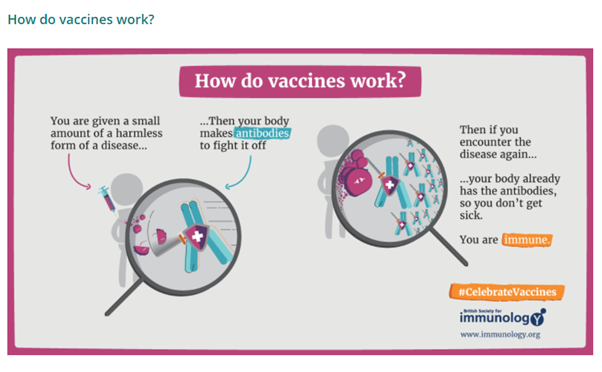
Here’s the basic idea: your body is injected with a small amount of the virus against which you are going to be inoculated, so that it starts creating the antibodies you need.

The diagram above is taken from the British Society of Immunology’s website and is the best I’ve found to summarise the vaccination process.

So let’s say we want to inoculate you against polio. When you’re injected with a small amount of the polio virus, the antibody production process is kick-started. If your body were subsequently invaded by polio, it would already have been primed for battle.

The concept behind vaccination is incredibly simple. It’s not new. And if vaccination did not work, diseases like polio would not have been largely eradicated in the world.

But the idea of injecting a virus into your body, albeit in a controlled fashion, could sound like voodoo. This may be why the following notion has gained currency:

‘Vaccines can be dangerous.’

In this context I cannot ignore the efforts of a disgraced doctor called Andrew Wakefield. This guy falsely claimed a link between the measles, mumps and rubella (MMR) vaccine and autism. To my knowledge no one ever managed to replicate his results.

This last point is crucial. A fundamental principle of experimental science is that an experiment must be repeatable. No other professional scientist ever replicated Wakefield’s results, which means his results have never been tested. There is no credible evidence of the link he claimed. Wakefield was stripped of his medical licence.

Yet this did not prevent MMR vaccination rates from plummeting (and incidence rates from rising). Infamy has not stopped Wakefield from becoming a cause célèbre in fact-free zones on the Internet. And we know how many such zones there are. Some people even believe that Covid-19 is a hoax created by governments to lock us up.

Anti-vaccine and anti-masking demonstrations have taken place all the way from London to Spokane in Washington State, on the West Coast of the USA. Half the population of France on BFMTV have said they would either not take the vaccine or accept it only reluctantly.

All of the above worries me. Ignorance is far more dangerous than any vaccine could be. Thanks to social media, opinions proliferate, and people seem to believe they can hold opinions about absolutely anything, even ‘facts’. In the Cambridge Dictionary a fact is

something that is known to have happened or to existespecially something for which proof exists, or about which there is information.

Here’s a fact: the Earth is round. In olden times people did not believe this – they thought that if they travelled far enough, they’d fall off the edge.

But we have now seen Earth from space. There are photographs to prove it. The one below (famously known as the Blue Marble) was taken from Apollo 17 in 1972. Are you still allowed an opinion on whether the Earth is round?

I suppose you don’t have to believe the evidence. Those of us fortunate enough to live in properly-functioning democracies have the freedom to choose our beliefs.

With freedom comes responsibility. Our beliefs have consequences. So let me come to

‘I’m not sick and I may not get Covid-19, why should I get vaccinated?

Because there is no guarantee that you won’t get sick. If you’re offered the vaccine but refuse it and you then get sick, who should pay for your medical care?

Vaccines alone are not cast-iron guarantees. There’s still a small chance you may not be protected. In addition, vaccines aren’t suitable for everyone. And those of us who are vaccinated could still be carriers. We would need to remain vigilant.

But vaccines represent our best hope. They are the first step in our long crawl back to normality. I, for one, am holding my breath.

Leave a comment

Filed under Corona Virus, England, Lockdown, Modern Life, United Kingdom

Good Things Come Out of Bad

Crisis forges character. Facing adversity changes us. Sometimes we rise to the occasion and get stronger, other times life overwhelms us; either way, we do not stay the same.

On March 20 2020 when Boris Johnson announced the closure of pubs, restaurants and gyms, life took a surreal turn, just as it did when I was diagnosed with a brain tumour many years prior. Circumstances were different, yet in some ways also the same. There were things beyond my control, but I had a choice in how I reacted.

My tumour was a haemangioblastoma: non-malignant, innocuous even. It was no more than a kidney-shaped bean inside my cerebellum, the lower half of the brain where motor functions reside. The tumour did not and would not have spread, but it caused a cyst – a bubble of liquid – to form around it. The cyst grew. By the time I saw a neurosurgeon, the bubble filled a third of my cerebellum. That’s how I knew it was there: the cyst had begun impinging on my brainstem.

I spent a weekend wishing I were in a dream, that the person who was me was actually someone else. And then I sprang into action. The moment I took charge – to the extent I could – marked the start of my recovery.

This experience was a test run for the future, except I did not know it. I made limited changes to my life.

Ten years later, almost to the day of my brain tumour diagnosis, I faced death again. This time I had cancer, breast cancer, which is relatively common. Still, there is no way to sugar-coat the moment I heard the news. Cancer was something that happened to others; I honestly did not think it would happen to me.

Good things eventually come out of bad. While stuck in a post-chemo depression, I started writing. It was an act of desperation: I never imagined I would emerge profoundly changed and happier, living life with passion.

Good things will also come out of COVID-19, even if we can’t see them all yet. Some positives are already obvious. There’s less pollution, for one thing. And Britain is enjoying a renewed sense of unity. Brexit broke this country; it has taken a virus to remind us that we have more in common than we have differences. That alone is amazing.

On a personal note, this pandemic has helped me resolve key issues around my identity. During the first week of Britain’s lockdown, when Matt Hancock, the Health Secretary, put out a call for 250,000 volunteers to help the National Health Service (NHS) I registered at once. I did not even need to think.

My place is here. Finally I know where home is.

I no longer feel torn. Between Britain, where I’ve lived most of my life, Malaysia, which remains in my dreams, and America, where I have family, friends and a literary agent. Thanks to a virus that emerged – ironically – from the land some of my ancestors came from, I understand what it means to be home. Isn’t that extraordinary?

I am exactly where I should be. To know that is a blessing.

The past two Thursdays, cheers rang out along the United Kingdom’s many streets for the key workers of this country: those in the NHS, in social care, in pharmacies, supermarkets and schools (now online). We saluted them right across the country. The moments were so poignant that I cried. I clapped, too, and for good measure, banged on a pot. The entire street was out. A neighbour blew a short tune on the saxophone.

This scourge afflicting us will be defeated. We will come out the other side. When we emerge, what will we see of ourselves?

I want to be able to look back and know that I acted as courageously, thoughtfully and compassionately as I could have. I want to know that I reached out where I could, gave comfort when I could, did all that I could to help.

Some of these same sentiments were summarised by New York State’s Governor, Andrew Cuomo, whose daily briefings have become must-watch events in an America clamouring for intelligent leadership. Here are a few of his words:

‘Ten years from now you’ll be talking about today to your children or your grandchildren, and you’ll shed a tear because you will remember the lives lost, and you’ll remember the faces and you’ll remember their names and you’ll remember how hard we worked and that we still lost loved ones. And you’ll shed a tear and you should because it will be sad, but you will also be proud. You’ll be proud of what you did. You’ll be proud that you showed up.’

It’s not for me to prescribe what anyone else should do. For myself, I know how tenuous life is; to squander this opportunity would be unforgivable. That is why I’m showing up.

But I’m also keeping well and trying to stay sane. Please do the same. Keep well, stay safe. We will get through this.

Leave a comment

Filed under Cultural Identity, England, Identity, Modern Life, Politics, United Kingdom

Thank You, Britain

I’m aware that I’ve been away from this blog for a while. Rest assured, I’ve been busy. Some folks, I know, are expecting news about my next book. I hope to be able to tell you more in the coming year. For the moment I’d like to come out on this blog, this time as a Brexit supporter. A friend warned me, ‘Be careful. You don’t want to alienate anyone.’

Extreme polarization is one of the challenges of our time. As a country, we used to be able to disagree with one another and remain civil, but in recent years discourse has turned toxic. Attitudes have hardened. ‘You’re wrong! I’m right.’ That’s very much the prevailing tone. I sincerely hope that readers of this blog will allow more subtlety than that.

I don’t intend to explain why I voted the way I did. It was a gut-wrenching decision, one which I took very seriously, not least because we were told it would be a ‘once-in-a-lifetime’ vote.

I discussed the issues with friends from whom I thought I might get insights not otherwise available, including a senior peer in the House of Lords. I made sure I listened to both sides of the argument. This wasn’t easy, since most of the people I know wanted the UK to Remain within the EU.

Days before the Referendum on 23 June, 2016, I grabbed two sheets of paper. One sheet was for Remain, the second for Leave. I drew a line down the middle of each sheet and listed arguments in favour of Leaving and the arguments in favour of Remaining. Pros and cons, in other words, pros on the left and cons on the right.

It appears that Boris Johnson did the same in even greater detail, going so far as to write an entire pro-Remain article. The existence of such an article is supposedly evidence of his being a two-faced so-and-so. You can criticise the guy for many things; on this point, however, he was doing no more than what writers often do: playing around with points of view. I did it because I could not see how else I would reach a decision. I took one side of the argument, slept with it for a night or two and then took the other side of the argument and slept with that, too.

My doubts persisted to the very end. Nonetheless, I think that listing those bullet points was a worthwhile exercise. There’s always more than one side to any story, and if we are to heal as a nation, we’ve got to be able to see the other side, too.

Since the Referendum result, it has been scary coming out as a Leave supporter. In fact, I would go so far as to say that coming out as a Brexiter has been scarier than coming out as gay. I was naïve the first time. I was at a cocktail party in a staunchly Remain household and could literally feel the hackles rising. I thought I’d get beaten up. After that, I kept my mouth shut.

Leave voters have been stereotyped as stupid, ignorant, racist, xenophobic, little Englanders. I’m none of those things. This absurdly simplistic depiction gained traction across the pond, too. A snippet in the New Yorker magazine from September celebrated a Lebanese street artist who came to Clerkenwell, London, to create graffiti. She sprayed ‘No to Brexit!’ and ‘No to borders!’ on a wall, as if wishing to Leave the EU is tantamount to withdrawing from the world (and as if the benefits of wholly porous borders are self-evident).

Implicit in the popular narrative is the unspoken juxtaposition of good, black or brown immigrants on one side, against bigoted, racist white natives on the other. Ergo, I the underdog immigrant, am necessarily in the right, whereas you, if you’re a native white Brit are presumed to be bigoted, especially if you have the audacity to question immigration policy (as Labour supporter Gillian Duffy did with Gordon Brown in 2010).

Reality is more nuanced. I have lived far longer in England than I ever did in my native Malaysia, and I reject the above caricatures. 17.4 million people – 52% of Referendum voters  – chose to leave the EU. The majority of this country is not racist. On the contrary, I have found England to be an incredibly tolerant, open place.

Have I faced racism? Of course. But those incidents pale in comparison with the overwhelming kindness and generosity I’ve also encountered. Moreover, racism is a two-way street. Immigrants are racist, too (and that’s before we even get to their sexism and homophobia).

Some may say that I’m blaming immigrants. I’m not, though how we behave matters. If we don’t bother integrating, acceptance becomes harder. Let’s take language. Most immigrants speak English, yes, but many do so rather poorly; some, after years, continue making basic errors. I find this wholly unacceptable. We have obligations as immigrants, the most basic being to learn the language of our host nation properly.

I went to the opposite extreme. Coming from a former British colony, I already spoke English well, but I did not initially have the British accent I have now. I acquired it through conscious effort. No one needs to do that – you don’t have to sound like the Queen to be accepted. For me, though, it was an important marker of belonging.

Many people – especially my white socialist British friends – like to castigate this country as cold and selfish. Jo Swinson, who led the Liberal Democrats, Britain’s third political party, until she lost her seat last week, said after being booted out: ‘I still believe that we as a country can be warm and generous, inclusive and open’, which implies that it isn’t. I disagree. I believe Britain is already that warm and generous, inclusive and open place.

This is why so many immigrants come. If Britain is so terrible, why do you think we come, and we stay, too?

I’d like to do something that’s not often done: to take this opportunity to thank my adopted country for the wonderful chances it has given me, chances I would never have had in Malaysia.

Thanks to Britain, I was able to gain a university place fairly and squarely, with ethnicity not being a primary consideration (as it is in Malaysia) and only the strength of my brain mattering. I went into examination halls secure in the knowledge that I would not be marked down because of my race or others marked up because of theirs and that if I worked, I could achieve anything.

Thanks to Britain, I’ve been able to express political ideas and opinions without fear of official recrimination. Only those who have lived under oppression can truly understand how amazing this is.

Thanks to Britain, I know what it feels like to have my vote count. This is a priceless freedom, one which too many Westerners take for granted.

Thanks to Britain, I don’t have to lie about who I am. I can live openly with a woman, even marry her, and have this right protected by law.

Thanks to Britain, I know that profound social change for the better is possible – because I’ve participated in it, seen it and experienced it for myself.

There’s no question that England has made me the person I am today. I will always owe her a huge debt. Too often, we immigrants are quick to complain and slow to thank. In my own small way, I’d like to rectify that here. Thank you, Britain.

4 Comments

Filed under England, Identity, Modern Life, Politics, United Kingdom

So You Think You Know Your Mother Tongue

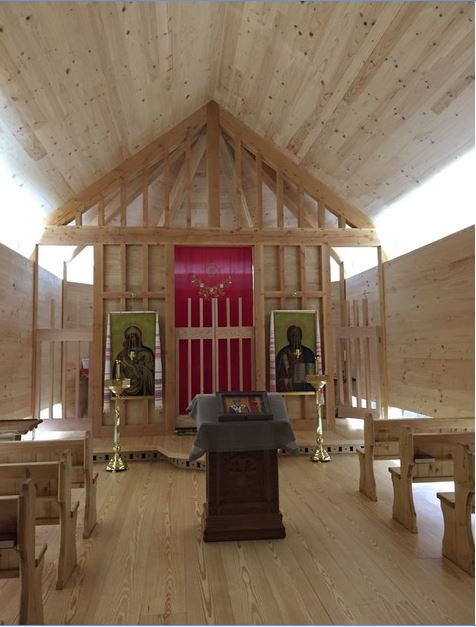
Near my house in north London there’s a Belarusian church made of wood. The Belarusian St. Cyril of Turau Church is the only wooden church that has been constructed in London since the great fire of 1666. Next to the church is a double-storey house – Marian House – where the priest lives. Marian House also serves as a community centre. By now you must be scratching your head, wondering why I’m telling you any of this.

The Beautiful Church Interior

It’s because I was at the Belarusian community centre last week, at a literary event to honour mother tongues. The concept of mother tongue is incredibly important to Belarusians, whose language was widely spoken in the region until they were Polonised and then Russified by conquering Polish and Russian empires. First things first; where is Belarus? For the answer, see the map below.

Where is Belarus?

The above comes from the BBC’s country profile. Belarus is a landlocked country in northern Europe, stuck between Poland to the west and Russia to the east. In the south is Ukraine, while Latvia and Lithuania lie north. The region has a fascinating history. I’m no expert (for a summary here’s a Wikipedia link), but the point is this: Belarusians in Belarus have been discriminated against for speaking Belarusian, their mother tongue.

Language shapes perception, and when those perceptions don’t accord with what an authoritarian regime wants them to be, the solution in that part of the world has been to crack down on language. This happened under Soviet rule.

Although Belarusians are now allowed to speak Belarusian, their language suffered years of decline. Even their Nobel Prize-winning author, Svetlana Alexievich, writes in Russian. It’s thus fitting that the Belarusian centre in London should host an annual event marking UNESCO’s International Mother Language Day.

And so we gathered, on the sunny afternoon of 23 February, to read poems in our mother languages. I, for one, had to think hard about which language to read in.

The first language I ever heard was Cantonese – which isn’t really a language, it’s a Chinese dialect. My parents also speak English, Malaysian-style English (known affectionately as Manglish), and up to the age of 10, I could not make head or tail of Western accents. When I started school, a third language – Malay – was thrown into the mix. Malay was the medium of instruction for us. By the time I left for England in my teens, I spoke and wrote Malay and English fluently while also using Cantonese in daily conversation.

What, then, is my mother tongue?

When someone asked the question after my talk at the 2018 London Book Fair, I fudged. I didn’t know. I’ve never consciously thought of Cantonese as my mother tongue, in the same way that China is not my homeland. I’ve visited China only once, and I left feeling eternally grateful that my ancestors went to Malaysia. English is now my first language and I write in it, but mother tongue? My mind just couldn’t get there. I also speak and read French, which I had to learn at my British boarding school; in fact, I speak English and French now better than either Malay or Cantonese.

In the end I reverted to the comfort of Malay. I read a couple of poems. Not my own, I hasten to add. My repertoire doesn’t yet extend to poetry.

First, though, I had to introduce Malaysia. People know the country for downed jetliners (MH17 ) and corruption (1MDB), but Malaysia is so much more than that.

The Excitement of Malaysia

You can see how animated I get when I talk about Malaysia. I made no bones about the profusion of languages in my life. These comments challenged some of what the two invited Belarusian poets of distinction, Uladzimir Arlou and Valiantsina Aksak, had said. They kicked the event off with beautiful poetry in Belarusian (their own). One of them then expressed the view that a person cannot exist without a mother tongue. Given Belarusian history, I understand this perspective, even if I disagree with it. Here they are below, listening graciously.

In multicultural Malaysia, some of us exist happily with no mother tongue or with more than one. Or with a present-day mother tongue that is different to our childhood mother tongue. Or a mother tongue our ancestors never spoke.

Distinguished Poets Uladzimir Arlou and Valiancina Aksak

The poems I read come from the Malay tradition of pantun. Pantun are verses in groups of four which have both rhythm and rhyme. I used to love pantun at school. The verses are witty, amusing and evocative: real, living poetry that people use in conversation. Here’s one:

Pisang emas dibawa belayar,

Masak sebiji di atas peti,

Hutang emas boleh dibayar,

Hutang budi dibawa mati.”

(Source: Soscili)

Below is my attempt at a rough translation:

Golden bananas are carried on voyages,

One ripens on top of a chest,

Debts of gold can be repaid,

Debts of kindness are carried to the grave.

For me, the lines above distil the essence of old Malay culture, where human kindness was valued above riches. A far cry, in other words, from what Malaysia became in recent years.

Elsewhere, I have mentioned how poetic Malay is as a language; pantun conveys this so well. At the same time, a lot of the poetry reveals the gentleness inherent in Malay culture. For instance, verses can be used to give someone a telling-off (without really telling them off). The audience giggled at the idea of poetry as admonishment.

They were surprised by the absence of titles. Pantun don’t need titles because this isn’t a high-faluting verse form; on the contrary, pantun is down-to-earth poetry anyone can make up. Yet, even in the eight lines I shared, people were moved by the beauty in its cadence.

The audience must have liked my presentation – they voted to give me first prize!

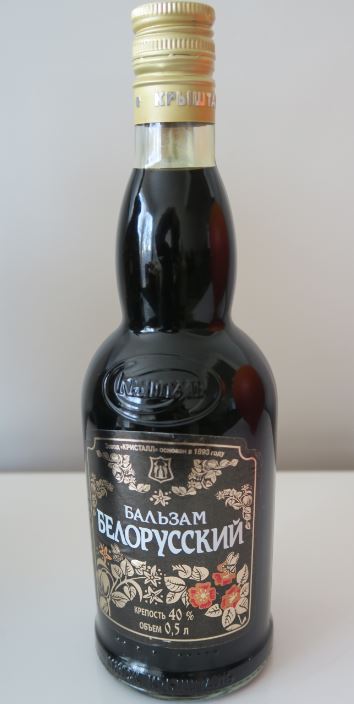
The prize was none other than a bottle of what will surely be a memorable Belarusian speciality. See that number at the bottom: 40? That’s the alcohol content. I kid you not. Apparently this is medicinal alcohol, a balm, I’m told. We shall see. (In fairness, the label does declare 20 herbs.)

The Highly Alcoholic Prize!

I know that my hosts are waiting anxiously for feedback on Balzam Belaruskii. For the moment I’m afraid I must disappoint them. Each time I look at the 40%, I shake my head. I’ll have to be very sick before I dare open this bottle.

In the meantime, I would like to thank the Anglo-Belarusian Society for a great event. Special thanks to Karalina Matskevich for her energetic organisation, Father Serge Stasievich for generous hosting, Aliaksandra Bielavokaja for her photography and to everyone else who was there, too, the young as well as the not-so-young. We departed into a glorious evening and I’d like to leave readers with an uplifting view. Here’s London’s Belarusian church at night, all lit up.

London’s Belarusian St. Cyril of Turau Church at Night

Leave a comment

Filed under Cultural Identity, Modern Life, Writing

A Month Away from Social Media

After reading an article about social media addiction, I decided to retreat into a virtual cave in September – just to see what it would feel like. And in light of the role played by social media in recent atrocities, being an online hermit doesn’t seem altogether crazy. But first, let me tell you about my September experiment.

It started with this article in Psychology Today. The article contains 6 questions. I answered ‘No’ to all of them, which put me firmly in the ‘Not Addicted to Social Media’ category. Nonetheless I thought abstention could be instructive.

It was.

The first thing that surprised me was how hard it was staying away. So, a word of warning for those who believe they’re not addicted to posting updates on Facebook, Twitter, Instagram, LinkedIn and Tumblr: you may be more hooked than you think.

I’d initially planned for my social media avoidance to commence on September 1 for one month. Then, the American senator John McCain passed away. This happened during the last week of August, and as I watched his daughter Meghan McCain deliver her eulogy at the memorial service held to celebrate his life, my first impulse was to post a tweet. I reached forward, before realising that it was Saturday, September 1. I was not supposed to be posting anything. I found myself debating what to do, can you imagine? I actually spent time contemplating whether to hold strong or to succumb. In the end I gave in, reasoning that I could postpone social media abstention until the next day.

This is how we get sucked in. Social media platforms have been very adept at training us in supposed ‘spontaneity’. No sooner does something happen than we reach for the nearest device in order to ‘share’. For the first few days I had to fight the urge.

And then Twitter noticed. This was by far the most interesting part of the experiment. Those of us who’re on social media – and that’s most people I know – are already accustomed to the emails routinely sent by various platforms to tell us what we’ve missed during our absence.

Twitter stood out for the intensity of its deluge. Once Twitter realised that I had not logged on for a while, it started sending me three reminders every single day. It only stopped when I resumed tweeting in October.

Think about this. Imagine how you’d feel if your mobile/cell operator were to send you 3 messages each day to remind you to use your phone. That’s the equivalent of what Twitter was doing.

Here’s the difference: your mobile/cell operator doesn’t need to remind you to use your phone. Sure, it may encourage you to use your phone more by advertising cheap minutes and ubiquitous data. At the end of the day, though, we use our phones because they’re pretty much indispensable to modern life. Social media isn’t at that stage (and on current evidence, may never get there). It’s amazing how we forget this.

What I learned during my month of not posting and sharing and reacting to every event as soon as it happened was that after a few days, I stopped missing social media. This is the greatest fear of social media platforms. That’s why they work so hard to keep us on.

Because once we start experimenting with social media detoxification, where will it all end? Heck, we may even find other ways of expressing ourselves and leave these platforms altogether. That’s the nightmare of social media owners and operators. If enough moderate people leave their platforms, then much of the venting which passes as conversation would end up in the hands of the implacably aggrieved.

Even though I’ve never been as big a fan of social media as some of my friends, I’m convinced that a month of voluntary detoxification has had an effect. My mind is less cluttered as a result. Honest.

If you’re reading this and wondering whether I’m being over the top, I’d recommend getting off social media for a week. Just try it. You may be surprised by how therapeutic the experience is.

On a slightly different note, let’s contrast Twitter’s robust response when I ceased activity with how the platform responded to a death threat reported to it. Twitter told political analyst Rochelle Ritchie that the threat she received from the now arrested pipe bomber broke none of its rules!

Twitter Ignored Death Threat

Such a response should be enough to focus anyone’s mind. If a death threat doesn’t break Twitter’s rules, what would?

And yes, I do intend to share this blog-post via social media. It’s a twist of post-modern irony.

Leave a comment

Filed under Modern Life