Tag Archives: Kebaya

Ruminations On Heritage 6: The Point of No Return

In February 2022, the woman who was then Malaysia’s Deputy Minister for Women and Family advised husbands to calm wayward wives by beating them ‘lightly’. The politician, Siti Zailah, remains a Member of Parliament. This is the sort of country I come from.  

When flight MH-17 was shot down in 2014 by a Russian missile, Malaysia’s flourishing Islamists, including the same Siti Zailah, blamed Malaysia Airlines. Allah’s wrath had apparently been incurred by the alcohol the airline continues to serve. His anger was further stoked by those sexy stewardesses parading in form-hugging kebaya blouses and skirts. The Malaysians who believe this are in the minority, but they’re allowed to make an awful lot of noise. This is the sort of country I come from.

On the things that really matter – religious extremism, endemic corruption, nepotism, cronyism and most of all, Malaysia’s entrenched racism – its leaders have been conspicuously silent. This is exactly the sort of country I come from.

A long time ago – May 13, 1969, to be precise – so-called ‘racial riots’ occurred just after a set of important elections. Most of the people killed were Malaysians of Chinese ethnicity. I remember it as a period of curfews, shop closures and adults walking in fear. When grown-ups are scared, kids get scared, too.

Afterwards, a new Prime Minister took over and a suite of racist policies, euphemistically called the New Economic Policy, was instigated. Such massive changes should have warranted close examination – as would have happened in any proper democracy.

Not Malaysia. For the next thirty years, we were told not to breathe the words ‘May 13’, as if just hearing the words would cause Malaysians to become hot and bothered and start attacking one another with parangs and krises. And like sheep, we obeyed! That, too, is the sort of country I come from.

Until those pivotal elections of 1969, there was real democracy. The largest political party, the United Malays National Organisation or UMNO, realised it could lose elections. Losing elections meant losing power and UMNO was determined not to lose power. Under the camouflage of ‘addressing racial inequality’, its leaders set about dismantling democracy, but we were too blind and naïve to notice.

That was so long ago, I hear you say: why does it matter anymore?

It matters because our present is shaped by the past. Truth matters.

Has any attempt been made by any Malaysian government since 1969 to find out the whole truth about May 13, 1969? Of course not. Until there is truth, how can there be reconciliation?

UMNO proceeded to rule until 2018. Think of it! Hegemony from 1957 to 2018 – a total of 61 years! Six decades are more than enough time to corrupt the entire country from the bottom up and dumb it down from the top to the very roots. The dumbing-down has been nothing short of phenomenal.

Earlier this year, in my home state of Perak, a woman seeking treatment at a public hospital was told off for her attire! Imagine the scenario: you need help, you go to a hospital and before anything else, the doctor lectures you about your clothes.

Here was the response from the chair of the state’s health committee:

‘If you go to a government department, there should be decorum. … If you go to a temple, there’s also no signboard, but we know we cannot wear short skirts there. It’s an unwritten understanding.’

The guy actually compared a temple to a hospital, even though a temple is a place of worship that you visit voluntarily, while a hospital IS NOT a place of worship and you go there normally under duress. His was a wonderful example of cow sense (with grave apologies to cows).

It reminded me of the last time I renewed my passport. I went to Perak’s Urban Transformation Centre (UTC) in Ipoh and the passport officer refused to serve me because I was wearing a T shirt and Bermuda shorts. My shorts were perfectly respectable – but not respectable enough, it seems, if you’re a Muslim-Malay passport officer. In Malaysia, the job of a civil servant is no longer limited to paperwork: it’s also his role to judge what you wear. He told me to come back with a sarong or trousers that would ‘cover my knees’.

The only surprise is that he didn’t also complain about my bare elbows. This will change, no doubt: Malaysia’s home-grown, Taliban-inclining political party, called Parti Islam Se-Malaysia or PAS for short, will see to that.

PAS was a fringe party when I left. It is now flying high, with more seats in Malaysia’s parliament than ever before. The politician I’ve already mentioned, Siti Zailah, is a member of PAS – a shining example of their intellectual quality.

On that same trip, on the very day my passport was renewed, I was asked by a Malaysian-Chinese businessman why I did not live there. What was it I had in England that I could not find in my land of origin?

I gave no answer, not because I didn’t know, but because the answer is so complicated that I did not know where to begin. How do you explain to someone who has never lived in a liberal democracy what it’s like to live in a country that isn’t corrupt from top to bottom, where you can trust the courts, the press isn’t muzzled, there is civic discourse and crucially, where I am equal to everyone else under the laws of the land?

The man who asked the question is obviously happy living under Ketuanan Melayu (Malay lordship). I wouldn’t be happy. And since I have a choice about where I live, I can’t see any reason to go back.

An estimated 1.8 million Malaysians live outside Malaysia (population 34 million in 2023). At least half of my classmates from secondary school and many members of my family have left. That’s a huge brain drain for any country, especially one still in development mode.

When Malaysia’s current Prime Minister, Anwar Ibrahim, visited New York recently, he was asked what he would do about this talent bleed. He gave an astonishingly lame reply about ‘enhancing incentives’.

The idea that money alone would bring us back is laughable. Financial incentives have been available to tempt Malaysians back since 2011 and only 2,500 overseas Malaysians have taken them up (Source: video below by Mariam Mokhtar), roughly 0.138% of the diaspora.

A charitable view is that Anwar just doesn’t get it. Perhaps he genuinely believes that tax breaks on luxury cars and tax breaks on just about everything else would be enough to bring us back. I will speak only for myself here, but I’d like to say it loudly and clearly: what I have in England is freedom, and this freedom is priceless.

Since freedom is a nebulous concept, an example might help. If I wrote an op-ed on the subject ‘Is Charles the King of all Britons, or does he represent the interests only of white Britons?’, I’m confident it would be accepted by a broadsheet publication here. But if I wrote an op-ed entitled ‘Is Malaysia’s King (Agong) really the King of all Malaysians, or does he favour the Malay race?’, would the official Malaysian press dare touch it?

The difference is that England goes out of its way to accommodate different viewpoints and to protect the rights of minority groups. In my adopted country I am equal by law and can rely on a judicial system I trust. No economic incentive is going to make me give this up.

Going back to Anwar Ibrahim (and his limp solutions for Malaysia’s brain drain), a less charitable view is that he actually understands what’s at stake and fears the consequences. What would Malaysia look like if all 1.8 million of us went back?

Some of us would surely join the brave Malaysians who’re still speaking up against the things its politicians don’t have the guts to discuss. We would be vocal, certainly. UMNO wouldn’t like that, and it’s unclear whether Anwar would be all that keen, either.

I once told myself that when Malaysia abolishes bumiputera rights, I will go back, at least for a time, in order to give something of myself to the country I came from. I now know this is a pipe dream. Bumiputera rights won’t be abolished anytime soon. But it took the break enforced by COVID for me to see the light.

Finally, after forty four years away, I’ve given up on Malaysia. Perhaps some immigrants reach this point, when both they and the country they left behind have changed so irrevocably that there’s no turning back.

Giving up on a dream is never easy. Part of me is angry, but mostly, I’m sad. We have all lost; even those who think they’ve gained have actually lost.

We lost the spirit of Malaysia and in losing that precious spirit we squandered the chance to build a truly great nation.

And for what? So that a small group could cling to power while enriching itself and its cronies.

I won’t be returning, but I will support the Malaysians still fighting for a better tomorrow. One of these is the writer Mariam Mokhtar. We don’t know one another; I’ve only enjoyed her articles from afar. As she describes below, her writing has been deemed so incendiary that the slavish Malaysian press won’t publish her.

That hasn’t stopped Mariam. She launched her own news platform and now makes videos, too. I discovered them while carrying out research for this blog-post and I find her analysis always spot-on. 

If you’re interested in what took place during May 13, 1969, I would recommend the book May 13 by Dr. Kua Kia Soong, director of Suaram (short for Suara Rakyat Malaysia, or Voices of the People of Malaysia). He wrote it by piecing together extracts from documents that were only declassified after thirty years. When his book came out in 2007, some Malaysian politicians wanted it banned – which is reason enough to read it.

Walau pun saya berada jauh, Malaysia tetap di hati.
3 Comments

Filed under England, Malaysia, Politics, United Kingdom

Celebrating the Year of the Water Snake

It began, as all Chinese New Year celebrations must, with food. Paper plates loaded with steaming hot rice and stir-fried vegetables were spread onto tables. “Eat! Eat!” the women running around both floors of the Islington Chinese Association (ICA) exhorted, in a way which brooked no dissent. Disobedience would not have been an option.

A crowd numbering hundreds had gathered on a discreet street in north London where the ICA is located, to ring in the Year of the Water Snake. In addition to fan dances, calligraphy, demonstrations from a kung fu master and of course, the Lion Dance, there was to be literature: poetry from a British-born Chinese writer, and a reading by me of extracts from my novel. We’ve never done this before, Dr. Stephen Ng, ICA’s Coordinator, and Lady Katy Blair, its co-Founder and CEO, had confided; you will be an experiment.

Amidst whispering and much howling (from the younger guests), it seemed to me a brave experiment, especially since part of the audience spoke only halting English. As I watched people run hither and thither, I wondered how the afternoon would go.

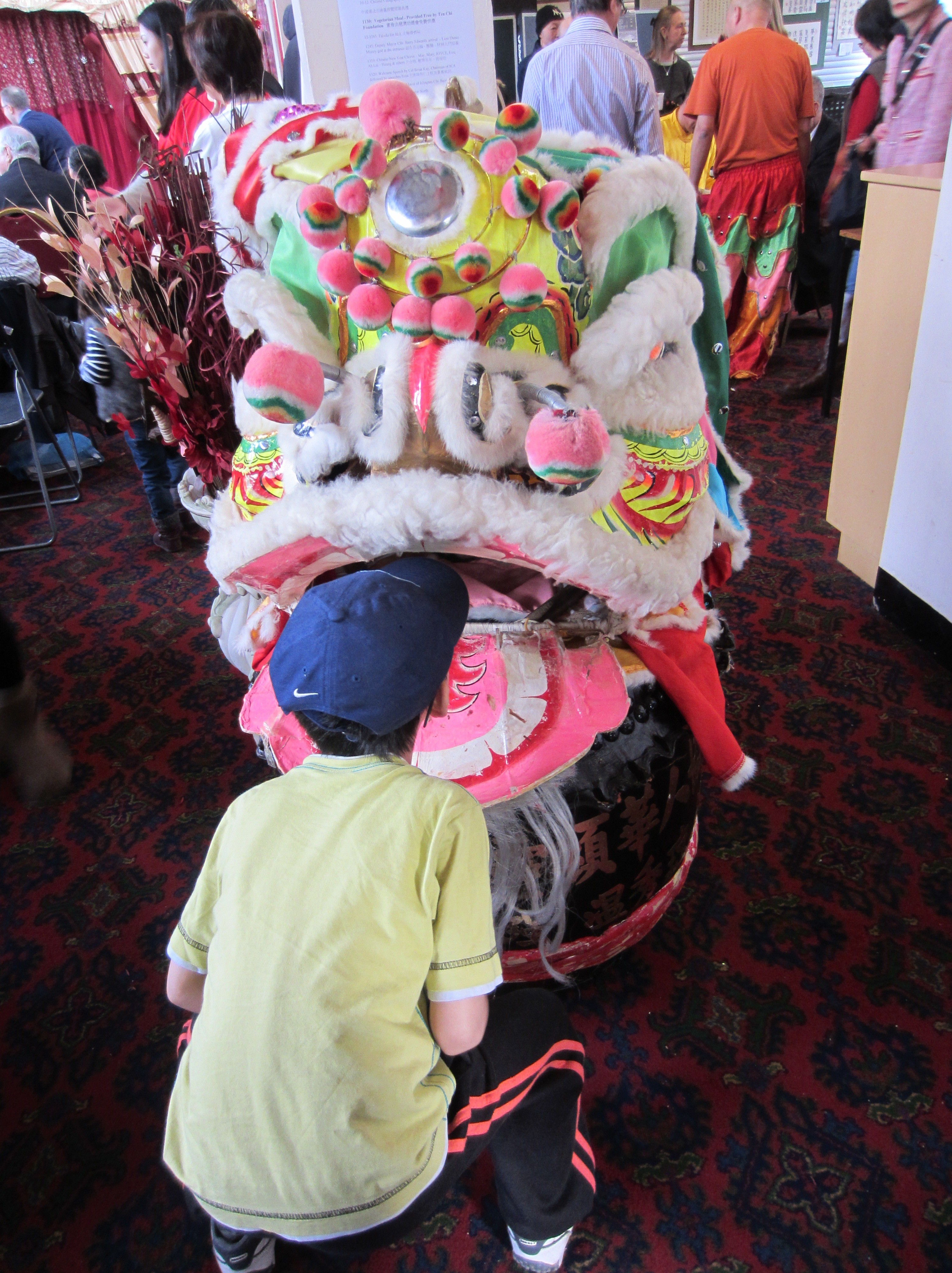
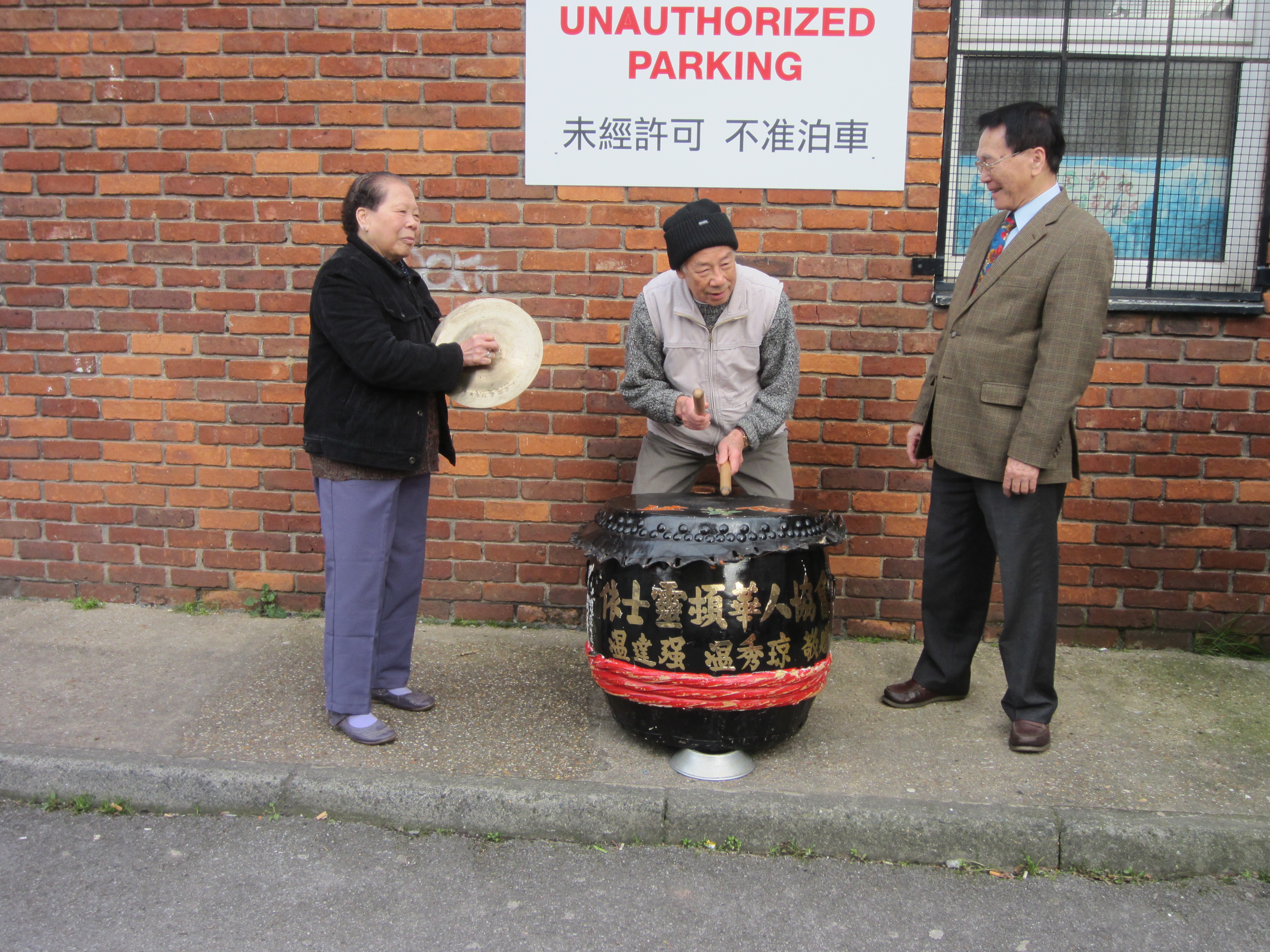
Those worries didn’t last long. We were soon distracted by an insistent beat and the clanging of cymbals. On a pavement outside, a round Chinese drum, its black lacquer gilded with golden characters, had been set up. Lion is approaching. boom-boom-boom The drum was extraordinarily loud, inducing a shiver in the pit of my stomach – a frisson I always feel when I know that the epic Lion Dance will follow. Neighbours peeked out of their windows as the Lion approached, bearing its multi-coloured head. This was a friendly beast, so friendly that at least one little boy was tempted to peer solemnly into its ravenous mouth. The Lion wagged cheeky pink tongue and tail in every corner, which I hope was enough to chase away any evil spirits lurking.

What's in there

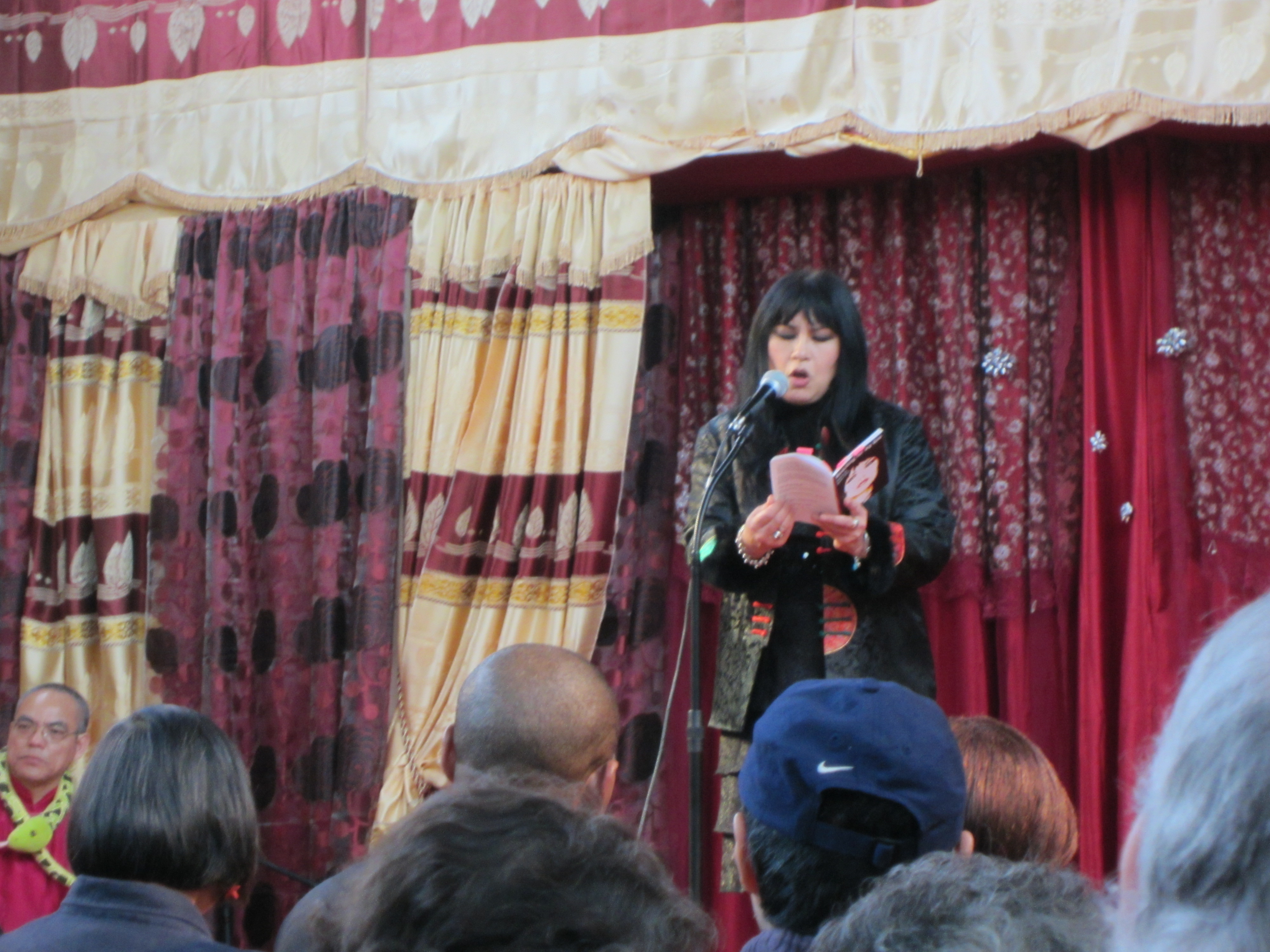
By the time I returned inside, the upper floor of the ICA had been transformed. In its place was a concert hall decked with rows of chairs. From the stage at the front came the dulcet tones of a Chinese flute, so lulling that even the children stopped squirming. When Anna Chen, poet and activist, took to the stage, she invigorated the crowd by half-reading and most astonishingly, half-singing, her poignant poems. The lyrical Anna May Wong must die was especially powerful – ‘a personal journey through the life and crimes of Hollywood’s first Chinese screen legend’, it says on Anna’s website. (I hope everyone reading this will have the opportunity to watch Anna perform). I could see that people listened, but you had to be able to hold their attention.Anna Chen reads her poetry

All too soon, it was my turn. I had been told I would go onstage after the fan dance. I waited in the wings, tense because I knew it would be the first novel reading at the ICA, afraid also that my story might not be regarded as ‘Chinese enough’ for a community event of this sort.

Indeed, the family in my novel is mixed, the woman who leads it being a Nyonya – part of the Chinese diaspora in South East Asia which dates back centuries. Many people today have never heard of the Nyonyas and Babas, even in Malaysia. This is a great shame, because the Nyonyas and Babas successfully created a unique fusion of Chinese and Malay culture long before globalisation existed. In their way of life, they have something to teach us, especially in present-day Malaysia where race drives your rights, or the lack of them (see blog-post The Malaysia We’ve Lost).

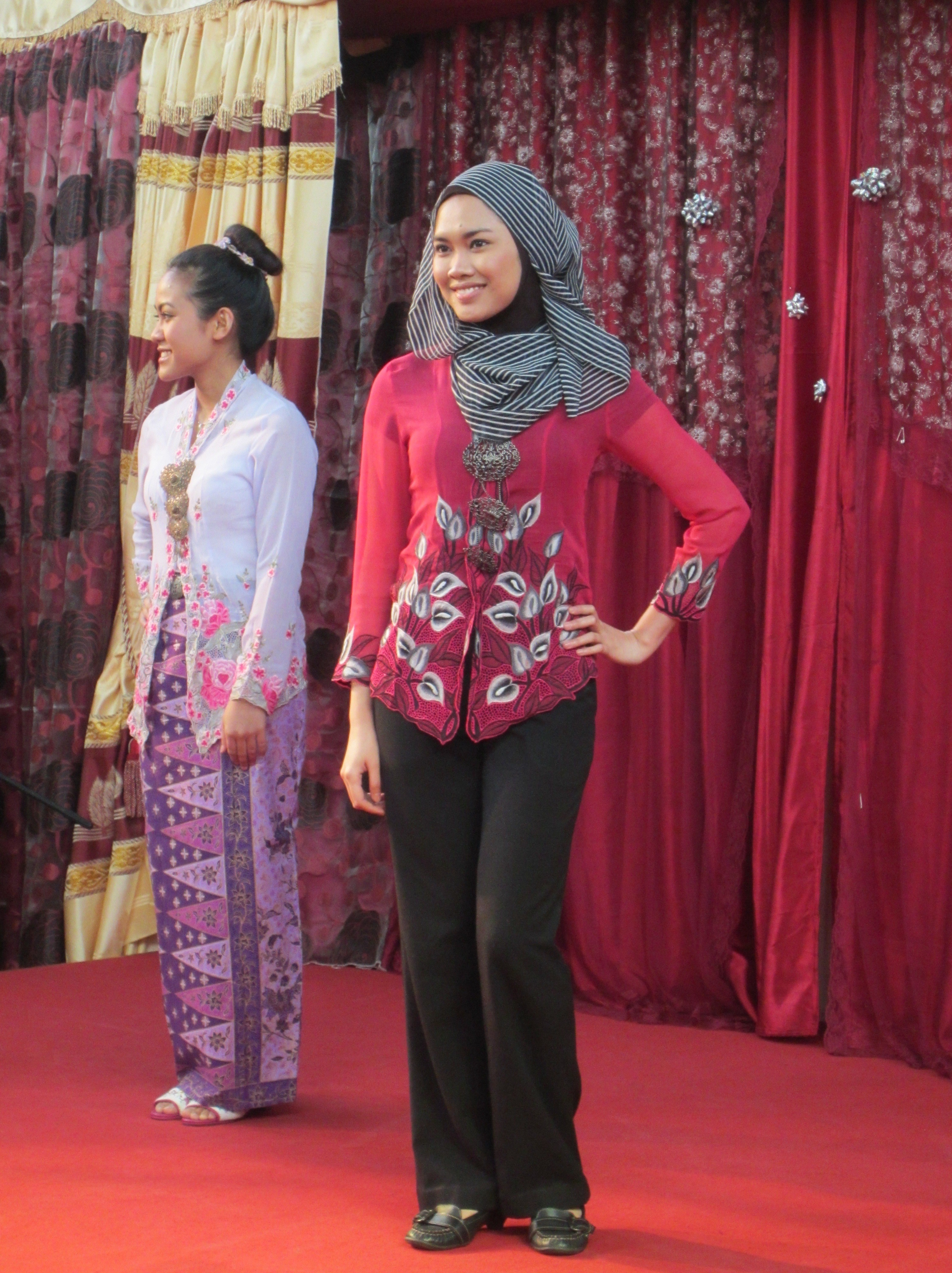
The first passage I read told the ancestral story of the Nyonyas and Babas. Selina introduces the Nyonya themeTo make my reading come alive, I had watched videos of actors and politicians speaking. I also enlisted the help of two Malaysian students, Wahidah and Aufa Dahlia, who gallantly came on stage modelling Nyonya costumes. Wahidah, her hair tied up in the famous Nyonya chignon, looked resplendent in a tailored vintage sarong kebaya.Demonstrating sarong kebaya Her blouse and sarong came from Aufa’s private collection, while her feet were adorned by a pair of hand-made Nyonya beaded slippers which had been purchased from a shop, Colour Beads, in Malacca. This beautiful town is arguably Malaysia’s most historic, and a large Nyonya-Baba community once lived there.

Wahidah was subsequently joined on stage by Aufa Dahlia, who showed off her modern Nyonya attire with great aplomb. The audience sat enraptured, so graceful were the kebaya ladies. Later, many went up to Aufa’s table, where she had placed a sample of the kebaya blouses she sells on her website as a hobby. If the kebaya ladies and I were to form an act, we would surely be hits on a reading circuit!

Modern NyonyaOther artistes followed, including the kung fu master whose rhythmic movements mesmerised everyone. Look at the picture below and you will see why he was a tough act to follow, especially by a writer reading her second passage late in the day. Kung-Fu masterFortunately, I was aided by the dramatic second scene I had chosen to read and by the prop I brought along: the Nyonya kueh (cakes) which feature in my novel. I had only two varieties with me – both from the Malaysia Hall Canteen in Bayswater – but they disappeared in seconds after being shared out!

Afterwards, people came up to say how much they had enjoyed my reading. One woman thanked me for opening her eyes to the diversity of the Chinese diaspora, a few even asked where they could buy my book. Alas, I had to say it was not yet published but I gave them my card nonetheless, as it has the address of this blog on the back.

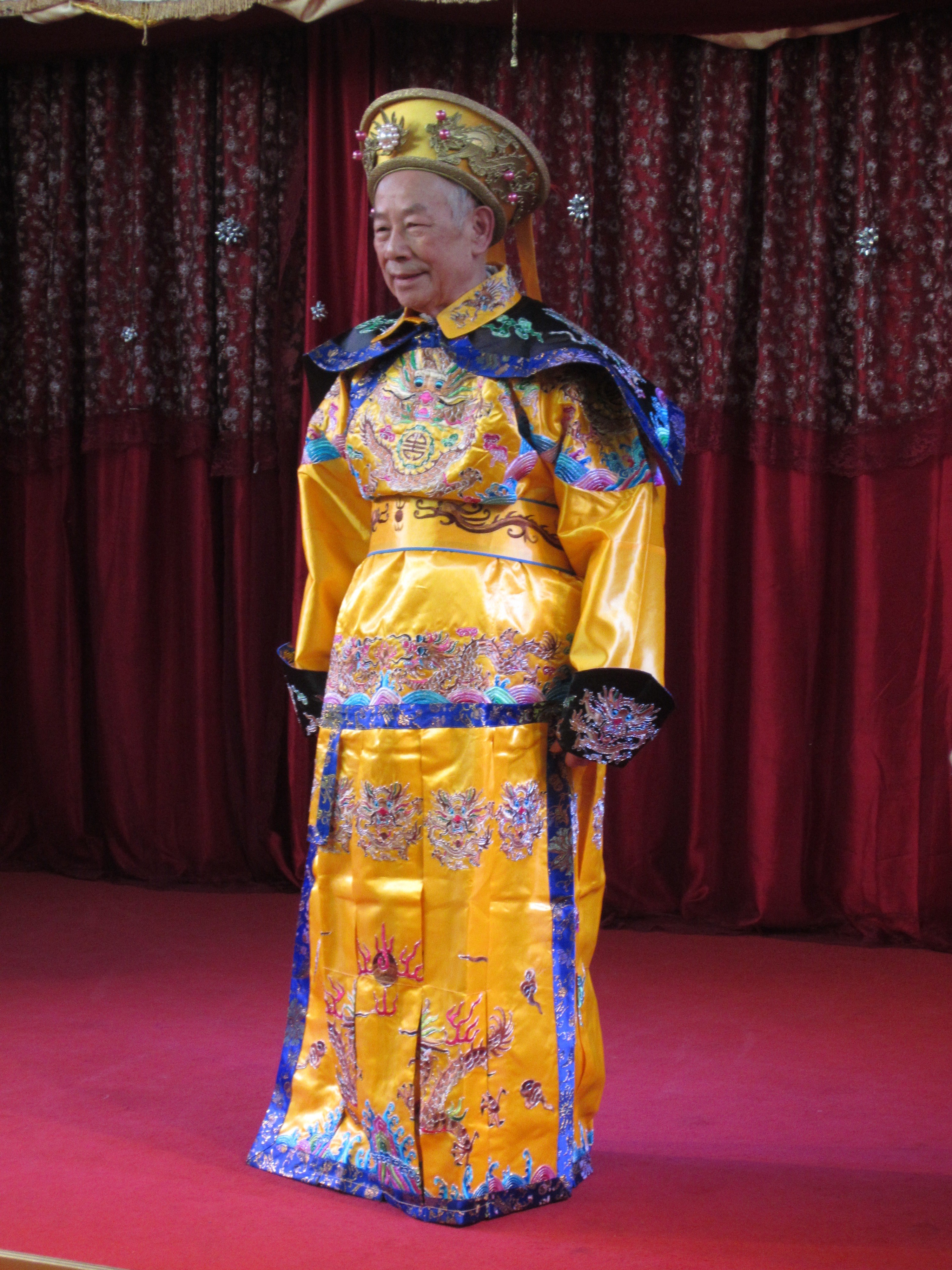
The grand finale of the afternoon was a Ching (Qing) Dynasty costume parade which starred a Mandarin, a Court Official, a Eunuch, the Empress and of course, the Emperor, all in borrowed robes which had never before been worn in the UK. Truly a fitting way with which to end such an uplifting day.

The EmperorAs we headed off, I thought of those who had come before us. It was not just Emperors and Empresses who made history but the coolies leaving in desperate circumstances, and before them, during the Ming Dynasty, the adventurer traders who left to settle elsewhere. These ancestors, all of them, have left their mark in the sands of history. And we their descendants are immensely fortunate, in having such a rich heritage to celebrate.

3 Comments

Filed under Cultural Identity, Identity, Malaysia, Novel, Nyonya

How to be a Good Daughter-in-Law

I had the good fortune of speaking to Malaysian writer Lee Su Kim during my recent trip. What that has to do with being a good daughter-in-law will be revealed in good time…

With Lee Su Kim, I share a fascination of things Nyonya and a love of reading and writing. She started writing long before I did, and has had several books published. Su Kim also happens to be a founder member of the Peranakan Baba Nyonya Association of Kuala Lumpur and Selangor, and its first woman President. Demonstrating true grit, Su Kim very kindly called me up despite being on her way to see a doctor!

Being a Nyonya herself, it’s not surprising that Malaysian as well as Nyonya themes run through her work. The fact that I heard about Su Kim at all was purely down to luck. My aunt happened to attend the launch last year of her latest book – a lovely collection of short stories entitled Kebaya Tales, published by Marshall Cavendish.

As I worked my way through the book, I realised how much I enjoyed reading it, which was why I set out to contact her. I could see how much of herself Su Kim has put into Kebaya Tales – the book comes across as a labour of love. In addition to stories, she has included personal mementoes: family photographs, shots of the vintage kebayas – the beautifully embroidered blouses in diaphanous material worn by Malay women and Nyonyas – which she inherited from her mother, as well as pictures of the beaded slippers for which Nyonyas are famous. All of these help make her culture come alive to a reader with no previous knowledge of what Nyonya means.

On the subject of beaded slippers, when I was last in Malacca, I bought two pairs of these. (As an aside, Malacca was at one point an important port; see map below to understand its strategic position.


Which also explains why it is one of Malaysia’s most historical towns and has a large Nyonya population). 

To get back to the famous beaded slippers, here’s a photograph of the pair which I gave my partner.

You may not be able to see them, but the top of the shoe comprises tiny beads in many colours. The beads are patiently threaded together to create the flowers and butterflies which adorn the black background, itself made up of the same tiny beads. The smaller the beads (which this shoe happens to have), the greater the expertise required, and the greater the patience demanded. At one time, beading was considered a required skill for a Nyonya, one on which a potential daughter-in-law could expect to be severely judged.

As for the stories in Kebaya Tales, Lee Su Kim succeeded in drawing me in and sometimes, in shocking me. Her tales contain unexpected and occasionally disturbing twists, but she invariably managed to weave in some or other aspect of Malaysia. A few stories touch on folklore, others on parts of our history which remain unresolved, such as what happened during the war years, yet others contain unspoken beliefs which permeate our culture.

However, you don’t need to be a Malaysia expert, because the stories provide easy reading. The collection is also totally self-contained; Su Kim even included brief notes about the Nyonyas as well as ample commentary about their kebayas and sarongs.

What, you may ask, does any of this have to do with being a good daughter-in-law? The answer is that in addition to the mementoes I mentioned above, Kebaya Tales is interspersed with fragments of idioms and poetry. The following ditty, itself taken from a book by another Malaysian writer, caught my eye:

HOW TO BE A GOOD DAUGHTER-IN-LAW

Dried bean curd, sweetened buns,

To be a good daughter-in-law, know your manners,

Go to bed late, get up early,

Comb your hair, powder your face, dab on rouge,

Enter a room holding a needle,

Go to the main hall and wash the crockery,

Praise your elder and younger brothers-in-law,

Your parents in turn will be praised for your good upbringing.

Hokkien ditty, reprinted in Kebaya Tales, taken from the book Of Comb, Powder and Rouge by Yeap Joo Kim 1992, published in Singapore by Lee Teng Lay Pte Ltd

I re-read the ditty above many times, always laughing. It amused me to see how miserably I would have failed! Based on the above criteria, I make a lousy daughter-in-law. Praise be to the Heavens.

4 Comments

Filed under Cultural Identity, Identity, Malaysia, Nyonya, Writing