A week ago my father took his final breath. He went quickly and peacefully after dinner. He’d had such a good day, eating all his food and even joking with his carers, that they did not have any inkling they were seeing a man in his final hours. I’m glad it happened that way.
If I could have spoken to my father, this is what I would have said.
I’m sorry, Dad, that I’m not by your side right now. I know you would have preferred to die in the house you had lived in for twenty five years. I’m really sorry I could not make that happen – you never got to see your house again.
But you were in a happy place. You didn’t like it initially, of course – who does? At Thanksgiving, when they asked you what you were thankful for, you said, ‘I’m thankful to be in this happy place.’
It was indeed a happy place, this small care home in a leafy suburb where they treated you as a person, not a number. Everyone knew your name and you knew theirs. They really looked after you. They are now shattered that you left without warning.
You were not a man of many words. We learned more about your life from files you had kept – which we found while cleaning up – than from anything you ever told us. You never talked about your achievements, almost as if you were a little embarrassed that they were not enough, that what you had done did not stack up in some people’s eyes. For a boy from a small town, born when Malaysia was still Malaya, who died 10,182 miles from his place of birth, you went a long way. You have a lot to be proud of.
Your own traditional Chinese father and mother did not speak English. You told me how, on your first day at an English-language school in Teluk Intan (Telok Anson in your days), you had no idea what the class teacher was saying. When he asked the whole class to stand up, your bum remained firmly on your seat. Fortunately, the teacher guessed that you did not understand. He was a Malay man who had married a Chinese woman and, having learned Cantonese himself, he said to you, ‘Hei sun, hei sun!’ (Get up, get up!).
From him you learned your first English words. And you never looked back. You were taught grammar the old-fashioned way. You had to learn spelling and syntax and punctuation; you knew the purpose of an apostrophe; you did not, unlike so many today, confuse ‘it’s’ with ‘its’.
But you were also a man of your generation and culture. Although you were interested in science, you never discussed science with me. When I announced my desire to become a physicist, you told me to ‘forget my fanciful dreams’. In those days, I suspect you could only imagine boys becoming physicists. Thank goodness that I inherited more than your logical mind – I also inherited your obstinacy. I ignored you. In the end I hope I made you proud.
Watching your physical deterioration this past year has been painful. There was no getting away from the reality that you no longer enjoyed the quality of life you’d previously had. You knew the end was near. You also knew the President’s name and what day of the week it was. I take comfort from the fact that you still smiled.
On your last full night on Earth, I’m told you sang through the night, keeping the entire house awake. In the morning you seemed oblivious to having been up. You continued bossing your carers about, demanding coffee.
I smile at this story. That extraordinary burst of energy would have worn anyone out.
Please, take it easy now, Dad. There is nothing more you need worry about, no one you must provide for. Sleep well.
When flight MH-17 was shot down in 2014 by a Russian missile, Malaysia’s flourishing Islamists, including the same Siti Zailah, blamed Malaysia Airlines. Allah’s wrath had apparently been incurred by the alcohol the airline continues to serve. His anger was further stoked by those sexy stewardesses parading in form-hugging kebaya blouses and skirts. The Malaysians who believe this are in the minority, but they’re allowed to make an awful lot of noise. This is the sort of country I come from.
On the things that really matter – religious extremism, endemic corruption, nepotism, cronyism and most of all, Malaysia’s entrenched racism – its leaders have been conspicuously silent. This is exactly the sort of country I come from.
A long time ago – May 13, 1969, to be precise – so-called ‘racial riots’ occurred just after a set of important elections. Most of the people killed were Malaysians of Chinese ethnicity. I remember it as a period of curfews, shop closures and adults walking in fear. When grown-ups are scared, kids get scared, too.
Afterwards, a new Prime Minister took over and a suite of racist policies, euphemistically called the New Economic Policy, was instigated. Such massive changes should have warranted close examination – as would have happened in any proper democracy.
Not Malaysia. For the next thirty years, we were told not to breathe the words ‘May 13’, as if just hearing the words would cause Malaysians to become hot and bothered and start attacking one another with parangs and krises. And like sheep, we obeyed! That, too, is the sort of country I come from.
Until those pivotal elections of 1969, there was real democracy. The largest political party, the United Malays National Organisation or UMNO, realised it could lose elections. Losing elections meant losing power and UMNO was determined not to lose power. Under the camouflage of ‘addressing racial inequality’, its leaders set about dismantling democracy, but we were too blind and naïve to notice.
That was so long ago, I hear you say: why does it matter anymore?
It matters because our present is shaped by the past. Truth matters.
Has any attempt been made by any Malaysian government since 1969 to find out the whole truth about May 13, 1969? Of course not. Until there is truth, how can there be reconciliation?
UMNO proceeded to rule until 2018. Think of it! Hegemony from 1957 to 2018 – a total of 61 years! Six decades are more than enough time to corrupt the entire country from the bottom up and dumb it down from the top to the very roots. The dumbing-down has been nothing short of phenomenal.
Earlier this year, in my home state of Perak, a woman seeking treatment at a public hospital was told off for her attire! Imagine the scenario: you need help, you go to a hospital and before anything else, the doctor lectures you about your clothes.
‘If you go to a government department, there should be decorum. … If you go to a temple, there’s also no signboard, but we know we cannot wear short skirts there. It’s an unwritten understanding.’
The guy actually compared a temple to a hospital, even though a temple is a place of worship that you visit voluntarily, while a hospital IS NOT a place of worship and you go there normally under duress. His was a wonderful example of cow sense (with grave apologies to cows).
It reminded me of the last time I renewed my passport. I went to Perak’s Urban Transformation Centre (UTC) in Ipoh and the passport officer refused to serve me because I was wearing a T shirt and Bermuda shorts. My shorts were perfectly respectable – but not respectable enough, it seems, if you’re a Muslim-Malay passport officer. In Malaysia, the job of a civil servant is no longer limited to paperwork: it’s also his role to judge what you wear. He told me to come back with a sarong or trousers that would ‘cover my knees’.
The only surprise is that he didn’t also complain about my bare elbows. This will change, no doubt: Malaysia’s home-grown, Taliban-inclining political party, called Parti Islam Se-Malaysia or PAS for short, will see to that.
PAS was a fringe party when I left. It is now flying high, with more seats in Malaysia’s parliament than ever before. The politician I’ve already mentioned, Siti Zailah, is a member of PAS – a shining example of their intellectual quality.
On that same trip, on the very day my passport was renewed, I was asked by a Malaysian-Chinese businessman why I did not live there. What was it I had in England that I could not find in my land of origin?
I gave no answer, not because I didn’t know, but because the answer is so complicated that I did not know where to begin. How do you explain to someone who has never lived in a liberal democracy what it’s like to live in a country that isn’t corrupt from top to bottom, where you can trust the courts, the press isn’t muzzled, there is civic discourse and crucially, where I am equal to everyone else under the laws of the land?
The man who asked the question is obviously happy living under Ketuanan Melayu (Malay lordship). I wouldn’t be happy. And since I have a choice about where I live, I can’t see any reason to go back.
An estimated 1.8 million Malaysians live outside Malaysia (population 34 million in 2023). At least half of my classmates from secondary school and many members of my family have left. That’s a huge brain drain for any country, especially one still in development mode.
A charitable view is that Anwar just doesn’t get it. Perhaps he genuinely believes that tax breaks on luxury cars and tax breaks on just about everything else would be enough to bring us back. I will speak only for myself here, but I’d like to say it loudly and clearly: what I have in England is freedom, and this freedom is priceless.
Since freedom is a nebulous concept, an example might help. If I wrote an op-ed on the subject ‘Is Charles the King of all Britons, or does he represent the interests only of white Britons?’, I’m confident it would be accepted by a broadsheet publication here. But if I wrote an op-ed entitled ‘Is Malaysia’s King (Agong) really the King of all Malaysians, or does he favour the Malay race?’, would the official Malaysian press dare touch it?
The difference is that England goes out of its way to accommodate different viewpoints and to protect the rights of minority groups. In my adopted country I am equal by law and can rely on a judicial system I trust. No economic incentive is going to make me give this up.
Going back to Anwar Ibrahim (and his limp solutions for Malaysia’s brain drain), a less charitable view is that he actually understands what’s at stake and fears the consequences. What would Malaysia look like if all 1.8 million of us went back?
Some of us would surely join the brave Malaysians who’re still speaking up against the things its politicians don’t have the guts to discuss. We would be vocal, certainly. UMNO wouldn’t like that, and it’s unclear whether Anwar would be all that keen, either.
I once told myself that when Malaysia abolishes bumiputera rights, I will go back, at least for a time, in order to give something of myself to the country I came from. I now know this is a pipe dream. Bumiputera rights won’t be abolished anytime soon. But it took the break enforced by COVID for me to see the light.
Finally, after forty four years away, I’ve given up on Malaysia. Perhaps some immigrants reach this point, when both they and the country they left behind have changed so irrevocably that there’s no turning back.
Giving up on a dream is never easy. Part of me is angry, but mostly, I’m sad. We have all lost; even those who think they’ve gained have actually lost.
We lost the spirit of Malaysia and in losing that precious spirit we squandered the chance to build a truly great nation.
And for what? So that a small group could cling to power while enriching itself and its cronies.
I won’t be returning, but I will support the Malaysians still fighting for a better tomorrow. One of these is the writer Mariam Mokhtar. We don’t know one another; I’ve only enjoyed her articles from afar. As she describes below, her writing has been deemed so incendiary that the slavish Malaysian press won’t publish her.
That hasn’t stopped Mariam. She launched her own news platform and now makes videos, too. I discovered them while carrying out research for this blog-post and I find her analysis always spot-on.
If you’re interested in what took place during May 13, 1969, I would recommend the book May 13 by Dr. Kua Kia Soong, director of Suaram (short for Suara Rakyat Malaysia, or Voices of the People of Malaysia). He wrote it by piecing together extracts from documents that were only declassified after thirty years. When his book came out in 2007, some Malaysian politicians wanted it banned – which is reason enough to read it.
Walau pun saya berada jauh, Malaysia tetap di hati.
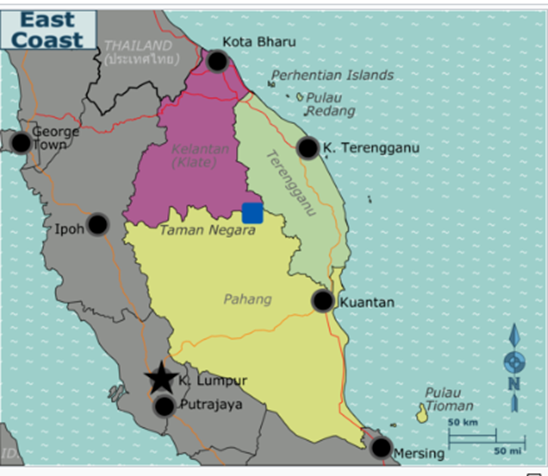
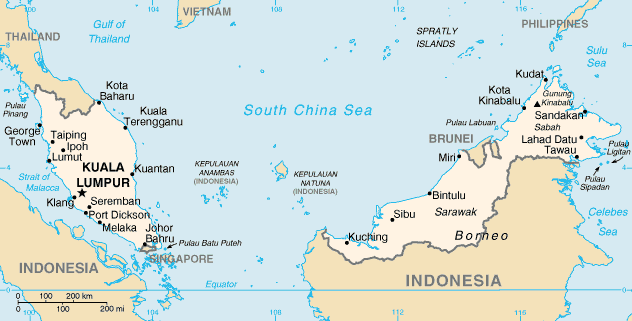
I first saw the stretch of water known as the ‘South China Sea’ when I was a child. My family went on holiday to the East Coast of Peninsula Malaysia. Travel wasn’t the same in those days – it was a huge adventure. We visited the states coloured purple, green and yellow on the map and I have vivid memories of the ‘South China Sea’. It seemed to always be there: blue and gently lapping on sunny mornings, dark and roiling when the storms came.
That trip was memorable for another reason. One night, after following a guide by torchlight for what felt like miles, I saw giant turtles with leathery backs on an isolated part of the coast. Those amazing turtles were clambering onto Malaysia’s pristine sands to lay their eggs! Almost at once, their eggs were removed. I was fascinated; at the same time I felt sorry for the poor mother turtles. I’m sure they sensed what was happening.
The ‘South China Sea’ brought more than giant turtles: it also brought people. Among these were my ancestors, some of who arrived from southern China in rickety boats.
They did not call the water that had brought them the ‘South China Sea’. In Chinese, the same stretch of water is actually known as the ‘South Sea’ (南海), meaning the sea south of the Chinese mainland.
As a child, it never occurred to me to ask why a sea on Malaysia’s eastern coast should be named after China. If you look at a map, you’ll see that the ‘South China Sea’ is really a Southeast Asian sea: it flows across Southeast Asia, eventually reaching southern China and Taiwan. But the bulk of this sea is not in North Asia.
Rather, it unfurls on the shores of Vietnam, the Philippines, Indonesia, Brunei, Singapore and, as I saw for myself, Malaysia. It swaddles the southern tip of Peninsula Malaysia, linking up with the Straits of Malacca. A more appropriate name for the ‘South China Sea’ might actually be the Southeast Asian Sea.
For me the Southeast Asian Sea isn’t just any sea: I saw it as a child, I stepped into its waters and I smelled it. It carried my ancestors and sustained others. It has given me a trove of memories. What happens in this sea matters to me. And rather a lot has been happening.
Did you know that China has claimed large parts of the Southeast Asian Sea for itself? The excuse China uses is ‘historical rights’.
The logic runs something like this: Chinese seamen ‘discovered’ reefs and islands in the Southeast Asian Sea 2,000 years ago and claimed them for China. Ever since, China has allegedly ruled over these islands. Because China claims to have governed godforsaken boulders in the middle of nowhere continuously, it also claims to own these islands and reefs. China has even created whole new islands where none existed before. It goes without saying that China owns the adjacent waters, too (and presumably, all the resources that go with them, and maybe even those turtles).
I am oversimplifying. The legal arguments are more sophisticated – you would hardly expect less from the Communist Party. For a detailed legal summary, you can see this link. But the sophisticated legal arguments really boil down to the above.
In the narrative above, the peoples of Southeast Asia are conspicuously absent. Imperial China regarded Southeast Asians as ‘southern barbarians’, as I learned when I reviewed a fascinating non-fiction book called ‘Writing the South Seas’ for the Asian Review of Books. It’s no surprise that Southeast Asians were excluded from considerations of power. Barbarians are to be civilised – they’re not capable of ‘discovering’ their own islands.
Imperial China may no longer exist, but a pattern of dominance, once established, is hard to dislodge. Attitudes die hard.
Achieving unity in the region may be easier said than done; like Europeans, we have a chequered history of squabbling, but we should at least try to come together. The Southeast Asian Sea lies mainly in Southeast Asia. That’s where its resources belong and that’s where its resources should stay. Granted, we have to share these among us – but Southeast Asia has a long tradition of sharing.
Thank goodness there are signs of unity coming, slowly but surely. We can do it, we have to do it. There is no other way.
Giant turtles were not seen in Malaysia for decades, but they have apparently returned. Despite adversity and precarious numbers, the turtles have come back to reclaim their sea and shores. We need to do the same. We must reclaim our sea, our reefs, our islands and our shores. Before it’s too late.
When I first came out as gay, my parents blamed England. If only they had not sent me to boarding school, ‘this’ would not have happened. It’s just not Asian!
I never asked which part wasn’t Asian. Did they mean:
Being attracted to someone of the same sex?
Telling a fundamental truth that made others uncomfortable?
Daring to think outside the box?
This took place in the mid-1980s. It would be tempting to believe that the whole world has changed since.
The map below shows the countries (in red) in which homosexuality remains illegal. There’s a very large mass of grey – not the case before – so, indeed, there has been progress. But we are nowhere near an egalitarian utopia. The Russian Federation, for instance, is hardly an oasis. Neither is China.
Earlier this year, mainland censors erased a lesbian plot-line from the sitcom ‘Friends’. No lesbians for the mainland! Just what is the Communist Party so afraid of? Obviously, merely hearing about lesbians on TV could give Chinese women ideas. Hardly a vote of confidence in their men.
One of the other countries in red is Malaysia. It has a Muslim majority and homosexuality is illegal. I still have relatives there, one of whom is gay. He isn’t a Muslim. He has lived in Malaysia all his life. He has also been in the closet his entire life.
An early memory I have is of waking one morning to be told that this particular relation had been in a terrible road accident. When I saw the photographs, I was shocked. To describe his car as a wreck would be an understatement – it was crushed. If you looked at photos alone, you would have assumed its occupant well dead.
Apparently, the accident was his fault. My relative had come out of a junction and was hit by a bus (if my recollection serves me right). Everyone was amazed he survived the catastrophe. At the same time, they could not fathom what he was doing in that part of town. I remember the adults around me shaking their heads, asking repeatedly: what was he doing there at that hour?
Years later, he told me. He had been meeting a man.
The revelation brought lightning clarity. Disjointed memories fell into place. Finally, I understood. I felt like Archimedes with his Eureka moment. When my relative swung his car out of that junction, his mind was occupied.
Obviously, such an accident could have happened anywhere. But if this relation of mine had been able to meet a man the same way he was encouraged to date women, he is unlikely to have been skulking off to a clandestine encounter in the early hours of dawn.
I have a gay cousin who did the same: he went around surreptitiously – until his parents accused him of being a drug addict! It took a dramatic argument for him to come clean with them. That story, at least, has a good ending. My cousin lives happily with his partner and has done so for years.
Not the case of my car-crash relative, whose sexual orientation is an open secret. Granted, he is loved by the family. This makes him fortunate. Nonetheless, can you imagine the amount of sniggering he has had to endure, what it must be like living within a culture where you’re asked ‘Are you married?’ within minutes of meeting someone?
As we celebrate Pride month, I thought it time to shine a light into the closet. It looks to me like a dank, dark place. I can’t imagine living in it, or how great the mental toll must be.
I’ve often heard that ‘we in Asia have our own way of doing things’ – we don’t need to talk about them. Some people believe there are things better left unsaid. No doubt they also think I should not be writing this blog-post. But ‘ways of doing things’ evolve. Chinese women used to bind their feet: should we return to that practice? Of course not – no culture is beyond universal human values. If we find it hard to say the word ‘gay’, it’s because we still associate shame with gayness. The dictum ‘we have our own way of doing things’ is no more than a convenient cover. It allows uncomfortable topics to be avoided.
All those years ago when my parents blamed England, they had a point. England did not make me gay, obviously, but it has given me a confidence, freedom and happiness I would not have enjoyed otherwise. Here I can live openly without having to hide; here I stand without fear, knowing that I am protected by law.
This freedom is indescribably precious. In a poignant moment a few years ago, my ex-wife and I welcomed a visitor from Dagestan. When he realised that he was the guest of two women who were married to each other, he was in awe. Without any hesitation whatsoever he proclaimed:
My country of origin, Malaysia, loves selling itself as the multicultural haven that it really isn’t. My adopted land, on the other hand, just gets on with it. England is showing the world what a truly multiracial, multicultural democracy looks like.
The parade of Secretaries and Ministers is evidence of just how far Britain has come. By now you will likely have heard of Rishi Sunak, Chancellor of the Exchequer, and Priti Patel, the Home Secretary. Both are descendants of first-generation Indian immigrants from East Africa. The former Vaccines Minister Nadhim Zahawi, who was tasked with rolling out the UK’s very successful vaccines programme, is himself a first-generation immigrant. Here he is giving one of those briefings. Zahawi is now the Education Secretary.
In England, politicians from ethnic minority groups aren’t just relegated to the side-lines, the way they are in Malaysia. Below are a few of England’s current Cabinet members.
In ‘Malaysia, Truly Asia’, there is virtually no ethnic diversity within a government that continues to be dominated by race-based political parties. By ‘race-based political party’, I mean a political party run along sectarian lines which admits full members from only one particular racial group.
Yes, you read that right. This may be 2022, but you still have to be Malay (or bumiputera) to be a full member of the ruling United Malays’ National Organisation (UMNO). In principle I am allowed to join, but only as part of an associated group following orders (as per Clauses 4.1.2 and 4.3 of UMNO’s Constitution). Unwanted, unwelcome, second-class: the same way I’d be treated if I lived in Malaysia.
The idea that you need to be a certain race to gain full membership of anything should be illegal. It has no place in today’s world. But race (and religion) are expedient tools for power. And the politics they nurture thrives on a self-fulfilling loop of tribalism. Nastiness is repeated ad infinitum, the audience become inured and tribalism ends up infecting a nation.
I discovered this when Sajid Javid was named Home Secretary in 2018. My phone pinged with messages. Some Malaysian family members were worried. ‘You now have a Muslim Home Secretary! London’s mayor is also a Muslim!’
Yes, and???
It transpired that a tonne of What’sApp videos were doing the rounds. One listed the British cities with Muslim mayors (hundreds, apparently). Another video purported to show a road somewhere in England being taken over by Muslim men bowed in Friday prayer. Yet another displayed Buckingham Palace. The Palace, it seemed, was going to be turned into a mosque. I wonder if someone has told Her Majesty. She is celebrating an unprecedented seventieth year as monarch and may have other plans for her home.
A few salient points are in order. First of all, a politician like Sajid Javid reached his position on merit – he was not favoured by positive discrimination. Secondly, he is a member of the Conservative Party which, whether or not you like it, is fully open to all races and faiths. Thirdly, he serves all Britons, not just British Muslims.
“…the sad truth is that if you look at recent high-profile convictions of gang-based child sexual exploitation, there is a majority of people that come from Pakistani heritage backgrounds – that’s plain for everyone to see. What I’ve said is that we, in trying to deal with this, trying to turn this round, we must look at all factors and we must not be too sensitive and shy away or be oversensitive.”
Spot on.
What Javid said and the way he said it is one of the fruits of freedom. Real democracy is sometimes messy. But after the storm comes sunshine. You are able to look at your own culture with clearer eyes. You can speak hard truths without feeling defensive.
Who we are, what we believe in and the values we stand for have never been more important. What would you do if a regime you strongly opposed appeared on your doorstep?
I have long asked myself that question. With Russia’s invasion of Ukraine, this is no longer a moot point.
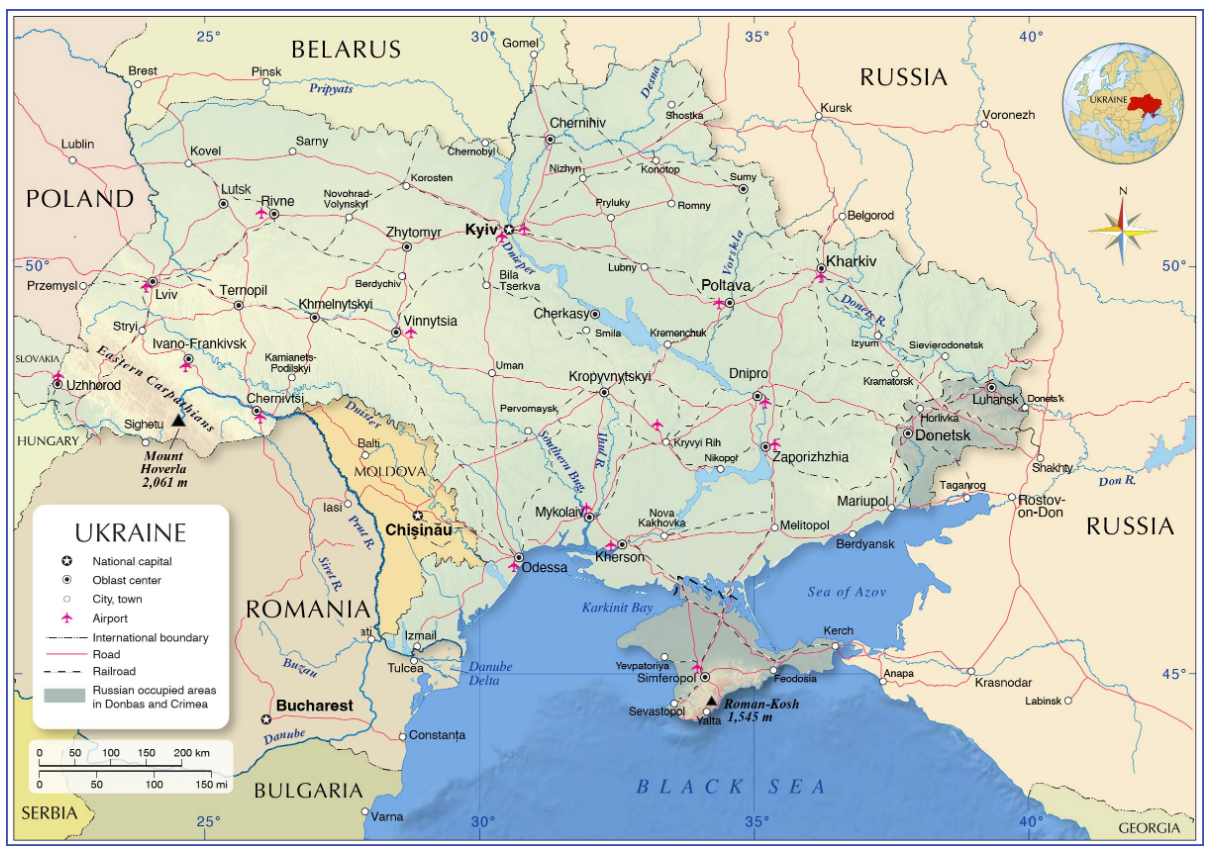
I visited Ukraine three times in 2014 in the months after Crimea was annexed. My now ex-wife is of both Russian and Ukrainian origin and has friends inKyiv, which we visited. We also went to Lviv. Both are charming cities. To me, Kyiv seemed more Soviet and therefore exotic, whereas Lviv, which is close to the Polish border, (see map below from nationsonline.org) reminded me of Vienna: beautiful yet familiar.
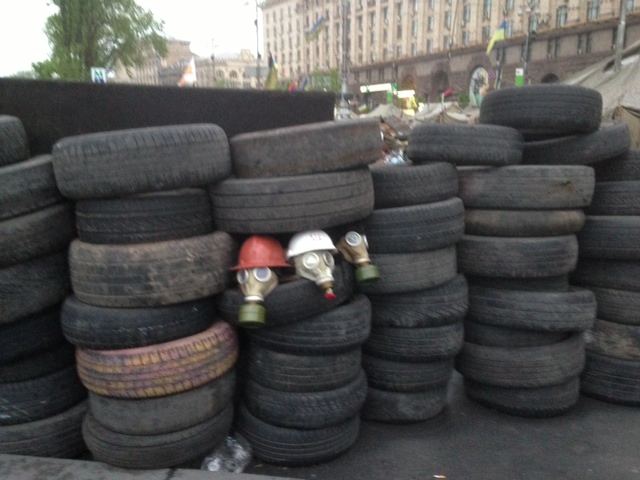
Everyone we spoke to in Ukraine shared the same aspirations. They were fed up of corruption and proud of how they had overthrown a leader who had done Moscow’s bidding. Our Kyiv friends showed us the square where thousands had congregated for weeks in freezing conditions, protected against bullets by the stacks of tyres they put up. They saw Ukraine’s future firmly in Europe. They did not wish to be part of some reformulated Russian empire – the shackles of which they had worked so hard to throw off.
Tyres Left in Maidan, Square in Kyiv
Till then, I had known little about Russian colonisation. (NB Technically, it was Soviet colonisation.) I heard many stories on those trips, and one was so harrowing that I could not get it out of my head. I had to write about it. What emerged was flash fiction – a very short piece. Masha’s Burning Memory was included in the UK’s National Flash Fiction Day’s 2014 anthology, ‘Eating My Words‘. Our friend Olga, who had related the story, cried when she read it.
The real event on which her tale was based took place in 1933, during what is known as Holodomor or the Great Hunger. Lest we forget the past, there is a museum in Kyiv dedicated to its memory. Remarkably, Kyiv’s Holodomor Museum continued putting up defiant updates in the midst of continuous bombardment. For a full and exhaustive account of Holodomor, I recommend the book Red Famine by Anne Applebaum. It doesn’t make for easy reading, though; I haven’t been able to finish it in two years.
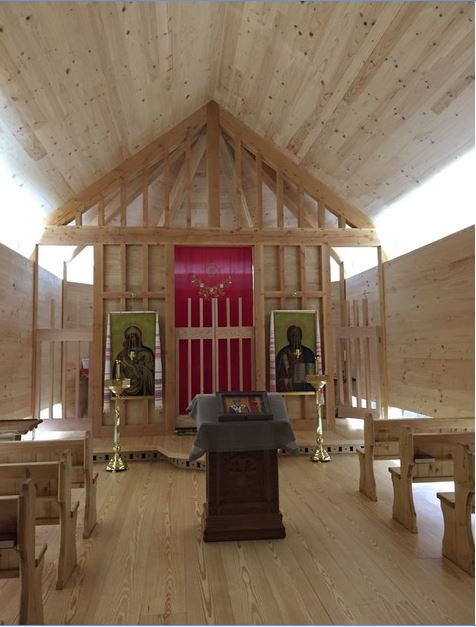
Church I Visited in 2014
Who knows what will be left of the church above? When I compare Russia’s subjugation of Ukraine with Britain’s colonisation of Malaya, I realise we got off very lightly. Indeed, Russia makes our British colonial masters seem positively benevolent. No wonder Ukrainians are fighting so hard.
But there is more to Ukrainian resistance than mere political self-determination. What they want is simple: freedom.
A cliché, I know, and like many clichés, buried within is a kernel of truth. I get this.
I have experienced a type of freedom in the West which I have not found elsewhere. The freedom of opportunity, freedom to fully express myself and explore, the freedom to choose.
I come from a country where little of the above exists and I cherish my freedoms. (Now that it has become common to count your freedoms, I have also begun using the plural). Alas, too many of my Western friends take their freedoms for granted. They have not known ‘un-freedom’.
Near my house in north London there’s a Belarusian church made of wood. The Belarusian St. Cyril of Turau Church is the only wooden church that has been constructed in London since the great fire of 1666. Next to the church is a double-storey house – Marian House – where the priest lives. Marian House also serves as a community centre. By now you must be scratching your head, wondering why I’m telling you any of this.
The Beautiful Church Interior
It’s because I was at the Belarusian community centre last week, at a literary event to honour mother tongues. The concept of mother tongue is incredibly important to Belarusians, whose language was widely spoken in the region until they were Polonised and then Russified by conquering Polish and Russian empires. First things first; where is Belarus? For the answer, see the map below.
Where is Belarus?
The above comes from the BBC’s country profile.Belarus is a landlocked country in northern Europe, stuck between Poland to the west and Russia to the east. In the south is Ukraine, while Latvia and Lithuania lie north. The region has a fascinating history. I’m no expert (for a summary here’s a Wikipedia link), but the point is this: Belarusians in Belarus have been discriminated against for speaking Belarusian, their mother tongue.
Language shapes perception, and when those perceptions don’t accord with what an authoritarian regime wants them to be, the solution in that part of the world has been to crack down on language. This happened under Soviet rule.
Although Belarusians are now allowed to speak Belarusian, their language suffered years of decline. Even their Nobel Prize-winning author, Svetlana Alexievich, writes in Russian. It’s thus fitting that the Belarusian centre in London should host an annual event marking UNESCO’s International Mother Language Day.
And so we gathered, on the sunny afternoon of 23 February, to read poems in our mother languages. I, for one, had to think hard about which language to read in.
The first language I ever heard was Cantonese – which isn’t really a language, it’s a Chinese dialect. My parents also speak English, Malaysian-style English (known affectionately as Manglish), and up to the age of 10, I could not make head or tail of Western accents. When I started school, a third language – Malay – was thrown into the mix. Malay was the medium of instruction for us. By the time I left for England in my teens, I spoke and wrote Malay and English fluently while also using Cantonese in daily conversation.
What, then, is my mother tongue?
When someone asked the question after my talk at the 2018 London Book Fair, I fudged. I didn’t know. I’ve never consciously thought of Cantonese as my mother tongue, in the same way that China is not my homeland. I’ve visited China only once, and I left feeling eternally grateful that my ancestors went to Malaysia. English is now my first language and I write in it, but mother tongue? My mind just couldn’t get there. I also speak and read French, which I had to learn at my British boarding school; in fact, I speak English and French now better than either Malay or Cantonese.
In the end I reverted to the comfort of Malay. I read a couple of poems. Not my own, I hasten to add. My repertoire doesn’t yet extend to poetry.
First, though, I had to introduce Malaysia. People know the country for downed jetliners (MH17 ) and corruption (1MDB), but Malaysia is so much more than that.
The Excitement of Malaysia
You can see how animated I get when I talk about Malaysia. I made no bones about the profusion of languages in my life. These comments challenged some of what the two invited Belarusian poets of distinction, Uladzimir Arlou and Valiantsina Aksak, had said. They kicked the event off with beautiful poetry in Belarusian (their own). One of them then expressed the view that a person cannot exist without a mother tongue. Given Belarusian history, I understand this perspective, even if I disagree with it. Here they are below, listening graciously.
In multicultural Malaysia, some of us exist happily with no mother tongue or with more than one. Or with a present-day mother tongue that is different to our childhood mother tongue. Or a mother tongue our ancestors never spoke.
Distinguished Poets Uladzimir Arlou and Valiancina Aksak
The poems I read come from the Malay tradition of pantun. Pantun are verses in groups of four which have both rhythm and rhyme. I used to love pantun at school. The verses are witty, amusing and evocative: real, living poetry that people use in conversation. Here’s one:
For me, the lines above distil the essence of old Malay culture, where human kindness was valued above riches. A far cry, in other words, from what Malaysia became in recent years.
Elsewhere, I have mentioned how poetic Malay is as a language; pantun conveys this so well. At the same time, a lot of the poetry reveals the gentleness inherent in Malay culture. For instance, verses can be used to give someone a telling-off (without really telling them off). The audience giggled at the idea of poetry as admonishment.
They were surprised by the absence of titles. Pantun don’t need titles because this isn’t a high-faluting verse form; on the contrary, pantun is down-to-earth poetry anyone can make up. Yet, even in the eight lines I shared, people were moved by the beauty in its cadence.
The audience must have liked my presentation – they voted to give me first prize!
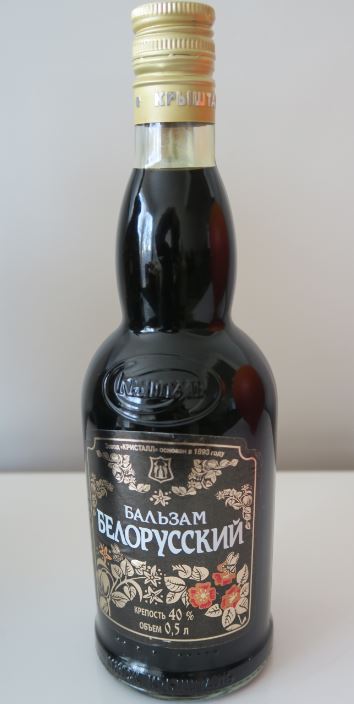
The prize was none other than a bottle of what will surely be a memorable Belarusian speciality. See that number at the bottom: 40? That’s the alcohol content. I kid you not. Apparently this is medicinal alcohol, a balm, I’m told. We shall see. (In fairness, the label does declare 20 herbs.)
The Highly Alcoholic Prize!
I know that my hosts are waiting anxiously for feedback on Balzam Belaruskii. For the moment I’m afraid I must disappoint them. Each time I look at the 40%, I shake my head. I’ll have to be very sick before I dare open this bottle.
In the meantime, I would like to thank the Anglo-Belarusian Society for a great event. Special thanks to Karalina Matskevich for her energetic organisation, Father Serge Stasievich for generous hosting, Aliaksandra Bielavokaja for her photography and to everyone else who was there, too, the young as well as the not-so-young. We departed into a glorious evening and I’d like to leave readers with an uplifting view. Here’s London’s Belarusian church at night, all lit up.
London’s Belarusian St. Cyril of Turau Church at Night
This Friday, August 31, will mark the 61st anniversary of Malaysia’s freedom from colonisation. For the first time in years, there is a revival of hope in my homeland.
It was inevitable that I spent part of this summer reflecting on what happened on May 9, when Malaysia went to the polls. We now know that Malaysians made history that day (see What Malaysia Means). UMNO, which stands for United Malays National Organisation, the political party that had ruled the country for 61 years, was finally booted out of office. The opposition coalition, led by former Prime Minister Dr. Mahathir Mohamad, won against all odds. His age – 93 years – is what Western journalists have focused on, but this is the least of it. What happened was astonishing, a rare victory for democracy and justice in today’s world.
As with many things Malaysian, the full story is dramatic and complicated. It began long before 2018. The tale is worth telling, though, for it bears the hallmarks of great fiction: power, intrigue, grit and remorse, forgiveness and possibly, just possibly, redemption.
But how to tell it to non-Malaysians in such a way that they will understand and enjoy? This article is my attempt. Between now and August 31, I will lay out Power, Remorse & Redemption in Three Acts here on my blog.
To understand the stunning firsts and reversals that took place on May 9, we must go back to another May, to a day that’s etched in the psyche of every Malaysian. May 13, 1969. On that day, the Malaysia of my childhood fell apart. Thus begins Act I.
May 13: Spontaneous Combustion or Arson?
I was only four when my father rushed home one afternoon. I remember his ashen face and gruff voice. He told my mother to switch on the radio, muttering a word I’d not heard till then: curfew. The broadcaster confirmed that a curfew had been declared. There were riots and fighting on Kuala Lumpur’s streets. My father’s descriptions were more graphic. He said that Malay men with sword-like knives had set fire to Chinese shop-houses.
Over the next few days fear permeated our house. It was the first time that I learnt to be suspicious of other races. Until then I’d thought of our Malay and Indian neighbours as people like us except that they wore interesting clothes and ate spicy food. May 13 destroyed this innocence. The crying shame is that many Malaysians have mixed lineage. Multiculturalism should have been a pillar of our country’s richness; instead, for the next 49 years, it became a political weapon.
To understand why Malaysia is naturally multiracial, you only have to look at a map. To the west of Peninsula Malaysia lies a narrow and sheltered stretch of water: the Straits of Malacca. In the days when pirates roamed the seas, seasonal winds brought adventurers from East and North, West and South. Ships invariably ended up docking in Malaysia.
They came from everywhere. From neighbouring countries like Indonesia and Thailand and from farther afield too: China, India, even Arabia and Armenia. Some of these traders settled. Malaysia is a paradise: peaceful, sunny and well-fed by rain, its very air exuding the promise of an easy life. Surrounding waters teem with fish; a seed only has to drop for it to grow.
European powers eventually arrived, first the Portuguese, then the Dutch and finally the British. It was the latter who recognised Malaysia’s potential. After gaining control of the country in the 19th century, Britain began developing the tin mines and rubber estates which would make the mother country rich. In a letter published in the London Review of Books on March 6 2014, Robert Lemkin, an Oxford-based filmmaker, wrote this about Malaysia:
‘In 1946 the colony’s rubber and tin industries brought the UK Treasury $118 million; the rest of the empire altogether yielded only a further $37 million. Without Malaya, the post-war British welfare state would have been unthinkable.’
Malaysia, then called Malaya, was the British Empire’s crown jewel. To develop their new industries, the colonials needed labour. They set about importing vast numbers of Chinese and Indian indentured labourers. Chinese and Indian populations had already settled naturally, but British policies changed Malaysia’s demographics overnight. The result is a rainbow country today with three main races: Malay (67%), Chinese (25%) and Indian (7%).
Many people confuse ‘Malaysian’ with ‘Malay’. Malaysian is the nationality, Malay the race. You can be Malaysian without being Malay, just as you can be British without being English.
For Malaysians of mixed heritage like me, of whom there are many, the crude classification above cannot properly reflect our roots. I fall under ‘Chinese’, but my great-grandmother had Malay lineage. And the many Malays I know with Chinese mothers or grandmothers are categorised merely as ‘Malay’. In reality Malaysians are a potpourri of Malay, Chinese, Indian and lots more. There were also indigenous tribes already in situ – the Orang Asli or ‘original people’ – the true natives of Malaysia, who are aggregated as ‘Malay’ in the above statistics.
Race is a lightning rod in Malaysia. It has been easy to use race to keep Malaysians apart because our political parties have traditionally been run along communal lines. What’s astonishing is that many still are – in 2018. You must be Malay to join UMNO, which is why it’s called the United Malays National Organisation. I would not be allowed into UMNO, though I’m eligible to join the Malaysian Chinese Association, MCA. Indians can join the Malaysian Indian Congress, MIC. This system of apartheid is crazy, but when you grow up with it you don’t see this. It’s such an accepted fact in Malaysia that even some of the newest political parties are race-based.
As a consequence of May 13, race ignited in the Malaysian consciousness – for all the wrong reasons. When race is used as a weapon, it’s a sign that someone’s power is being threatened. This was precisely the case in Malaysia.
On May 10 1969, a general election had been held – Malaysia’s third. The political line-up included three non-racial parties that were all part of the opposition. Anyone could join those parties, but their members were mainly ethnic Chinese and Indians, their supporters people like my parents, who were delighted by the results. The ruling alliance led by UMNOretained power but garnered only 44% of the vote, and lost its majority in three of Malaysia’s wealthiest states (as well as one on the east coast). Crucially, UMNO lost the two-thirds parliamentary majority that had allowed it to change Malaysia’s constitution at will.
But even more than the above, it was the lessons on race that terrified UMNO. In 1969, two of the multi-racial parties in the opposition fielded Malay candidates who were elected into office. This was a first; until then politics in Malaysia had been solidly communal. The results showed that a substantial minority of Malaysians were already prepared – in 1969 – to herald in a less racist country. It was equally clear that Malaysians wanted a real opposition, not toothless puppets. There was the promise of stronger democracy. Foreign correspondents praised Malaysia’s democratic process, predicting more efficient governance in future.
What happened next would change the above premise. It was a watershed moment.
The official explanation for the May 13 riots is that they were a ‘spontaneous’ outburst, the result of simmering tensions in a multiracial society. But a cursory glance at Malaysia’s 1969 election results will tell you that UMNO’s hegemony was being challenged.
Unsurprisingly, May 13 has not been properly discussed within Malaysia. No one has been called to account. There has been neither truth nor reconciliation, only avoidance. Official documents remained classified for 30 years. When I was growing up May 13 was the spectre we were not allowed to mention publicly, lest racial riots ‘flare up again’. It took this article for me to understand the significance of Malaysia’s 1969 elections.
A Malaysian social scientist, Kua Kia Soong, after a painstaking analysis of declassified documents, concluded that May 13 was no spontaneous outburst. ‘There was a plan to unleash this racial violence’. He adds:
‘Nor does it necessarily follow that there will be conflict when different ethnic communities coexist, as is implied in pluralist analyses. The role of the state has to be analysed in the particular historical conjuncture.’
(May 13, published by Suaram Komunikasi in 2007)
His analysis makes sense in light of what happened next. The UMNO-led government initiated policies that would seal UMNO’s position in the Malaysian political landscape. UMNO would rein in Malaysian democracy. Malaysia lost; UMNO gained.
It’s worth remembering that UMNO was formed first and foremost as a freedom movement. Its initial raison d’être was to rid the country of British rule. In this it was ferociously effective. But freedom movements don’t necessarily make good governments, as we have seen across the Commonwealth.
UMNO’s internal politics paved the way for the rise of the man known as Dr. Mahathir Mohamad, who would muzzle the press and dismantle institutional checks and balances. In so doing, he systematically destroyed Malaysia’s fabric, whether or not he intended to.
The fact that millions of Malaysians young and old came together 49 years later, also in the month of May, to support the same Dr. Mahathir and his new allies, is remarkable. I was among the many doing so, something I never imagined would happen.
I woke up on Tuesday morning in London on edge, thinking about Malaysia. A general election was due to be held the next day, Wednesday May 9, and I had not slept well. The campaigning had been outright dirty, even by Malaysia’s already chequered standards. We all knew this would be a crucial election – our country could not go on as it had. With Malaysia’s soul being fought for, it felt wrong to be so far away.
The crazy idea entered my head that I ought to go back. I began searching the Internet for flights and tickets and found that if I took a flight on Tuesday evening, I would arrive in time for the election results. It would be a thirteen-hour flight on a trip I had not even planned, but so what? I had done mad things before.
At the last general election five years prior, I had sat glued to screens in London, flipping between sites on the blogosphere. I was cautiously optimistic at the outset (see blog-post Malaysia’s Election Eve) and bitter by the end. I felt profound disappointment, not because what I had hoped for did not materialise, but because I believed that a small win had been stolen from the opposition.
There were reports of a dodgy electoral roll, washable indelible ink, mysterious ballot boxes and non-Malaysian voters. As I sat and watched the numbers trickling in it was clear, even from London, that the results were being massaged. Incumbent wins were reported quickly while opposition wins were delayed. At some point I remember a convenient power breakdown at Radio Television Malaysia. Perhaps my memory is playing tricks, but that is what I recall. Would it be different this time?
I did not know; I knew only what I felt – that I could not stay away. No matter what the outcome, I had to be there for these critical hours.
I packed hurriedly. I was surprised by how full the flight was, crowded with returning Malaysians like me. We landed just after polls closed. Kuala Lumpur, though calm, had an element of tense excitement.
It felt right to be back. Up in the air at thirty seven thousand feet, I finally understood how much Malaysia means to me. The bond I have with this land is unbreakeable. I carry Malaysia inside – it doesn’t matter that I’ve lived longer elsewhere.
If I had stayed away at this seminal moment in Malaysia’s history, I would have regretted it for the rest of my life.
The past forty eight hours have been exhilarating and sleepless, if a little worrying, but I would not have exchanged them for anything else. Yet, when I made the decision to come, we did not know how things would turn out. Some friends thought I was flying into trouble.
We know now that the opposition coalition of hope, Pakatan Harapan, led by Malaysia’s former Prime Minister Tun Mahathir Mohamad, secured an unequivocal win . The transition to a new government is not over and there is plenty of speculation about attempted chicanery by members of the previous government. But they are now dust; I don’t want to talk about them. What I’d rather focus on is that even if you aren’t Malaysian and haven’t visited Malaysia, my country can still be a beacon for you.
Because we Malaysians have achieved what once seemed utterly impossible.
We have managed to vote out a government that was tyrannical, rotten and so corrupt by the end that I’m told its cronies were seen openly bribing voters on the streets. Despite this and despite using every trick in the book – the gerrymandering of boundaries, an Election Commission unfit for office, an electoral roll on which as many as 15% of voters did not have addresses – they lost. Malaysians voted them out. The odds were stacked against us, but we did it.
We did this together, we Malaysians of all races and faiths. We came together as Malay, Chinese, Indian and everything in between; we came together as Muslim, Buddhist, Hindu, Christian, Sikh, atheist and whatever else; we came together for the common cause of saving our beloved country. We did this without bloodshed, riots or unrest.
This is something we can truly be proud of.
As I write this, the euphoria has not settled. We are still celebrating. The road forward will be hard – we know that. But it does not detract from what a great thing we Malaysians have done. And if we can do it, others can too. God bless Malaysia.
At the start of this series when I wrote about the Malaysian obsession with food, I mentioned that some street food vendors have been able to send their children overseas to study. This happens in my debut novel, The Woman Who Breathed Two Worlds. In reviews of the book, at least one American reader has expressed scepticism over such an outcome.
But in Malaysia it is perfectly possible for street vendors to become wealthy. To understand why, you have to appreciate the role of food for us. It serves as balm and salve, feeding not only our bodies but also our minds, and possibly even our souls.
The above is not an understatement. Food is everywhere in Malaysia, permeating culture and consciousness in ways I’ve not seen in any of the other 60 countries I’ve been to. Part of this probably has to do with Malaysia being tropical. Colours and tastes seem somehow more vivid in the open-air than in a cold climate and you end up smelling food pretty much all the time. Walk down any street, something is sure to be frying. Avoiding food is impossible, and we all know what heavenly aromas do to our stomachs.
Oyster Omelette – Can’t You Smell It?
Another part of the phenomenon has to do with the melting pot that is Malaysia. There are three main races – Malay, Chinese and Indian – each with its own distinctive cuisine. Food hawkers have therefore long had lots of competition; they’ve had to compete not just with each other but also with vendors of the other types of cuisine. Only the very best survive. The bar was raised from the outset; even foreign chains have to work harder. When I was a child, Kentucky Fried Chicken tasted very different in Malaysia than in the UK, for the simple reason that to entice customers, the Colonel’s chefs had to mix in local spices. The result was jazzed-up chicken that arrived crisp in baskets (instead of boxes).
But Malaysia is also dotted with the other extreme: whole coffee shops dedicated to a single dish. Many of the most successful food hawkers specialise in this way.
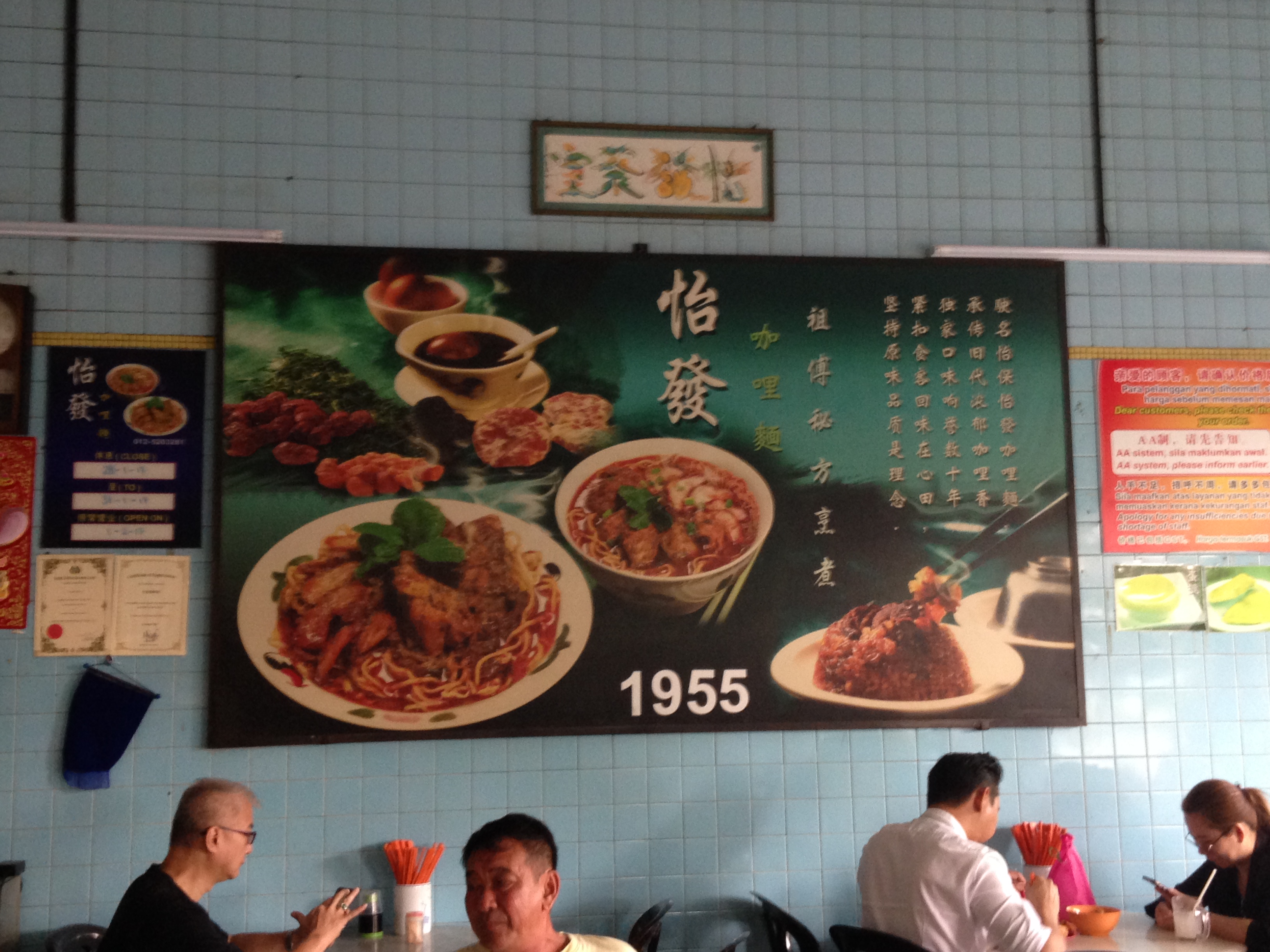
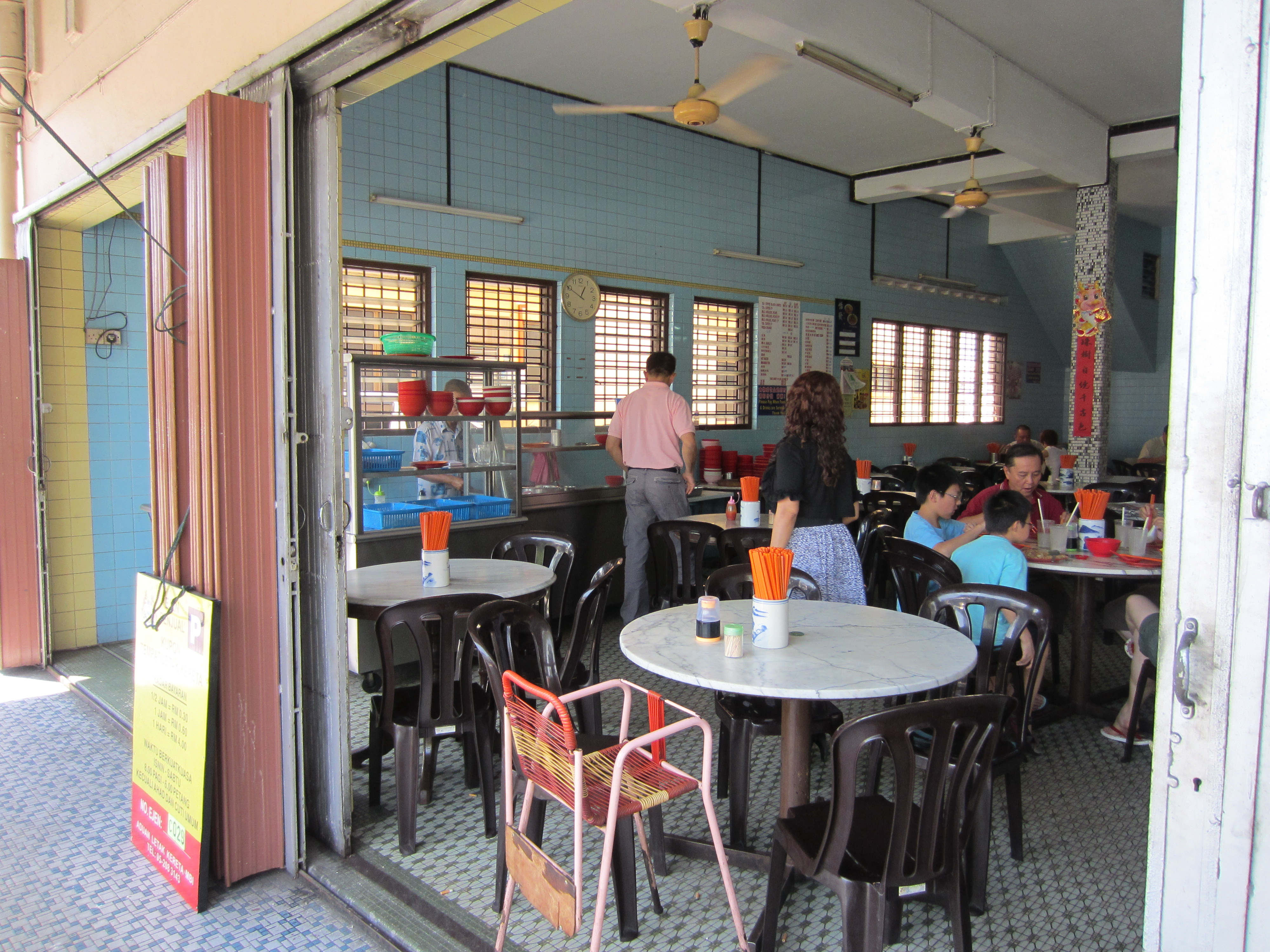
There’s a good example opposite my old school in Ipoh. The coffee shop is called Yee Fatt, it’s been going since 1955 and it’s famous for curry noodles. Yes, you read right. The place is known for curry noodles – not exactly a fancy dish. But the dish is so popular in Malaysia that it even has its own Wikipedia entry (as curry mee, which is what it’s also called).
All That They Sell – and Going Since 1955
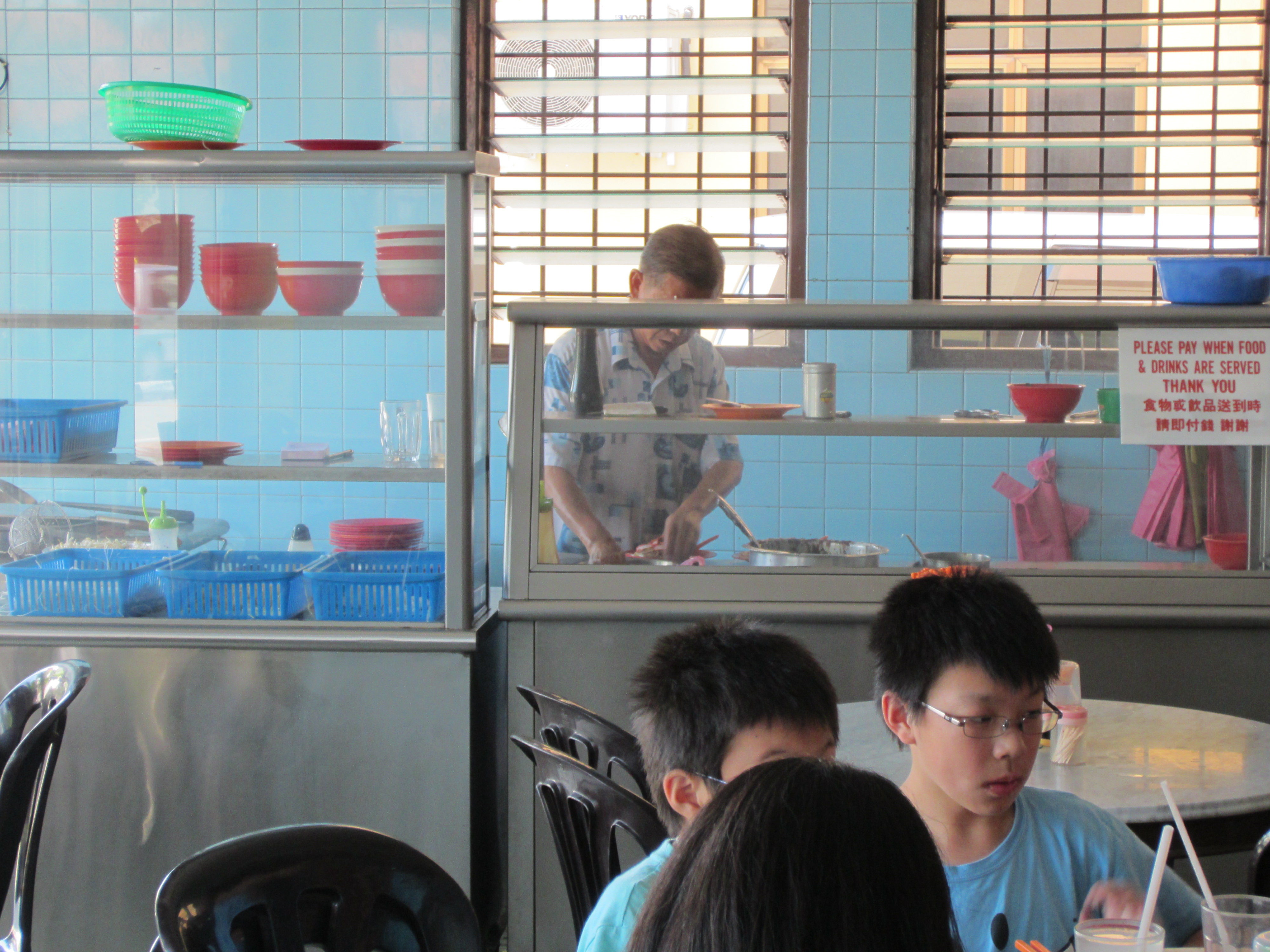
The boss at Yee Fatt is the middle-aged Chinese man in the picture below. What he’s doing behind the counter is blanching noodles and bean sprouts in hot water, lifting them on to plates, sprinkling barbecued pork over the top and then dousing it all in a thick curry sauce. He does this hour after hour, day in and day out, which may not sound like much of a life to some.
The Big Boss
But here’s the thing: the guy is his own boss. He opens early for breakfast, serves lunch and then closes his shop around three in the afternoon. That’s him done for the day! Afterwards he goes on a strenuous walk up Kledang Hill, one of many beautiful hills around Ipoh. We know because by the time we arrive at five, he’s well into his descent.
Note Yee Fatt’s longevity. How many small eating places do you know that have been going since 1955? Non-Malaysians may also find it amazing that Yee Fatt sells only two dishes: curry noodles and glutinous rice with pork (the mound on the bottom-right in the second photograph above). The curry noodles come in two versions: either dry – with noodles on a plate and spoonfuls of curry sauce heaped over – or wet, where the noodles are dunked in a bowl with curry soup. If you like, you can order extra bean sprouts and pieces of deep-fried bean curd as accompaniments.
My Favourite Dry Curry Mee
I love Yee Fatt’s noodles – soft but not over-cooked – which I guess would be called al dente in the West. Also, their bean sprouts are perfectly crunchy. Of course, it helps that they use Ipoh’s bean sprouts, which I think are the best in the world. I’ve told this to the Guardian newspaper, National Geographic Traveller UK and anyone who cares to listen! I can just imagine a celebrity chef like Anthony Bourdain declaiming the contrasts in this dish: the crunchiness of Ipoh‘s bean sprouts against the softness of just-right noodles. Smeared on top of it all is Yee Fatt’s irresistible curry sauce. I’m salivating as I write this and groaning a little too, since I won’t be having a bite anytime soon.
I’m not alone in being a fan, as this feature article in the Malay Mail (a Malaysian English language daily) a few years ago shows. And while polishing up this blog-post I found 7 other blogs praising Yee Fatt! (Here’s one link and another: I told you we were food-obsessed!)
Where, you may ask, does wealth come into the picture? Let’s just say that the boss, who looks as unassuming as his coffee shop, is said to be doing very well. I know you wouldn’t think this by looking at the photos. From a Malaysian perspective, however, the shop’s modest décor is actually comforting. It tells us that the food must be good – you certainly aren’t going for anything else. By keeping overheads low, the boss is making sure that he’ll be serving the town lots more curry noodles.
Unassuming and Brilliant
The man at the Yee Fatt coffee shop is not the only food hawker who has done well; there are others like him. Their success, though, may be peculiar to Malaysia, where people care more about taste than décor and will drive miles through pouring rain for a hawker’s food.
Readers love asking me how much of my stories are fact and how much fiction. One answer is that the historical events are real, but the characters are made up. Chye Hoon in The Woman Who Breathed Two Worlds was inspired by my own great-grandmother, who I never met. I know, though, that she earned a successful living as a food hawker, enough to send one of her sons to Britain for further education. So I can assure doubting readers that it’s possible for a food vendor in Malaysia to do this: it happened in my own family.










 Window into Other Worlds