Tag Archives: Malaysia

Snapshots – 5: Where is Home?

Home is a place where people understand what they see when they look at you, because when they look at you, they are seeing a reflection of themselves. In a foreign land, this doesn’t happen. In a foreign land, the people become confused by something as simple as your cheekbones. What sort of cheekbones are those, you see them silently wondering, as they scrutinise you with friendly curiosity?

My earliest memories are of my parents, of devouring the leg of a roasted duck, and the dark expanse of Malaysian sky overhead with its shimmering stars. It is warm, and I feel safe. I run around the garden singing Twinkle, Twinkle, Little Star, the first song I ever learnt. I look up at the sky and wonder how far the stars really are, if I can ever visit one of those stars.


The voices were already there.          “Dengan itu pendatang-pendatang Cina yang mulanya menetap di Melaka…” “With that, the Chinese newcomers who at first settled in Malacca…”

“…perubahan yang paling nyata dalam kehidupan orang Melayu ialah kemasukan secara beramai-ramai pendatang-pendatang Cina.” “…the most notable change in the lives of the Malays was the mass influx of Chinese newcomers.”

(Quotes from ‘The Malay Dilemma’ by Mahathir Mohamad, a book banned in Malaysia until he became Prime Minister).

 The voices haunted us.


In Malaysia, no one is confused when they see me. They can tell at once that I’m Chinese, and not a Muslim. These are the simple facts about my life which mark me out, as if I wore a yellow star on my head.


Her name was Puan Asny (Mrs Asny). For me, she is forever in her thirties, this Malay teacher with curly black hair, a long face and thin lips that curved into the most welcoming of smiles. She came from a village house near Ipoh, but it was at the Methodist Primary School in Petaling Jaya where she taught me. Though the images have become fuzzy with time, the kindness Puan Asny brought into her classroom has lingered inside of me, never to be forgotten. 

Puan Asny didn’t cover her head with the Muslim headscarf (tudung). None of my friends or their mothers did. The only person at my mission school who wore the tudung was a religious woman with bad breath who taught us the Arabic alphabet. I tell you this to make you aware that things haven’t always been the way they are today, in the home I once had.

I was in Standard Six when Puan Asny became my teacher, old enough to understand what the voices were saying. “The government’s policies aren’t fair,” I said one day. “But Selina,” Puan Asny said, looking at me with her large brown eyes which in my mind, were tinged with green. “The Malays are not like the Chinese. They need help.” We disagreed animatedly, she and I, but that didn’t stop our mutual respect.

Once, after my family moved back to Ipoh and I had left the school, my mother took me to wish Puan Asny a happy Hari Raya Puasa (the end of the fasting month) at her family’s village home. She was so happy to see us that she let out a scream, while I too rushed eagerly forward. We went inside to be received by her family, who enveloped us within their warmth. The memory of that feeling, that warmth, has stayed somewhere in my head as well as my heart.

The next year, I left for England and never saw Puan Asny again.


When I left Malaysia, part of my soul stayed behind, the part which I am only now beginning to rediscover. It creeps up on me at unexpected moments, giving succour to the Malayan family story I am busy polishing.


The voices have since become louder and more insidious. “Orang Cina cuma tumpang disini sahaja.” “The Chinese are only squatting here.” (Remarks made by Ahmad Ismail, Malay politician, at an open meeting on 23 August 2008, as reported by Li Weihua of the Guang Ming Daily).

The politician was banned from his political party for three years, but rank-and-file members received him as a hero, even awarding him a traditional Malay dagger.  


Learning how to be at home in a country which doesn’t welcome you is an art for which I lack the patience. Perhaps if I had no choice, it would be different. I would then, like my compatriots, pretend not to care, and learn somehow to block out the chattering voices. As it is, I hear their high-pitched whispers everywhere. 

Sekiranya tidak puas hati, pelajar Cina disuruh balik ke Beijing, Cina, atau pun Sekolah Foon Yew.  Beliau mengatakan pelajar-pelajar Cina tidak diperlukan. Bagi pelajar India, tali sembahyang yang diikat dipergelangan tangan dan leher pelajar India ianampak seakan anjing dan beliau mengatakan hanya anjing akan mengikat seperti itu.”

“In case of dissatisfaction, Chinese students were told to go back to Beijing, China, or to the Foon Yew School. She said that Chinese students are not needed. As for Indian students, the prayer strings they wear around their wrists and neck make them look like dogs and she said that only dogs would be tied in that way.”

(Taken from a police report on remarks made by a Malay headmistress during morning assembly at a multi-racial school in Johore, Malaysia, on 12 August 2010).

The headmistress was never dismissed, only transferred to another school.


To stay or to go, that was once the question. To stay put or to go back, that is now a question. If I go back, which part of me will I regain? If I don’t, which part of me will remain lost? 

Kerana Malaysia ialah tanahairku. Because Malaysia is my homeland (usual translation), my soil and water (literal translation), land which nourishes my soul (own poetic translation).

(Taken from personal notes which I jotted down during a recent visit to Malaysia, February 2012)

Below, I share an excerpt from my unpublished novel.

I had loved Ipoh’s hills from the moment I set eyes on them. On cool rain-soaked afternoons when everything outside smelt fresh, the trees covering the hills became so dark, they looked almost black, as if that were the only way they could retain the moisture from the heavens. Light mist would occasionally drift in, its white veil like the strokes of a brush on a perfect Chinese painting. On hot mornings, I could see the exposed rock more clearly and would marvel at the shapes which had been created …narrow pendants stretching down like long teardrops along the sides of many cliffs…and in the opposite direction, fat mounds that rose up from beneath, seemingly without effort…sculpted by years of the rain and wind which lashed down over the Kinta Valley.”

COPYRIGHT SIAK CHIN YOKE 2012


Is it possible to feel at home in a country which doesn’t want you? Yes, but only because you know it so well that it’s like an old shoe, wrapping itself around the contours of your feet and carrying you effortlessly onto familiar terrain. To survive as a non-Malay in Malaysia today, you must bury yourself in concrete to block out the echoing voices.

 “Orang Cina Malaysia, apa lagi yang anda mahu?...Berikut adalah senarai 10 orang terkaya di Malaysia. 1. Robert Kuok Hock Nien…10. Tan Sri Vincent Tan Chee Yioun.”

“Chinese of Malaysia, what more do you want?…The following is a list of the 10 richest people in Malaysia…(a list follows of whom 8 are Chinese, 1 Indian and 1 Malay)”

(Extract from an article by a Malay journalist in the Malay newspaper Utusan Malaysia dated 28 April 2010)


Can I block out the hissing whispers? I ask myself this repeatedly, and wonder about the cost of such effort. Where is home?
6 Comments

Filed under Cultural Identity, Identity, Malaysia

Snapshots – 3. Day with a Special Chef

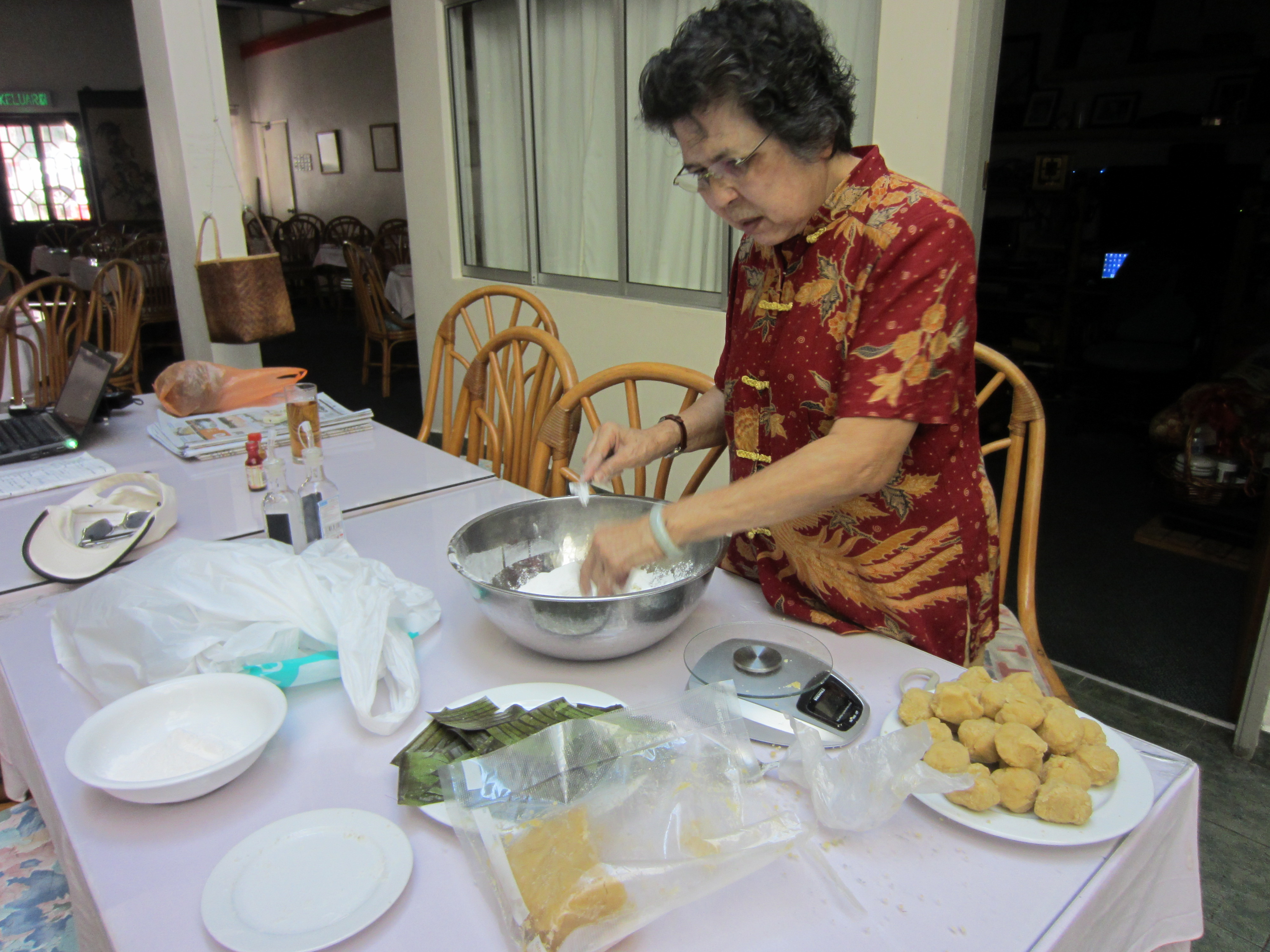
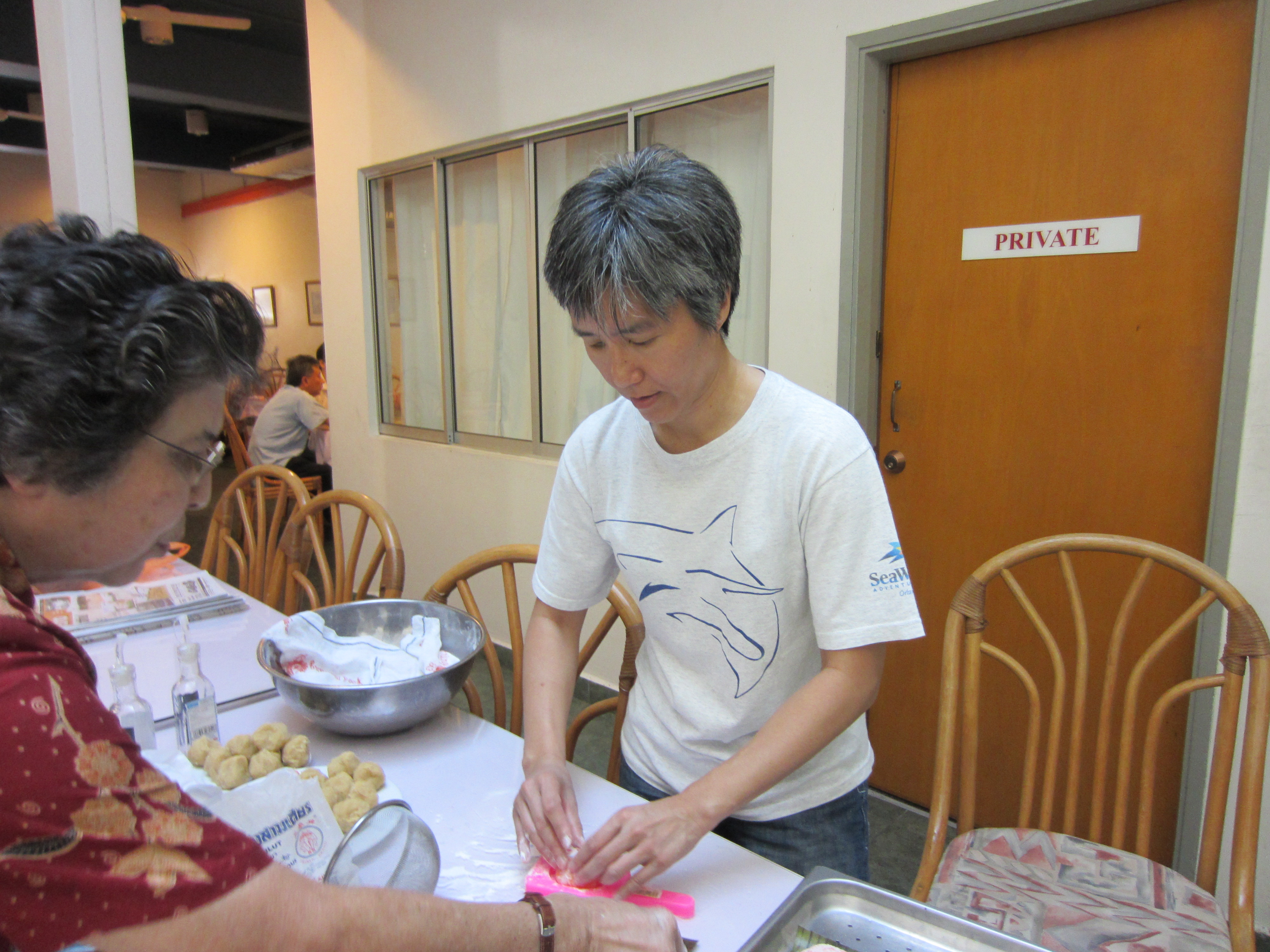
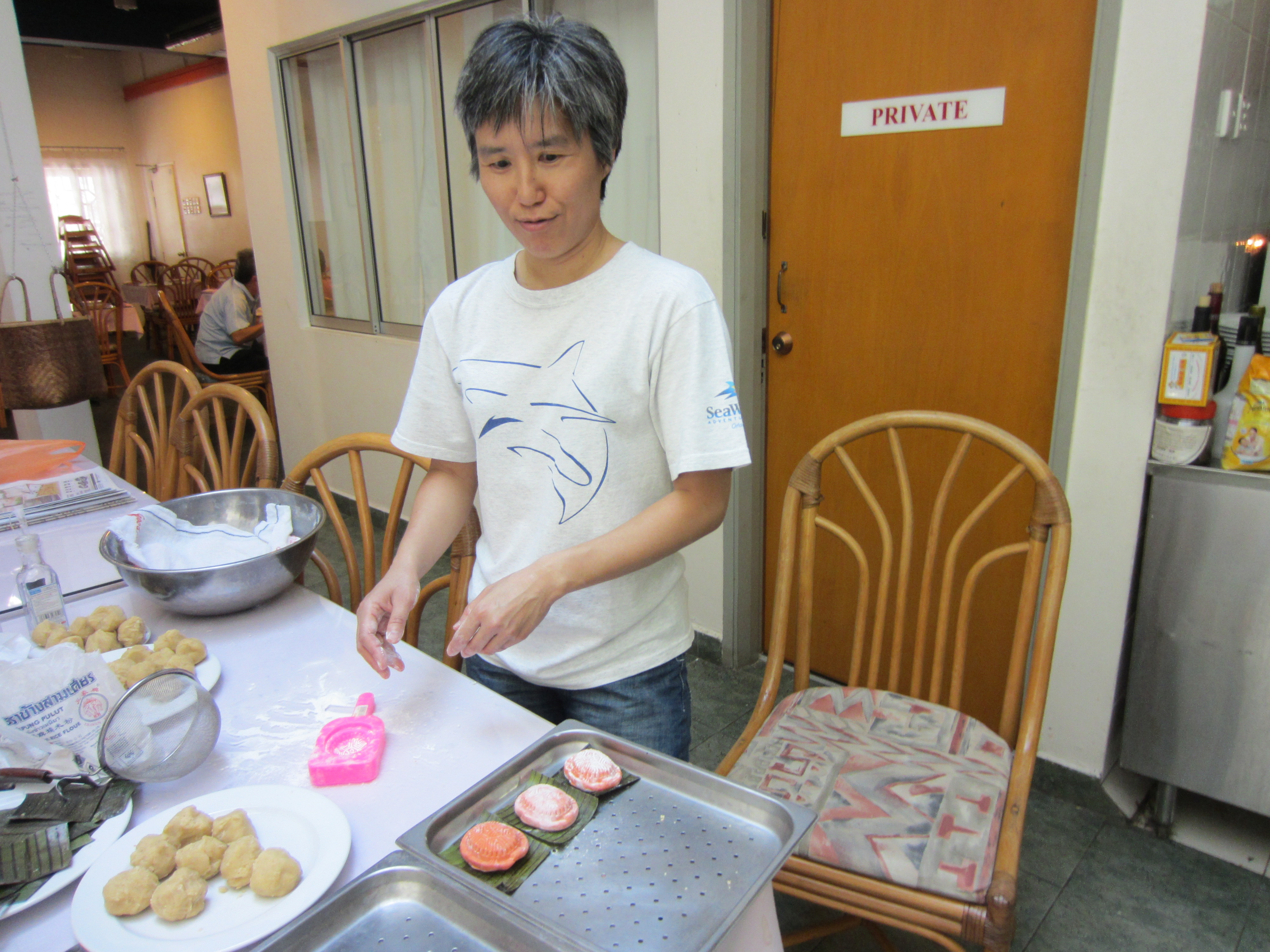
I held my breath. On turning the bright pink mould upside down and giving it a gentle tap, I could barely believe that what I had just fashioned with my fingers would fall out. Yet fall out it did, plopping into my open palm without fuss, its shape intact. You can see the look of utter surprise on my face.

I had finally made my first angkoo.

If you’re not from south-east Asia, you may well ask what angkoo is and why on earth I would want to make it.

In the photograph on the right, angkoos are the orange-red mounds resting on the tray at the bottom. Each angkoo comprises a glutinous rice skin, coloured orange-red and filled with steamed mung beans. Not your cup of tea? You may change your mind once you’ve tasted one: angkoos are sweet and delightfully aromatic, with lots of thick coconut milk and sugar.

Why this interest in angkoo? Well, angkoo is a well-known type of ‘cake’ or kueh made by the Nyonyas. It also has symbolic significance, because angkoos were traditionally given by a Nyonya couple to their family and friends when a new baby reached its first month. Angkoo features at key moments in my novel because of this symbolism. It has additional import for my main character, because it is while making angkoo one day that she finally realises what being a Nyonya actually means for her.

Because of the role angkoo plays in my novel, I’ve had to follow its recipe in detail, trying to imagine what it would have been like making angkoo in a sweaty olden kitchen. This week, I decided it was time to consult an expert.

Who better than my aunt Lorna, who comes from multiple lines of Nyonyas? My aunt’s grandmother was my Great Grandmother, a fierce Nyonya woman, and my aunt’s mother was also a Nyonya descendant of many generations. Aunt Lorna runs Sri Nyonya, one of the best-known restaurants in Petaling Jaya specialising in Nyonya cuisine. (Petaling Jaya, PJ to locals, is close to Malaysia’s capital of Kuala Lumpur).

I was nervous before we started, uncertain how the day would go. Everyone had told me beforehand what hard work Nyonya cooking was, especially the ‘cakes’ or kueh I wished to learn.

For the first few minutes, I stood watching my aunt in awe. By the time the photograph with my stunned face was taken, I had relaxed, because most of the arduous work had been done. I call it arduous, yet it was easier than in the days when my main character was making her angkoos. She would have had to grind her own glutinous rice flour by hand; we bought ours in ready-made packets. She would also have had to chop firewood for the stove and use bellows to control the strength of the fire.

Despite our modern conveniences, I can’t say the work was easy. There was much mixing and kneading and steaming. Even though aunt Lorna had steamed and crushed the mung beans the day before, it still took us a couple of hours to make thirty two angkoos. Each angkoo has to be made individually, which means that the amounts for every skin and ball of filling have to be separately weighed. Only thereafter could the fun begin: the shaping of each angkoo into its mould and the ‘knocking out’ of the angkoo.

From the photographs, it’s obvious I had to concentrate hard. Aunt Lorna showed me how to flatten the orange-red angkoo skin on my palm, making sure the skin became thin but at the same time, was thick enough to hold its filling. When the skin was properly prepared, I placed a ball of the mung bean filling onto it and slowly pulled at the sides of the skin to close the wrapped ball up. Then, I pushed the ball into an intricately designed mould. The traditional moulds were wooden, but we used a bright pink plastic mould with the characteristic tortoise pattern inscribed. I was told that if I coated the mould properly with glutinous rice flour, the angkoo should simply drop out when the mould was turned over and given a soft tap. Although I understood the theory, it still felt like a small miracle whenever an angkoo fell out with no problem. I always breathed a sigh of relief.

My angkoos tended to have wobbly sides, not the clean lines of my aunt’s expert hands, but that didn’t matter, because they all tasted wonderful once they had been steamed. They were a perfect shade of orange-red too – thanks entirely to my aunt, who had mixed in the colouring in judicious proportions.

It was only afterwards, in the quiet of the night, that I became aware of the emotions I must have carried during the day. I remembered the joy I felt as we, my aunt and her helper Theresa and I, chatted happily while knocking angkoos out. I imagined my main character doing the same a hundred years ago in her old-fashioned kitchen. She would also have been standing with other women, surrounded by the sound of chattering and familiar aromas, of garlic frying and pandanus leaf steaming. It was in the midst of such activity that she learnt to appreciate her heritage.

For me, what began as a research adventure turned into an intense, highly personal event. Making angkoo with aunt Lorna was a privilege, an experience I will never forget.

3 Comments

Filed under Cultural Identity, Malaysia, Novel, Nyonya, Research

Snapshots – 1. Malaysian Hospitality

This week, I’ve decided to become a part-time tourist. I’m in Kuala Lumpur , capital of Malaysia, bustling metropolis, city of gleaming skyscrapers. At least, that’s the image Tourism Malaysia likes to project. But this image, like many others, is part of a more complex reality.

So what’s Malaysia really like? In a series of short blog-posts, snapshots really, I’d like to share my personal impressions as a returning visitor. Most of these snapshots won’t relate directly to my novel, some will, but I hope all will help provide a better picture of what Malaysia has become today.

Although I know I’m not the average tourist, most people seem to assume I’m a foreigner. It must be the way I stride around. They’re usually shocked when I start speaking in Malay or Cantonese. Up till that moment, I’m sure my experience is as good as any tourist’s. So it only seems appropriate for my first snapshot to be about Malaysian hospitality.

Forgive me for beginning with a cliché: Malaysian hospitality really is as warm as that projected in advertisements. Thank goodness for that, because things often don’t work the way they’re supposed to in this country.

Take the online check-in process with Malaysian Airlines. I couldn’t for the life of me work out how to check my partner and me in online (it turned out I wasn’t given an obscure piece of information which the website requires). So I called the helpline number on the website, and bingo! Problems resolved, with true Malaysian service in the process. The man who answered the call stayed with me throughout, listening to what I was doing, repeating numbers and letters, until I had checked us both in. Even though I was still in London at the time, the service struck me as different: there was warmth, a friendliness which I thought distinctly Malaysian. (Tip: if you ever need help on anything Malaysian, find a real person to speak to).

The same thing happened with my pre-paid SIM card. I had difficulty topping it up online. After fiddling for several hours, I gave up. I took it back to the shop, where the man remembered me from when I had bought the card. With a smile, he asked after my partner and topped up the SIM card in 3 seconds flat.

Examples like these happen all the time. I personally think that what we know today as Malaysian service comes from traditional Malay hospitality, which is gracious, gentle and full of warmth. I love it; it evokes a feeling which is distinctly Malaysian. For this, we have to thank our Malay fellow-citizens, whose language encapsulates the essence of this hospitality. ‘Thank You’ in Malay is ‘Terima Kasih.’ Literally translated, the words mean ‘Receive Love’. Long may Malaysian service continue being what it is.

1 Comment

Filed under Cultural Identity, Malaysia

The Malaysia We’ve Lost

My novel, set in Malaya (now called Malaysia) is multi-layered. I’ve written it in such a way that a reader can enjoy it without knowing any Malaysian history. Of course, the story would be richer for those with some knowledge of the country. Malaysians will see more to the story than Westerners…perhaps even controversy and criticism of present-day Malaysian racial politics.

It’s not intended as such; I simply wanted to tell a powerful and entertaining story. Yet, there’s no denying that at the time the story begins, Malaya was more truly one country than it is today. Which is ironic, because the current Prime Minister has initiated a campaign called “One Malaysia” – 1Malaysia, supposedly to ‘preserve and enhance the diversity which is our strength’. I will explain in this blog-post why the slogan 1Malaysia is farcical when used in today’s Malaysia. Below, I write from my personal experience and understanding.

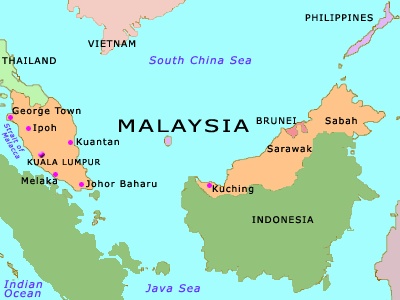
First, I have to tell you more about Malaysia. Let’s start with where it’s situated. The map below should help. Malaysia is coloured orange and comprises two parts: a western peninsula, and the northern part of Borneo (the island on the right, which belongs mostly to Indonesia). The point to note is Malaysia’s strategic position. India lies to the north-west, China to the north and north-east. Siam (now Thailand) neighbours it to the north, while Indonesia lies directly south. That narrow bit of sea which separates western Malaysia from Indonesia, known as the Straits of Malacca, provides a sheltered channel for ships and is still famous for pirates.

Because of this fortuitous position, Malaysia has been at cultural cross-roads for centuries. Malays themselves are thought to have come from Yunnan in southern China. Traders from as far as Arabia also came, as did Indian princes and of course, some of my ancestors, the Chinese, who arrived in their junk-boats. Nearer home, Malays from neighbouring Indonesia migrated in regular waves, not to mention the south-bound Siamese (modern Thais) on the backs of elephants.

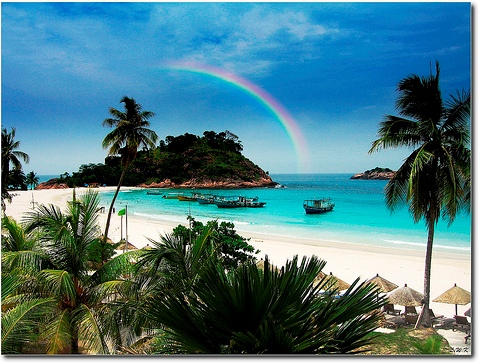
Many of these early immigrants settled in Malaya, which is not surprising – the land I come from is glorious, its people hospitable. It has everything: stretches of sand where palm trees sway, pristine waters always warm to the touch, but also mountains crowned in luscious green.

It’s a piece of paradise on earth. As a result, new communities grew, including mixed-heritage peoples like the Nyonyas.

Then, the British came. (Though there were other Europeans before – Dutch, Portuguese, they’re not important to this narrative). The British arrived in the late 1700s, but their influence reached its nadir during the late 1800s where my novel begins. Under British rule, the waves of migration – which had happened naturally in Malaya until then – were disrupted by the large-scale organised import of labour from India and China. The new workers were needed for the rubber plantations and tin mines which the British opened up.

With all this migration, you might have thought that nobody lived on these lands until the waves of immigrants arrived. Not so, because there are indigenous peoples in Malaysia– the Orang Asli (which incidentally means the ‘original people’ in Malay).

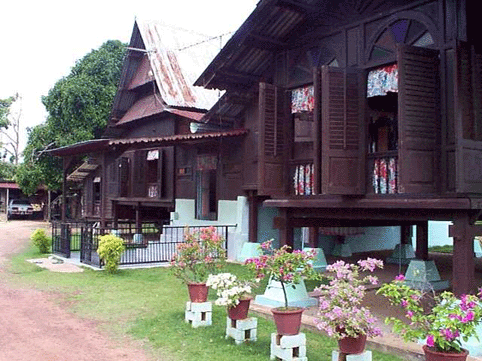
The racial composition of modern Malaysia is: Malay (50%), Chinese (24%), Orang Asli (11%), Indian (7%), others (8%).  As with many multi-cultural societies, each community is famous for certain things – except for the Orang Asli, who have been marginalised. Malays have a refined sense of beauty; just look at their traditional dresses and houses (picture on right, below).

Indians are entrepreneurs and professionals, especially in law and medicine. As for the Chinese, well, shrewd business people who work hard, with many self-made millionaires from among the coolies who arrived during the tin years. In fact, the Chinese diaspora in Asia are called the Jews of the East, our priorities being family, children’s education and business. I know quite a few who say, “Let me do my business. I don’t care about politics”.

With such rich heritage and diversity, Malaysia must be the perfect place to live, right? Just like in that world-famous song from the Malaysian Tourist Board ad campaign – Malaysia, Truly Asia  –where people of different races dance and smile happily? Unfortunately, not quite.

In the late 60s just after I was born, a series of Chinese pogroms happened. Many Chinese were murdered. Actually as soon as I was born, I had to flee Singapore: my grandmother and her maid took me away from my parents to a safer place (near Ipoh), many hours away by train at the time. For two women travelling alone in that time of calamity, it was heroic, and I am so grateful…

And then, on the infamous day 13 May 1969, I remember my father returning early from work. He rushed up, shouting in Cantonese, “They’re killing us!” “Who, who?” my mother asked, and when we heard that Malay mobs were attacking Chinese with scythes and knives, we could hardly believe it. We’d had Malay neighbours, Indian neighbours, all sorts – people who came to our house and drank from the same glasses. In fact, we were living in a predominantly Malay area then, and almost all our neighbours were Malay. We were terrified: if a mob had come to our house, we could have been killed….

No one really knows who caused the incitement which led to these so-called ‘racial riots.’ However soon after – in order to ‘manage racial tensions’ (i.e. to make Malays as rich as Chinese were), racially discriminatory policies commenced which are still in place today. Note that these policies are supposedly justified on the grounds that the Malays arrived in Malaysia before the other immigrants did. Therefore, they are entitled to ‘special rights.’ They’ve even invented a term to enshrine this quality of specialness: bumiputera, which means the Princes of the earth. (Obviously, they couldn’t call themselves Orang Asli, since there were already indigenous peoples.)

These discriminatory policies have been sold as a programme of ‘positive discrimination’ to allow the Malays to catch up economically with the Chinese and Indians. Policy examples:

  • Any listed company to have at least 30% of equity ownership in bumiputera hands.
  • University places reserved for bumiputera, regardless of the academic performance (now modified, but still a two-tier system).
  • For a limited period, a certain percentage of new housing in any development reserved for bumiputera buyers, with developers required to provide a minimum 7% discount to these buyers.

There are plenty of others, but I’ll be restrained here.

Such blatantly race-based policies are bound to have consequences. They have changed Malaysia – and not for the better. Races have become more separated, less friendly to each other, with a cultivated list of grudges. Nyonya culture – that colourful mix of Malay and Chinese traditions, values and beliefs which emerged through centuries of living together and inter-marrying– could never happen in modern Malaysia.

Policies based solely on race are unjustifiable for other reasons.

First, they de facto assume that Malays would be incapable of competing on merit. As a person with Malay blood somewhere down the line, my Great-Grandmother being a Nyonya, I find this insulting (as no doubt do my mixed Malay-Chinese cousins).

Secondly, who cares whose ancestors arrived first on our shores? Surely what is more important is what we can each contribute to building up our country.

Thirdly, it creates the indescribable reality that not all Malaysians are equal. Which is sad, but true. This has played a large part in making it hard for me to come to terms with being Malaysian-Chinese (evidently, though I have Malay blood, I don’t have enough of it).

In the face of all this, how can we even talk of 1Malaysia?

There may well be Malaysians reading this who call me unpatriotic. Some may even say that if I don’t like it, I should go ‘home’. I don’t know where they think my home is; China? My response would be that if they can’t be criticised, they should stop pretending we have a democracy.

Especially for those who question my patriotism, I describe here what it was like for me being back in Malaysia after seventeen years away. I remember the moment well. It was afternoon when we landed. As soon as I stepped outside the airport, a blast of humid air hit me, and I felt the heat seep into my bones. It was such a familiar feeling, even after so many years, that if feelings could be painted, then that moment is forever engraved in my memory. I knew instantly that I had come home.

That moment made me realise my visceral connection with this land in which I grew up. It’s my country too. I will always have this connection, no matter where I live in this world. And no matter what racist policies remain in place in Malaysia. Policies which make me feel unwelcome and unable to live here to the full. Where is home for me?

2 Comments

Filed under Cultural Identity, Identity, Malaysia

She Arrived on an Elephant – Why I’m Writing my Novel

My novel is based on my Great Grandmother, whom I first heard about when still quite small. I remember being shown a black and white photograph in which a rather plump woman stood, wearing a patterned blouse that was fastened by an enormous brooch. “That’s grandma,” my mother told me simply. It turned out that was the only photo ever taken of my Great Grandmother and it was brown with age even then; it revealed a forbidding-looking woman, someone a child would be frightened of, despite the semblance of a smile on her round face. This impression was reinforced whenever Great Grandmother came up in conversation; with bated breath, the adults around me would exclaim – “Wahh! Very fierce ah!”

I was told Great Grandmother came from Siam (now Thailand) and was a Nyonya, words I hadn’t heard before and which seemed too complicated for my little brain to deal with. For years I didn’t dig any further, content to simply associate the word Nyonya with spicy dishes and with the kueh I enjoyed (see my previous blog post). Those who know me may find this hard to believe, but the fact that there was something I liked eating was actually a big deal – because I hated eating as a child. Every meal was a tortured ritual in which my mother was forced to slowly hand-feed me. I took so long to eat that by the time I finished, it would almost be time for the next meal. The net result was that for me, all meals blended into a single nightmare, so it must have seemed like a gift from heaven to my poor mother when she discovered that I would happily devour Nyonya kueh.

Over the years as I grew up, I remember being told that I was just like my Great Grandmother – stubborn and fierce. The comments weren’t necessarily intended as compliments, and initially they didn’t please me. But they were repeated so often that I became curious about the woman who had inspired them. Eventually I felt I had no choice except to find out more. It was then that I heard how she raised nine children on her own, unaided, with nothing to fall back on except her wits and business acumen. She couldn’t even read and write, but that didn’t stop her from establishing her own business. For a woman in Malaya in 1910, that must have taken guts, something Great Grandmother appeared to have plenty of.

Hers was a story I had long intended to write, but creative writing didn’t fit in with the fast world of finance. I was seldom at home and worked such insane hours, often in far-flung corners of the world, that there was barely time for sleep. Everything else fell by the wayside; in those days writing seemed a hazy dream to be pursued later, a bit like golf.

Then, two years ago, I was diagnosed with breast cancer. Because it was cancer, it meant I had to have not only surgery but also radio- and chemotherapy. For someone with needle-phobia who doesn’t take any drugs and faints at the sight of blood, the entire process proved very stressful – although I didn’t feel it at the time. It was only after my treatment had finished that I realised life had changed. For months afterwards, I felt adrift. No matter how much I slept, I couldn’t seem to regain my previous energy. My confidence waned, and there were days when I wondered if I could ever be the person I once was. I knew then that I had to alter the way I lived.

As a result, I began to do things I never did before. I stopped rushing around. I scaled down my business. And I discovered writing. I had heard about cancer survivors who had found a lifeline through creative self-expression, activities like pottery or singing, as well as writing. At a low-ebb one day, I simply sat down with a blank Word page and just started typing. Magically, as the sentences flowed, I could literally feel myself getting better.

Within two months, when I asked myself whether there was anything I would regret not having done if my life were to end tomorrow, I knew at once what the answer was. It was clear then what my next project had to be. Great Grandmother had already waited far too long.

8 Comments

Filed under Cultural Identity, Identity, Malaysia, Novel, Nyonya, Writing

My Great Grandmother’s Cakes…

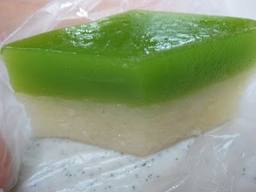
 …well, not literally. These are modern photographs, and sadly, not my own, but they convey the wonderful colour and intricacy of the ‘cakes’ my great grandmother would have made.

The ‘cakes’ feature heavily in my novel, as does the cuisine of the Nyonyas (explained below) – to the extent that my editor wryly told me one of the chapters made her very hungry! Which I took to be a good sign, given that I didn’t include pictures in my draft.

Now here’s what’s interesting about the ‘cakes’, which I will refer to henceforth by their Malay name of ‘kueh’ : they are wheat- and dairy-free. This makes them perfect for those of us who wish to avoid gluten and animal milk. Alas, I have to say the kueh are not for the weight-conscious, because they generally include copious amounts of coconut milk, coconut cream or grated coconut (sometimes all three!) as well as palm sugar (that lovely semi-viscous brown stuff you want to stick your fingers into). So the kueh may help with allergies, but not with girth…

Before I write more about the kueh, I should say a little about the formidable women who created them. The kueh you see here weren’t made by just anyone – but by a small community of women in Malaya known as the Nyonyas. This is important in my novel because the main character is a Nyonya (just like my great grandmother on whom the character is based). Therefore, the cakes the women made are known as Nyonya kueh. Which begs the question: who were the Nyonyas? 

The short answer is that they are women of mixed Malay-Chinese heritage going back centuries (from the time Chinese traders first arrived on the Malay archipelago). The timeframe is important, because there may be many people with mixed heritage, but very few have managed to evolve a community with a culture as distinctive as the Nyonyas’. The Nyonyas succeeded by combining local Malay values and customs with the beliefs and traditions of their Chinese husbands, in very particular ways. For example, the women – who were Moslem – took on the religion of their husbands, converting to Taoism. I mention this because religion played an important role in Nyonya life, and bowing before an altar table, lit joss-sticks in hand, is a recurring theme in my story. 

Of course in modern Malaysia, the fact that local Moslem women were able to convert from Islam to another religion, is never discussed. (It isn’t allowed today; today in Malaysia, if you’re born a Moslem, you remain a Moslem).  Which is another reason why Nyonya culture is so unique and fascinating: it developed during a time when Malaya truly was one. I will have more to say about this in a later blog. Watch this space!

Now, to come back to Nyonya kueh. There are many varieties, all delectable and delicious, and some have symbolic significance. For example, the red ones below (angkoo) are traditionally given to relatives and friends to celebrate a baby’s first month on earth. I remember my first taste of angku when I was three: how the skin, made of glutinous rice flour and sweet potatoes, felt soft; the filling, of crushed mung beans, even softer, and bursting with flavour. I didn’t know what the flavour was at the time; now I’ve learnt it’s the scent of the pandanus leaves with which the beans are steamed. Simply delicious!

So, with all these varieties, you may well ask why I haven’t made any Nyonya kueh yet. The answer is partly because I fear the work, Nyonya cuisine being notorious for its sheer labour (when done properly, with no shortcuts), and partly because I haven’t had time to source the necessary ingredients in London. I’m referring here to exotic things like pandanus leaves, green pea flour, and natural colourings from for example, the clitoria flower (I haven’t made that up). Once I’ve made my first batch of Nyonya kueh, you’ll be the first to see the results!


9 Comments

Filed under Cultural Identity, Identity, Malaysia, Nyonya