Ambiga, Allah and this Visit Malaysia Year

Did you know that 2014 has been designated Visit Malaysia Year? Following a successful campaign in 2007, this is my country’s ambitious attempt to draw even more visitors to its beautiful shores.

When it comes to tourism, the Malaysian government has learnt what to say. To lure the world, Malaysia’s racial, cultural and religious diversity are endlessly exploited. On a page entitled People, Culture and Language, my favourite part comes at the end of the first paragraph:

“Malaysians…respect one another, regardless of one’s race, religion and background. It is this ‘true’ Malaysian value that binds them together” (my emphasis).

Indeed. Malaysia is multi-racial, multi-religious and multi-cultural. It has been this way for so long that we cannot remember a time when the country was monolithic, if indeed it ever was. And Malaysians do continue to live in relative peace and harmony with one another.

But intolerance has been on the rise. I have felt this myself. I am recognisably Chinese, and during my last three visits, I was stared at by cold eyes which said: SQUATTER! I know I was not imagining this, because there were plenty of others (thank goodness) who welcomed me warmly as a fellow-Malaysian.

Into this fray comes the word ‘Allah’. Allah is Arabic for God, though I would liken Allah more to Almighty God, a concept pertinent to the monotheistic religions of the world. Allah has been widely used – without any issue – by Muslims, Christians and Jews in the Middle East and elsewhere. Moreover, there are claims that the word Allah pre-dates Islam. (For anyone interested, here are a few links: In the Name of Allah, The Economist Oct 15, 2013; an informative blog from the Arabic Bible Outreach Ministry; also Christian Answers which states that Jews and Christians in the Middle East called God Allah for five hundred years before the birth of the Prophet Muhammad).

Within Malaysia itself, the word Allah has apparently long been used by Malay-speaking Christians, who knows for how long. Since 1615, claims the Asia Sentinel. Who can tell? All I will do here is to note that Portuguese traders actually arrived in Malacca (a well-known port in Malaysia) in 1511, and among their missionaries was St. Francis Xavier.

Does any of this matter? It wouldn’t, if the Malaysian government had not decided to ban the use of ‘Allah’ by anyone other than Muslims when referring to God.

This issue, which has simmered since 2007, is not just a matter of semantics: when the use of a word is deemed to be the sole preserve of a particular group, it encourages feelings of religious exclusivism, superiority even, which in turn, breed intolerance. The loop here is subtle, self-perpetuating and insidious.

I have already described the rise of intolerance in Malaysia in an earlier post (see Where is Home?). Since the Allah row broke out, a sinister new twist has been added: places of worship – a host of churches, a Sikh temple (because Malay-speaking Sikhs also use the word Allah), and in retaliation, Muslim places of prayer – have been attacked. I deplore all of these, acts which would have been unthinkable in the Malaysia I once knew. A country riven by division is not the country I want to see.

Unfortunately, we can hardly count on the current government to halt the trend, since it helped create it in the first place. Tensions rose again when Malay-language Bibles (with the word Allah) were seized by the religious department. In a gesture of peace and reconciliation, Marina Mahathir, daughter of Malaysia’s famous former Prime Minister, appeared with flowers at a church. This is the Malaysia I remember, yet she was far from universally applauded. Following this, the King declared that in Malaysia, the word Allah was only for Muslims. Right on cue, another church was firebombed with Molotov cocktails.

Diversity itself is not the issue. There will always be divisions in any society: brown/white; Muslim/non-Muslim; Sunni/Shia; rich/poor; Chelsea fans/Arsenal fans. This last is only half a joke, my point being that any division could be turned into a fault-line if it is ruthlessly exploited. Differences do not need to become fault-lines; they only become fault-lines when a corrupt government, hell-bent on staying in power, deliberately cultivates religious and racial tensions to divide and conquer.

The bigger question is this: what sort of Malaysia do we want? A country where all religions are truly respected, as the Visit Malaysia Year website tries to imply? Or a country where Islam is implicitly assumed to be superior and every non-Muslim deemed an infidel, tolerated only because s/he cannot be got rid of?

I keep being told that the majority of Malaysians are like me, that they want a pluralistic, progressive, tolerant society of the twenty first century. This may be true, but we face a problem: the majority stays silent. The silence of the majority has allowed the vociferousness of a minority to shape a political agenda which has slowly but invidiously changed the country. As this thoughtful opinion in the Jakarta Post notes: “there is only a thin line between tolerance and intolerance”. THERE IS ONLY A THIN LINE BETWEEN TOLERANCE AND INTOLERANCE. We should not be complacent.

In a clarion call last week, a courageous lady told Malaysians that we must resist our silence and fear. Dato’ Ambiga Sreenevasan, former President of the Malaysian Bar, a woman honoured by Hillary Clinton with an International  Women of Courage Award in 2009 for her unstinting pursuit of judicial reform and good governance, made a speech reminiscent of Martin Luther King’s.

Here is part of it:  “When they speak the language of racism and bigotry, we must respond with the language of unity and togetherness. When they speak the language of ignorance, we must speak the language of knowledge. When they attack our brothers and sisters, we must defend them. We must respond from a position of knowledge if we see such ignorance. When they create fear, we must respond with courage, when they divide, we must unite.” (As reported by The Malaysian Insider, Feb 11 2014)

No one could have put it better. Fellow-Malaysians, our despair is the enemy’s biggest weapon. It is not too late to rise, to challenge bigotry when we see it, and reclaim the Malaysia we’ve lost. Because Malaysia Boleh (Malaysia Can).

7 Comments

Filed under Cultural Identity, Identity, Malaysia

When do you Stop?

In just a few days, the Snake will give way to the Horse (in the Chinese zodiac). It was roughly a year ago, before the Snake had even entered, that I finished my tome of a historical novel.

Here’s what I mean by ‘finished’: I planned it, did my research, wrote the first draft, and then ‘edited’ that draft twice – from the first page through to the last, where editing included the heavy re-writing of particular chapters. I was aided throughout, even in the early stages, by Dr. Nathalie Teitler, poet, director of The Complete Works II and a professional developmental editor. Some writers think this unusual, but for me, feedback is invaluable while I’m still crafting a story.

Ultimately, the whole endeavour took two years. This, I was told, was not that long, given the scope of what I attempted: a story commencing in 1878 and ending just before the Japanese invasion of Malaya in 1941 (a period which spans sixty three years), where real history is incorporated into a fictional setting.

Writing my book made me look at art and artists in a different way. Most of us see only the finished piece, be it a book or play, opera or painting; we don’t usually think about how much effort a ballerina or opera singer, actor or painter, has had to put in. Now I know.

My novel Spirit of Kueh contains roughly 145,000 words. To give you an idea of what that means, the first two paragraphs of this blog-post contain approximately 100 words. Imagine writing 1,450 more paragraphs like those and then editing each twice, and you will perhaps see why it took so long. By the time I finished, I had reached the point of exhaustion. I closed the folder on my PC marked ‘Manuscript’ and could not look at it again. There was no way I could have edited my novel a third time – not then anyway.

In this age of bite-sized concentration and 140-character sound bites, I’m aware that a novel of 145,000 words is deemed long, especially for a first-time novelist. A published novelist I met (who hasn’t read any of my work) claimed I would never find a publisher. We shall see.

I don’t doubt the challenge, but having put a lot of thought into the way my story should be structured, I believe it hangs together as a coherent whole and some impact would be lost if the story were to be split up. Also, we’re not short of drama: the female protagonist, who is illiterate, starts her own business while raising a family of ten children. Ten children! How many of us could imagine raising ten children? All of this takes place against a backdrop of a rapidly westernising Malaya. Hence the themes in my novel are rather contemporary : the ongoing conflict between modernisation and tradition, and especially for those of us living as minorities in a foreign land: what is the true cost of (our) cultural assimilation?

My next step then, after three months of research, was to send off query letters to agents, together with a synopsis and the relevant pages or chapters. Each agent, incidentally, is different: writing to them is like applying for a job; there is no ‘standard’, and everyone asks for something slightly different, which means that each query takes time to prepare. I wrote to five agents, received one response – a no – and was ignored by the others.

Fortunately or unfortunately, life then took over. I became bogged down with managing a house renovation project in a new country (France) and my routine went kaput. In snatched moments, I wrote. Not being able to focus in the same way, I turned my hand to non-fiction, jotting down hundreds of snippets about the many surprises France laid my way. I also wrote two pieces of flash fiction (published in Litro Online and Postcard Shorts) and several short stories (now under consideration for publication). Without a proper routine, it was impossible for me to even think about what Helen Dunmore, the award-winning author who visited us during the one Arvon Foundation course I attended, called ‘writing biz’: the process of dealing with the commercial, non-creative side of writing. Agents and publishers fall into this category.

Now that we are about to enter the Year of the Horse, it feels to me that the time has come. I have looked again at the folder marked ‘Manuscript’ and have, inevitably, begun further editing. This time, I bring a fresh eye and new skills, skills I could only have gained by writing short fiction. Indeed, I find that many of the published novels I read today could use further editing. In art though, there is no right or wrong; you could continue editing a story ad infinitum. When do you stop?

4 Comments

Filed under Novel, Writing

Truth and Compromise

What do you do as a writer if you are asked to substantially edit a piece you have written? To change its nuance, remove paragraphs, and substitute them with anodyne words to which no one could possibly object? Do you comply so that you can be published, or stand firm at the risk of not adding to your writing credits?

This was my dilemma recently. While trying to publish a piece of non-fiction, I walked into a minefield. It was a strange experience, because the handful of words to which objections were raised seemed so innocuous to me. Here is what I wrote:

“While there are excellent foreign-trained practitioners, my overall experience has been that UK-trained general practitioners are more thorough than foreign general practitioners.”

The editors didn’t like that sentence. A British friend argued that what I wrote could be regarded as inflammatory. I read and re-read the piece many, many times, and failed to see what could have been inflamed. The sentiments conveyed seemed to me to be pretty innocuous. After all, I did not mention race, colour or religion, diminish anyone or incite hatred and violence.

If we cannot say something as mild as this in the United Kingdom, just what can we say? It seemed crazy, especially since I am also a foreigner (a point I made in the article).

For twenty four hours, I thought very hard about complying with the suggested editorial changes. The possibility of adding another publication credit was tempting. It would have been so simple…all that was needed was for me to change a single paragraph in the middle of the piece. The prose already flowed well and few adjustments would have been necessary.

But whenever I returned to the sentence above, the idea that such harmless sentiments had to be wiped away always made me choke.

Now, if the editors of the journal concerned ever read this blog-post, they will protest that I have not provided enough context. They will say that they had good reasons for recommending their changes. And of course they did: we humans can rationalise anything we wish. But equally, there is no denying that what I faced was censorship. And it felt wrong.

It’s not that I believe in the right to absolute freedom of speech. Words create our reality, and when we use them carelessly, there should be consequences, especially in this age of bite-sized concentration and click-of-the-button diffusion. Freedom of expression should not extend to protecting the arrogant young men who threaten women on Twitter with rape and other abuse. Freedom of speech should not protect the Front National candidate who last week compared France’s sitting Minister of Justice, a black woman, to a monkey.

But when all that you are doing is relating your own experience in as thoughtful a way as you possibly could; when you have taken great care not to insult – are you not entitled to share your view?

Granted, there could have been someone somewhere who may have taken offence at what I wrote. A lot of what we say has the potential to cause offence, rightly or wrongly. But, aside from making sure that we are not abusive, slurring anyone or inciting violence and hatred, do we really have a duty to protect everyone on this planet from being offended? Where do we stop – should we also avoid speaking what we believe is the truth? And who do we really protect in the end – others from being offended, or ourselves from being attacked?

I kept imagining the article the editors wanted to see, versus the one which I had wanted to write. If I compromised on such a simple point, what hope was there that I would ever be able to stand up for any principle?

A quote from the novel The Powerbook by British author Jeanette Winterson describes what it felt like:

“The body can endure compromise and the mind can be seduced by it. Only the heart protests.”

It was my heart which protested. My eyes looked at what I was told I had to cut out, and my heart would not let me rest. If I had to choose again, I know I would make the same choice, even if it means another opportunity forgone.

2 Comments

Filed under Writing

The Garage, the Maestro and the Wardrobes

I took a holiday from this blog during August. Post the near-completion of our French house project (see blog-post Oh Interfering Life!), I was exhausted. The time was perfect to bask in the sun. I then planned, after a short break, to continue searching for an agent before commencing work on another book – the second in my intended trilogy.

But when you spend time in country that is not your own, even the simplest interaction can contain the unexpected. My brain became full of impressions of France which begged to be recorded. Once I began writing them down, I found I couldn’t stop; other forces took over and stories leapt onto paper. France seemed truly able to surprise. Here I present: a simple story about wardrobes.

(Copyright: Selina Siak Chin Yoke).

These were no ordinary wardrobes, having been designed and made-to-measure by Jean-Paul, a Frenchman who has been supplying customised wardrobes for twenty five years. He visited my partner’s house not once but twice to take detailed measurements. Everything about Jean-Paul was elegant; even his moustache seemed to grey elegantly. ‘I want to be complètement sûr,’ Jean-Paul said while stroking the manicured tuft over his lips, ‘that I have the exact measurements.’ With such precision, my hopes were high for his wonder wardrobes.

France

Their components rumbled towards the house one Friday afternoon. The neighbours, already accustomed to trucks and vans and strange workers outside my partner’s house, peered out of their windows. What more could these foreigners be doing?

For an hour, the neighbours were entertained by the sight of Jean-Paul, slim and standing six-foot tall, side-by-side with a squat truck driver whose obligatory pot-belly must have got in the way. Little and Large battled with sixty pieces of doors and shelving. They panted and yelled and heaved until eventually, our not-inconsequential garage was three-quarters full.

‘But,’ I asked Jean-Paul, ‘will all the pieces stay there over the weekend?’

Mais oui,’ he replied, giving me a strange look.

‘Won’t you start putting up wardrobes today?’

Bah non!’ Jean-Paul exclaimed, steely blue eyes flashing. ‘The parts are heavy, vous voyez. Besides, there is a lot of work to do.’

Quite, I thought; why not start now? But no, Jean-Paul shook his head adamantly. His sole task that day, he insisted, was to receive the goods and make sure he had everything his fitters would need; assembly would wait till the next week.

The following Monday, Jean-Paul duly turned up with a man and a boy. The boy, who looked all of sixteen and was called Robert, turned out to be Jean-Paul’s son. Thankfully, the man was a seasoned worker; I could tell this from the lines on his face and the muscles etched into his arms. Jean-Paul introduced him as Georges. Georges, Jean-Paul announced, was un vrai artisan, the best in the business. Georges would put our wardrobes together, aided by the young Robert.  ‘I give you my best worker,’ Jean-Paul crowed before leaving. ‘Georges loves cupboards!’

Georges did indeed love cupboards, as I discovered two days later. After an enormous amount of drilling and knocking from the principal bedroom, spiced by the odd shout of merde!, Georges finally invited me to view his handiwork. His normally serious face broke into a grin. ‘It was very hard,’ he said. ‘Your floors are not level. I had to make many adjustments. But we succeed!’

Georges slid the wardrobe doors open with a flourish. ‘Regardez! Rollers on both the top and bottom,’ he told me proudly. Georges pulled what he called the ‘beautiful’ drawers in and out. He pointed eagerly to the hanging spaces he had made, all the while caressing the smoothly lacquered doors like a man in love.

By lunchtime the following day, a more sombre mood had settled. Georges shuffled into the study to see me. ‘You have to come,’ he said, ushering me towards the guest room. ‘We have a serious problem.’

I followed Georges. Shelves were up in the guest room, wardrobe doors already in place. What on earth could the matter be? Georges slowly pulled one of the doors all the way to one side, so that the cupboard it fronted was ostensibly closed. ‘Look what happens now.’ Georges released his hand. We watched as the burnished white door slid – and continued sliding until the cupboard was half-open. ‘Your floors are too uneven,’ Georges muttered. ‘I managed a trick in the main bedroom, but here, non! The doors won’t stay shut. I’ve tried everything. Incroyable!’

‘But…how can this be?’ I wondered aloud. ‘Jean-Paul himself came twice to take measurements. And now we have cupboards…THAT CANNOT STAY CLOSED??’ I looked at Georges, who merely gave an almighty Gallic shrug of both shoulders. But I saw that his brown eyes were troubled.

I stared at the wonder doors. When I pushed one for myself, it felt as if we had doors on skates. I knew where the problem lay: the rollers Georges had installed were simply too good. ‘Georges, you must give us shittier rollers,’ I said, and his eyes nearly popped out from behind metallic glasses.

Non non Madame,’ he shouted, ‘I have a solution! Des amortisseurs!’

The decibel level in the room rose as Georges described the shock absorbers which could be fitted to the end of every door. Each would apparently have its own magnet, and it was obvious Georges could hardly wait. ‘You just give a gentle push,’ he explained, tenderly pushing a door shut to demonstrate, ‘et voilà! This solution is le top!’

Georges was so pre-occupied by the phenomenon of doors gliding on their own that he overlooked an even larger problem: four of the doors that had been delivered were of the wrong type. He didn’t spot the mistake, and neither did I. It took my partner’s fresh eyes to point out the error. ‘How are they going to stick the glass onto the fronts?’ she asked innocently.

I looked down at Jean-Paul’s plan, up at the glassless doors in front of us, and back down at my paper again. Yup, there was no doubt: we had the wrong bloody doors. So much for Jean-Paul’s process of stock-checking; shouldn’t he have picked that up?

There was nothing else to do but to call in yet another Frenchman: the door maker himself. France remains a country of artisans, which by and large is a good thing, so Jean-Paul knew Pierre – the man who had made our doors – personally. Pierre rolled up, coiffed and perfumed and dressed in hip black. He was a short man adorned with the paunch of the well-fed. In one hand he carried a note-pad. ‘Enchanté Madame,’ he said, offering me his free hand.

As Pierre toured the rooms, Georges and Robert tagged behind. An animated discussion ensued which sounded as if the men were coming to blows. It was like one of the many French radio talk-shows which seem to work on the principle that whoever shouts the loudest gets heard. Listening to them, you would have thought you were at l’Assemblée Nationale (the French parliament) during a contentious debate on a matter of national importance. I tiptoed carefully into the guest room, and entered just in time to see Georges pointing a triumphant finger, ‘There! Vous voyez! She won’t stay closed!’

Pierre frowned. You could almost see the numbers carved all over his smooth forehead. He was going to have to replace the wrong doors and give us the vaunted shock absorbers – le top, as Georges had described – for free. This project would be costly. But the door maker rose to the occasion.

Madame, I will make them for you as soon as possible, in any event before the holiday season.’ Pierre was referring to August, the month when France shuts down. It was then the third week of July. We were running out of time.

—————

September 8, 2013 Our glass-fronted doors were finally delivered on August 30 and were stored in the garage. Georges was meant to fit them on September 2, but he was felled by a trapped nerve in his back. Meanwhile the correct doors lie on their sides in our garage, but the wrong doors remain where they were at the end of July and still don’t shut.

With so much real-life drama, how could I possibly write about anything else?

(NOTE: the above story is based on true facts but all names have been changed).

5 Comments

Filed under Cultural Identity, Writing

Blame the Chinese!

I enjoy hearing from readers. Even when they express views I find disturbing.

Just before the last Malaysian general election, I wrote a blog-post about the corrupting influence of unfettered power (see Malaysia’s Election Eve). The article focused on corruption in Malaysia, not race. But as with most things Malaysian, race is never far behind.

In recent days, a reader picked up on this blog-post and delivered a simple message: you Chinese in Malaysia are the cause of our corruption. We Malays were innocents until the British ‘let’ you in to the country (my emphasis). Stop complaining, since it is your corrupting influence that is coming back to bite you. (To see the comment for yourself, scroll down along the comments section  below Malaysia’s Election Eve.)

Leaving aside the historical point that there were Chinese in Malaysia long before the British arrived, forgive me for stating the blindingly obvious: corruption in any country affects all its citizens. Corruption in Malaysia (which the reader appears to accept) affects Malay, Chinese, Indian and Orang Asli (the indigenous peoples of Malaysia) equally.

Blaming minority races in Malaysia is not new. The day after the recent general elections, when the ruling party lost the popular vote but nonetheless kept the majority of seats, the incumbent Prime Minister explained his performance in terms of a ‘Chinese tsunami’. Utusan Malaysia, a leading Malay-language newspaper, regularly publishes incendiary material which deliberately stokes racial feeling and attributes all kinds of evil to the Chinese. An infamous article with the heading Orang Cina Malaysia – apa lagi yang anda mahu? (Chinese of Malaysia – what more do you want?) listed Malaysia’s 10 wealthiest people, 8 of whom were Chinese. The message? You’re already rich, what more could you possibly want? Equality? This provocative title was repeated after the recent general election results, in yet another twisted article.

But let us put all this aside. Let us assume for a minute that what the reader contends is true – that palm-greasing is a peculiarly Chinese phenomenon. How does this explain Singapore, a country within spitting distance of Malaysia?

Singapore has a Chinese majority in power, yet it is consistently ranked amongst the least corrupt countries in the world. On the Tranparency International Index, where a lower number is better, Singapore is ranked 5th while Malaysia shares 54th place with the Czech Republic, Latvia and Turkey. Why the difference? What does Singapore have which Malaysia lacks?

The answer seems pretty clear to me: good governance.

I suggest that it is the absence of good governance – the absence of sufficient checks and balances to the wielding of power – which has put China, Mexico, Malaysia, Saudi Arabia and Russia in the top 5 in terms of illicit outflows between 2001 and 2010. Power corrupts, and in Malaysia, fifty six years of power corrupt absolutely. There is no evidence to suggest that the Chinese, Mexicans, Malays, Arabs and Russians are intrinsically more corrupt than anyone else on the planet, despite the staggering numbers in this report.

It is easier of course, to find a scapegoat than to face up to the real issues at hand. Why bother, when all you need do is point your finger at the successful minority groups in your midst? Malaysia today is nowhere near where it should be in this world, given the extent of its natural resources. Its tiny neighbour to the south, an island so small you need a magnifying glass to see it on the map, has left Malaysia far behind. How could a former mosquito-infested swamp which has to import everything, even drinking water, have raced ahead of a land as bountiful as Malaysia?

That is the question Malaysia’s ruling party and its acolytes should be asking. With the rise of China and India, Malaysia could benefit handsomely from home-grown ties, but instead of embracing its Chinese and Indian minorities, Malaysia treats its minorities as second-class citizens, forever fearing that the Malays will not be able to make it in this world unless they receive special help.

In blaming minority races for a host of travails, the ruling party and its acolytes are following a well-trodden path. When propaganda triumphs over reason, the consequences are stark, and the examples in other countries do not bear thinking about.

Malaysia is still far from such extremes, and I truly hope it remains that way. But I fear more and more for my country. It is already no longer as tolerant as the home I once knew, and I worry Malaysia will lose its way even more. Instead of the different races coming together, we may be pulled further apart. If we are to build the country we all want, we must…

I don’t have the answers, but one of them must surely be: stop blaming the Chinese.

8 Comments

Filed under Cultural Identity, Malaysia

Of Gates and Gatekeepers

A bird with yellow and black feathers and a blood-red beak rises into the air off the lawn. I have no idea what sort of bird it is, but its beauty is astonishing. I hold my breath; the sight makes three months of effort worth every minute (see previous blog-post Oh Interfering Life!).

As always, great things come at a price. And the price I have paid is that for three months, I took my eye off the publishing ball.

After sending parts of my manuscript to five literary agents in March, I’ve done nothing else with regard to getting my novel published. In case you’re wondering why I’m contacting agents, it’s because in most Western markets, it is virtually impossible for a novelist to approach a publisher without an agent. An agent’s job is to represent a novelist and to sell that writer’s work –  first and foremost to publishers, but also to film producers and others. Ergo, to get my novel published, I need an agent.

Like potential employers, every agent demands something different: some ask for the first 10,000 words, others the first three chapters; many accept electronic submissions but some still require manuscripts by post; yet others require that you upload material onto their private electronic platforms, accompanied by assorted information about yourself. Each is thus like a separate job application, and takes thought and care to prepare.

Unlike employers though, agents do not tend to reply. Of the five to whom I wrote, only one provided a personal letter of rejection. Another agent acknowledged receipt of material – for which I was immensely grateful – but sadly, this agency did not come back with anything else. As for the remaining three, I can only assume that they received my emails.

The experience has been educational. I’m assured by writer friends (including those already published) that not hearing back is the norm.

In this electronic age, I find that extraordinary. I don’t expect feedback (though that would be wonderful); what surprises me is not even receiving a simple automated reply to tell me that my material has reached its intended destination. That much, surely, should be possible?

In contrast, I’ve received an electronic acknowledgement of receipt – of the kind described above – for every short story submitted, whether to a journal or a competition. Short-story journals tend to be lean, so if they can acknowledge receipt and send messages of rejection, I see no reason why everyone else cannot.

Granted, this bold statement is based on the tiniest of samples (so small that it would not qualify statistically as a sample). I only began writing short stories in earnest last November after an Arvon course with the wonderful Tania Hershman and Adam Marek (see blog-post Trapped in Totleigh Barton! which describes my experience of writing in this pre-Domesday manor house). Between them, Tania and Adam and my fellow-participants managed to transform the way I felt about short fiction. And so far, my sojourn into their world has been thrilling.

From each of the four competitions and three journals to which I submitted, I received an acknowledgement which I could file. The seven emails thanking me for my submissions were heartwarming, following as they did on the heels of my first round with literary agents. Even the rejections were encouraging, since they showed at least that the stories had been read.

Of the competitions entered, I wasn’t placed in one, was long-listed in a second and am waiting to hear on another two. One of my journal submissions, Night of Falling Stars, was accepted by Litro Online and published on 21 June 2013. (Incidentally, the same story was rejected just days previously by another publication, which shows that there is always hope.) I never thought short stories could be so much fun! I even enjoy the submissions process.

What then, of my novel?

If I want to get it published conventionally in the West, I will need to contact more agents. But I may not restrict myself to conventional publishing. Or indeed, to the West.

Then, there is the lure of short fiction. And even a piece or two of non-fiction which, thanks to this blog, I’ve been invited to embark on. If I amass a collection of published short stories before I hear back from an agent, I may yet focus on the short, including the micro and the nano. Trying to construct a story in 140 Twitter characters is challenging and, would you believe, there is a home for them – One Forty Fiction – where a story cannot exceed 140 Twitter characters! For someone who not long ago was convinced of the impossibility of this genre, my change of heart has come as a surprise, especially to me.

12 Comments

Filed under Novel, Writing

Oh Interfering Life!

William Golding, the renowned British novelist, poet, Booker Prize winner and Nobel laureate, once wrote:

“Novelists do not write as birds sing, by the push of nature. It is part of the job that there should be much routine and some daily stuff on the level of carpentry.”

I’m learning this the hard way, having come through a period when routine all but vanished in my life. Instead of sitting at a desk as soon as I woke, I found myself fielding calls, traipsing to shops, and generally dealing with crises.

The reason? My partner bought a house in France a few months ago and I set about managing its renovation remotely, little appreciating what a mammoth task this would be in the land of foie gras and insane bureaucracy. (The wonderful picture below is taken from another blog, that of an American who has lived in France for many years, Anne Stark Ditmeyer.) pretavoyager-francebureaucracy

Let us take as an example the hiring of skips. Only in France could the humble skip, that unadorned metal crate into which junk is placed, tell a story. In practical countries like the UK, you don’t need permission to have a skip unless you wish to place it on a public road, or in a spot which obstructs someone else’s path.

Which makes sense, right? Not in France.

This straight-forward Anglo-Saxon approach would be too simple for a people who revel in creating complexity where none should exist. To have a skip parked on your private driveway – where it inconveniences no one but you – you need the local mayor’s permission. Not only that, but you have to notify him or her in writing via a letter which you must sign. In that same missive, you are expected to give precise details of why you need a skip, which company will provide it, as well as the dates and hours it will remain on your driveway. Such detail obviously satisfies the Gallic obsession with minutiae. Moreover, before permission for a skip can be granted, the local policeman must question you – ostensibly so that he can verbally clarify what you have already told him in your long letter of explanation. I can only assume that the policeman is undertaking due diligence at the same time, assessing whether or not you are a person who could be trusted with a skip. After the policeman talks to you, he issues an arrêté, a decree which announces to the world exactly when you will be blocking your own garage! This worthy paper is autographed by no less a personage than the local mayor.

Thus, what should be a simple commercial transaction between two parties, namely you and the skip operator, turns into a convoluted chain involving five and more people: skip operator, local policeman, every worker in the mayor’s office, the mayor himself and you, the poor person looking for a skip. Yet, such administrative zeal brings no benefit to anyone. Decrees flutter in the French wind, desperately trying to attract the attention of the passers-by who willfully ignore them.

Now imagine the same complications extending to every aspect of a house renovation and you will understand why my routine was decimated, despite having an excellent project manager on-site. The unexpected invariably happened, which led to new problems, which resulted in yet more decisions…and so the loop went. During the days, I was interrupted whenever I tried to work, and during the nights, I couldn’t dream – except about tiles and wood and the bloody-minded French. The result was that I no longer rose with fully-formed sentences of fiction, but began waking up having conversations in my head with the many people I wanted to shout at.

Not that I wrote nothing. In the brief moments I could snatch, I completed a short story that had been on the back burner, wrote the first draft of a second, and finished two entirely new pieces of flash fiction. One of these was actually long-listed in The National Flash Fiction Day 2013 Micro Fiction competition, the first flash fiction competition I ever entered. But I couldn’t write anything very long.

Thankfully, my period of turbulence is about to end. I will soon have a regulated life back, a life in which I know when I will rise, when I will eat, when I will trade and when I will write. At that point I shall finally breathe. I can then collate the many tales I’ve picked up, a whole new genre I had never planned. The stories are sure to feature decreed skips and broken bathtubs and men called Jean-Marie. I can hardly wait.

8 Comments

Filed under Writing

Malaysia’s Election Eve

Power corrupts. Fifty six years of power corrupt absolutely. That is how long the ruling elite has held the reins of power in Malaysia.

What new ideas could it possibly offer which it had not thought of during its half century of uninterrupted rule?

In a country thousands of miles away, I remember the Thatcher years. I became an adult in Britain then, and watched an initially energetic government run out of steam by 1992, a mere thirteen years later. The Conservatives limped on for another five years, but change was inevitable.

Imagine if the Conservative Party had carried on for three times longer than their run of eighteen years. The governmental coalition in Malaysia, known as Barisan Nasional (National Front in Malay), has done exactly that. Is it plausible that any regime which has held authority for so long could remain uncorrupted? (This is something neighbouring Singapore has achieved, but Singapore is an exceptional country; see for example Transparency International’s 2012 League Table.)

Tomorrow, Malaysians will go to the polls. Some of us overseas have already handed in our postal votes (a right which incidentally, we were denied until a few months ago. Before then, the only Malaysians living overseas who were given postal votes were students, public servants and members of the military).

I, like many of my fellow-Malaysians, will be following the election results closely. I have no illusion over whether this 13th General Election will be free and fair. It has so far been a dirty election, and is likely to be up to the last minute. Anwar Ibrahim, the leader of the Opposition Coalition, has complained of dubious voters being flown in from neighbouring countries. The Malaysian ‘Electoral Commission’, a purportedly impartial organisation, has admitted that voters have been flown in from abroad by ‘friends of the ruling regime’, but the Commission has actually defended this practice! (Such is the state of Malaysia today).

These are the desperate actions of a morally bankrupt regime. Despite all this, I am filled with anticipation, a little excitement, and plenty of apprehension too, for I know I could yet be disappointed.

The possibility of change is frightening. I have no idea what form any change in Malaysia would actually take, should it happen.

Do I trust Anwar Ibrahim? No. But he’s the best hope we have.

His Opposition Coalition includes an Islamist party, the Parti Islam Se-Malaysia, commonly known as PAS. Does PAS worry me? Yes, but the incumbents, who have abused religion and race through the years as tools with which to divide Malaysians – solely to keep themselves in power – worry me even more.

Malaysians do not take easily to the streets. We are often afraid of expressing our true opinions. But the political scandals have become too numerous to list, or ignore. Let me quote just one statistic: under the current government, Malaysia became the third most corrupt country in the world as measured by illicit outflows between 2001 and 2010 (third after China and Mexico, both far larger and more populous countries).

For Malaysia, change must come, if not tomorrow, then on another day. I know that no maggot-filled regime has ever survived indefinitely in history. At some point the maggots will run out of flesh and will have to feed on themselves, or be overthrown. Unfortunately this could take decades, even centuries.

Tomorrow, whatever happens, I will take heart from the words of American cultural anthropologist Margaret Mead: ‘Never doubt that a small group of thoughtful, committed citizens can change the world. Indeed, it is the only thing that ever has.’

Malaysia, Ubah!

11 Comments

Filed under Malaysia

On Grandmothers and Pioneers

March 8 is International Women’s Day. On this day, men in Eastern Europe send flowers to the women in their lives, while the women finally get a much-needed break from housework.

In the rest of the world though, March 8 does not hold much significance. The odd gathering takes place, but many of my friends have no idea when International Women’s Day actually is. Which makes the style in which I celebrated it last month – at the Fox Club in Mayfair, central London – especially memorable. Within the lovely setting of this private members’ club, a dozen women from across the globe communed, to exchange stories about our lives and those of our grandmothers. What could have been more apt?

The backdrop of a London overwrought with leaden skies and puddles also proved poignant, at least for me. It was cold and drizzly. This is the London I know like the back of my hand. I may moan about it and grumble, but its familiarity makes me feel at home.

Conversation hummed as we sat down to a lunch hosted by the Hong Kong Society Women’s Group. I had been invited to read extracts from my novel alongside Kerry Young, whose debut work Pao was published in 2011 to much acclaim by Bloomsbury. Neither of our novels has any Hong Kong connection, but Karen Luard (who had arranged the lunch) wanted Kerry and I to share our experiences of being part of the far-flung Chinese diaspora.

When discussion was eventually opened up to the floor, there were fascinating contributions from our audience. Because my novel tells the story of a woman who starts a business to save her family, it made many of those present think about the women in their own families, especially their grandmothers. Whether they hailed from South Africa or Malaysia, the stories they recounted had a common thread: they featured stoical old women, all unsung, who were not well-educated but who sustained their families. These grandmothers used whatever means they could: some sewed; others, like the heroine in my novel, cooked. Without so much as a moment’s thought, our grandmothers and great-grandmothers were unwitting pioneers.

And pioneers are not always appreciated, certainly not during their lifetimes. How much consternation, ridicule even, our grandmothers and great-grandmothers could have faced. We think we have an easier time today – and that is true in many ways – but there have been many occasions when I have felt extremely uncomfortable listening to the way male friends or colleagues talk about women, especially about those women who dare to stand above the parapet. Their tone is sneering, coloured by a disdain which allows misogyny in all its subtle forms, to be disguised.

Take Hillary Clinton. I have heard her reviled in ways reserved only for female politicians. Yes there are plenty of male politicians who are hated, loathed even, but I have never heard them discussed in the same scornful tone – one which veers well beyond contempt.

And there are still people today who would not vote for a woman.

April 8 saw the passing of Margaret Thatcher, a towering figure no matter what you thought of her. I arrived in Britain months after she became Prime Minister, and became an adult during her tenure. She was nothing if not polarising: most strong personalities are. Amidst the hubbub, it is easy to forget that she was a pioneer – it could hardly have been a doddle being the country’s first female Prime Minister. As Barack Obama tweeted, “She stands as an example to our daughters that there is no glass ceiling that can’t be shattered.”

I could not have put it better. Thankfully, glass ceilings everywhere continue to fall. But more International Women’s Days will have to pass before we can all truly say that we are as happy celebrating the birth of a daughter as much as that of a son.

8 Comments

Filed under Identity, Novel

Celebrating the Year of the Water Snake

It began, as all Chinese New Year celebrations must, with food. Paper plates loaded with steaming hot rice and stir-fried vegetables were spread onto tables. “Eat! Eat!” the women running around both floors of the Islington Chinese Association (ICA) exhorted, in a way which brooked no dissent. Disobedience would not have been an option.

A crowd numbering hundreds had gathered on a discreet street in north London where the ICA is located, to ring in the Year of the Water Snake. In addition to fan dances, calligraphy, demonstrations from a kung fu master and of course, the Lion Dance, there was to be literature: poetry from a British-born Chinese writer, and a reading by me of extracts from my novel. We’ve never done this before, Dr. Stephen Ng, ICA’s Coordinator, and Lady Katy Blair, its co-Founder and CEO, had confided; you will be an experiment.

Amidst whispering and much howling (from the younger guests), it seemed to me a brave experiment, especially since part of the audience spoke only halting English. As I watched people run hither and thither, I wondered how the afternoon would go.

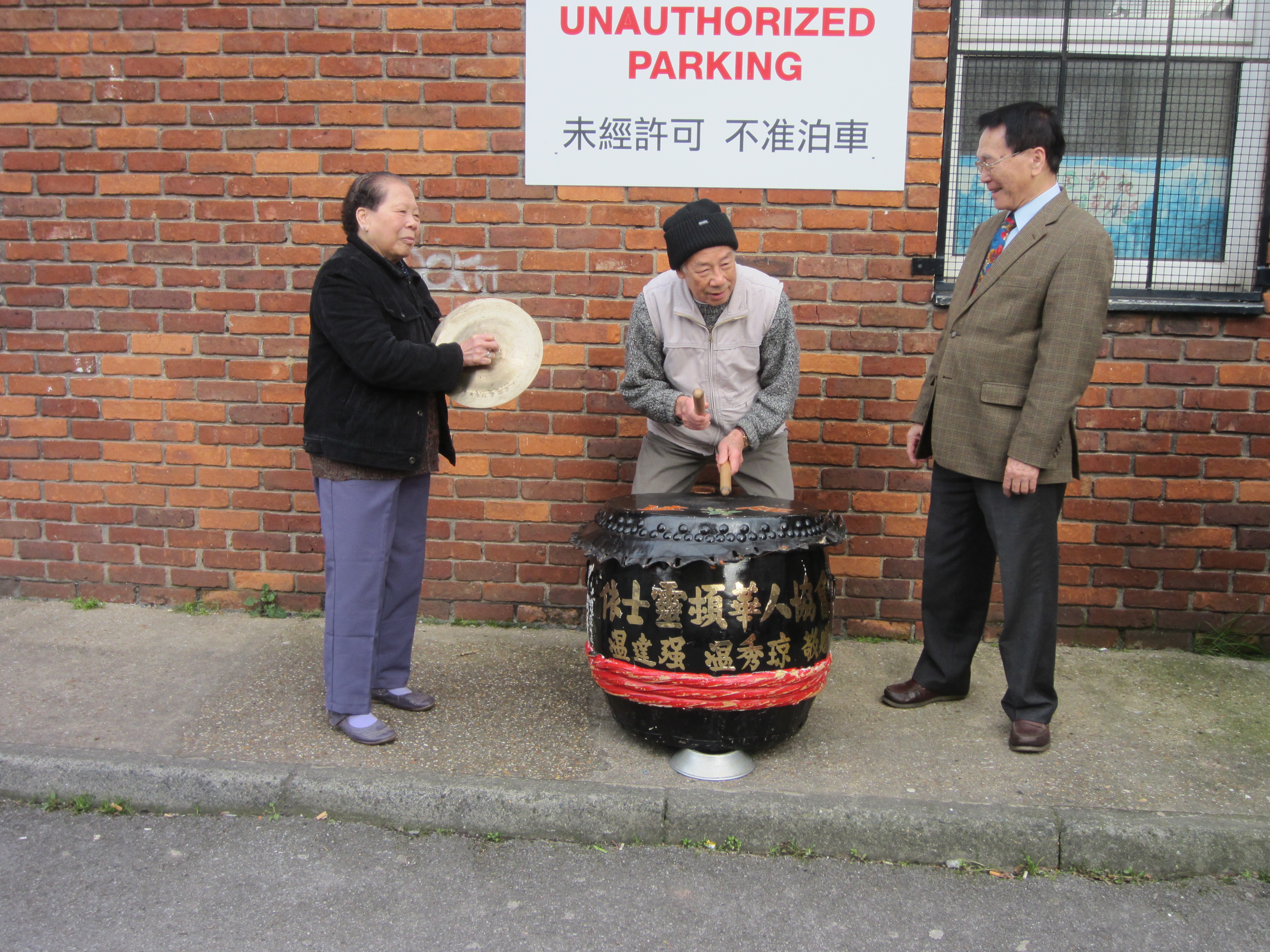
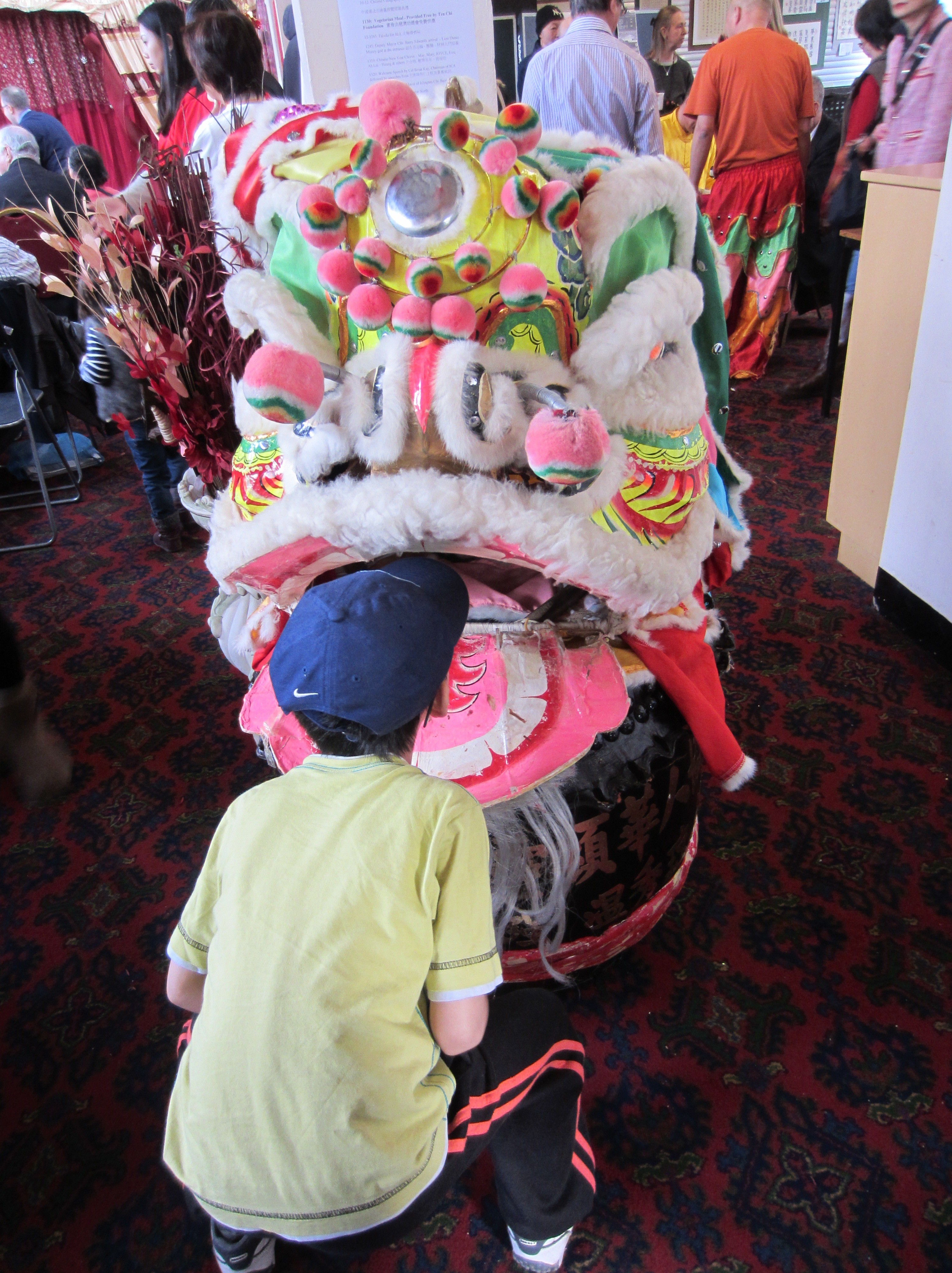
Those worries didn’t last long. We were soon distracted by an insistent beat and the clanging of cymbals. On a pavement outside, a round Chinese drum, its black lacquer gilded with golden characters, had been set up. Lion is approaching. boom-boom-boom The drum was extraordinarily loud, inducing a shiver in the pit of my stomach – a frisson I always feel when I know that the epic Lion Dance will follow. Neighbours peeked out of their windows as the Lion approached, bearing its multi-coloured head. This was a friendly beast, so friendly that at least one little boy was tempted to peer solemnly into its ravenous mouth. The Lion wagged cheeky pink tongue and tail in every corner, which I hope was enough to chase away any evil spirits lurking.

What's in there

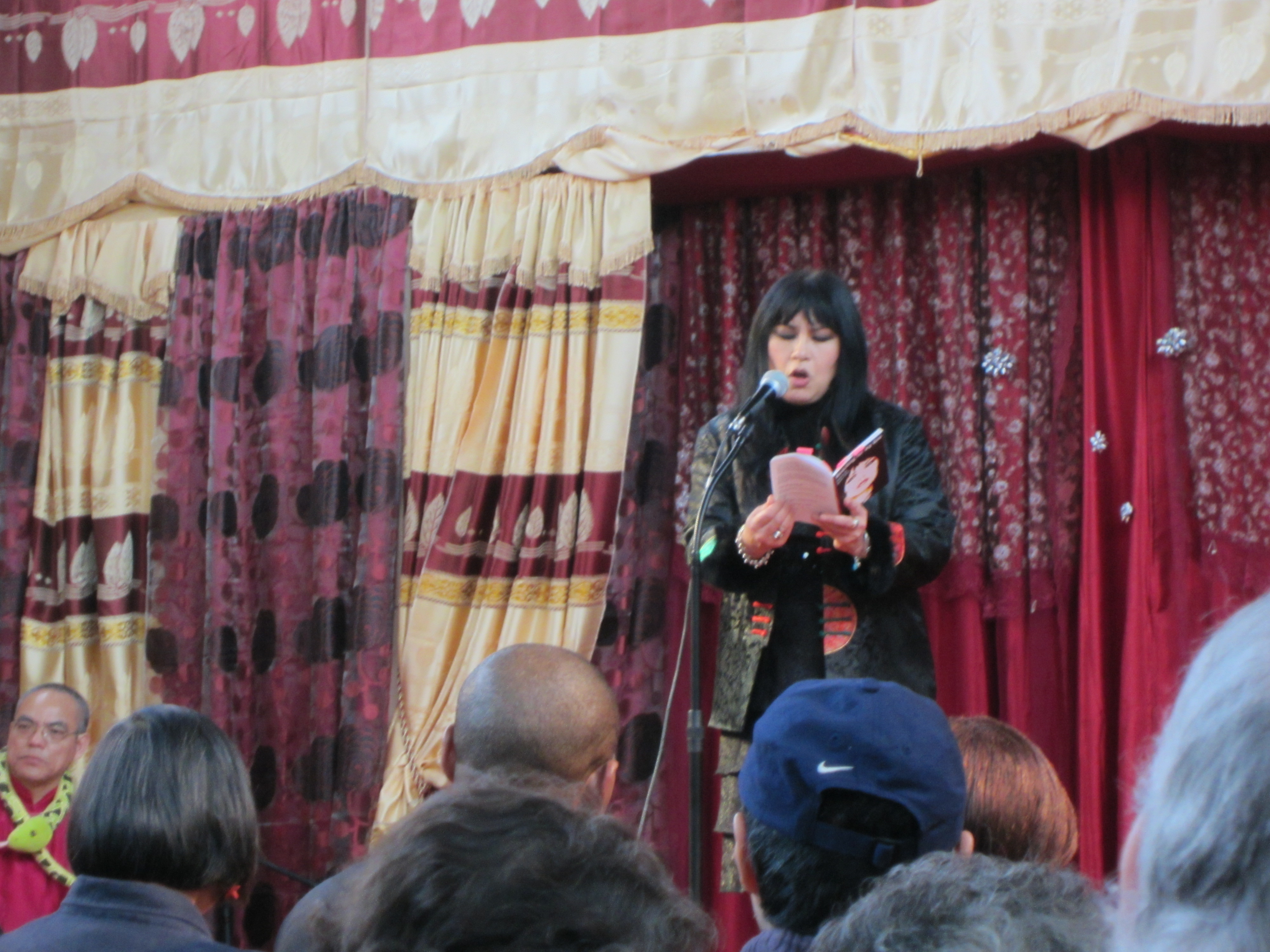
By the time I returned inside, the upper floor of the ICA had been transformed. In its place was a concert hall decked with rows of chairs. From the stage at the front came the dulcet tones of a Chinese flute, so lulling that even the children stopped squirming. When Anna Chen, poet and activist, took to the stage, she invigorated the crowd by half-reading and most astonishingly, half-singing, her poignant poems. The lyrical Anna May Wong must die was especially powerful – ‘a personal journey through the life and crimes of Hollywood’s first Chinese screen legend’, it says on Anna’s website. (I hope everyone reading this will have the opportunity to watch Anna perform). I could see that people listened, but you had to be able to hold their attention.Anna Chen reads her poetry

All too soon, it was my turn. I had been told I would go onstage after the fan dance. I waited in the wings, tense because I knew it would be the first novel reading at the ICA, afraid also that my story might not be regarded as ‘Chinese enough’ for a community event of this sort.

Indeed, the family in my novel is mixed, the woman who leads it being a Nyonya – part of the Chinese diaspora in South East Asia which dates back centuries. Many people today have never heard of the Nyonyas and Babas, even in Malaysia. This is a great shame, because the Nyonyas and Babas successfully created a unique fusion of Chinese and Malay culture long before globalisation existed. In their way of life, they have something to teach us, especially in present-day Malaysia where race drives your rights, or the lack of them (see blog-post The Malaysia We’ve Lost).

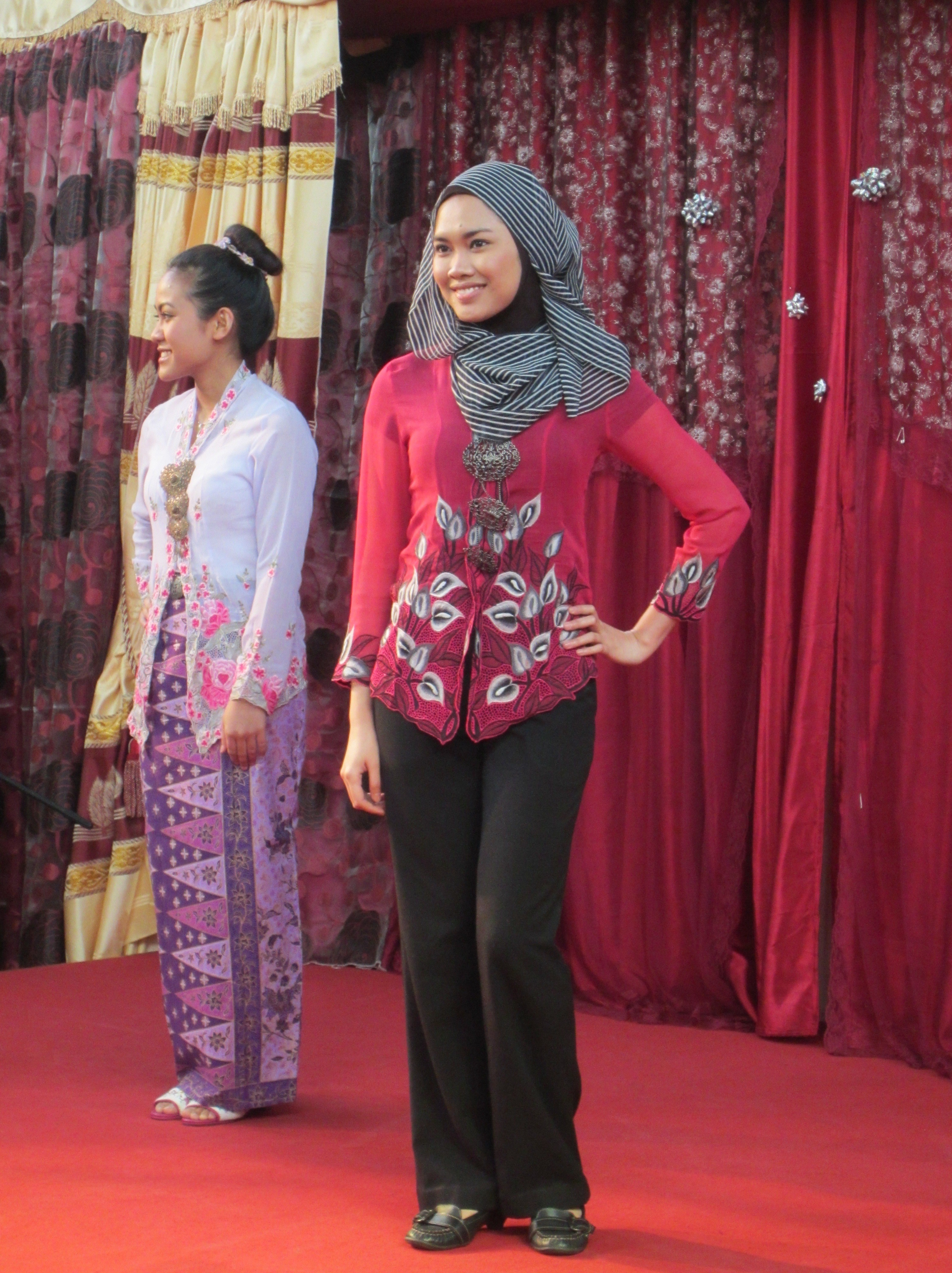
The first passage I read told the ancestral story of the Nyonyas and Babas. Selina introduces the Nyonya themeTo make my reading come alive, I had watched videos of actors and politicians speaking. I also enlisted the help of two Malaysian students, Wahidah and Aufa Dahlia, who gallantly came on stage modelling Nyonya costumes. Wahidah, her hair tied up in the famous Nyonya chignon, looked resplendent in a tailored vintage sarong kebaya.Demonstrating sarong kebaya Her blouse and sarong came from Aufa’s private collection, while her feet were adorned by a pair of hand-made Nyonya beaded slippers which had been purchased from a shop, Colour Beads, in Malacca. This beautiful town is arguably Malaysia’s most historic, and a large Nyonya-Baba community once lived there.

Wahidah was subsequently joined on stage by Aufa Dahlia, who showed off her modern Nyonya attire with great aplomb. The audience sat enraptured, so graceful were the kebaya ladies. Later, many went up to Aufa’s table, where she had placed a sample of the kebaya blouses she sells on her website as a hobby. If the kebaya ladies and I were to form an act, we would surely be hits on a reading circuit!

Modern NyonyaOther artistes followed, including the kung fu master whose rhythmic movements mesmerised everyone. Look at the picture below and you will see why he was a tough act to follow, especially by a writer reading her second passage late in the day. Kung-Fu masterFortunately, I was aided by the dramatic second scene I had chosen to read and by the prop I brought along: the Nyonya kueh (cakes) which feature in my novel. I had only two varieties with me – both from the Malaysia Hall Canteen in Bayswater – but they disappeared in seconds after being shared out!

Afterwards, people came up to say how much they had enjoyed my reading. One woman thanked me for opening her eyes to the diversity of the Chinese diaspora, a few even asked where they could buy my book. Alas, I had to say it was not yet published but I gave them my card nonetheless, as it has the address of this blog on the back.

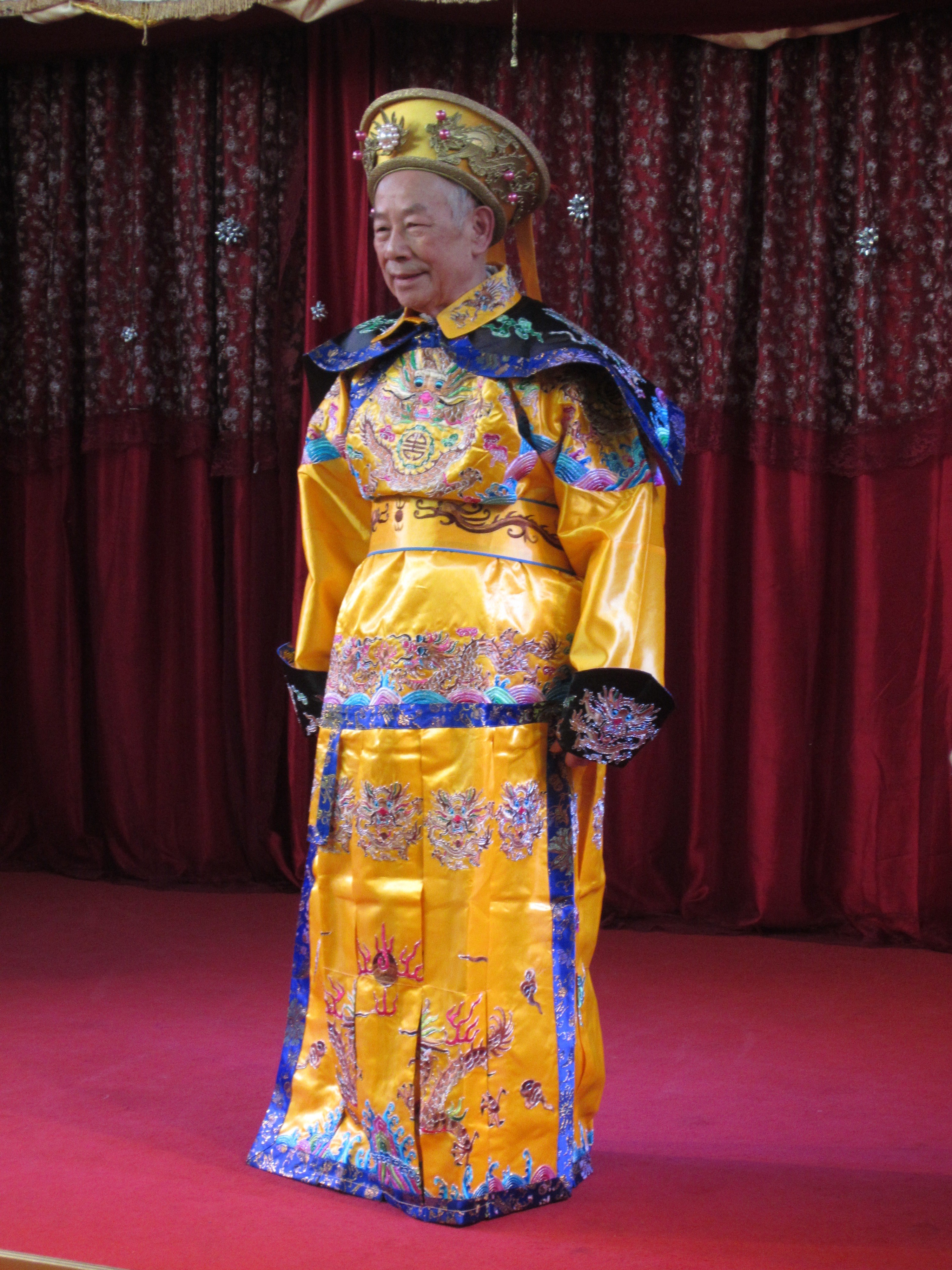
The grand finale of the afternoon was a Ching (Qing) Dynasty costume parade which starred a Mandarin, a Court Official, a Eunuch, the Empress and of course, the Emperor, all in borrowed robes which had never before been worn in the UK. Truly a fitting way with which to end such an uplifting day.

The EmperorAs we headed off, I thought of those who had come before us. It was not just Emperors and Empresses who made history but the coolies leaving in desperate circumstances, and before them, during the Ming Dynasty, the adventurer traders who left to settle elsewhere. These ancestors, all of them, have left their mark in the sands of history. And we their descendants are immensely fortunate, in having such a rich heritage to celebrate.

3 Comments

Filed under Cultural Identity, Identity, Malaysia, Novel, Nyonya