Tag Archives: May 13

Ruminations On Heritage 6: The Point of No Return

In February 2022, the woman who was then Malaysia’s Deputy Minister for Women and Family advised husbands to calm wayward wives by beating them ‘lightly’. The politician, Siti Zailah, remains a Member of Parliament. This is the sort of country I come from.  

When flight MH-17 was shot down in 2014 by a Russian missile, Malaysia’s flourishing Islamists, including the same Siti Zailah, blamed Malaysia Airlines. Allah’s wrath had apparently been incurred by the alcohol the airline continues to serve. His anger was further stoked by those sexy stewardesses parading in form-hugging kebaya blouses and skirts. The Malaysians who believe this are in the minority, but they’re allowed to make an awful lot of noise. This is the sort of country I come from.

On the things that really matter – religious extremism, endemic corruption, nepotism, cronyism and most of all, Malaysia’s entrenched racism – its leaders have been conspicuously silent. This is exactly the sort of country I come from.

A long time ago – May 13, 1969, to be precise – so-called ‘racial riots’ occurred just after a set of important elections. Most of the people killed were Malaysians of Chinese ethnicity. I remember it as a period of curfews, shop closures and adults walking in fear. When grown-ups are scared, kids get scared, too.

Afterwards, a new Prime Minister took over and a suite of racist policies, euphemistically called the New Economic Policy, was instigated. Such massive changes should have warranted close examination – as would have happened in any proper democracy.

Not Malaysia. For the next thirty years, we were told not to breathe the words ‘May 13’, as if just hearing the words would cause Malaysians to become hot and bothered and start attacking one another with parangs and krises. And like sheep, we obeyed! That, too, is the sort of country I come from.

Until those pivotal elections of 1969, there was real democracy. The largest political party, the United Malays National Organisation or UMNO, realised it could lose elections. Losing elections meant losing power and UMNO was determined not to lose power. Under the camouflage of ‘addressing racial inequality’, its leaders set about dismantling democracy, but we were too blind and naïve to notice.

That was so long ago, I hear you say: why does it matter anymore?

It matters because our present is shaped by the past. Truth matters.

Has any attempt been made by any Malaysian government since 1969 to find out the whole truth about May 13, 1969? Of course not. Until there is truth, how can there be reconciliation?

UMNO proceeded to rule until 2018. Think of it! Hegemony from 1957 to 2018 – a total of 61 years! Six decades are more than enough time to corrupt the entire country from the bottom up and dumb it down from the top to the very roots. The dumbing-down has been nothing short of phenomenal.

Earlier this year, in my home state of Perak, a woman seeking treatment at a public hospital was told off for her attire! Imagine the scenario: you need help, you go to a hospital and before anything else, the doctor lectures you about your clothes.

Here was the response from the chair of the state’s health committee:

‘If you go to a government department, there should be decorum. … If you go to a temple, there’s also no signboard, but we know we cannot wear short skirts there. It’s an unwritten understanding.’

The guy actually compared a temple to a hospital, even though a temple is a place of worship that you visit voluntarily, while a hospital IS NOT a place of worship and you go there normally under duress. His was a wonderful example of cow sense (with grave apologies to cows).

It reminded me of the last time I renewed my passport. I went to Perak’s Urban Transformation Centre (UTC) in Ipoh and the passport officer refused to serve me because I was wearing a T shirt and Bermuda shorts. My shorts were perfectly respectable – but not respectable enough, it seems, if you’re a Muslim-Malay passport officer. In Malaysia, the job of a civil servant is no longer limited to paperwork: it’s also his role to judge what you wear. He told me to come back with a sarong or trousers that would ‘cover my knees’.

The only surprise is that he didn’t also complain about my bare elbows. This will change, no doubt: Malaysia’s home-grown, Taliban-inclining political party, called Parti Islam Se-Malaysia or PAS for short, will see to that.

PAS was a fringe party when I left. It is now flying high, with more seats in Malaysia’s parliament than ever before. The politician I’ve already mentioned, Siti Zailah, is a member of PAS – a shining example of their intellectual quality.

On that same trip, on the very day my passport was renewed, I was asked by a Malaysian-Chinese businessman why I did not live there. What was it I had in England that I could not find in my land of origin?

I gave no answer, not because I didn’t know, but because the answer is so complicated that I did not know where to begin. How do you explain to someone who has never lived in a liberal democracy what it’s like to live in a country that isn’t corrupt from top to bottom, where you can trust the courts, the press isn’t muzzled, there is civic discourse and crucially, where I am equal to everyone else under the laws of the land?

The man who asked the question is obviously happy living under Ketuanan Melayu (Malay lordship). I wouldn’t be happy. And since I have a choice about where I live, I can’t see any reason to go back.

An estimated 1.8 million Malaysians live outside Malaysia (population 34 million in 2023). At least half of my classmates from secondary school and many members of my family have left. That’s a huge brain drain for any country, especially one still in development mode.

When Malaysia’s current Prime Minister, Anwar Ibrahim, visited New York recently, he was asked what he would do about this talent bleed. He gave an astonishingly lame reply about ‘enhancing incentives’.

The idea that money alone would bring us back is laughable. Financial incentives have been available to tempt Malaysians back since 2011 and only 2,500 overseas Malaysians have taken them up (Source: video below by Mariam Mokhtar), roughly 0.138% of the diaspora.

A charitable view is that Anwar just doesn’t get it. Perhaps he genuinely believes that tax breaks on luxury cars and tax breaks on just about everything else would be enough to bring us back. I will speak only for myself here, but I’d like to say it loudly and clearly: what I have in England is freedom, and this freedom is priceless.

Since freedom is a nebulous concept, an example might help. If I wrote an op-ed on the subject ‘Is Charles the King of all Britons, or does he represent the interests only of white Britons?’, I’m confident it would be accepted by a broadsheet publication here. But if I wrote an op-ed entitled ‘Is Malaysia’s King (Agong) really the King of all Malaysians, or does he favour the Malay race?’, would the official Malaysian press dare touch it?

The difference is that England goes out of its way to accommodate different viewpoints and to protect the rights of minority groups. In my adopted country I am equal by law and can rely on a judicial system I trust. No economic incentive is going to make me give this up.

Going back to Anwar Ibrahim (and his limp solutions for Malaysia’s brain drain), a less charitable view is that he actually understands what’s at stake and fears the consequences. What would Malaysia look like if all 1.8 million of us went back?

Some of us would surely join the brave Malaysians who’re still speaking up against the things its politicians don’t have the guts to discuss. We would be vocal, certainly. UMNO wouldn’t like that, and it’s unclear whether Anwar would be all that keen, either.

I once told myself that when Malaysia abolishes bumiputera rights, I will go back, at least for a time, in order to give something of myself to the country I came from. I now know this is a pipe dream. Bumiputera rights won’t be abolished anytime soon. But it took the break enforced by COVID for me to see the light.

Finally, after forty four years away, I’ve given up on Malaysia. Perhaps some immigrants reach this point, when both they and the country they left behind have changed so irrevocably that there’s no turning back.

Giving up on a dream is never easy. Part of me is angry, but mostly, I’m sad. We have all lost; even those who think they’ve gained have actually lost.

We lost the spirit of Malaysia and in losing that precious spirit we squandered the chance to build a truly great nation.

And for what? So that a small group could cling to power while enriching itself and its cronies.

I won’t be returning, but I will support the Malaysians still fighting for a better tomorrow. One of these is the writer Mariam Mokhtar. We don’t know one another; I’ve only enjoyed her articles from afar. As she describes below, her writing has been deemed so incendiary that the slavish Malaysian press won’t publish her.

That hasn’t stopped Mariam. She launched her own news platform and now makes videos, too. I discovered them while carrying out research for this blog-post and I find her analysis always spot-on. 

If you’re interested in what took place during May 13, 1969, I would recommend the book May 13 by Dr. Kua Kia Soong, director of Suaram (short for Suara Rakyat Malaysia, or Voices of the People of Malaysia). He wrote it by piecing together extracts from documents that were only declassified after thirty years. When his book came out in 2007, some Malaysian politicians wanted it banned – which is reason enough to read it.

Walau pun saya berada jauh, Malaysia tetap di hati.
3 Comments

Filed under England, Malaysia, Politics, United Kingdom

Power, Remorse & Redemption: in Three Acts

This Friday, August 31, will mark the 61st anniversary of Malaysia’s freedom from colonisation. For the first time in years, there is a revival of hope in my homeland.

It was inevitable that I spent part of this summer reflecting on what happened on May 9, when Malaysia went to the polls. We now know that Malaysians made history that day (see What Malaysia Means). UMNO, which stands for United Malays National Organisation, the political party that had ruled the country for 61 years, was finally booted out of office. The opposition coalition, led by former Prime Minister Dr. Mahathir Mohamad, won against all odds. His age – 93 years – is what Western journalists have focused on, but this is the least of it. What happened was astonishing, a rare victory for democracy and justice in today’s world.

As with many things Malaysian, the full story is dramatic and complicated. It began long before 2018. The tale is worth telling, though, for it bears the hallmarks of great fiction: power, intrigue, grit and remorse, forgiveness and possibly, just possibly, redemption.

But how to tell it to non-Malaysians in such a way that they will understand and enjoy? This article is my attempt.  Between now and August 31, I will lay out Power, Remorse & Redemption in Three Acts here on my blog.

To understand the stunning firsts and reversals that took place on May 9, we must go back to another May, to a day that’s etched in the psyche of every Malaysian. May 13, 1969. On that day, the Malaysia of my childhood fell apart. Thus begins Act I.

May 13: Spontaneous Combustion or Arson?

I was only four when my father rushed home one afternoon. I remember his ashen face and gruff voice. He told my mother to switch on the radio, muttering a word I’d not heard till then: curfew. The broadcaster confirmed that a curfew had been declared. There were riots and fighting on Kuala Lumpur’s streets. My father’s descriptions were more graphic. He said that Malay men with sword-like knives had set fire to Chinese shop-houses.

Over the next few days fear permeated our house. It was the first time that I learnt to be suspicious of other races. Until then I’d thought of our Malay and Indian neighbours as people like us except that they wore interesting clothes and ate spicy food. May 13 destroyed this innocence. The crying shame is that many Malaysians have mixed lineage. Multiculturalism should have been a pillar of our country’s richness; instead, for the next 49 years, it became a political weapon.

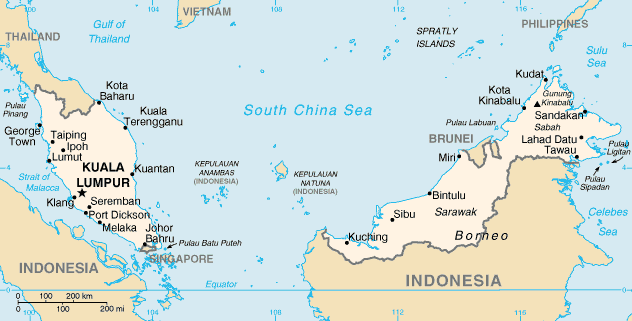
To understand why Malaysia is naturally multiracial, you only have to look at a map. To the west of Peninsula Malaysia lies a narrow and sheltered stretch of water: the Straits of Malacca. In the days when pirates roamed the seas, seasonal winds brought adventurers from East and North, West and South. Ships invariably ended up docking in Malaysia.

File:My-map.png

They came from everywhere. From neighbouring countries like Indonesia and Thailand and from farther afield too: China, India, even Arabia and Armenia. Some of these traders settled. Malaysia is a paradise: peaceful, sunny and well-fed by rain, its very air exuding the promise of an easy life. Surrounding waters teem with fish; a seed only has to drop for it to grow.

European powers eventually arrived, first the Portuguese, then the Dutch and finally the British. It was the latter who recognised Malaysia’s potential. After gaining control of the country in the 19th century, Britain began developing the tin mines and rubber estates which would make the mother country rich. In a letter published in the London Review of Books on March 6 2014, Robert Lemkin, an Oxford-based filmmaker, wrote this about Malaysia:

‘In 1946 the colony’s rubber and tin industries brought the UK Treasury $118 million; the rest of the empire altogether yielded only a further $37 million. Without Malaya, the post-war British welfare state would have been unthinkable.’

Malaysia, then called Malaya, was the British Empire’s crown jewel. To develop their new industries, the colonials needed labour. They set about importing vast numbers of Chinese and Indian indentured labourers. Chinese and Indian populations had already settled naturally, but British policies changed Malaysia’s demographics overnight. The result is a rainbow country today with three main races: Malay (67%), Chinese (25%) and Indian (7%).

Many people confuse ‘Malaysian’ with ‘Malay’. Malaysian is the nationality, Malay the race. You can be Malaysian without being Malay, just as you can be British without being English.

For Malaysians of mixed heritage like me, of whom there are many, the crude classification above cannot properly reflect our roots. I fall under ‘Chinese’, but my great-grandmother had Malay lineage. And the many Malays I know with Chinese mothers or grandmothers are categorised merely as ‘Malay’. In reality Malaysians are a potpourri of Malay, Chinese, Indian and lots more. There were also indigenous tribes already in situ – the Orang Asli or ‘original people’ – the true natives of Malaysia, who are aggregated as ‘Malay’ in the above statistics.

Race is a lightning rod in Malaysia. It has been easy to use race to keep Malaysians apart because our political parties have traditionally been run along communal lines. What’s astonishing is that many still are – in 2018. You must be Malay to join UMNO, which is why it’s called the United Malays National Organisation. I would not be allowed into UMNO, though I’m eligible to join the Malaysian Chinese Association, MCA. Indians can join the Malaysian Indian Congress, MIC. This system of apartheid is crazy, but when you grow up with it you don’t see this. It’s such an accepted fact in Malaysia that even some of the newest political parties are race-based.

As a consequence of May 13, race ignited in the Malaysian consciousness – for all the wrong reasons. When race is used as a weapon, it’s a sign that someone’s power is being threatened. This was precisely the case in Malaysia.

On May 10 1969, a general election had been held – Malaysia’s third. The political line-up included three non-racial parties that were all part of the opposition. Anyone could join those parties, but their members were mainly ethnic Chinese and Indians, their supporters people like my parents, who were delighted by the results. The ruling alliance led by UMNO retained power but garnered only 44% of the vote, and lost its majority in three of Malaysia’s wealthiest states (as well as one on the east coast). Crucially, UMNO lost the two-thirds parliamentary majority that had allowed it to change Malaysia’s constitution at will.

But even more than the above, it was the lessons on race that terrified UMNO. In 1969, two of the multi-racial parties in the opposition fielded Malay candidates who were elected into office. This was a first; until then politics in Malaysia had been solidly communal. The results showed that a substantial minority of Malaysians were already prepared – in 1969 – to herald in a less racist country. It was equally clear that Malaysians wanted a real opposition, not toothless puppets. There was the promise of stronger democracy. Foreign correspondents praised Malaysia’s democratic process, predicting more efficient governance in future.

What happened next would change the above premise. It was a watershed moment.

The official explanation for the May 13 riots is that they were a ‘spontaneous’ outburst, the result of simmering tensions in a multiracial society. But a cursory glance at Malaysia’s 1969 election results will tell you that UMNO’s hegemony was being challenged.

Unsurprisingly, May 13 has not been properly discussed within Malaysia. No one has been called to account. There has been neither truth nor reconciliation, only avoidance. Official documents remained classified for 30 years. When I was growing up May 13 was the spectre we were not allowed to mention publicly, lest racial riots ‘flare up again’. It took this article for me to understand the significance of Malaysia’s 1969 elections.

A Malaysian social scientist, Kua Kia Soong, after a painstaking analysis of declassified documents, concluded that May 13 was no spontaneous outburst. ‘There was a plan to unleash this racial violence’. He adds:

Nor does it necessarily follow that there will be conflict when different ethnic communities coexist, as is implied in pluralist analyses. The role of the state has to be analysed in the particular historical conjuncture.

(May 13, published by Suaram Komunikasi in 2007)

His analysis makes sense in light of what happened next. The UMNO-led government initiated policies that would seal UMNO’s position in the Malaysian political landscape. UMNO would rein in Malaysian democracy. Malaysia lost; UMNO gained.

It’s worth remembering that UMNO was formed first and foremost as a freedom movement. Its initial raison d’être was to rid the country of British rule. In this it was ferociously effective. But freedom movements don’t necessarily make good governments, as we have seen across the Commonwealth.

UMNO’s internal politics paved the way for the rise of the man known as Dr. Mahathir Mohamad, who would muzzle the press and dismantle institutional checks and balances. In so doing, he systematically destroyed Malaysia’s fabric, whether or not he intended to.

The fact that millions of Malaysians young and old came together 49 years later, also in the month of May, to support the same Dr. Mahathir and his new allies, is remarkable. I was among the many doing so, something I never imagined would happen.

(to be continued)

8 Comments

Filed under Cultural Identity, Identity, Malaysia, Politics

An Unexpected Discovery

A few days ago, when I told a Frenchman that I came from Malaysia, he said, ‘Ah, you have a simple language.’ It was not the first time someone had told me that s/he thought Malay “simple”. The sub-text, albeit unarticulated, was usually: “simple language, simple people”.

I felt it again with this Frenchman, a European condescension towards my Asian culture. I thought to myself: what does he even know about Malay?

Malay was a language of my childhood, one of three. My family spoke English and Cantonese at home but I was taught in Malay at school – part of the first intake of students to be educated exclusively in the Malay language in what had previously been English-medium schools.

I learned the language, but failed to appreciate its poetic beauty. This was partly because in Malaysia, Mathematics and the Sciences are more highly regarded than the Humanities, and partly because of the political context in which the switch from English to Malay took place.

It occurred in the aftermath of May 13 1969,  a day on which Malaysians of Chinese origin were targeted for slaughter at the hands of mobs of Malays in Kuala Lumpur’s streets. The killings occurred after UMNO – the political party which has ruled Malaysia since its independence from Britain in 1957 – and its allies lost the popular vote and many parliamentary seats in a general election.

The period afterwards was a time of radical change. Within about a year, Malaysia had a new Prime Minister; within two years, a raft of racially discriminatory measures was put in place. It was then that Malay was imposed as the medium of instruction in previously English-medium schools.

Language, of course, is not only a means of communication: it is also a political tool. In Malaysia certainly, language and religion are used adroitly by UMNO. UMNO understood early on the power of language. It has been uncommonly adept at choosing emotive words and at using these words to craft an insidious political narrative.

Thus I grew up hearing that I was pendatang yang tumpang sahaja di Malaysia, a newcomer who was only squatting in Malaysia. This was the backdrop in which I was taught Malay. Perhaps unsurprisingly, I never stopped to think about what a beautiful language Malay actually is. If French (which I speak) is romantic, then Malay is poetic. It was only when I started writing a novel and began filling my landscapes with characters who ran around speaking different languages that I was struck by just how poetic the Malay language is.

Take for instance the simple concept of homeland. The Malay equivalent is tanahair, literally translated as “soil (tanah) water (air)”, in other words the earth and water from which you come. I hope you will agree that the expression “my soil and water” is much more evocative than “homeland”.

Or take that well-known beast, the “orang-utan”. In truth, the latter is a bastardisation of the words orang, meaning a person, and hutan, meaning forest. Orang hutan is actually “a person of the forest”. The phrase, if you think about it, is immensely inclusive; it says, “Here is the forest, we share it with this creature which is not so different from us – a person of the forest.” For me, orang hutan captures the essence of traditional Malay culture, which was at once utterly respectful of others and very gentle towards them.

Even that wonderful political creation, the bumiputera – the prince (putera) of the earth (bumi) or son of the soil, a person who by dint of race or religion is privileged in Malaysia – has a certain ring to it. From a purely linguistic standpoint, the word bumiputera is really rather beautiful.

There are many other examples, and yet poetic beauty is not what people think of when they mention the Malay language. Instead they say what the Frenchman said to me: Malay is “simple”.

What he and others don’t seem to realise is that Malay was written using the Arabic script, a form known as Jawi, until quite recently. I discovered this for myself while carrying out research for my second novel (for which incidentally I have completed a first draft). Most of this research took place at the National Library of Singapore (whose generous opening hours of between 10 a.m. and 9 p.m. allowed me ample time to work). There, shivering in the ultra-cold air-conditioning which Malaysians and Singaporeans seem to favour, I found that the Malay language newspapers I wanted to read had been published solely in the Arabic script. On further digging, I could not find a single Malay newspaper which had not been printed in Jawi up to the Second World War. I was of course unable to read any of them; the Jawi which we had been taught in school was rudimentary, because Jawi was already not in everyday use by the time I went to school.

If Malay were still written today the way it used to be – in the Arabic script – would people go around denigrating it as a simple language?

I grew up hearing and speaking Malay every day but I took the language for granted, in the same way Malaysians assume they will see the sun every day. Only recently have I rediscovered Malay. At the same time, I began to appreciate the richness of Malaysia’s multilingual environment. I can easily recall the distinctive sounds of my native country: Malay, with its elegant smoothness; the no-frills brand of Cantonese I grew up with, rough and ready, a far cry from the haughty Hong Kong version but more in tune with the go-getting entrepreneurs who spoke it loudly and merrily; and the energetic, tongue-rolling Tamil used by our Indian friends, full of indecipherable syllables at which I could only shake my head.

We in Malaysia are fortunate to have this wealth as our heritage. But I have yet to hear a Malaysian adoring any of our languages the way the French adore theirs. The French are happy to debate the intricacies of their language for hours and will happily tell you how wonderful French is. This is something I wish Malaysians could also do, starting with our national language, Bahasa Malaysia. I would love to see Malaysians not only owning Bahasa Malaysia and learning it with enthusiasm, but also acknowledging its inherent poetry and being proud of it.


11 Comments

Filed under Cultural Identity, Malaysia, Novel, Research