Category Archives: Novel

When do you Stop?

In just a few days, the Snake will give way to the Horse (in the Chinese zodiac). It was roughly a year ago, before the Snake had even entered, that I finished my tome of a historical novel.

Here’s what I mean by ‘finished’: I planned it, did my research, wrote the first draft, and then ‘edited’ that draft twice – from the first page through to the last, where editing included the heavy re-writing of particular chapters. I was aided throughout, even in the early stages, by Dr. Nathalie Teitler, poet, director of The Complete Works II and a professional developmental editor. Some writers think this unusual, but for me, feedback is invaluable while I’m still crafting a story.

Ultimately, the whole endeavour took two years. This, I was told, was not that long, given the scope of what I attempted: a story commencing in 1878 and ending just before the Japanese invasion of Malaya in 1941 (a period which spans sixty three years), where real history is incorporated into a fictional setting.

Writing my book made me look at art and artists in a different way. Most of us see only the finished piece, be it a book or play, opera or painting; we don’t usually think about how much effort a ballerina or opera singer, actor or painter, has had to put in. Now I know.

My novel Spirit of Kueh contains roughly 145,000 words. To give you an idea of what that means, the first two paragraphs of this blog-post contain approximately 100 words. Imagine writing 1,450 more paragraphs like those and then editing each twice, and you will perhaps see why it took so long. By the time I finished, I had reached the point of exhaustion. I closed the folder on my PC marked ‘Manuscript’ and could not look at it again. There was no way I could have edited my novel a third time – not then anyway.

In this age of bite-sized concentration and 140-character sound bites, I’m aware that a novel of 145,000 words is deemed long, especially for a first-time novelist. A published novelist I met (who hasn’t read any of my work) claimed I would never find a publisher. We shall see.

I don’t doubt the challenge, but having put a lot of thought into the way my story should be structured, I believe it hangs together as a coherent whole and some impact would be lost if the story were to be split up. Also, we’re not short of drama: the female protagonist, who is illiterate, starts her own business while raising a family of ten children. Ten children! How many of us could imagine raising ten children? All of this takes place against a backdrop of a rapidly westernising Malaya. Hence the themes in my novel are rather contemporary : the ongoing conflict between modernisation and tradition, and especially for those of us living as minorities in a foreign land: what is the true cost of (our) cultural assimilation?

My next step then, after three months of research, was to send off query letters to agents, together with a synopsis and the relevant pages or chapters. Each agent, incidentally, is different: writing to them is like applying for a job; there is no ‘standard’, and everyone asks for something slightly different, which means that each query takes time to prepare. I wrote to five agents, received one response – a no – and was ignored by the others.

Fortunately or unfortunately, life then took over. I became bogged down with managing a house renovation project in a new country (France) and my routine went kaput. In snatched moments, I wrote. Not being able to focus in the same way, I turned my hand to non-fiction, jotting down hundreds of snippets about the many surprises France laid my way. I also wrote two pieces of flash fiction (published in Litro Online and Postcard Shorts) and several short stories (now under consideration for publication). Without a proper routine, it was impossible for me to even think about what Helen Dunmore, the award-winning author who visited us during the one Arvon Foundation course I attended, called ‘writing biz’: the process of dealing with the commercial, non-creative side of writing. Agents and publishers fall into this category.

Now that we are about to enter the Year of the Horse, it feels to me that the time has come. I have looked again at the folder marked ‘Manuscript’ and have, inevitably, begun further editing. This time, I bring a fresh eye and new skills, skills I could only have gained by writing short fiction. Indeed, I find that many of the published novels I read today could use further editing. In art though, there is no right or wrong; you could continue editing a story ad infinitum. When do you stop?
4 Comments

Filed under Novel, Writing

Of Gates and Gatekeepers

A bird with yellow and black feathers and a blood-red beak rises into the air off the lawn. I have no idea what sort of bird it is, but its beauty is astonishing. I hold my breath; the sight makes three months of effort worth every minute (see previous blog-post Oh Interfering Life!).

As always, great things come at a price. And the price I have paid is that for three months, I took my eye off the publishing ball.

After sending parts of my manuscript to five literary agents in March, I’ve done nothing else with regard to getting my novel published. In case you’re wondering why I’m contacting agents, it’s because in most Western markets, it is virtually impossible for a novelist to approach a publisher without an agent. An agent’s job is to represent a novelist and to sell that writer’s work –  first and foremost to publishers, but also to film producers and others. Ergo, to get my novel published, I need an agent.

Like potential employers, every agent demands something different: some ask for the first 10,000 words, others the first three chapters; many accept electronic submissions but some still require manuscripts by post; yet others require that you upload material onto their private electronic platforms, accompanied by assorted information about yourself. Each is thus like a separate job application, and takes thought and care to prepare.

Unlike employers though, agents do not tend to reply. Of the five to whom I wrote, only one provided a personal letter of rejection. Another agent acknowledged receipt of material – for which I was immensely grateful – but sadly, this agency did not come back with anything else. As for the remaining three, I can only assume that they received my emails.

The experience has been educational. I’m assured by writer friends (including those already published) that not hearing back is the norm.

In this electronic age, I find that extraordinary. I don’t expect feedback (though that would be wonderful); what surprises me is not even receiving a simple automated reply to tell me that my material has reached its intended destination. That much, surely, should be possible?

In contrast, I’ve received an electronic acknowledgement of receipt – of the kind described above – for every short story submitted, whether to a journal or a competition. Short-story journals tend to be lean, so if they can acknowledge receipt and send messages of rejection, I see no reason why everyone else cannot.

Granted, this bold statement is based on the tiniest of samples (so small that it would not qualify statistically as a sample). I only began writing short stories in earnest last November after an Arvon course with the wonderful Tania Hershman and Adam Marek (see blog-post Trapped in Totleigh Barton! which describes my experience of writing in this pre-Domesday manor house). Between them, Tania and Adam and my fellow-participants managed to transform the way I felt about short fiction. And so far, my sojourn into their world has been thrilling.

From each of the four competitions and three journals to which I submitted, I received an acknowledgement which I could file. The seven emails thanking me for my submissions were heartwarming, following as they did on the heels of my first round with literary agents. Even the rejections were encouraging, since they showed at least that the stories had been read.

Of the competitions entered, I wasn’t placed in one, was long-listed in a second and am waiting to hear on another two. One of my journal submissions, Night of Falling Stars, was accepted by Litro Online and published on 21 June 2013. (Incidentally, the same story was rejected just days previously by another publication, which shows that there is always hope.) I never thought short stories could be so much fun! I even enjoy the submissions process.

What then, of my novel?

If I want to get it published conventionally in the West, I will need to contact more agents. But I may not restrict myself to conventional publishing. Or indeed, to the West.

Then, there is the lure of short fiction. And even a piece or two of non-fiction which, thanks to this blog, I’ve been invited to embark on. If I amass a collection of published short stories before I hear back from an agent, I may yet focus on the short, including the micro and the nano. Trying to construct a story in 140 Twitter characters is challenging and, would you believe, there is a home for them – One Forty Fiction – where a story cannot exceed 140 Twitter characters! For someone who not long ago was convinced of the impossibility of this genre, my change of heart has come as a surprise, especially to me.

12 Comments

Filed under Novel, Writing

On Grandmothers and Pioneers

March 8 is International Women’s Day. On this day, men in Eastern Europe send flowers to the women in their lives, while the women finally get a much-needed break from housework.

In the rest of the world though, March 8 does not hold much significance. The odd gathering takes place, but many of my friends have no idea when International Women’s Day actually is. Which makes the style in which I celebrated it last month – at the Fox Club in Mayfair, central London – especially memorable. Within the lovely setting of this private members’ club, a dozen women from across the globe communed, to exchange stories about our lives and those of our grandmothers. What could have been more apt?

The backdrop of a London overwrought with leaden skies and puddles also proved poignant, at least for me. It was cold and drizzly. This is the London I know like the back of my hand. I may moan about it and grumble, but its familiarity makes me feel at home.

Conversation hummed as we sat down to a lunch hosted by the Hong Kong Society Women’s Group. I had been invited to read extracts from my novel alongside Kerry Young, whose debut work Pao was published in 2011 to much acclaim by Bloomsbury. Neither of our novels has any Hong Kong connection, but Karen Luard (who had arranged the lunch) wanted Kerry and I to share our experiences of being part of the far-flung Chinese diaspora.

When discussion was eventually opened up to the floor, there were fascinating contributions from our audience. Because my novel tells the story of a woman who starts a business to save her family, it made many of those present think about the women in their own families, especially their grandmothers. Whether they hailed from South Africa or Malaysia, the stories they recounted had a common thread: they featured stoical old women, all unsung, who were not well-educated but who sustained their families. These grandmothers used whatever means they could: some sewed; others, like the heroine in my novel, cooked. Without so much as a moment’s thought, our grandmothers and great-grandmothers were unwitting pioneers.

And pioneers are not always appreciated, certainly not during their lifetimes. How much consternation, ridicule even, our grandmothers and great-grandmothers could have faced. We think we have an easier time today – and that is true in many ways – but there have been many occasions when I have felt extremely uncomfortable listening to the way male friends or colleagues talk about women, especially about those women who dare to stand above the parapet. Their tone is sneering, coloured by a disdain which allows misogyny in all its subtle forms, to be disguised.

Take Hillary Clinton. I have heard her reviled in ways reserved only for female politicians. Yes there are plenty of male politicians who are hated, loathed even, but I have never heard them discussed in the same scornful tone – one which veers well beyond contempt.

And there are still people today who would not vote for a woman.

April 8 saw the passing of Margaret Thatcher, a towering figure no matter what you thought of her. I arrived in Britain months after she became Prime Minister, and became an adult during her tenure. She was nothing if not polarising: most strong personalities are. Amidst the hubbub, it is easy to forget that she was a pioneer – it could hardly have been a doddle being the country’s first female Prime Minister. As Barack Obama tweeted, “She stands as an example to our daughters that there is no glass ceiling that can’t be shattered.”

I could not have put it better. Thankfully, glass ceilings everywhere continue to fall. But more International Women’s Days will have to pass before we can all truly say that we are as happy celebrating the birth of a daughter as much as that of a son.

8 Comments

Filed under Identity, Novel

Celebrating the Year of the Water Snake

It began, as all Chinese New Year celebrations must, with food. Paper plates loaded with steaming hot rice and stir-fried vegetables were spread onto tables. “Eat! Eat!” the women running around both floors of the Islington Chinese Association (ICA) exhorted, in a way which brooked no dissent. Disobedience would not have been an option.

A crowd numbering hundreds had gathered on a discreet street in north London where the ICA is located, to ring in the Year of the Water Snake. In addition to fan dances, calligraphy, demonstrations from a kung fu master and of course, the Lion Dance, there was to be literature: poetry from a British-born Chinese writer, and a reading by me of extracts from my novel. We’ve never done this before, Dr. Stephen Ng, ICA’s Coordinator, and Lady Katy Blair, its co-Founder and CEO, had confided; you will be an experiment.

Amidst whispering and much howling (from the younger guests), it seemed to me a brave experiment, especially since part of the audience spoke only halting English. As I watched people run hither and thither, I wondered how the afternoon would go.

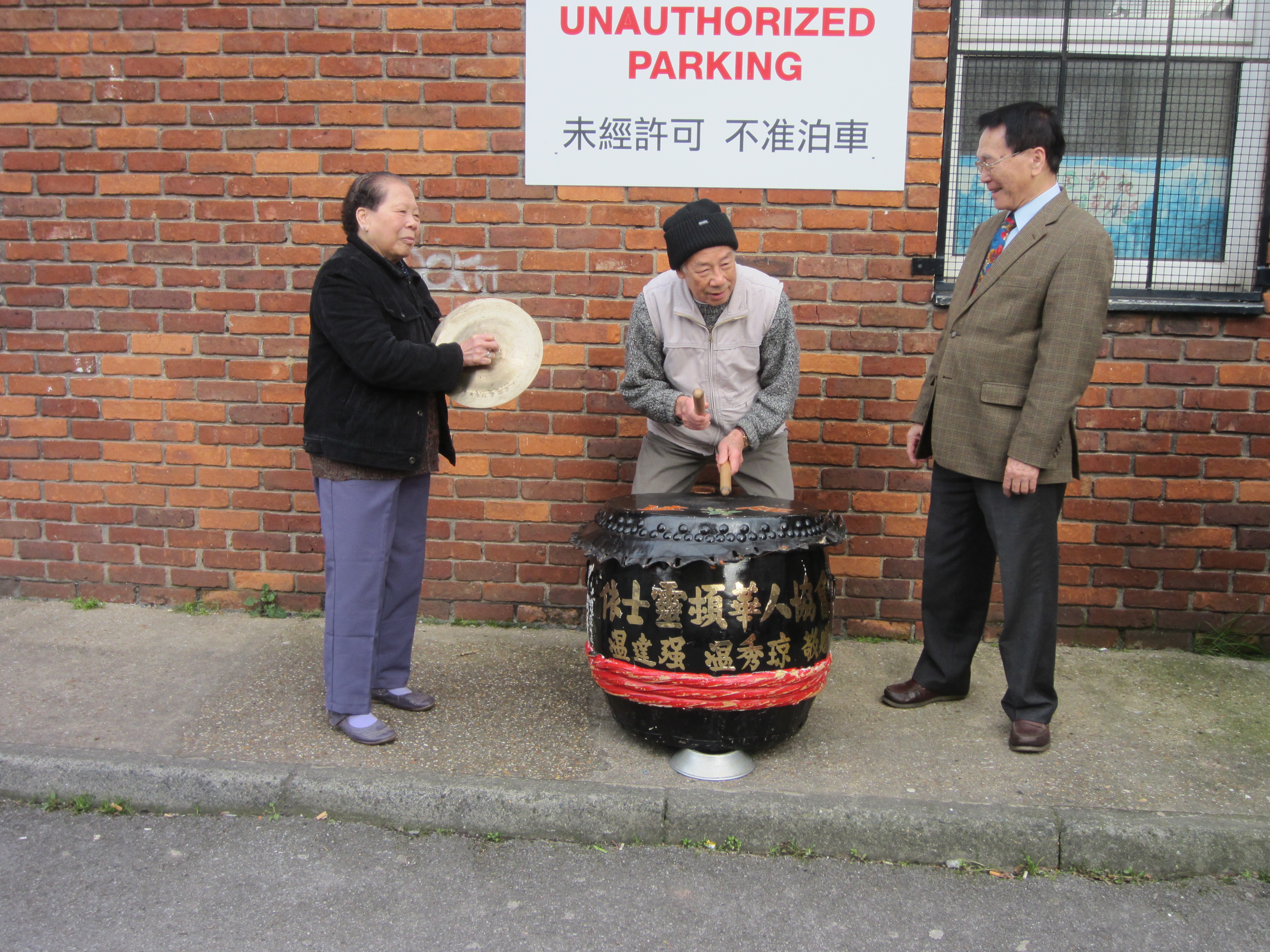
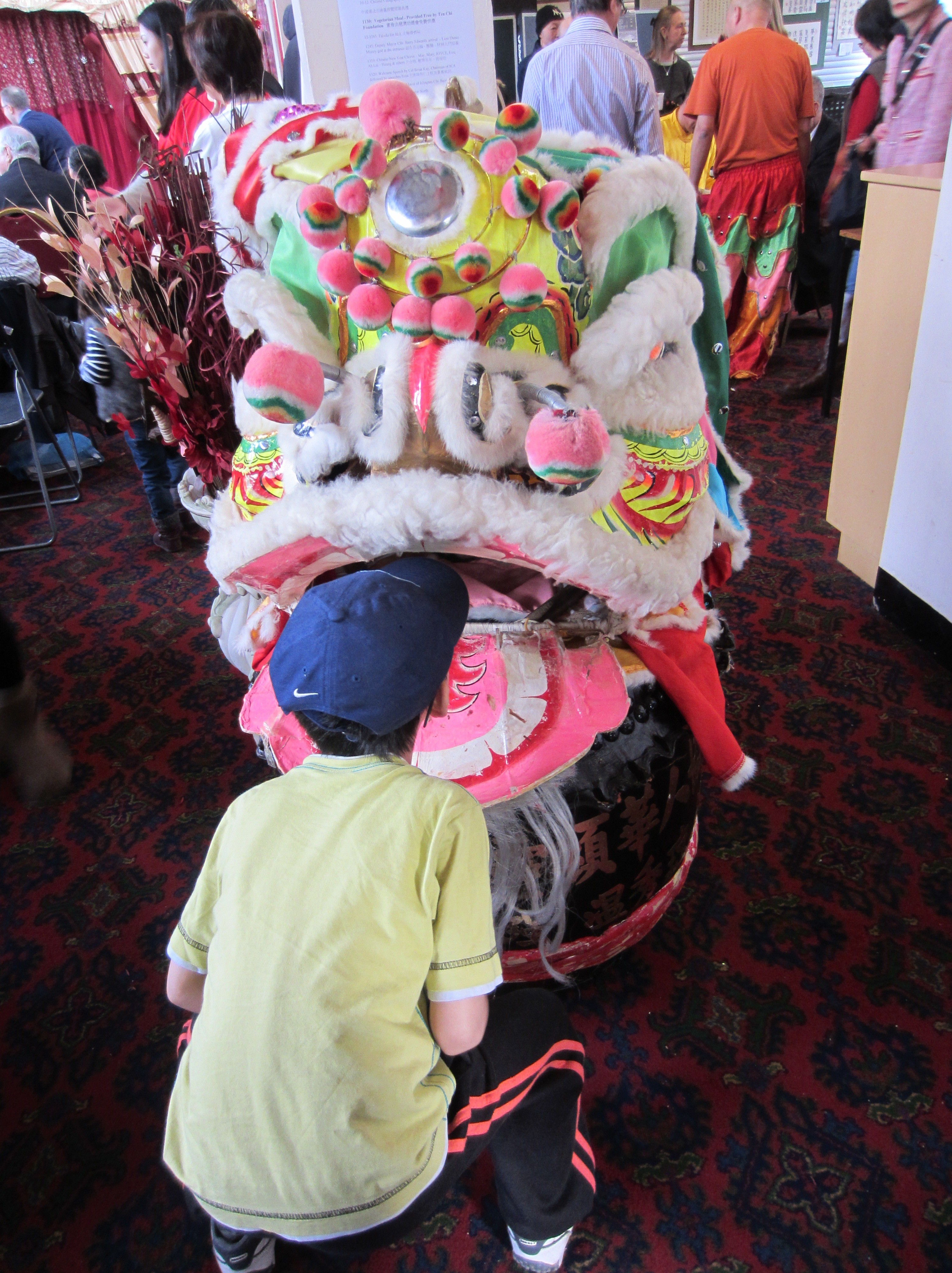
Those worries didn’t last long. We were soon distracted by an insistent beat and the clanging of cymbals. On a pavement outside, a round Chinese drum, its black lacquer gilded with golden characters, had been set up. Lion is approaching. boom-boom-boom The drum was extraordinarily loud, inducing a shiver in the pit of my stomach – a frisson I always feel when I know that the epic Lion Dance will follow. Neighbours peeked out of their windows as the Lion approached, bearing its multi-coloured head. This was a friendly beast, so friendly that at least one little boy was tempted to peer solemnly into its ravenous mouth. The Lion wagged cheeky pink tongue and tail in every corner, which I hope was enough to chase away any evil spirits lurking.

What's in there

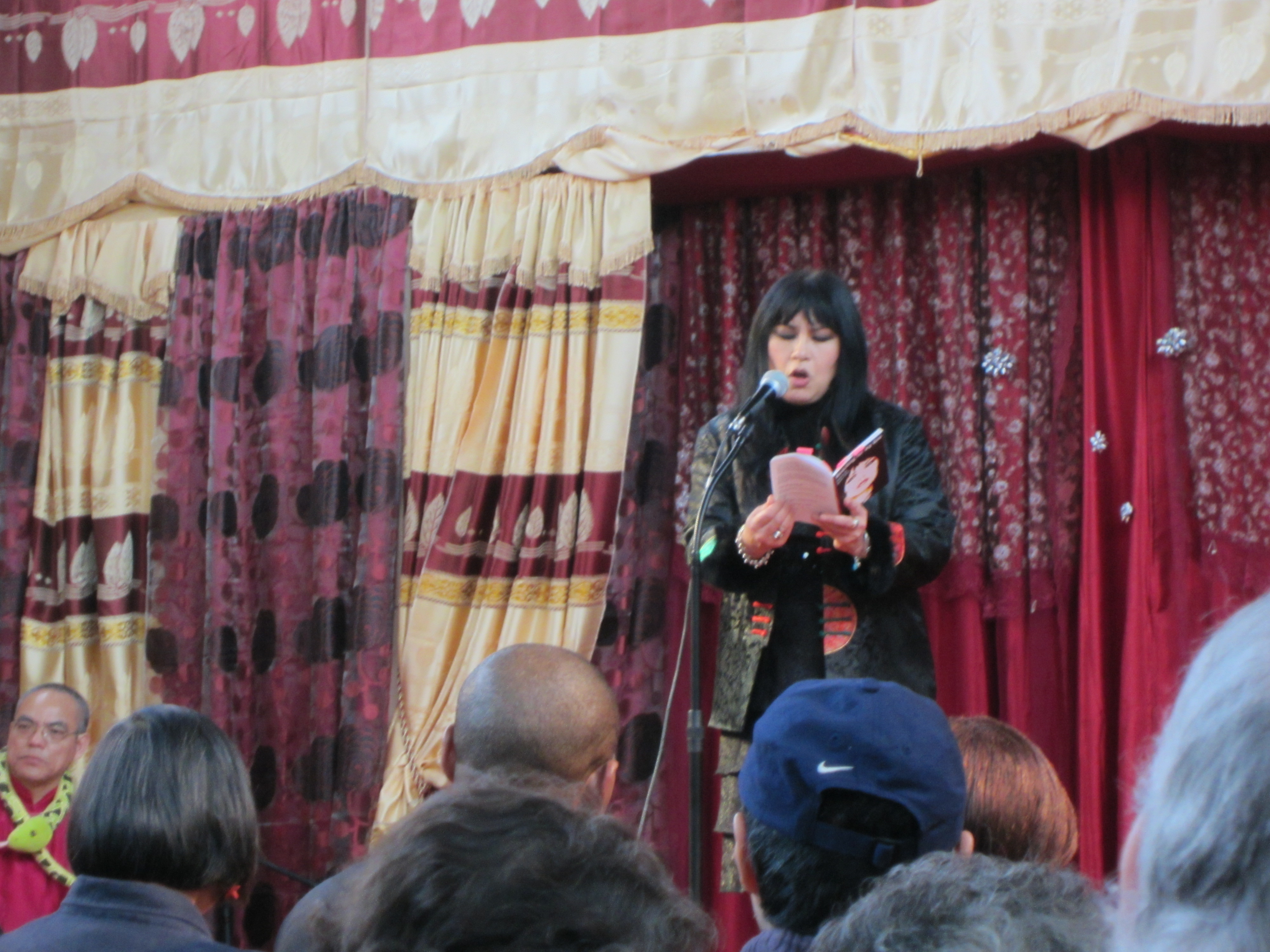
By the time I returned inside, the upper floor of the ICA had been transformed. In its place was a concert hall decked with rows of chairs. From the stage at the front came the dulcet tones of a Chinese flute, so lulling that even the children stopped squirming. When Anna Chen, poet and activist, took to the stage, she invigorated the crowd by half-reading and most astonishingly, half-singing, her poignant poems. The lyrical Anna May Wong must die was especially powerful – ‘a personal journey through the life and crimes of Hollywood’s first Chinese screen legend’, it says on Anna’s website. (I hope everyone reading this will have the opportunity to watch Anna perform). I could see that people listened, but you had to be able to hold their attention.Anna Chen reads her poetry

All too soon, it was my turn. I had been told I would go onstage after the fan dance. I waited in the wings, tense because I knew it would be the first novel reading at the ICA, afraid also that my story might not be regarded as ‘Chinese enough’ for a community event of this sort.

Indeed, the family in my novel is mixed, the woman who leads it being a Nyonya – part of the Chinese diaspora in South East Asia which dates back centuries. Many people today have never heard of the Nyonyas and Babas, even in Malaysia. This is a great shame, because the Nyonyas and Babas successfully created a unique fusion of Chinese and Malay culture long before globalisation existed. In their way of life, they have something to teach us, especially in present-day Malaysia where race drives your rights, or the lack of them (see blog-post The Malaysia We’ve Lost).

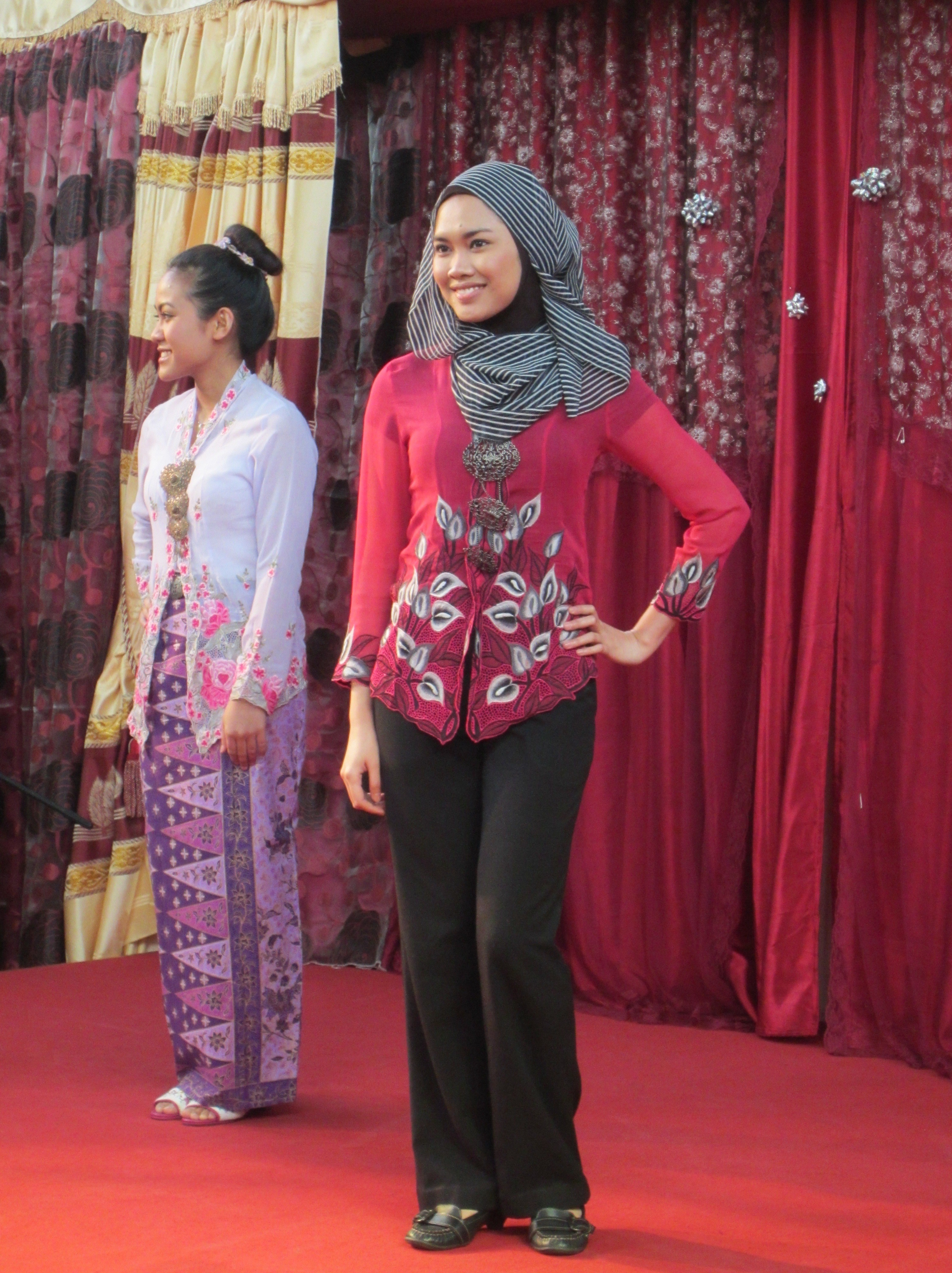
The first passage I read told the ancestral story of the Nyonyas and Babas. Selina introduces the Nyonya themeTo make my reading come alive, I had watched videos of actors and politicians speaking. I also enlisted the help of two Malaysian students, Wahidah and Aufa Dahlia, who gallantly came on stage modelling Nyonya costumes. Wahidah, her hair tied up in the famous Nyonya chignon, looked resplendent in a tailored vintage sarong kebaya.Demonstrating sarong kebaya Her blouse and sarong came from Aufa’s private collection, while her feet were adorned by a pair of hand-made Nyonya beaded slippers which had been purchased from a shop, Colour Beads, in Malacca. This beautiful town is arguably Malaysia’s most historic, and a large Nyonya-Baba community once lived there.

Wahidah was subsequently joined on stage by Aufa Dahlia, who showed off her modern Nyonya attire with great aplomb. The audience sat enraptured, so graceful were the kebaya ladies. Later, many went up to Aufa’s table, where she had placed a sample of the kebaya blouses she sells on her website as a hobby. If the kebaya ladies and I were to form an act, we would surely be hits on a reading circuit!

Modern NyonyaOther artistes followed, including the kung fu master whose rhythmic movements mesmerised everyone. Look at the picture below and you will see why he was a tough act to follow, especially by a writer reading her second passage late in the day. Kung-Fu masterFortunately, I was aided by the dramatic second scene I had chosen to read and by the prop I brought along: the Nyonya kueh (cakes) which feature in my novel. I had only two varieties with me – both from the Malaysia Hall Canteen in Bayswater – but they disappeared in seconds after being shared out!

Afterwards, people came up to say how much they had enjoyed my reading. One woman thanked me for opening her eyes to the diversity of the Chinese diaspora, a few even asked where they could buy my book. Alas, I had to say it was not yet published but I gave them my card nonetheless, as it has the address of this blog on the back.

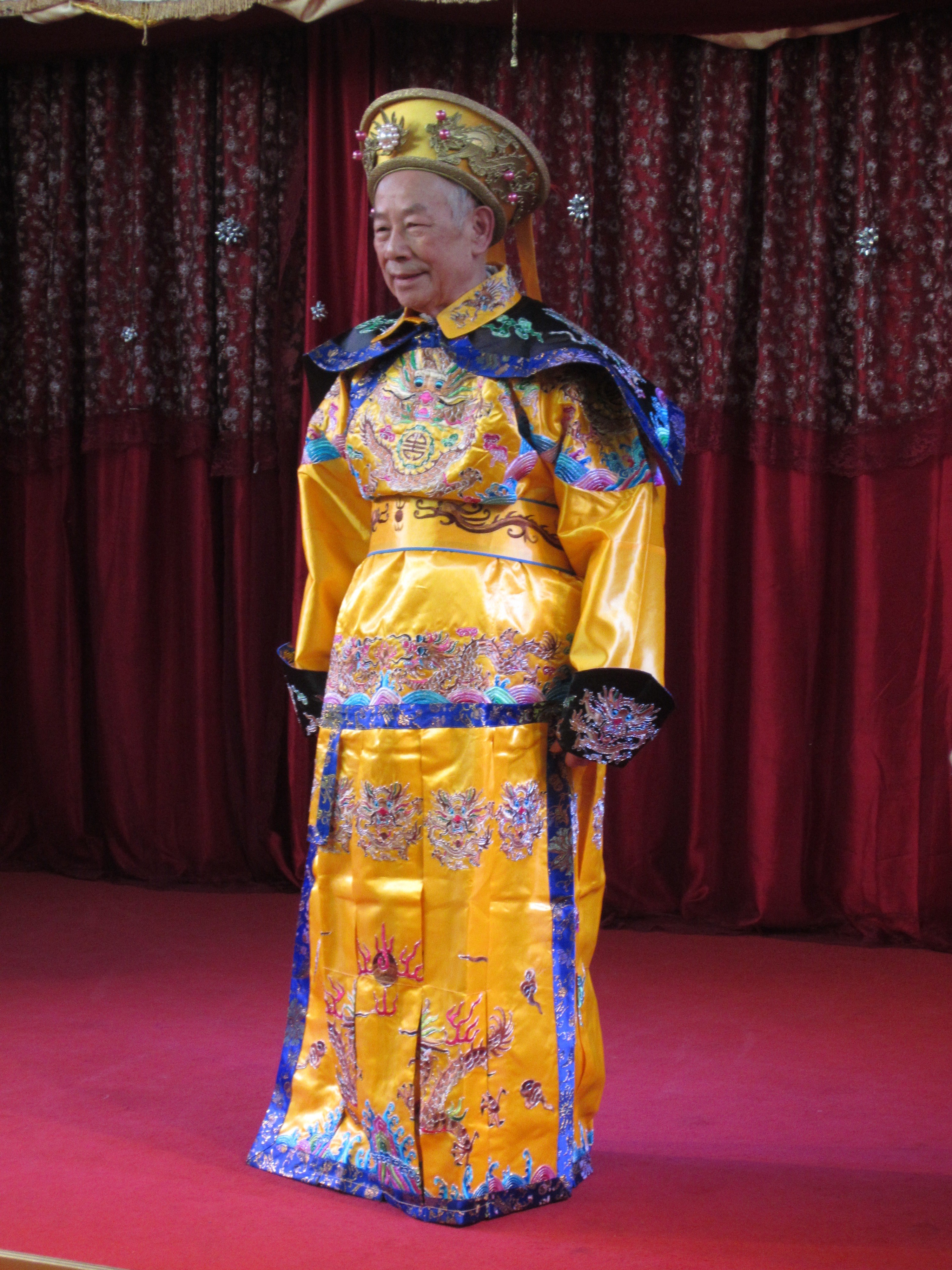
The grand finale of the afternoon was a Ching (Qing) Dynasty costume parade which starred a Mandarin, a Court Official, a Eunuch, the Empress and of course, the Emperor, all in borrowed robes which had never before been worn in the UK. Truly a fitting way with which to end such an uplifting day.

The EmperorAs we headed off, I thought of those who had come before us. It was not just Emperors and Empresses who made history but the coolies leaving in desperate circumstances, and before them, during the Ming Dynasty, the adventurer traders who left to settle elsewhere. These ancestors, all of them, have left their mark in the sands of history. And we their descendants are immensely fortunate, in having such a rich heritage to celebrate.

3 Comments

Filed under Cultural Identity, Identity, Malaysia, Novel, Nyonya

I’ve Finished, Now What?

Many readers of this blog have asked when my novel will be published. A few even assumed, after my last post, that it had already been published!

Ahh, if only…

Two years ago, I attended one of the conferences organised by a unit of Bloomsbury Publishing (of Harry Potter fame). The conference was temptingly called ‘How to Get Published – the Insider Guide to the Media’.

Several hundred of us hopeful writers made our way into a hall at the Wellcome Collection in central London. It was a typical conference hall, with seats on an incline that pointed towards a stage at the front. From their vaunted podium, the first thing senior executives of Bloomsbury did was to greet us. Then they proceeded to say that at any point in time,  a million manuscripts were floating around in search of a publisher. Thanks for the welcome, I thought. The message was so razor-sharp, it could have sliced stone-hard bread: British publishing didn’t need us; it already had enough backlog.

During breaks, I heard other people’s stories. A few delegates, having lived through multiple rejections, had been attending the same conference for many years. Some had been told by agents that there was ‘no market’ for their work. While listening to such war stories, I could see the attractions of self-publishing, though none of my fellow writers showed much enthusiasm. They wanted the prestige of traditional publishing. Others didn’t feel they had the business background to self-publish.

While at the conference, I bought a copy of the Writers’ and Artists’ Yearbook without knowing whether or how I would use it. This tome not only lists agents and publishers in major Western countries, it also gives detailed suggestions for how pitch letters and synopses should be written. Covered with such plaudits as ‘The one-and-only indispensable guide to the world of writing’, this from William Boyd, who could resist? It seemed a snip at £18.99. (Older editions are even cheaper on Amazon). For a fleeting moment, the conference on How to Get Published made me wonder whether I even wanted to be published, but this lasted all of a nano-second before natural ambitiousness took over. I could see my Chinese and Nyonya ancestors standing over me, wagging fingers, tsk-tsking. I left armed with a resolve to complete writing my novel. I decided to worry about publication at a later date.

That crucial moment has now arrived. I have to decide how best to get my novel published and into the hands of the readers whom I believe will be there. This may seem presumptious for a first-time novelist, but on the other hand, I’m supposed to know my audience – and I do. My target readership is Isabel Allende‘s, the Chilean-American writer who has sold 57 million books world-wide. That’s a nice number,  not at all bad for a target audience, I’d say. I think my novel would appeal to her readers because I write in the same story-telling style, and also because my work is a multicultural historical epic family drama, as are many of hers.

But I’m looking to attract new readers too, especially those with Asian roots. While writing my book, I consciously set out to portray Asians as we see ourselves, and to weave as much of South East Asia – be it place, ancestral stories or folklore – into the story as possible.

Knowing this is all very well, but what the hell should I do now? Previously, I would have had little choice but to go down the route of traditional publishing. That would mean fighting for the attention of an agent, because with the million manuscripts floating around, agents too are inundated. Even if I succeeded in finding an agent, there would still be no guarantee of publication – the agent would have to place the manuscript with a publisher willing to take on the book and the risk of a new writer.

But we are now in the digital age, and I have the option of publishing and selling the novel myself. Yet, when I think about what this would entail – all of the copy-editing, proof-reading, lay-out, design, printing (since not everyone in my target audience would have an e-book reader) and most of all, the marketing which a traditional publisher would undertake for its authors – I shudder. It would take me light years away from the creative process. I baulk, despite having a business background which equips me well enough to grapple with rankings on Amazon, persuade reviewers to read my book, even trudge from store to store to sweet-talk them into stocking copies. Because I do have business experience, I realise that this would be a very long-term project for a new writer. Not impossible, just extremely tough for my genre. Though it is a perfectly legitimate route, and one which would give me complete control over my work, as well as (in principle) the lion’s share of any royalties.

Whenever I think about publishing, it becomes abundantly clear that writing was actually the easy part!

For the moment, I have decided to pursue traditional publishing. This is mainly because my first novel is intended as the start of a trilogy and – call me mad – I’ve already started the second. Only a small part, mind, and there’s still a lot more research to do. But a start has been made! This second novel will continue the epic family saga beyond 1941, when the Second World War reaches Malaya.

One way or another, I intend to get published. Meanwhile, if you’re in London over the next two months, I’ll be reading extracts from my novel at two events:

16 February 2013 at the Islington Chinese Association, as part of a Cultural Day to celebrate Chinese New Year

8 March 2013 at a lunch to be hosted by the Hong Kong Society Women’s Group, where together with Kerry Young, author of the acclaimed novel Pao, I will read and explore perspectives on the Chinese spirit for International Women’s Day

Do come if you can!

9 Comments

Filed under Novel, Writing

I’ve Finished!

Six days ago, I finished my novel. Yes! It has taken four drafts and almost two years to hone the 150,000 or so words of my historical epic family drama.

Given that I completed the first draft in just twelve months of furious writing, I find it amazing that I then spent another eleven months editing my work, word by precious word. In the early months, when I sat before my personal computer in full narrative flow, I naively wondered why some books took their authors seven to ten years to write. Now I know.

Looking back, I can see that the first draft contained mainly bare bones. It was as if I had to pour the words out onto a page, so that I could tell the story to myself. Many writers say they don’t share their first drafts with anyone else, but perhaps I’m more thick-skinned. Besides, I find I need feedback to get those creative juices flowing. I therefore showed my first draft to my partner, and also to a professional developmental editor. If I had to do it again, I would do exactly the same thing. I was fortunate in having Dr. Nathalie Teitler, formerly a tutor at Spread the Word, among other organisations, as my editor. The drama I’ve written takes place in Ipoh, Malaya (see map), within a complex multicultural setting, and I needed an editor who would be sympathetic to such material. Right from the start, I became used to criticism, to having chunks decimated, even a whole chapter rejected. I write to be read, and I needed such input. ipoh

In that period, I also sent my early draft to two literary consultancies. Both are reputable and advertise themselves as ‘leading’ consultancies, yet they gave opposing feedback: one very encouraging, the other much less so (I had not told either that this was a first draft). The experience confirmed what I had already suspected – that whether your writing is deemed ‘good’ is highly subjective. Much in the writing industry seems a matter of taste.

When I started the second draft, Nathalie worried I would lose momentum. It happens to many, she said. With me, the opposite was true: ideas came quickly and not always in tangible form, often at night in half-dreams from which I awoke, unsure of the words that had been churning in my head. I was in Malaysia at the time. Something about the heat, the food, family and the way people speak there  (Wahh! Like that also can ah?) stirred my imagination. Thanks to a prolific subconscious, large chunks were added to and taken away in the second draft. A major edit, I thought, until I began the third draft.

That was when I really did sharpen every word in every sentence. It is now quite a different book to what I had at the beginning, or even after the second draft. By that, I don’t mean that the underlying story has changed, rather, that I’ve told it using many more motifs and metaphors.

Editing, I was to learn, is an art. An art which I resisted, until I started to enjoy it. Editing is hugely time-consuming, and anyone who has put together a presentation in the corporate world will understand one of its frustrations. Changing a phrase in the third paragraph of the second chapter could impact the flow of what came before, as well as what comes after. Often, you have to re-read a lot more than just the short paragraph you are changing.

Late in the editing process, I discovered a critical tool: reading aloud. I found that if I could not get my tongue around a sentence, it was usually because there was a problem with that sentence. When I re-wrote it in a way that made it easier on the tongue, the prose invariably became clearer. But reading aloud an entire epic drama of 150,000 words twice from start to finish takes a lot of time. It has a cost on family life too, if your partner happens to be your first reader, which is the case with me. Every time I re-wrote a piece, she was asked to read it. This was especially true of the beginning and end, which I re-wrote, re-read and re-wrote many more times than five, in fact, so many times that I fear I may have lost my first reader in the process. I worry she won’t bother to read the published book! Be that as it may, I can finally say I have completed my first novel. Hallelujah!

30 Comments

Filed under Malaysia, Novel, Writing

What Great-Grandmother Taught Me about Economics

Hang a banker a week until the others improve.” These extraordinary words were uttered by Ken Livingstone, formerly London’s mayor, in a speech in February this year.

His words clearly incite hate, but in the West of today, hating bankers and business, especially big business, seems perfectly acceptable. Livingstone is far from alone. “Outrage over £13 billion lavished on bonuses for bankers while the rest of us struggle to make ends meet,” screamed the MailOnline on 20 September.

With such righteous indignation, it was hardly surprising that two poets, Alice Oswald and John Kinsella, withdrew from the TS Eliot prize on the grounds of its ‘tainted’ sponsorship. The money for the prize was to come from investment firm Aurum, which manages funds of hedge funds. “The business of Aurum does not sit well with my personal politics and ethics”, said Mr. Kinsella, who described hedge funds as being “at the very pointy end of capitalism.” Fair enough. It is laudable to stand up for what you believe in. I only hope Mr. Kinsella never plans to retire, because his pension fund, if he has one, is likely to have exposure to hedge funds (or to mutual funds which employ hedge fund techniques).

Into this charged atmosphere, it would be interesting to see the response to my début novel in which private entrepreneurship is celebrated. My protagonist Chye Hoon fully embraces capitalism, because it offers her and her family opportunities. In colonial Malaya, there is no other lifeline, no entitlement: life is what you make of it. Chye Hoon cannot even read or write but this doesn’t deter her, because she can count. She starts a business in Malaya in 1910, making and selling the delicacies with which she has grown up – the Nyonya kueh of her childhood. On the first morning, Chye Hoon stands in her kitchen inhaling the smells of steaming coconut milk and pandanus leaves, and she knows she will make money.

This she proceeds to do – very successfully. Bahh, you may say. Your book is fiction. Maybe, but my protagonist is based on my great grandmother, who personified the traits of many overseas Chinese. We are the descendants of those who dared leave China. There are plenty of rags-to-riches stories from among us, and all are true. (When I say rags, I mean literally rags. Here is one of many photographs of newly-arrived immigrants at the Chinatown Heritage Centre in Singapore, an excellent museum.) 

Great-Grandmother shared the absolute determination of her Chinese ancestors to succeed. She might even have taught Gordon Brown a thing or two. Ipoh, where she lived, was a mining town, its fortunes tied to tin. And the price of tin, Great-Grandmother knew, went up and down. She understood intuitively that there would be good years as well as bad. If she had heard anyone say, as the former Chancellor did in his pre-budget report of 1999, “Under this Government, Britain will not return to the boom and bust of the past”, she would have exclaimed, Malaysian style, “What? He crazy ah?”

In the good years, Great-Grandmother worked and saved, to prepare for the bad years that were always just round the corner. In the bad years she worked just as hard, but saved less. There was no point complaining, and no one to complain to. Great-Grandmother lived in a world in which no safety net existed: there was no unemployment benefit, no healthcare, or pension. She provided for herself and her children, all nine of them.

At some point Great-Grandmother made enough money, and was approached by others for loans. That was when she became a money-lender in Ipoh. My own protagonist Chye Hoon also becomes a money-lender in my novel. Chye Hoon discovers an under-served niche (women), and her activities play a vital role in the growth of micro-enterprise in her town. In writing about how Chye Hoon builds her business, I drew from twenty years of experience as a banker and entrepreneur. 

Business is about survival, and growth. Always, you have to make sure you survive, no matter how large your business. This is the stuff of life. It’s what I write about in my novel. In the anti-capitalist discourse of today, we sometimes forget that businesses serve needs. As does banking.

Make no mistake: Great-Grandmother’s enterprise may have been small, but she was as keen on profit as any large corporation. Without profit, she could not have survived; our family wouldn’t be here, and I wouldn’t be completing a novel.

As I read some of the headlines in the West today, I can’t help thinking about her. Her golden rules were simple: work your butt off, save like crazy, and take advantage of every opportunity. Oh, and don’t borrow. This last was ironic, given her money-lending activities.

But perhaps a dose of such conservatism has its uses. At the last count, Britain’s households held £1.4 trillion of personal debt. This means that the average amount owed by each person in the UK represents 117% of average earnings.

Some people say this level of debt doesn’t matter (BBC News: The Truth about the UK’s Debt). Perhaps, but surely having less debt could do no harm.

In any case, are bankers solely responsible for the debt mountain? The facts speak for themselves: personal debt climbed during the go-go years between 1997 and 2007.  Loans were given too freely then, but no banker forced anyone to take a loan under duress. Somewhere in the narrative of entitlement, personal responsibility has got lost.

My novel goes against that grain. It is about identity and loss of culture yes, but it is also a story of personal responsibility, and the power we have as individuals. In this time of crisis, it offers a message of hope. Against all odds, a woman faces the Great Depression of the 1930s on her own, with no help whatsoever. She succeeds on her own terms. We can too.

3 Comments

Filed under Identity, Malaysia, Novel

My First Book Reading

It is a wonderful time to be in the New Forest (the brown blob at the bottom of the map). The New Forest lies in Hampshire, and is now one of England’s national parks. In early October the trees are still green, but the oranges and gold of autumn have crept in.

Ponies meander in open fields; along the streets of Beaulieu village, famous for its National Motor Museum, wild donkeys poke their curious nozzles into the doorways of shops.

It was in this pastoral setting that I gave a book reading on the evening of October 3. I had been invited by Monty’s Book Club, whose members meet once a month in the Montagu Arms, a pub and hotel located in the heart of Beaulieu. The club reads the whole range of literary fiction, from contemporary works through to classics. This book club has existed for three years and is thriving; it even has a waiting list. Membership is restricted to ten at any time, because the club borrows books from the local library and ten was felt to be a manageable number. A member told me the size is just right, as it allows for varied discussion without being intimidating.

I was only the second writer to read to Monty’s, the first being Natasha Solomons. To publicise her debut novel Mr Rosenblum’s List, Ms. Solomons went on a quest to visit as many British book clubs as she could. She duly arrived in Beaulieu. There, she paved the way for others, because her reading was such a success that Monty’s members welcomed me too.

My own invitation came about through personal links. During the six years I spent at SouthamptonUniversity as a theoretical physicist, I often sought refuge in the New Forest. I loved its peace, its trees and the colour of its skies. I still visit, to see a long-standing friend whenever I can. On one such visit in the summer, I heard about Monty’s Book Club, and wondered aloud whether the club would be interested in a reading of my novel.

The club said yes. Like Ms. Solomons’ reading, mine was also to be a special event, held not in the Montagu Arms but in a member’s house. I arrived with some trepidation. I had never given a book reading before and didn’t know what to expect. I knew the atmosphere would be genteel and its members polite, but I didn’t want people to say nice things just because they felt obliged to. If anyone became bored during the half hour or so while I read, it would have been obvious to me – and the rest of the audience.

So I practised, many times. I recorded my voice on a sleek, silver Olympus recording machine my partner had given me as a present. It’s a fabulous gadget: pocket-sized yet powerful. On it, you can hear everything, even the rustle of paper. I listened to my enunciation, making sure there was enough nuance in my voice to keep everyone’s attention. I learnt to pull my stomach muscles in when my voice fell, so that I could better project sound across a room. I imagine that this is what singers have to do.

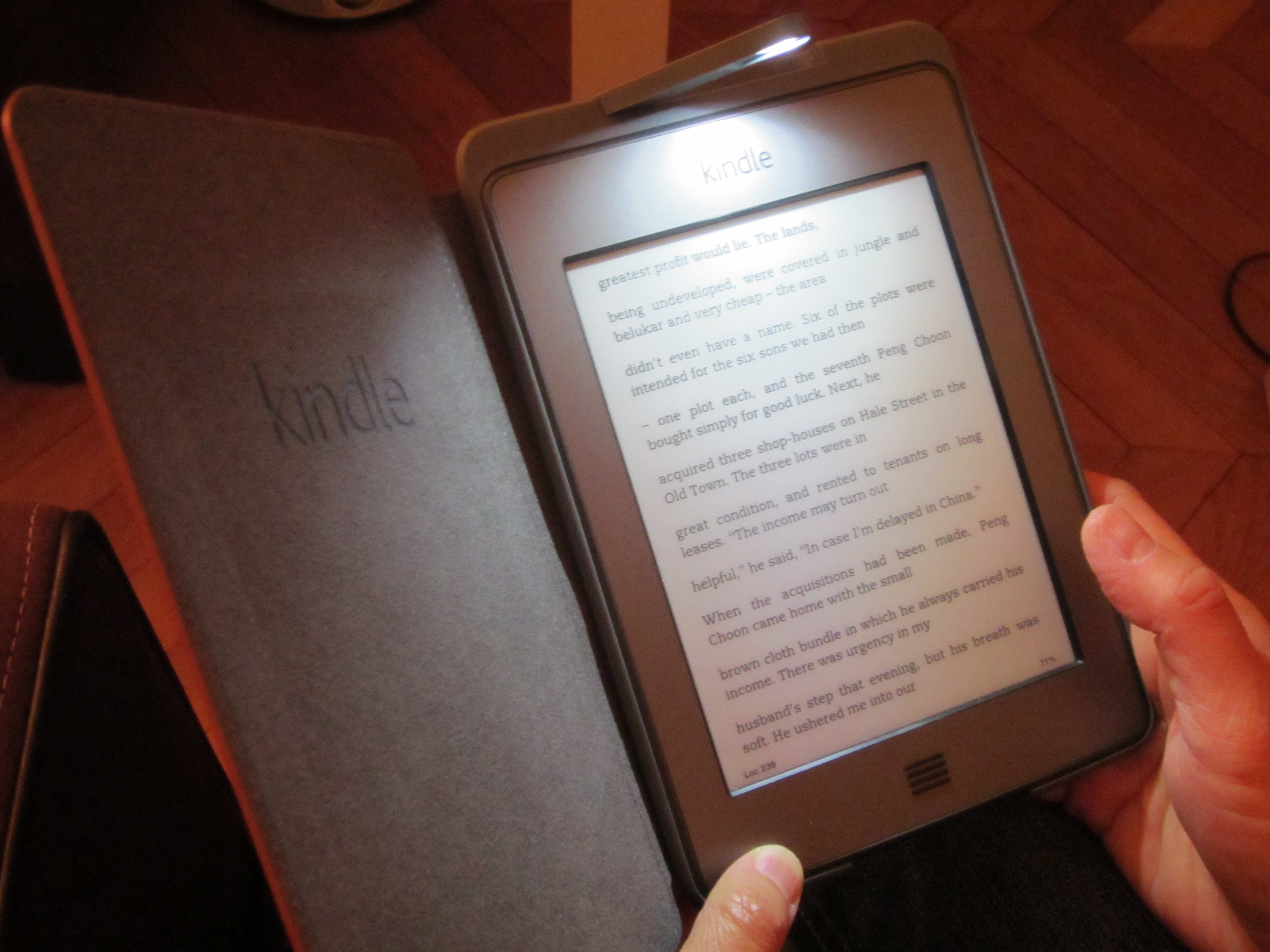
I read from a Kindle reader with a special leather cover that has its own discreet lamp at the top. The light flicks in and out; it can be fully tucked in unless needed, a highly ergonomic design. Much as I love holding a physical book, I also love my Kindle and its cover. Its leather feels wonderful in my hands, and the fact that its light shines directly onto the page is a huge bonus. The Kindle proved incredibly useful during my reading. 

In the end, I read two sections, one short, the second longer. The first was the ancestral story of the Nyonyas, the people from whom my main protagonist, Chye Hoon, is descended. I looked at my audience as I read, watching for any sign of a yawn or of eyes glazing over. None came. I could see that the members of Monty’s Book Club were imagining the scene in their own minds, seeing the character in my story who is herself telling a story.

When I began the second, longer section, the eyes of my audience were still on me. The scene takes place on the island of Penang, which a few in the room had been to. But my Penang is the Penang of 1898, and I invoke a place covered in virgin jungle, where elephants are still a form of transport. In this scene, Chye Hoon is about to get married. It is a huge celebration, because Chye Hoon is an independent-minded girl with a fearsome temper and no one believes she will ever find a suitor. But get married she does, in the colourful Nyonya-Baba tradition of the day which left my modern British audience wide-eyed.

Afterwards, the members of Monty’s asked many questions. We talked about the Nyonyas and Babas, whom none had heard of previously. We talked also of Malaysia, the real Malaysia, not the one touted on Tourism Malaysia billboards. I was impressed that this group – educated women, some with careers, many who stayed at home, some now pursuing post-graduate studies, and all juggling a host of family commitments – remained late into the night to engage in a culture they had never heard of, in a country some had yet to visit. I took it as a good sign that there would be interest from a Western audience in my multi-cultural novel. Its themes are topical today: the ongoing tension between modernity and tradition, and the invisible cost of the cultural assimilation which some of us must face.

In my novel, the characters speak like real-life Malaysians. I mentioned this in a previous blog-post What Does it Cost to Write a Novel?, in which I had said I was unsure about this point of style. A member of Monty’s, a speech therapist, said she loved my dialogue. She especially liked the way I had changed the order of words. She put it very aptly: “Language isn’t just about communication; it also conveys a sense of place.” In a number of novels she had read, the characters had spoken in ordinary English even though the stories were set in foreign lands, and she had felt this sense of place to be missing. Others in the group agreed. I breathed a sigh of relief, because my audience had validated an intuition which I, as a Malaysian writer, have long had.

My grateful thanks to Monty’s Book Club; they made the evening what it was, and also helped clarify an ambiguity in my own mind. A few members asked when my novel would be published. Some worried it might not. But it will – because I write to be read, not so that my script remains as bits on a motherboard. When and in what form my novel will be published, I cannot say. But I will work to get it there, even if it means having to start a publishing company.

12 Comments

Filed under Malaysia, Novel, Nyonya

What does it Cost to Write a Novel?

I have now been writing my novel for 580 days. How many hours would that make? I haven’t counted, but given that there are 13,920 hours in 580 days, a rough estimate must yield a number in the thousands. A sobering thought…

With my business background and Chinese heritage, I can’t help thinking about what people in business call ‘the opportunity cost’. In other words, what else I could have done in that time, and how much more income I might have generated.

In a year and a half, the total package garnered by a senior manager working full-time could come to a few hundred thousand pounds (if we included bonuses, healthcare and pension contributions). I chose to leave the corporate world, and I don’t for one nanosecond regret that decision. Not because I hated it, but because in my time, I survived two life-threatening illnesses. Writing was integral to my recovery (see blog-post The Miracle of Writing), and I believe I need to continue telling stories for my well-being.

While I would love to be commercially successful as a writer, I have to be realistic: I’m writing historical fiction, not Harry Potter. My aim is to be both accessible and literary at the same time. In the process, I hope to entertain many, and to touch a few. Although my novel is historical, it carries themes of contemporary interest, such as the invisible cost of cultural assimilation – what it means to lose a heritage, and the ongoing tension between modernity and tradition.

It took me twelve months to write the first draft of this epic drama. That is fast, I’m told, for 150,000 words. (In comparison, the average book now has 100,000 to 120,000 words). Once I started, I couldn’t stop. I worked like a fiend. It helped that I could work at my second job from home, which gave me plenty of flexibility to write. I also had a wonderfully supportive partner who agreed not to speak to me before 3 pm each day. Although this was the subject of constant jokes amongst our friends, I can happily say there is no substitute for discipline.

At that whirlwind speed, I expected to be finished in no time. But my editor shook her head after the second draft. Nope, not ready yet, she told me in no uncertain terms. It is only now, well into my third draft, that I fully appreciate how much work has to go into polishing each and every word. I sit thinking about tenses and grammar. I stare at commas and semi-colons, the presence or absence of which could subtly change a sentence.

When I gave the second draft to a book-loving friend for a lay-person’s opinion, the work had grown to 170,000 words. I’m very grateful to my friend for her patience and her many comments. But what is a writer to do with wildly opposing feedback?

The bone of contention: the fact that my characters talk like Malaysians. (By that, I mean the dialogue between characters, not the narrative flow itself). Here’s an example. Instead of saying “How can that be?”, a Malaysian in real life might say, “Like that, how can-ah?”

To me as a Malaysian, the words written in that way simply jump off the page. I can hear the sentence, “Like that, how can-ah?” in all three of Cantonese, Malay or Malaysian English (Manglish). While creating the dialogue between my characters, I realised that when Malaysians speak English, we often just translate from our own languages.

By changing the order of the words on the page, I hoped to convey some of the cadence and intonation of Malaysian speech. It would have been easy to stick to the tried and tested Malaysian favourites: ‘lah’ and ‘ah’ and even ‘ai-yahh’; I wanted, perhaps ambitiously, to capture more of Malaysia’s atmosphere in my novel. If you haven’t been to South-East Asia, this may be lost, and the speech could seem trying. This is why I’ve restricted ‘Malaysian-isation’ to only the dialogue between the characters in my book. A matter of style, but it has already proven controversial. My editor loved it, and my friend hated it. Their reactions told me that other readers were also likely to fall into those two camps. As the writer, I will have to make the final decision.

Writers are always encouraged to read as widely as possible. Yet, while writing my first draft, I found that if I read any work written in a style dissimilar to mine (a story-telling style à la Isabel Allende), my own writing became affected. The sentences would cease to flow. In that period, I was forced to read and re-read Isabel Allende. Not a hardship, since I love her writing. In contrast, reading widely has helped me with my second and third drafts. I’ve read a string of novels recently, including The Thousand Autumns of Jacob de Zoet, a sad story set in Japan in the late 1700s, in which David Mitchell displays wonderful techniques with dialogue.

Latterly, I’ve discovered a trick I wish I had used earlier. Now that my work is nearly ready to be more widely exposed, I have a number of readings planned. While preparing for them, I began to read passages of my work aloud to myself. That was when I realised I could use reading aloud as a tool to weed out unwieldy sentences. If my tongue couldn’t get around a sentence first time, it was usually because the sentence didn’t work, and I had to change it.  Reading aloud also helps when you’re trying to spot repetition. Gillian Slovo had mentioned this at a writing workshop at the Faber Academy, but once I arrived home, I promptly forgot her advice. She was spot-on though.

Soon, it will be time to think about how to get my work published. I’m not looking forward to the process; why that is the case deserves another blog-post. To return to the question I asked at the outset: what does it cost to write a novel? Answer: many years of a writer’s life. And what does it take to get to the finish line? Discipline, determination and an insane belief that you have a worthwhile story to share with the world.

5 Comments

Filed under Malaysia, Novel, Writing

Tan Twan Eng, the Garden of Evening Mists and Memories of War

I’m always on the lookout for writers and artists from Malaysia. I get a particular thrill when a piece of literary or artistic work reflects Malaysians as we are, in the places we know and love. It is rare to come across such work outside Malaysia. So when it happens, and the work then goes on to achieve international recognition, I’m doubly excited!

This is what has happened with Malaysia-born Tan Twan Eng. (Surname: Tan, name: Twan Eng. See my blog-post What’s in a Chinese Name?). His two novels have both been long-listed for the prestigious Man Booker Prize – a remarkable feat. I first heard of him in 2007 when his début novel The Gift of Rain was published in the UK. A former banking colleague had recommended I read it. “It’s beautiful,” he told me. He was right. The Gift of Rain is set on the magical island of Penang, home of sandy beaches and swaying palms. The story in it unfolds in lyrical prose as light as stardust.

Yet, Tan Twan Eng is not especially known in Malaysia. This is a shame – because his work ripples with themes Malaysians would find interesting.

To begin with, both novels are about the War and its aftermath. For Malaysians, there is but one War: the Second World War – when Malaya was occupied by Japanese forces. This occurred between 1941 and 1945. Roughly seventy years may have passed, but we continue to be affected by the events which took place then. They changed Malaya irrevocably, in ways we are only beginning to explore and understand.

I know I was obsessed with stories from the War era as a child. Whenever my now-dead maternal Grandmother visited, I would beg her to tell me what the War was like. She would sit, as calm as a lake on a still night, and in her deep voice, would tell me things I simply could not imagine. Soldiers rapping on doors and windows, looking for girls and women; men being rounded up, forced to stand in 30+ degree Celsius heat with no water; the screams that could be heard from one of the hospitals in Ipoh, where the Japanese had set up a torture chamber; heads on spikes, on full display at the front gates of Ipoh’s Central Market as a warning to the headstrong.

I thought I knew much about the War. Yet, both The Gift of Rain and Garden of Evening Mists, Tan Twan Eng’s latest novel, taught me new things.

For example, I grew up believing that the British Colonial administration had done its very best to defend our country. Not so, according to The Gift of Rain, and my own research confirmed this. Much has been made of the Malayan Campaign. But if we cut through it all, here is the bald fact: Britain largely abandoned us to the Japanese. Japanese forces attacked the north-eastern coast of Malaya first, before swiftly marching across the country: westwards and southwards, over mountains and across jungle our Colonial rulers had said was impenetrable. Yes there were battles – mainly in support of retreat – unlike in Europe, where the British army fought for every inch of ground, to the death. In Malaya, the Colonial troops retreated…and retreated…until they reached the island of Singapore and there was nowhere else to go. At that point, some hopped onto ships bound for Australia, following their women and children. Those who didn’t leave on time were captured when Singapore fell.

I was sorely disappointed by what I learnt. It still rankles today. The only thing I can do with my feelings is to write about what happened.

I imagine Tan Twan Eng must have been similarly affected, though he has worked wonders to weave history into his stories easily. His writing doesn’t feel dense, nor is there any rancour. Amazingly, each novel incorporates a Japanese central character. In Garden of Evening Mists, this happens to be the Emperor’s gardener; in The Gift of Rain, it is an aikido master. Tan himself has first-dan ranking in aikido, and has obviously studied Japanese thinking. He manages to convey some of its Zen-like mystery and beauty through slow, deliberately measured prose, so that even the positioning of stones within a garden becomes pure poetry.

Garden of Evening Mists tells the story of a young Malaysian-Chinese woman, Yun Ling, who goes on to become a lawyer, but who cannot forget the War. After graduating from Cambridge, she takes leave to learn the art of creating a Japanese garden from a man who was the Emperor’s gardener. This fictional garden is located high up in the Malaysian hills, in Cameron Highlands, a dreamy place once shrouded in jungle and mist. It was developed because it reminded British Colonialists of their home. Yun Ling hopes the creation of a garden will be cathartic; instead, it adds layers of intrigue and pain she only comprehends years later. 

Japanese themes also echo in The Gift of Rain. A Eurasian boy, Philip (Note: By Eurasian, I don’t mean someone from that piece of land known as Eurasia, but a person with one European parent and one Asian parent), who lives in Penang, is befriended by a Japanese man, Endo, before the War. Philip is taught aikido by Endo. Perhaps I read too much into it, but what develops within Philip is a depth of feeling which struck me as homo-erotic. (Though I stress this isn’t a ‘gay’ novel.) Philip learns not only aikido, but also the Japanese language. Then, the Japanese arrive, en masse. You will have to read the book to find out what happens to him, his family and Penang.

Incidentally, there is an explicitly gay character in Garden of Evening Mists. I mention this because it shows me that Tan Twan Eng isn’t afraid of tackling a subject we in Asia prefer to avoid.

Like a good story-teller, Tan Twan Eng folds his own experiences seamlessly into his writing. Having lived in Cape Town for the past few years, he inserted an Afrikaner into his latest book. There are therefore plenty of lekker braais (delicious barbecues) alongside descriptions of Cape Dutch houses and flora. And these are all made to fit into Cameron Highlands!

Reading Tan Twan Eng has inevitably made me reflect on my own work. My current novel deals with an equally dramatic period for Malaya – the years after colonisation but before the War. It was a time of great change: cars and airplanes came to Malaya then, Malayans started to learn English and many families became westernised. There was also a Japanese community in Malaya, whom we later learnt were spies. Many were photographers; one of them features in my novel towards the end, just before the eve of the Japanese invasion, when the matriarch in my story dies.

I had always intended my novel to be the first in a trilogy, with the second in the series focusing on the impact of the War years on a particular family in Ipoh. Reading Garden of Evening Mists has made me realise how much is left to explore…What an incredible life this is.

2 Comments

Filed under Malaysia, Novel, Research, Writing