I’ve Finished, Now What?

Many readers of this blog have asked when my novel will be published. A few even assumed, after my last post, that it had already been published!

Ahh, if only…

Two years ago, I attended one of the conferences organised by a unit of Bloomsbury Publishing (of Harry Potter fame). The conference was temptingly called ‘How to Get Published – the Insider Guide to the Media’.

Several hundred of us hopeful writers made our way into a hall at the Wellcome Collection in central London. It was a typical conference hall, with seats on an incline that pointed towards a stage at the front. From their vaunted podium, the first thing senior executives of Bloomsbury did was to greet us. Then they proceeded to say that at any point in time,  a million manuscripts were floating around in search of a publisher. Thanks for the welcome, I thought. The message was so razor-sharp, it could have sliced stone-hard bread: British publishing didn’t need us; it already had enough backlog.

During breaks, I heard other people’s stories. A few delegates, having lived through multiple rejections, had been attending the same conference for many years. Some had been told by agents that there was ‘no market’ for their work. While listening to such war stories, I could see the attractions of self-publishing, though none of my fellow writers showed much enthusiasm. They wanted the prestige of traditional publishing. Others didn’t feel they had the business background to self-publish.

While at the conference, I bought a copy of the Writers’ and Artists’ Yearbook without knowing whether or how I would use it. This tome not only lists agents and publishers in major Western countries, it also gives detailed suggestions for how pitch letters and synopses should be written. Covered with such plaudits as ‘The one-and-only indispensable guide to the world of writing’, this from William Boyd, who could resist? It seemed a snip at £18.99. (Older editions are even cheaper on Amazon). For a fleeting moment, the conference on How to Get Published made me wonder whether I even wanted to be published, but this lasted all of a nano-second before natural ambitiousness took over. I could see my Chinese and Nyonya ancestors standing over me, wagging fingers, tsk-tsking. I left armed with a resolve to complete writing my novel. I decided to worry about publication at a later date.

That crucial moment has now arrived. I have to decide how best to get my novel published and into the hands of the readers whom I believe will be there. This may seem presumptious for a first-time novelist, but on the other hand, I’m supposed to know my audience – and I do. My target readership is Isabel Allende‘s, the Chilean-American writer who has sold 57 million books world-wide. That’s a nice number,  not at all bad for a target audience, I’d say. I think my novel would appeal to her readers because I write in the same story-telling style, and also because my work is a multicultural historical epic family drama, as are many of hers.

But I’m looking to attract new readers too, especially those with Asian roots. While writing my book, I consciously set out to portray Asians as we see ourselves, and to weave as much of South East Asia – be it place, ancestral stories or folklore – into the story as possible.

Knowing this is all very well, but what the hell should I do now? Previously, I would have had little choice but to go down the route of traditional publishing. That would mean fighting for the attention of an agent, because with the million manuscripts floating around, agents too are inundated. Even if I succeeded in finding an agent, there would still be no guarantee of publication – the agent would have to place the manuscript with a publisher willing to take on the book and the risk of a new writer.

But we are now in the digital age, and I have the option of publishing and selling the novel myself. Yet, when I think about what this would entail – all of the copy-editing, proof-reading, lay-out, design, printing (since not everyone in my target audience would have an e-book reader) and most of all, the marketing which a traditional publisher would undertake for its authors – I shudder. It would take me light years away from the creative process. I baulk, despite having a business background which equips me well enough to grapple with rankings on Amazon, persuade reviewers to read my book, even trudge from store to store to sweet-talk them into stocking copies. Because I do have business experience, I realise that this would be a very long-term project for a new writer. Not impossible, just extremely tough for my genre. Though it is a perfectly legitimate route, and one which would give me complete control over my work, as well as (in principle) the lion’s share of any royalties.

Whenever I think about publishing, it becomes abundantly clear that writing was actually the easy part!

For the moment, I have decided to pursue traditional publishing. This is mainly because my first novel is intended as the start of a trilogy and – call me mad – I’ve already started the second. Only a small part, mind, and there’s still a lot more research to do. But a start has been made! This second novel will continue the epic family saga beyond 1941, when the Second World War reaches Malaya.

One way or another, I intend to get published. Meanwhile, if you’re in London over the next two months, I’ll be reading extracts from my novel at two events:

16 February 2013 at the Islington Chinese Association, as part of a Cultural Day to celebrate Chinese New Year

8 March 2013 at a lunch to be hosted by the Hong Kong Society Women’s Group, where together with Kerry Young, author of the acclaimed novel Pao, I will read and explore perspectives on the Chinese spirit for International Women’s Day

Do come if you can!

9 Comments

Filed under Novel, Writing

I’ve Finished!

Six days ago, I finished my novel. Yes! It has taken four drafts and almost two years to hone the 150,000 or so words of my historical epic family drama.

Given that I completed the first draft in just twelve months of furious writing, I find it amazing that I then spent another eleven months editing my work, word by precious word. In the early months, when I sat before my personal computer in full narrative flow, I naively wondered why some books took their authors seven to ten years to write. Now I know.

Looking back, I can see that the first draft contained mainly bare bones. It was as if I had to pour the words out onto a page, so that I could tell the story to myself. Many writers say they don’t share their first drafts with anyone else, but perhaps I’m more thick-skinned. Besides, I find I need feedback to get those creative juices flowing. I therefore showed my first draft to my partner, and also to a professional developmental editor. If I had to do it again, I would do exactly the same thing. I was fortunate in having Dr. Nathalie Teitler, formerly a tutor at Spread the Word, among other organisations, as my editor. The drama I’ve written takes place in Ipoh, Malaya (see map), within a complex multicultural setting, and I needed an editor who would be sympathetic to such material. Right from the start, I became used to criticism, to having chunks decimated, even a whole chapter rejected. I write to be read, and I needed such input. ipoh

In that period, I also sent my early draft to two literary consultancies. Both are reputable and advertise themselves as ‘leading’ consultancies, yet they gave opposing feedback: one very encouraging, the other much less so (I had not told either that this was a first draft). The experience confirmed what I had already suspected – that whether your writing is deemed ‘good’ is highly subjective. Much in the writing industry seems a matter of taste.

When I started the second draft, Nathalie worried I would lose momentum. It happens to many, she said. With me, the opposite was true: ideas came quickly and not always in tangible form, often at night in half-dreams from which I awoke, unsure of the words that had been churning in my head. I was in Malaysia at the time. Something about the heat, the food, family and the way people speak there  (Wahh! Like that also can ah?) stirred my imagination. Thanks to a prolific subconscious, large chunks were added to and taken away in the second draft. A major edit, I thought, until I began the third draft.

That was when I really did sharpen every word in every sentence. It is now quite a different book to what I had at the beginning, or even after the second draft. By that, I don’t mean that the underlying story has changed, rather, that I’ve told it using many more motifs and metaphors.

Editing, I was to learn, is an art. An art which I resisted, until I started to enjoy it. Editing is hugely time-consuming, and anyone who has put together a presentation in the corporate world will understand one of its frustrations. Changing a phrase in the third paragraph of the second chapter could impact the flow of what came before, as well as what comes after. Often, you have to re-read a lot more than just the short paragraph you are changing.

Late in the editing process, I discovered a critical tool: reading aloud. I found that if I could not get my tongue around a sentence, it was usually because there was a problem with that sentence. When I re-wrote it in a way that made it easier on the tongue, the prose invariably became clearer. But reading aloud an entire epic drama of 150,000 words twice from start to finish takes a lot of time. It has a cost on family life too, if your partner happens to be your first reader, which is the case with me. Every time I re-wrote a piece, she was asked to read it. This was especially true of the beginning and end, which I re-wrote, re-read and re-wrote many more times than five, in fact, so many times that I fear I may have lost my first reader in the process. I worry she won’t bother to read the published book! Be that as it may, I can finally say I have completed my first novel. Hallelujah!

30 Comments

Filed under Malaysia, Novel, Writing

Trapped in Totleigh Barton!

The blurb had advertised Totleigh Barton as a ‘thatched, pre-Domesday manor house’. On looking up Wikipedia, I discovered that the Domesday Book was completed in 1086. Did I say 1086? Even modern British houses are cold, I find, especially their bathrooms. What was a house with a thatched roof built before 1086 going to be like? And in November…Totleigh Barton

Worse was what I had actually enrolled to do: learn new techniques for short stories, and actually write them. Short stories were not ‘my’ genre, I told myself, while wondering what the hell I was doing there.

But it was too late to turn back. Not least because we were in the middle of nowhere. Literally. Having tried to find Totleigh Barton on googlemaps beforehand, I realised we would be heading for a dot in the middle of an ocean of fields. The nearest town, Sheepwash, was two miles away. There was no wi-fi, not even mobile reception. To get mobile reception, you had to walk up a steep hill – which I couldn’t do because I was still using a crutch, thanks to an ankle sprain six weeks previously.

Then, there was the rain. We were in Devon after all, where rain falls in biblical proportions. devonI heard it in my slumber and would wake up with ready-made sentences. A short story I wrote began like this: “Winds like the dogs of Cantelabra howled through the night. Rain dropped in pellets, hitting the window panes of Sheepwash. The sheep in their pens were soaked; their clothes turned into mink, pink like the rain.

These aren’t my finest lines, but they are an example of what we were encouraged to do: let our imagination meander anywhere it cared to go . There are no rules in the short story, we were told. We gave ourselves permission to write whatever we wanted, in any way we wanted. Otherwise, I would never in a million years have come up with the dogs of Cantelabra or sheep in pink mink.

Our tutors, Tania Hershman and Adam Marek, were extraordinary. The whole course was extraordinary, as you would expect from Arvon, the UK’s premier writing foundation, which has perfected its recipe over many years. Our tutors’ seemingly crazy exercises undoubtedly produced results, because within ten minutes of our first session, we had all written a piece of flash fiction (a very short story of generally fewer than 500 words).

Equally important, we had great fun. So much so that on the last morning, when we were supposed to have free time, we asked for more writing exercises. How masochistic is that? We were simply hooked – not even the cold of the beautifully restored barn could stop us. When Tania and Adam complied, everyone came. We stretched out on sofas in the barn, then after a break, moved into the mediaeval dining room to huddle along benches, our shoulders hunched over a banqueting table the celebrity chef Heston Blumenthal would surely covet (see photograph below from the Arvon website, reproduced with their kind permission).

TotelighdiningroomSo just why had I been so afraid of going on an Arvon course?

A clue came in the middle of the week. That evening, we had a guest writer to visit. We were sitting at the mediaeval dining table, warmed by sips of wine and a roaring fire, when Oliver Meek, who with his wife Claire Berliner runs Totleigh Barton, mentioned that Arvon was thinking of ways to attract a more diverse audience. Arvon, he said, wanted to reach out into new communities. To do this, it had expanded its courses to certain cities; ethnic minorities, it seemed, were intimidated by secluded rural centres. As Oliver spoke, something clicked in my brain. I identified immediately with his words, which may sound strange to some. Fear of the countryside? Why would anyone be wary of sheep and rolling fields?

Only much later, after I had left the calm of Devon, was I able to reflect on this. I too, had been put off by where Totleigh Barton is situated. Though Sheepwash is beautiful, my mind associates seclusion with few people, all very similar but different from me, whose view is limited to a tiny piece of the world. I expect danger. And hostility. I didn’t fancy being stuck in such a place with strangers, unable to escape. Sweeping generalisations these may be, but they are the things we cannot rationalise away. Or even articulate to ourselves: until Oliver spoke, I wasn’t fully aware of what my fears had been about.

Such baggage may be stereotype and pre-conception, but it has power. I nearly didn’t book myself onto this Arvon course. And if I, with my privileged Oxford and City background, had been anxious, how much more would others be.

I’m so glad Arvon wants to reach beyond its traditional catchment. Oliver’s words made me stupidly happy. I walked on a high all evening. Perhaps it was also the Dunmore effect: the fabulous Helen Dunmore, prize-winning poet and novelist who spoke to us after dinner, is nothing if not breathtakingly eloquent. She could put anyone on a cloud. If you ever have a chance to hear her speak, grab it.

For anyone reading this who is hesitating over an Arvon course, especially if you come from an ethnic minority group – don’t be afraid, just do it. The magic will come. Arvon cares about everyone who comes through its doors. Its formula works. But you have to be open, and be prepared to give of yourself.

There was something in the air over Totleigh Barton, a magic which came precisely from being secluded in a beautiful place with others who loved words and stories. There was another kind of magic – the kind that comes from being cared for all day long. I had never expected to enjoy it so much. Even sleeping in a building which had once been home to pigs seemed exotic (see photograph below of my bedroom in the Pig Stiles, with windows on the other side overlooking green fields). The Pig Stiles

When it came time to leave, we discovered that Devon was covered in water and trains were only running from the next county. But I didn’t care. I had learnt about dribbles (micro stories of 50 words) and drabbles (micro stories of 100 words) and had finally found my short story voice. What did it matter that England was soggy?

7 Comments

Filed under Cultural Identity, Writing

What Great-Grandmother Taught Me about Economics

Hang a banker a week until the others improve.” These extraordinary words were uttered by Ken Livingstone, formerly London’s mayor, in a speech in February this year.

His words clearly incite hate, but in the West of today, hating bankers and business, especially big business, seems perfectly acceptable. Livingstone is far from alone. “Outrage over £13 billion lavished on bonuses for bankers while the rest of us struggle to make ends meet,” screamed the MailOnline on 20 September.

With such righteous indignation, it was hardly surprising that two poets, Alice Oswald and John Kinsella, withdrew from the TS Eliot prize on the grounds of its ‘tainted’ sponsorship. The money for the prize was to come from investment firm Aurum, which manages funds of hedge funds. “The business of Aurum does not sit well with my personal politics and ethics”, said Mr. Kinsella, who described hedge funds as being “at the very pointy end of capitalism.” Fair enough. It is laudable to stand up for what you believe in. I only hope Mr. Kinsella never plans to retire, because his pension fund, if he has one, is likely to have exposure to hedge funds (or to mutual funds which employ hedge fund techniques).

Into this charged atmosphere, it would be interesting to see the response to my début novel in which private entrepreneurship is celebrated. My protagonist Chye Hoon fully embraces capitalism, because it offers her and her family opportunities. In colonial Malaya, there is no other lifeline, no entitlement: life is what you make of it. Chye Hoon cannot even read or write but this doesn’t deter her, because she can count. She starts a business in Malaya in 1910, making and selling the delicacies with which she has grown up – the Nyonya kueh of her childhood. On the first morning, Chye Hoon stands in her kitchen inhaling the smells of steaming coconut milk and pandanus leaves, and she knows she will make money.

This she proceeds to do – very successfully. Bahh, you may say. Your book is fiction. Maybe, but my protagonist is based on my great grandmother, who personified the traits of many overseas Chinese. We are the descendants of those who dared leave China. There are plenty of rags-to-riches stories from among us, and all are true. (When I say rags, I mean literally rags. Here is one of many photographs of newly-arrived immigrants at the Chinatown Heritage Centre in Singapore, an excellent museum.) 

Great-Grandmother shared the absolute determination of her Chinese ancestors to succeed. She might even have taught Gordon Brown a thing or two. Ipoh, where she lived, was a mining town, its fortunes tied to tin. And the price of tin, Great-Grandmother knew, went up and down. She understood intuitively that there would be good years as well as bad. If she had heard anyone say, as the former Chancellor did in his pre-budget report of 1999, “Under this Government, Britain will not return to the boom and bust of the past”, she would have exclaimed, Malaysian style, “What? He crazy ah?”

In the good years, Great-Grandmother worked and saved, to prepare for the bad years that were always just round the corner. In the bad years she worked just as hard, but saved less. There was no point complaining, and no one to complain to. Great-Grandmother lived in a world in which no safety net existed: there was no unemployment benefit, no healthcare, or pension. She provided for herself and her children, all nine of them.

At some point Great-Grandmother made enough money, and was approached by others for loans. That was when she became a money-lender in Ipoh. My own protagonist Chye Hoon also becomes a money-lender in my novel. Chye Hoon discovers an under-served niche (women), and her activities play a vital role in the growth of micro-enterprise in her town. In writing about how Chye Hoon builds her business, I drew from twenty years of experience as a banker and entrepreneur. 

Business is about survival, and growth. Always, you have to make sure you survive, no matter how large your business. This is the stuff of life. It’s what I write about in my novel. In the anti-capitalist discourse of today, we sometimes forget that businesses serve needs. As does banking.

Make no mistake: Great-Grandmother’s enterprise may have been small, but she was as keen on profit as any large corporation. Without profit, she could not have survived; our family wouldn’t be here, and I wouldn’t be completing a novel.

As I read some of the headlines in the West today, I can’t help thinking about her. Her golden rules were simple: work your butt off, save like crazy, and take advantage of every opportunity. Oh, and don’t borrow. This last was ironic, given her money-lending activities.

But perhaps a dose of such conservatism has its uses. At the last count, Britain’s households held £1.4 trillion of personal debt. This means that the average amount owed by each person in the UK represents 117% of average earnings.

Some people say this level of debt doesn’t matter (BBC News: The Truth about the UK’s Debt). Perhaps, but surely having less debt could do no harm.

In any case, are bankers solely responsible for the debt mountain? The facts speak for themselves: personal debt climbed during the go-go years between 1997 and 2007.  Loans were given too freely then, but no banker forced anyone to take a loan under duress. Somewhere in the narrative of entitlement, personal responsibility has got lost.

My novel goes against that grain. It is about identity and loss of culture yes, but it is also a story of personal responsibility, and the power we have as individuals. In this time of crisis, it offers a message of hope. Against all odds, a woman faces the Great Depression of the 1930s on her own, with no help whatsoever. She succeeds on her own terms. We can too.

3 Comments

Filed under Identity, Malaysia, Novel

My First Book Reading

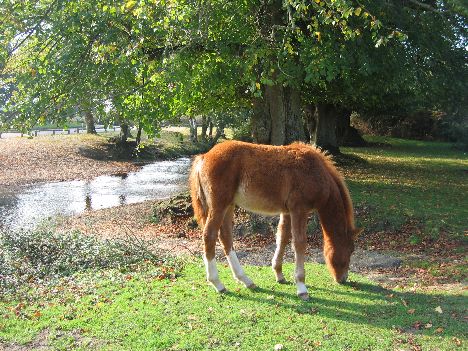
It is a wonderful time to be in the New Forest (the brown blob at the bottom of the map). The New Forest lies in Hampshire, and is now one of England’s national parks. In early October the trees are still green, but the oranges and gold of autumn have crept in.

Ponies meander in open fields; along the streets of Beaulieu village, famous for its National Motor Museum, wild donkeys poke their curious nozzles into the doorways of shops.

It was in this pastoral setting that I gave a book reading on the evening of October 3. I had been invited by Monty’s Book Club, whose members meet once a month in the Montagu Arms, a pub and hotel located in the heart of Beaulieu. The club reads the whole range of literary fiction, from contemporary works through to classics. This book club has existed for three years and is thriving; it even has a waiting list. Membership is restricted to ten at any time, because the club borrows books from the local library and ten was felt to be a manageable number. A member told me the size is just right, as it allows for varied discussion without being intimidating.

I was only the second writer to read to Monty’s, the first being Natasha Solomons. To publicise her debut novel Mr Rosenblum’s List, Ms. Solomons went on a quest to visit as many British book clubs as she could. She duly arrived in Beaulieu. There, she paved the way for others, because her reading was such a success that Monty’s members welcomed me too.

My own invitation came about through personal links. During the six years I spent at SouthamptonUniversity as a theoretical physicist, I often sought refuge in the New Forest. I loved its peace, its trees and the colour of its skies. I still visit, to see a long-standing friend whenever I can. On one such visit in the summer, I heard about Monty’s Book Club, and wondered aloud whether the club would be interested in a reading of my novel.

The club said yes. Like Ms. Solomons’ reading, mine was also to be a special event, held not in the Montagu Arms but in a member’s house. I arrived with some trepidation. I had never given a book reading before and didn’t know what to expect. I knew the atmosphere would be genteel and its members polite, but I didn’t want people to say nice things just because they felt obliged to. If anyone became bored during the half hour or so while I read, it would have been obvious to me – and the rest of the audience.

So I practised, many times. I recorded my voice on a sleek, silver Olympus recording machine my partner had given me as a present. It’s a fabulous gadget: pocket-sized yet powerful. On it, you can hear everything, even the rustle of paper. I listened to my enunciation, making sure there was enough nuance in my voice to keep everyone’s attention. I learnt to pull my stomach muscles in when my voice fell, so that I could better project sound across a room. I imagine that this is what singers have to do.

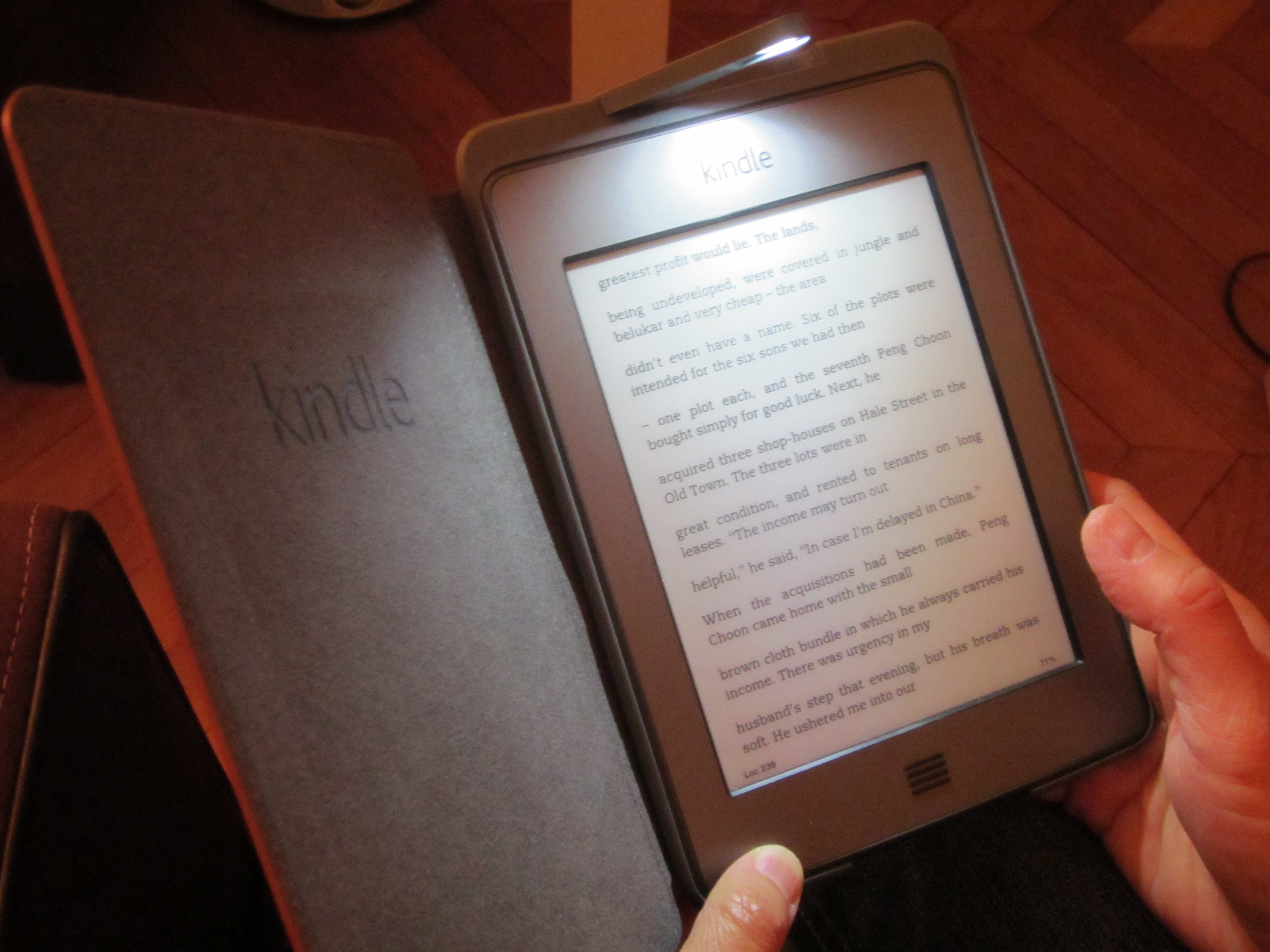
I read from a Kindle reader with a special leather cover that has its own discreet lamp at the top. The light flicks in and out; it can be fully tucked in unless needed, a highly ergonomic design. Much as I love holding a physical book, I also love my Kindle and its cover. Its leather feels wonderful in my hands, and the fact that its light shines directly onto the page is a huge bonus. The Kindle proved incredibly useful during my reading. 

In the end, I read two sections, one short, the second longer. The first was the ancestral story of the Nyonyas, the people from whom my main protagonist, Chye Hoon, is descended. I looked at my audience as I read, watching for any sign of a yawn or of eyes glazing over. None came. I could see that the members of Monty’s Book Club were imagining the scene in their own minds, seeing the character in my story who is herself telling a story.

When I began the second, longer section, the eyes of my audience were still on me. The scene takes place on the island of Penang, which a few in the room had been to. But my Penang is the Penang of 1898, and I invoke a place covered in virgin jungle, where elephants are still a form of transport. In this scene, Chye Hoon is about to get married. It is a huge celebration, because Chye Hoon is an independent-minded girl with a fearsome temper and no one believes she will ever find a suitor. But get married she does, in the colourful Nyonya-Baba tradition of the day which left my modern British audience wide-eyed.

Afterwards, the members of Monty’s asked many questions. We talked about the Nyonyas and Babas, whom none had heard of previously. We talked also of Malaysia, the real Malaysia, not the one touted on Tourism Malaysia billboards. I was impressed that this group – educated women, some with careers, many who stayed at home, some now pursuing post-graduate studies, and all juggling a host of family commitments – remained late into the night to engage in a culture they had never heard of, in a country some had yet to visit. I took it as a good sign that there would be interest from a Western audience in my multi-cultural novel. Its themes are topical today: the ongoing tension between modernity and tradition, and the invisible cost of the cultural assimilation which some of us must face.

In my novel, the characters speak like real-life Malaysians. I mentioned this in a previous blog-post What Does it Cost to Write a Novel?, in which I had said I was unsure about this point of style. A member of Monty’s, a speech therapist, said she loved my dialogue. She especially liked the way I had changed the order of words. She put it very aptly: “Language isn’t just about communication; it also conveys a sense of place.” In a number of novels she had read, the characters had spoken in ordinary English even though the stories were set in foreign lands, and she had felt this sense of place to be missing. Others in the group agreed. I breathed a sigh of relief, because my audience had validated an intuition which I, as a Malaysian writer, have long had.

My grateful thanks to Monty’s Book Club; they made the evening what it was, and also helped clarify an ambiguity in my own mind. A few members asked when my novel would be published. Some worried it might not. But it will – because I write to be read, not so that my script remains as bits on a motherboard. When and in what form my novel will be published, I cannot say. But I will work to get it there, even if it means having to start a publishing company.

12 Comments

Filed under Malaysia, Novel, Nyonya

What does it Cost to Write a Novel?

I have now been writing my novel for 580 days. How many hours would that make? I haven’t counted, but given that there are 13,920 hours in 580 days, a rough estimate must yield a number in the thousands. A sobering thought…

With my business background and Chinese heritage, I can’t help thinking about what people in business call ‘the opportunity cost’. In other words, what else I could have done in that time, and how much more income I might have generated.

In a year and a half, the total package garnered by a senior manager working full-time could come to a few hundred thousand pounds (if we included bonuses, healthcare and pension contributions). I chose to leave the corporate world, and I don’t for one nanosecond regret that decision. Not because I hated it, but because in my time, I survived two life-threatening illnesses. Writing was integral to my recovery (see blog-post The Miracle of Writing), and I believe I need to continue telling stories for my well-being.

While I would love to be commercially successful as a writer, I have to be realistic: I’m writing historical fiction, not Harry Potter. My aim is to be both accessible and literary at the same time. In the process, I hope to entertain many, and to touch a few. Although my novel is historical, it carries themes of contemporary interest, such as the invisible cost of cultural assimilation – what it means to lose a heritage, and the ongoing tension between modernity and tradition.

It took me twelve months to write the first draft of this epic drama. That is fast, I’m told, for 150,000 words. (In comparison, the average book now has 100,000 to 120,000 words). Once I started, I couldn’t stop. I worked like a fiend. It helped that I could work at my second job from home, which gave me plenty of flexibility to write. I also had a wonderfully supportive partner who agreed not to speak to me before 3 pm each day. Although this was the subject of constant jokes amongst our friends, I can happily say there is no substitute for discipline.

At that whirlwind speed, I expected to be finished in no time. But my editor shook her head after the second draft. Nope, not ready yet, she told me in no uncertain terms. It is only now, well into my third draft, that I fully appreciate how much work has to go into polishing each and every word. I sit thinking about tenses and grammar. I stare at commas and semi-colons, the presence or absence of which could subtly change a sentence.

When I gave the second draft to a book-loving friend for a lay-person’s opinion, the work had grown to 170,000 words. I’m very grateful to my friend for her patience and her many comments. But what is a writer to do with wildly opposing feedback?

The bone of contention: the fact that my characters talk like Malaysians. (By that, I mean the dialogue between characters, not the narrative flow itself). Here’s an example. Instead of saying “How can that be?”, a Malaysian in real life might say, “Like that, how can-ah?”

To me as a Malaysian, the words written in that way simply jump off the page. I can hear the sentence, “Like that, how can-ah?” in all three of Cantonese, Malay or Malaysian English (Manglish). While creating the dialogue between my characters, I realised that when Malaysians speak English, we often just translate from our own languages.

By changing the order of the words on the page, I hoped to convey some of the cadence and intonation of Malaysian speech. It would have been easy to stick to the tried and tested Malaysian favourites: ‘lah’ and ‘ah’ and even ‘ai-yahh’; I wanted, perhaps ambitiously, to capture more of Malaysia’s atmosphere in my novel. If you haven’t been to South-East Asia, this may be lost, and the speech could seem trying. This is why I’ve restricted ‘Malaysian-isation’ to only the dialogue between the characters in my book. A matter of style, but it has already proven controversial. My editor loved it, and my friend hated it. Their reactions told me that other readers were also likely to fall into those two camps. As the writer, I will have to make the final decision.

Writers are always encouraged to read as widely as possible. Yet, while writing my first draft, I found that if I read any work written in a style dissimilar to mine (a story-telling style à la Isabel Allende), my own writing became affected. The sentences would cease to flow. In that period, I was forced to read and re-read Isabel Allende. Not a hardship, since I love her writing. In contrast, reading widely has helped me with my second and third drafts. I’ve read a string of novels recently, including The Thousand Autumns of Jacob de Zoet, a sad story set in Japan in the late 1700s, in which David Mitchell displays wonderful techniques with dialogue.

Latterly, I’ve discovered a trick I wish I had used earlier. Now that my work is nearly ready to be more widely exposed, I have a number of readings planned. While preparing for them, I began to read passages of my work aloud to myself. That was when I realised I could use reading aloud as a tool to weed out unwieldy sentences. If my tongue couldn’t get around a sentence first time, it was usually because the sentence didn’t work, and I had to change it.  Reading aloud also helps when you’re trying to spot repetition. Gillian Slovo had mentioned this at a writing workshop at the Faber Academy, but once I arrived home, I promptly forgot her advice. She was spot-on though.

Soon, it will be time to think about how to get my work published. I’m not looking forward to the process; why that is the case deserves another blog-post. To return to the question I asked at the outset: what does it cost to write a novel? Answer: many years of a writer’s life. And what does it take to get to the finish line? Discipline, determination and an insane belief that you have a worthwhile story to share with the world.

5 Comments

Filed under Malaysia, Novel, Writing

An Open Letter to my Malay Friends and Anyone Who Cares Where Malaysia is Going

August 31 is Malaysia’s Independence (Merdeka) Day. On this day fifty five years ago, the Union Jack was lowered for the last time and a new country was born.

Malaysia (then called Malaya). 

She was to be a powerful narrative for multiculturalism. A place where many races – Malay, Chinese, Indian, Eurasian, Orang Asli (native indigenous people) – would live together, work together, as one, to move the country beyond the shadow of colonisation.

Malaysia remains a powerful idea. It’s one I believe in. But it has gone badly wrong. That’s why today, I’m writing this open letter to my Malay family and friends. I believe Malaysia is fast reaching a crossroad; where it goes next will be determined by you, my dear Malay friends. And where Malaysia goes is important to the world – because it remains one of the more tolerant Muslim countries.

First though, I want to say a big thank you. On this Merdeka day, I want to thank you, my Malay family and friends, and all fellow-Malaysians of Malay descent, for your historic generosity. Your ancestors welcomed mine when they arrived. You have shared the land with us, and this in turn, gave us opportunities we wouldn’t have had on mainland China. You provided us safe refuge from the turmoil of China. When I learn what happened there in the past century, I am so grateful my ancestors left. And that they found shelter in the beautiful land now called Malaysia.

My Malay friends, your own ancestors came from other places. They knew what it was like to be strangers in a new country. They treated my ancestors with that gracious hospitality which I myself have experienced countless times. All this I acknowledge, and thank you for.

But now I need to move on to something else: why I left Malaysia, and why I won’t be returning any time soon.

You may already know that 2 out of 10 Malaysian graduates live outside Malaysia. This is an astonishing fact for a middle-income country like Malaysia. It was revealed in a detailed study on Malaysia’s brain drain, carried out by the World Bank.

My Malay family and friends, do you not care about this exodus of talent? This isn’t just an abstract number: in our family, half those of my generation live abroad. We are the graduates this World Bank report identifies. We compete happily in the world economy and have no need to return.

Perhaps, my Malay friends, you think the brain drain irrelevant, since most of the people who have left are of Chinese and Indian descent? Certainly, this is what many Malays think, as Nurul Izzah Anwar, daughter of Anwar Ibrahim, has alluded to. (If you haven’t heard her speak, I recommend you watch this youtube clip. The opening is in Malay; the rest in English). 

“For me,” she says, “one Malaysian regardless of race, who has left the country…is a loss to us. They should be here celebrating, to improve the economy. I detest many people trying to singularly find out whether they are Malays, Chinese or Indians.”

My sentiments entirely. This fixation on race, race, race, in Malaysia is strangling the country. Yes, 88% of the one million Malaysians estimated to be living abroad are of Chinese and Indian descent. So what? My Malay friends, I ask you: does our race matter more than the fact that we have taken our talents elsewhere?

Yet, should I expect anything else? How could any Malaysian not be fixated on race, when you, my Malay family and friends, are accorded ‘special’ rights solely because of your race and religion?

Imagine if the United States had given ‘special’ privileges to the Pilgrim Fathers and Mothers and their descendants. Special rights to land, schools, gold mines and everything else – all because they sailed first; yes, just imagine! This is exactly what your special rights equate to. If the US had adopted such a policy, do you think it would have turned into a magnet for talent and skills?

Tell anyone about a Malaysian university reserved for people with ‘special’ privileges based on race, and you will see the reaction. What? People stare in disbelief. You must be kidding!

I’m not. And there have been demonstrations against opening the institute up to other Malaysians. Yet, Malaysians are so used to these oddities that we don’t bat an eyelid. We no longer notice the strange ideas plaguing our country.

Your ‘special’ rights, my Malay family and friends, alienate me. They make me feel unwelcome, unwanted and second-class. They are why I left. They are also why I won’t be back. Rights are a zero-sum game: for you to have more rights, others must necessarily have fewer. TalentCorp (the agency set up to attract Malaysians back) completely misses the point.

And when I see the culture of entitlement your ‘special’ privileges have led to, and the increasingly racist rhetoric this culture generates, I fear for Malaysia. Outrageous remarks are now commonplace, as former US ambassador John R. Malott outlined in his Feb 8 2011 op-ed in the Wall Street Journal.

Malaysia has once again been called Tanah Melayu (Malay Land). Malay Land was given airtime by none other than Mahathir Mohamed, former Prime Minister and rabble-rouser extraordinaire, who is himself from a family with Indian immigrants. Malay Land is more than just a name. His is a supremacist concept: a land for Malays, where Malays will be Lords, everyone else their subjects.

Some people say Mahathir no longer matters, but actually he does. I feel less welcome now in Malaysia than at any time in the past. The attitudes of Malay Land are creeping in, and Malay Land is completely the opposite of Malaysia. Malay Land excludes, while Malaysia embraces and includes – a country for all races.

My Malay family and friends, which is it you want: Malay Land, or Malaysia? You cannot have both; you must choose.

On this Merdeka Day, I urge you to think about that choice. Because you, my dear Malay friends, are the only people who can truly change the direction Malaysia takes. Know that we, your fellow-Malaysians who have voted with our feet, are rooting for Malaysia. We are no traitors. 68% of the Malaysians abroad who were surveyed by the World Bank expressed a strong sense of patriotism/attachment to Malaysia. I am among this 68%. I may have been away for thirty three years, but Malaysia continues to be in my dreams. I left with regret, and I stay away with sadness. I hope Malaysia will prevail. Assalamualaikum.

The above blog-post was published in its entirety, but without video or links, on Malaysia Kini on August 31 2012 (http://www.malaysiakini.com/letters/207623).

33 Comments

Filed under Cultural Identity, Identity, Malaysia

Tan Twan Eng, the Garden of Evening Mists and Memories of War

I’m always on the lookout for writers and artists from Malaysia. I get a particular thrill when a piece of literary or artistic work reflects Malaysians as we are, in the places we know and love. It is rare to come across such work outside Malaysia. So when it happens, and the work then goes on to achieve international recognition, I’m doubly excited!

This is what has happened with Malaysia-born Tan Twan Eng. (Surname: Tan, name: Twan Eng. See my blog-post What’s in a Chinese Name?). His two novels have both been long-listed for the prestigious Man Booker Prize – a remarkable feat. I first heard of him in 2007 when his début novel The Gift of Rain was published in the UK. A former banking colleague had recommended I read it. “It’s beautiful,” he told me. He was right. The Gift of Rain is set on the magical island of Penang, home of sandy beaches and swaying palms. The story in it unfolds in lyrical prose as light as stardust.

Yet, Tan Twan Eng is not especially known in Malaysia. This is a shame – because his work ripples with themes Malaysians would find interesting.

To begin with, both novels are about the War and its aftermath. For Malaysians, there is but one War: the Second World War – when Malaya was occupied by Japanese forces. This occurred between 1941 and 1945. Roughly seventy years may have passed, but we continue to be affected by the events which took place then. They changed Malaya irrevocably, in ways we are only beginning to explore and understand.

I know I was obsessed with stories from the War era as a child. Whenever my now-dead maternal Grandmother visited, I would beg her to tell me what the War was like. She would sit, as calm as a lake on a still night, and in her deep voice, would tell me things I simply could not imagine. Soldiers rapping on doors and windows, looking for girls and women; men being rounded up, forced to stand in 30+ degree Celsius heat with no water; the screams that could be heard from one of the hospitals in Ipoh, where the Japanese had set up a torture chamber; heads on spikes, on full display at the front gates of Ipoh’s Central Market as a warning to the headstrong.

I thought I knew much about the War. Yet, both The Gift of Rain and Garden of Evening Mists, Tan Twan Eng’s latest novel, taught me new things.

For example, I grew up believing that the British Colonial administration had done its very best to defend our country. Not so, according to The Gift of Rain, and my own research confirmed this. Much has been made of the Malayan Campaign. But if we cut through it all, here is the bald fact: Britain largely abandoned us to the Japanese. Japanese forces attacked the north-eastern coast of Malaya first, before swiftly marching across the country: westwards and southwards, over mountains and across jungle our Colonial rulers had said was impenetrable. Yes there were battles – mainly in support of retreat – unlike in Europe, where the British army fought for every inch of ground, to the death. In Malaya, the Colonial troops retreated…and retreated…until they reached the island of Singapore and there was nowhere else to go. At that point, some hopped onto ships bound for Australia, following their women and children. Those who didn’t leave on time were captured when Singapore fell.

I was sorely disappointed by what I learnt. It still rankles today. The only thing I can do with my feelings is to write about what happened.

I imagine Tan Twan Eng must have been similarly affected, though he has worked wonders to weave history into his stories easily. His writing doesn’t feel dense, nor is there any rancour. Amazingly, each novel incorporates a Japanese central character. In Garden of Evening Mists, this happens to be the Emperor’s gardener; in The Gift of Rain, it is an aikido master. Tan himself has first-dan ranking in aikido, and has obviously studied Japanese thinking. He manages to convey some of its Zen-like mystery and beauty through slow, deliberately measured prose, so that even the positioning of stones within a garden becomes pure poetry.

Garden of Evening Mists tells the story of a young Malaysian-Chinese woman, Yun Ling, who goes on to become a lawyer, but who cannot forget the War. After graduating from Cambridge, she takes leave to learn the art of creating a Japanese garden from a man who was the Emperor’s gardener. This fictional garden is located high up in the Malaysian hills, in Cameron Highlands, a dreamy place once shrouded in jungle and mist. It was developed because it reminded British Colonialists of their home. Yun Ling hopes the creation of a garden will be cathartic; instead, it adds layers of intrigue and pain she only comprehends years later. 

Japanese themes also echo in The Gift of Rain. A Eurasian boy, Philip (Note: By Eurasian, I don’t mean someone from that piece of land known as Eurasia, but a person with one European parent and one Asian parent), who lives in Penang, is befriended by a Japanese man, Endo, before the War. Philip is taught aikido by Endo. Perhaps I read too much into it, but what develops within Philip is a depth of feeling which struck me as homo-erotic. (Though I stress this isn’t a ‘gay’ novel.) Philip learns not only aikido, but also the Japanese language. Then, the Japanese arrive, en masse. You will have to read the book to find out what happens to him, his family and Penang.

Incidentally, there is an explicitly gay character in Garden of Evening Mists. I mention this because it shows me that Tan Twan Eng isn’t afraid of tackling a subject we in Asia prefer to avoid.

Like a good story-teller, Tan Twan Eng folds his own experiences seamlessly into his writing. Having lived in Cape Town for the past few years, he inserted an Afrikaner into his latest book. There are therefore plenty of lekker braais (delicious barbecues) alongside descriptions of Cape Dutch houses and flora. And these are all made to fit into Cameron Highlands!

Reading Tan Twan Eng has inevitably made me reflect on my own work. My current novel deals with an equally dramatic period for Malaya – the years after colonisation but before the War. It was a time of great change: cars and airplanes came to Malaya then, Malayans started to learn English and many families became westernised. There was also a Japanese community in Malaya, whom we later learnt were spies. Many were photographers; one of them features in my novel towards the end, just before the eve of the Japanese invasion, when the matriarch in my story dies.

I had always intended my novel to be the first in a trilogy, with the second in the series focusing on the impact of the War years on a particular family in Ipoh. Reading Garden of Evening Mists has made me realise how much is left to explore…What an incredible life this is.

2 Comments

Filed under Malaysia, Novel, Research, Writing

In Search of Great-Grandmother’s Name

I don’t know my great-grandmother’s name.

When I began writing my novel, I tried to find out what it was. I didn’t need her name to write my story, but I was curious. I knew she was a devout Buddhist who prayed at the Siamese Temple in Tambun Road, Ipoh, so my first stop was the temple, where I hoped to find Great-Grandmother’s ashes. As a Buddhist, she would have been cremated, and I reasoned that if I could find the urn containing her ashes, I would learn what her name was.

The picture below shows what the Siamese Temple on Tambun Road looks like today: a set of beautiful buildings with elaborate roofs built around a serene courtyard.  Its architecture is typical of a temple, with a large airy central room serving as the main shrine hall and adjacent buildings housing the wooden tablets set up in memory of the deceased. (In case you’ve never seen a Buddhist tablet, here are examples below. They are the red oblong objects standing vertically side by side, some adorned with photographs of the deceased. Like Christian tombstones, the tablets can be elaborate.)

I visited the Siamese Temple with my aunt and uncle, and it remains thankfully smaller than other temples, which meant fewer tablets to examine. Nonetheless we spent a good half hour making sure we hadn’t missed Great-Grandmother.

To no avail, for it turned out her ashes lay elsewhere.

My search took us next to the Sam Poh Tong (Temple), the second oldest Chinese temple built inside the famous limestone caves surrounding Ipoh (see my blog-post My Ipoh). One of my aunts told me Great-Grandmother had been cremated there, so my uncle and I went straight to see the temple caretaker. He was a middle-aged man who sat all day in his cave office with a notebook, cooled by a whirring table fan which stirred the air from the hills.

The caretaker’s first question was what Great-Grandmother’s name was. When we told him we didn’t know, he looked at us through narrowed eyes.

“Hmmm…then, very hard,” he said.

When our faces fell, the caretaker added, “But, maybe possible from the year of her birth.”

Unfortunately we didn’t know the year of her birth, just the exact date of her death. I proudly passed this information on, and was surprised when it didn’t impress the caretaker.

“That, no use,” he declared.

How could the date of her death not help? I wondered aloud. Didn’t they keep records?

The caretaker looked at me as if I were mad. There were records, but not dating as far back as 1941. Didn’t I know how many cremations there had been since? “Come”, he said, “I show you.”

He led us down steps, past a murky green pond at the front in which turtles floated languidly, half dead from the Malaysian heat. On we went, towards a brick shelter which stood on its own in the middle of nowhere.

“In there-lah”, the caretaker said, pointing to the windowless hut. It wasn’t lit, so the man kindly brought an electric lamp which he hooked up. Then, wishing us luck, he left.

We went inside a dark musky room crammed eerily full of the ashes of the long-dead. It was clearly the room for the untended, and I felt the goose-bumps rise on my skin even though I’m not superstitious. The room was cold and damp and stacked from floor to ceiling with clay urns which glared at us from atop the wooden shelves. Amid the shadows cast by our dim yellow light, the urns looked identical. They were dusty, fusty, as decayed and faded as the building which held them, but some of the vessels still retained a haunting beauty; the Chinese writing on their bodies stood out, as if they could never be erased despite the evident lack of care. We searched for an hour, but my uncle and I failed to find Great-Grandmother. It was obviously not to be, at least not that time.

——————

How is it that I don’t know Great-Grandmother’s name?

In previous generations, people didn’t address anyone older by her or his name. This is a bit like ‘Mum’ and ‘Dad’ in Western culture, except that the Chinese had forms of address for many other relatives (at one time, probably for every relative).

For example, the woman who inspired my novel was actually my mother’s grandmother, or in Chinese, my Big Maternal Grandmother. In Chinese, it is important whether a person is related to you maternally or paternally; traditional forms of address are as specific as that. They were intended not only as public demonstrations of respect – from the young towards the old – but were also a means of conveying the exact blood relationships between parties, so that any listener would understand the ties at once and have no need to ask embarrassing questions.

To give another example, my mother has five brothers, one half-brother and one half-sister. Her second brother is therefore my Second Maternal Uncle. When I was a child therefore, I always addressed him as ‘Yee Kow’ in Cantonese: ‘yee’ meaning ‘second’, while ‘kow’ is the word for ‘Maternal Uncle’. Anyone who heard me would then have known exactly how we were related. It’s like hearing an echo: you open your mouth to speak and what bounces back are your exact blood relationship, which family generation you belong to and your status within the family.

Similarly to ‘maternal uncle’, there are Chinese words for maternal great-grandfathers, maternal great-grandmothers, maternal grandfathers, and so on…everyone down the line, all the way to maternal uncles and maternal aunts. And then, there is a whole other set of words – for your father’s relations. I don’t know when this strict hierarchical custom began. (If you do, please write and tell me.) I suspect Confucius, though I can’t be sure. Such hierarchy must have served a useful purpose at some point, but by the time I came along, the downsides were only too obvious.

One of these is that no one can tell me my great grandmother’s name. There are still people alive today who remember her, but none of them ever heard her called by her name. She came from a generation which expected to be addressed as ‘Big Madam’ or ‘Big Sir’, even by strangers. And Big Maternal Grandmother, in her role as a leading female entrepreneur in her town, demanded and received, justifiably, the respect that was her due. As a result, her real name remains a mystery.

——————

For a Western reader, the traditional Chinese form of address may actually be a saving grace. All of the characters in my novel address their older relatives according to their familial relationship, such as ‘Big Brother’ or ‘Second Sister’. This relieves the reader of the need to remember a great many Chinese names (see my blog-post What’s in a Chinese Name?). Alas, traditional forms of address were used only for people who were older; those who were peers or younger were called by name (which still means a healthy dose of Chinese names in my story).

——————

How did my great grandmother end up in the room for the untended dead? This, sadly, is one of the results of our cultural loss. Big Maternal Grandmother sent her sons to a leading mission school, where they learnt to speak English and adopted Western culture. Her sons also took on the religion of the West, Christianity, or alternatively, became non-religious. Only the wife of her third son – my Third Maternal Grandaunt – remained a Buddhist, and it therefore fell on this good woman to look after Great-Grandmother’s urn and ashes. When Third Maternal Grandaunt passed away, Great-Grandmother’s urn stopped being tended. It has since lain at the Sam Poh Temple, cast into a dark room with other unloved urns. 

Of course, our story isn’t just about cultural loss; my family bears responsibility too. One of her sons could have taken the trouble to re-learn Buddhist rituals and to look after Great-Grandmother’s ashes, as she would no doubt have wanted. This isn’t as straight-forward as it sounds; unless you’re exposed to Buddhist rituals, you wouldn’t know what to do. In any event, no one took the trouble, and I feel sad when I think of it. It’s enough to spur me to continue trying to discover her name. Is there a Malaysian equivalent to the No. 1 Ladies’ Detective Agency? If so, I would like to hire this formidable detective.

5 Comments

Filed under Cultural Identity, Identity, Malaysia, Research

Lost Cells 2: Chinaman, Englishman and the Malaysian-Chinese Divide

“Chinaman!”

I remember the first time I heard the word. It was more a cry really, a shout which came back in a dream, stirring the depths of my memory.

I wonder what the word conjures up for you. Does it evoke an image? I would love to know. Please click below to answer a simple question.

Thank you for sharing your experience.

—————

It was the tone in which ‘Chinaman’ was said which must have caught my attention, because I began to ask questions. The adults around me squirmed, and then became evasive as they pretended that ‘Chinaman’ was an innocuous word. They told me it referred to a man from China, in the same way that ‘Englishman’ referred to a man from England.

But they were lying.

‘Chinaman’ had a ring to it; the word shook the dust, as if phlegm were being expelled. No one said ‘Englishman’ in the same way, or ‘Frenchman’, or any other word which contained the name of a country.

As I grew up, I learnt its many connotations.

Uncouth.

Lower class.

Untrustworthy.

Dirty.

Greedy.

Rude.

Slitty-eyed ugly.

No wonder the adults had been ambiguous. There is nothing attractive in the descriptions above, and they must have been embarrassed at having to explain themselves. Every one of them was of Chinese ethnicity, and I wonder what they could have been thinking. If you were Chinese – a Chinaman or a Chinawoman – what did you have to tell yourself in order to be able to spit out ‘Chinaman’, a word loaded with implications, so easily? How did you deal with the confusion which must have lurked somewhere inside your head and your heart?

—————

As I held the contradictions inside, I veered between shame and outsized pride. There were moments when I shuddered, disgusted at my association with a race of coarse, yellow-skinned peasants who spat on the street and spiced each meal with slurping and burping. How could I have come from the same stock? There was no escaping genetics, but I sometimes pretended I could. I had to make these ‘Chinamen’ separate from me.

—————

Before I came into the world, my grandfather and granduncles did the same. They were born in Malaya in the early 1900s, a time when China was fast declining while Britain’s star remained in the ascent. My great-grandfather Chin Choon Sam was a first-generation Chinese immigrant who married a Nyonya woman, my legendarily fierce great-grandmother. When my great-grandfather settled in Ipoh (see map and blog-post My Ipoh), he raised a second family, as was common with Chinese immigrants of the time who had left families behind in China. We know little about his first family other than that he had a China-born son, who often visited his half-siblings in Malaya.

His two families were raised very differently, however. With the onslaught of British colonisation, his Malayan sons were educated in English – at the Anglo-Chinese School in Ipoh. This is one of Malaysia’s most famous schools and among the first to be founded by missionaries (as detailed in my blog-post Smart Girls don’t find Husbands?!). My grandfather and granduncles learnt to speak and write fluently in English; they wore Western clothes, adopted healthy doses of British manners, and converted to Christianity. In contrast, their China-born half-brother, having been schooled in China, spoke only Chinese and was more comfortable with traditional Chinese customs.

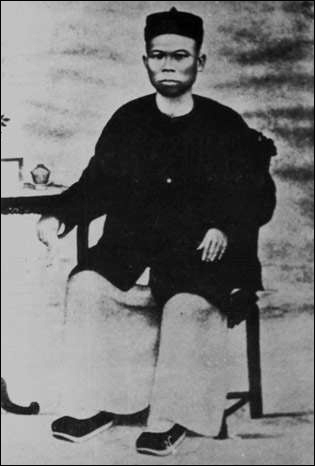
It was perhaps inevitable that my grandfather and granduncles thought themselves superior to this ‘Chinaman’ among them. We have no photographs of my China-born granduncle; whenever I try to imagine what he looked like, all I can see is a man with a brown face, clad in a Mandarin suit, his hair covered by a cloth cap or a hard conical hat. This, I realise, is simply an image of a Chinaman I have picked up somewhere along the way, a picture not unlike that well-known photograph of Yap Ah Loy, the founder of Kuala Lumpur (see map), Malaysia’s capital city.

I wonder what my Westernised grandfather and granduncles must have thought as they sat with the supposedly flesh-and-blood intruder inside their home. Perhaps choice words came into their minds?

Uncouth.          Lower class.   Untrustworthy.

My aunt who remembers the visitor from China confirmed the disdain with which my China-born granduncle was treated. “Like a second-class citizen!”

The poor man eventually decided his prospects would be better in his native country and returned there for good. I only hope life wasn’t too harsh for him after the Communists came to power.

—————

My family’s story was not atypical. In the decades when Malaysians looked up to the West and regarded English as superior, Malaysians of Chinese descent who came from English-speaking homes looked down on their Chinese-speaking compatriots. (Of course, all Malaysian-Chinese speak both English and Chinese to some extent; what I’m referring to is our primary preference, our modus operandi: the language in which we feel the most comfortable and which shapes how we behave in this world.)

For a long time, we English-speaking Malaysian-Chinese walked with a swagger. Our compatriots felt our condescension, as I was reminded by a Malaysian-Chinese friend from a Chinese-speaking background. She herself attended a Chinese language primary school before continuing to one of the former mission schools for her secondary education.

There, she met Malaysian-Chinese students from English-speaking homes. It was then that she felt the subtle divide which separated her from her English-speaking peers. Nothing was ever said and no one was openly rude, but she knew she was perceived as a lesser person: less wealthy, more ulu (market Malay for backward), not as well-dressed. In the canteen, social segregation took place; English and Chinese speakers usually sat in separate groups. Segregation continued inside the classroom, because in Malaysia, students are streamed according to ability and in general, English-speaking students achieved better examination results.

For my friend, what she felt palpably from one day to another drove her. She wanted to prove to her English-speaking classmates that she was their equal. She has succeeded admirably in this goal; after university in Australia, she worked for a multinational company and now lives a global lifestyle. Years later when she recounted her story, I could still hear the anguish in her voice. My friend’s success has come at a price though: she has now forgotten her Mandarin.

—————

This is largely in the past. With the rise of China, social perceptions have changed. Malaysians no longer look to the West in the same way, and Malaysian-Chinese now prefer their children to be educated in Chinese (for political reasons which I will not discuss here).

In this brave new world, even the word ‘Chinaman’ has lost some of its sting. But a shifting state of affairs always brings its own challenges. A recent review in the UK’s Guardian paper  brought home to me what some of these may be. The reviews was of the much-acclaimed novel Chinaman which is about, of all things, cricket.

Here’s what it said. “A Chinaman in cricket is a particular delivery, a slower ball designed to fool the batsman into thinking it will bounce in the opposite direction to the one it does. It also, in Sri Lankan argot, is a term indicating gullibility.”

Guile and gullibility, juxtaposed effortlessly over one another. This tells me that there are people – perhaps many – who fear and loathe the Chinese (us Chinese?) at the same time. (I rewrote that last sentence repeatedly and still couldn’t decide which phrase to use. Who do I stand with here? Do people regard me in the same way as they do the mainland Chinese? Do they fear us too but would never say so openly?) Their fear and loathing may well increase as China continues to ascend, as it surely will. And while this happens, we overseas Chinese will have to continually reassess our relationship with the land our ancestors once graced, as well as with each other, whether or not we wish to.

5 Comments

Filed under Cultural Identity, Identity, Malaysia