Category Archives: Cultural Identity

An Unexpected Discovery

A few days ago, when I told a Frenchman that I came from Malaysia, he said, ‘Ah, you have a simple language.’ It was not the first time someone had told me that s/he thought Malay “simple”. The sub-text, albeit unarticulated, was usually: “simple language, simple people”.

I felt it again with this Frenchman, a European condescension towards my Asian culture. I thought to myself: what does he even know about Malay?

Malay was a language of my childhood, one of three. My family spoke English and Cantonese at home but I was taught in Malay at school – part of the first intake of students to be educated exclusively in the Malay language in what had previously been English-medium schools.

I learned the language, but failed to appreciate its poetic beauty. This was partly because in Malaysia, Mathematics and the Sciences are more highly regarded than the Humanities, and partly because of the political context in which the switch from English to Malay took place.

It occurred in the aftermath of May 13 1969,  a day on which Malaysians of Chinese origin were targeted for slaughter at the hands of mobs of Malays in Kuala Lumpur’s streets. The killings occurred after UMNO – the political party which has ruled Malaysia since its independence from Britain in 1957 – and its allies lost the popular vote and many parliamentary seats in a general election.

The period afterwards was a time of radical change. Within about a year, Malaysia had a new Prime Minister; within two years, a raft of racially discriminatory measures was put in place. It was then that Malay was imposed as the medium of instruction in previously English-medium schools.

Language, of course, is not only a means of communication: it is also a political tool. In Malaysia certainly, language and religion are used adroitly by UMNO. UMNO understood early on the power of language. It has been uncommonly adept at choosing emotive words and at using these words to craft an insidious political narrative.

Thus I grew up hearing that I was pendatang yang tumpang sahaja di Malaysia, a newcomer who was only squatting in Malaysia. This was the backdrop in which I was taught Malay. Perhaps unsurprisingly, I never stopped to think about what a beautiful language Malay actually is. If French (which I speak) is romantic, then Malay is poetic. It was only when I started writing a novel and began filling my landscapes with characters who ran around speaking different languages that I was struck by just how poetic the Malay language is.

Take for instance the simple concept of homeland. The Malay equivalent is tanahair, literally translated as “soil (tanah) water (air)”, in other words the earth and water from which you come. I hope you will agree that the expression “my soil and water” is much more evocative than “homeland”.

Or take that well-known beast, the “orang-utan”. In truth, the latter is a bastardisation of the words orang, meaning a person, and hutan, meaning forest. Orang hutan is actually “a person of the forest”. The phrase, if you think about it, is immensely inclusive; it says, “Here is the forest, we share it with this creature which is not so different from us – a person of the forest.” For me, orang hutan captures the essence of traditional Malay culture, which was at once utterly respectful of others and very gentle towards them.

Even that wonderful political creation, the bumiputera – the prince (putera) of the earth (bumi) or son of the soil, a person who by dint of race or religion is privileged in Malaysia – has a certain ring to it. From a purely linguistic standpoint, the word bumiputera is really rather beautiful.

There are many other examples, and yet poetic beauty is not what people think of when they mention the Malay language. Instead they say what the Frenchman said to me: Malay is “simple”.

What he and others don’t seem to realise is that Malay was written using the Arabic script, a form known as Jawi, until quite recently. I discovered this for myself while carrying out research for my second novel (for which incidentally I have completed a first draft). Most of this research took place at the National Library of Singapore (whose generous opening hours of between 10 a.m. and 9 p.m. allowed me ample time to work). There, shivering in the ultra-cold air-conditioning which Malaysians and Singaporeans seem to favour, I found that the Malay language newspapers I wanted to read had been published solely in the Arabic script. On further digging, I could not find a single Malay newspaper which had not been printed in Jawi up to the Second World War. I was of course unable to read any of them; the Jawi which we had been taught in school was rudimentary, because Jawi was already not in everyday use by the time I went to school.

If Malay were still written today the way it used to be – in the Arabic script – would people go around denigrating it as a simple language?

I grew up hearing and speaking Malay every day but I took the language for granted, in the same way Malaysians assume they will see the sun every day. Only recently have I rediscovered Malay. At the same time, I began to appreciate the richness of Malaysia’s multilingual environment. I can easily recall the distinctive sounds of my native country: Malay, with its elegant smoothness; the no-frills brand of Cantonese I grew up with, rough and ready, a far cry from the haughty Hong Kong version but more in tune with the go-getting entrepreneurs who spoke it loudly and merrily; and the energetic, tongue-rolling Tamil used by our Indian friends, full of indecipherable syllables at which I could only shake my head.

We in Malaysia are fortunate to have this wealth as our heritage. But I have yet to hear a Malaysian adoring any of our languages the way the French adore theirs. The French are happy to debate the intricacies of their language for hours and will happily tell you how wonderful French is. This is something I wish Malaysians could also do, starting with our national language, Bahasa Malaysia. I would love to see Malaysians not only owning Bahasa Malaysia and learning it with enthusiasm, but also acknowledging its inherent poetry and being proud of it.


11 Comments

Filed under Cultural Identity, Malaysia, Novel, Research

The Story of Great Grandfather Chin Choon Sam and a Mosque

There is a road in the Greentown area of Ipoh, Malaysia, which is named after my maternal great grandfather Chin Choon Sam. He was the husband of the woman who inspired my first novel.

ipoh_on_malaysian_map1[1]

Chin Choon Sam was also the father of (among others) the late Chin Kee Onn. Chin Kee Onn in turn was the author of Malaysian classics such as Malaya Upside Down – the first non-fictional account of life in Malaya under Japanese occupation (from December 1941 through September 1945) and Twilight of the Nyonyas – a fictional tale of a Nyonya family in the early twentieth century, a period of decline for this mixed-race community (of which more below).

Not much is known about Chin Choon Sam other than that he was an educated man who came from a Hakka village in southern China. Great Grandfather arrived in Malaya at some point towards the end of the nineteenth century and apparently set himself up as a roving accountant to Ipoh’s first entrepreneurs. He didn’t become a millionaire but he did well for himself, so well that he decided to settle in Malaya.

By all accounts, my great grandfather loved his adopted home. He already had a wife in China, but Chinese immigration policy was such that women were not allowed to leave the country in the same numbers as men. In order to put roots down in Malaya, Chin Choon Sam took a local woman as his second wife. He chose a woman from the mixed-race Nyonya community who was shrewd, blessed with a fiery tongue and who delighted in feeding him eye-watering, spicy dishes.

Who exactly were the Nyonyas? Unfortunately, many people today, even in Malaysia, don’t know the answer. This is in large part because the Nyonyas (and their male counterparts, the Babas) do not fit into the political narrative which the Malaysian government and its ultra-zealous supporters would like us to espouse. The dominant narrative in today’s Malaysia holds that the country was “first” inhabited by the Malay people who, by dint of having arrived “first”, deserve “special privileges” – first priority in the civil service, education, public scholarships, land purchases and financial hand-outs. Protection for the rights of this privileged class is enshrined in the country’s Constitution (which incidentally, was generously agreed by our wonderful British rulers prior to their departure).

Moreover, because the Malays converted to Islam sometime between the twelfth and the fifteenth century – a religion brought by traders from India and the Middle-East – it necessarily follows that all Malays born today in Malaysia are Muslim. It must be so, how could they possibly be anything else?

There are some who would like us to believe that it has always been this way in Malaysia: that every person of Malay descent has been incontrovertibly a Muslim since the twelfth century.

Alas, the Nyonyas are thorns in the above narrative. Here were local Malay women marrying immigrants from China and then proceeding to adopt some of their husbands’ customs, including, crucially, their religion. Instead of practising Islam, the Nyonyas adopted Buddhist-Taoism.

Worse, Nyonya and Baba communities were established along the coastal parts of Malaya from the fifteenth century onwards. In other words, a sizable Chinese community began settling in Malaya six hundred years ago – a very long time ago by anyone’s standards. If it were not so, Nyonyas and Babas would never have come into being.

The existence of Nyonyas and Babas is rather inconvenient. Should their descendants (people like me) not also deserve “special privileges”? For how many generations do your forbears need to have been around before you enjoyed such privilege? This question is best avoided, otherwise Malaysia’s racial policies would be shown up for the poisonous, antiquated trash they are.

Therefore, instead of celebrating an interesting part of our heritage, the Malaysian government chooses to ignore it. Evidently, parts of Malaysia’s history cannot be publicised – it would give the citizens ideas. The Nyonyas and Babas point to a time (not even that long ago) when Malaysia was actually liberal, when the Department for Islamic Development (JAKIM) did not exist and there were no officials lurking to poke their noses into people’s daily lives.

It was in that age that Chin Choon Sam married a woman from the Nyonya community. They had nine children together: three girls and six boys. To cement his position in Malaya, Great Grandfather invested in seven plots of land in Ipoh, my family’s hometown. He would have bought them sometime in the first decade of the twentieth century, when Ipoh comprised barely more than a few streets.

Of all the places in Ipoh, Chin Choon Sam chose to buy his land in Greentown. Greentown then was not the thriving metropolis it is today. It was actually a bit of a wilderness – far from town, full of rubber estates and mosquitoes. To say that Greentown had uncertain prospects would have been generous. Most people must have thought Great Grandfather mad or very foolish, which is why he probably acquired his seven plots for a song.

Why only seven plots, you may ask, when he had nine children? Because my great grandfather, as typical of any Chinese man of the time, was thinking only of his sons. Each son would need to build his own house, while it was assumed that his daughters would marry and be provided for by their husbands.

But there was one extra plot. This, Chin Choon Sam donated to the Malay community specifically so that they could build a mosque. The only mosque in the area is the Masjid Muhibbuddin Shah (Masjid meaning Mosque in Malay) on Jalan Abdul Jalil. It’s close to where my family used to live and is very likely to have been built on Great Grandfather’s seventh plot. In those days, gestures of friendship between non-Muslims and Muslims were uncontroversial. My great grandfather’s donation was welcomed and a little road in Greentown was named after him.

The Author on Chin Choon Sam Road

The Author on Chin Choon Sam Road

Contrast that with what happened in Malaysia last week, when plans by the Democratic Action Party (DAP), an opposition party, to build a mosque, were condemned as an “insult” to Muslims because funds for building mosques had to be “halal”. The DAP, despite having Muslim members, is conveniently branded a political party of and for Malaysian-Chinese, who are of course not halal.

My great grandfather’s desire to pay homage to his adopted country was natural and highly laudable but I  wonder: would his gift have been accepted now? In the sorry state that is today’s Malaysia, I suspect not.

To Malaysian Readers: I do know that Article 153 of Malaysia’s Constitution safeguards the position not of Malays per se but of “Bumiputras“. The definition of Bumiputra – a Prince of the Soil, a protected class of person in Malaysia – is convoluted though, and not relevant to this blog-post. Article 153 is a minefield in Malaysian politics which would require separate discussion.

5 Comments

Filed under Cultural Identity, Malaysia, Novel, Nyonya

Of Hot Cross Buns and Croissants

An email arrived recently in my mailbox screaming “JAKIM bans hot cross buns in its bakeries”. In case you hadn’t guessed, JAKIM stands for JAbatan Kemajuan Islam Malaysia – the Department of Ismalic Development in Malaysia. The headline I saw was therefore entirely plausible.

Digging a little, I found out that the article was old news. The story had done the rounds a few years previously, when it was said that in JAKIM bakeries, the crosses on hot cross buns had been turned into mere ropes. In other words, one of the lines on the cross (see photograph) had been removed, purportedly to avoid “offending” Muslims.

A Hot Cross Bun on a Plate

There was just a small problem: a hot cross bun with no cross is no longer a hot cross bun. This observation prompted an imaginative local blogger to christen the new bun with the name “tali-bun”, “tali” being the word for rope in Malay. Talibun is also deliciously close to Taliban, and we all know what that connotes.

If JAKIM has indeed banned hot cross buns, it will not have been the first time that this innocuous pastry has sailed into controversy. Which is mind-boggling if you think about it – how could a sweet, spiced ball of dough possibly cause such fuss? Yes a cross sits astride its top and yes, the bun is traditionally eaten at Easter, but the bread holds barely any religious connotation today.

And yet, the sign of the cross still has the power to terrify.

As early as 2003, Britain’s Daily Telegraph ran a story saying that a handful of local councils in Britain had banned the traditional hot cross buns at schools to avoid causing “offence” to “non-Christians”. When it emerged that the councils named by the Telegraph did not in fact have policies on hot cross buns, the paper had to apologise.

However, the debate over hot cross buns just wouldn’t go away. A few years later, it was the turn of a British hospital to cause a furore by not serving hot cross buns at Easter. This decision upset so many people that the hot cross buns were soon reinstated.

The Brits who spent time worrying about how the sight of crosses could “upset”, “offend” or otherwise imperil Muslims had obviously not heard the story of the croissant. The croissant is today associated with France but it did not originate there: the bread actually came from Austria, from Vienna to be precise. Anyone familiar with the extraordinary variety and quality of Austrian pastries will not find this revelation surprising.

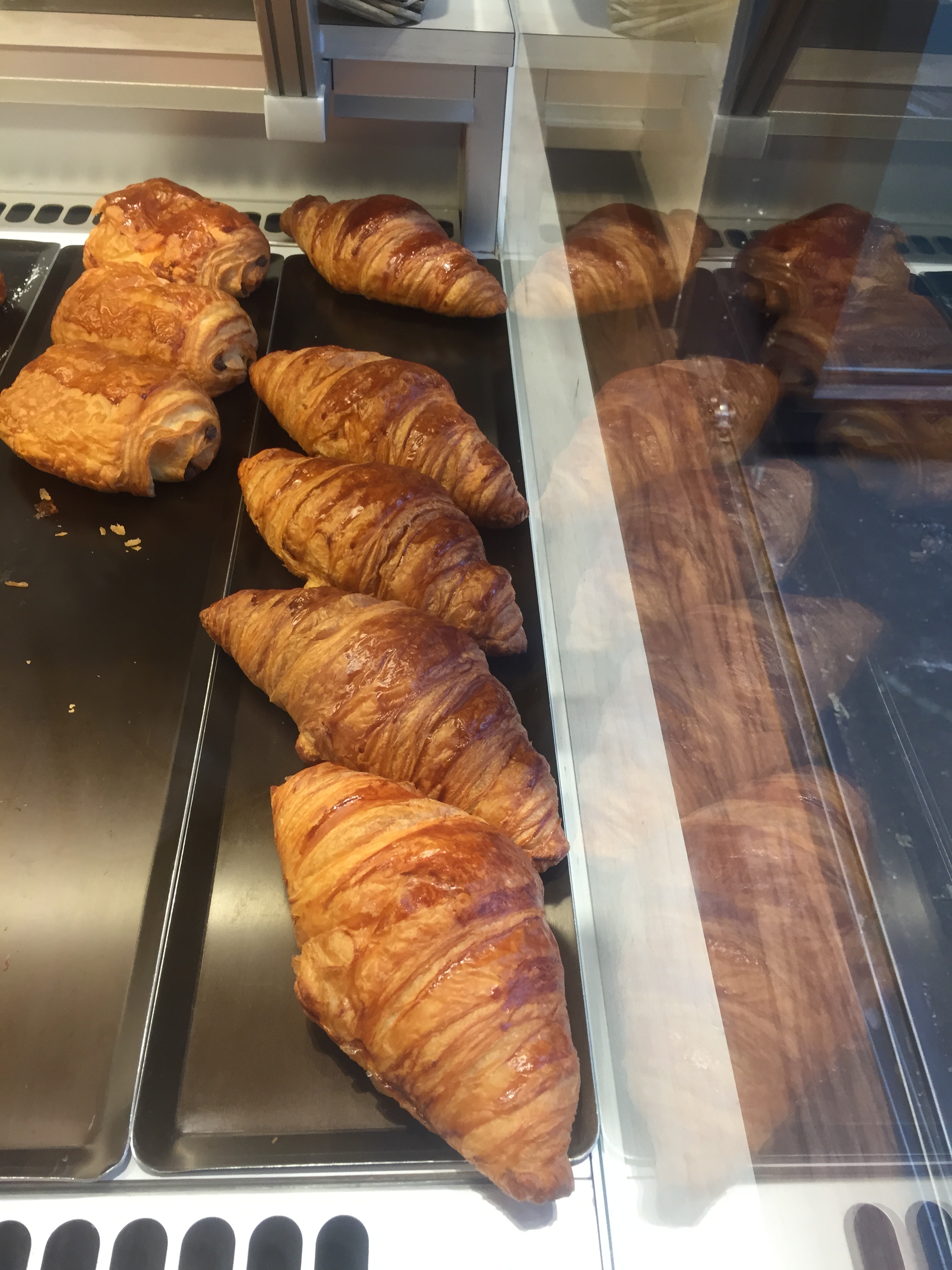
Among the most memorable characteristics of the croissant is its shape: the bread looks like a crescent. Croissants in a WindowIndeed, the croissant may well have first been baked after the siege of Vienna in 1683, when bakers working in their cellars throughout the night heard burrowing underground – the sound of Ottoman soldiers invading – and alerted the authorities, thus saving Austria. As a reward, legend has it that the Viennese bakers were given the right to make a pastry in the shape of the Ottoman crescent.

I first read the above account in Stephen Clarke’s wonderfully entertaining book 1000 Years of Annoying the French. The author makes plain that there are other theories regarding the origin of the croissant, one of which is that it derives from an Austrian pastry known as the kipfel. There are records of the kipfel going back to the middle ages. In contrast, croissants do not appear in French literature until 1853, when a chemist named Anselme Payen wrote a book called Des Substances Alimentaires (Dietary Substances) – a title almost designed to put you off your food. In his book, Monsieur Payen discusses croissants under the section “fantasy or luxury bread”.

Regardless of who is right about the origins of the croissant, what is clear is that it was introduced from Austria into France. In its adopted country, the croissant soon became a breakfast favourite. Since then, millions of people – Christian, Muslim, Buddhist and otherwise – have been gulping down crescents – the sign of Islam (and of the moon) – without even being aware of the fact. Ingesting a crescent every morning, with and without butter and almonds and chocolate, has not upset anyone, irrespective of religion, nor has it dented faith itself.

The benign nature of the croissant did not stop a group of rebels in Syria from issuing a fatwa, a Muslim religious edict, against the bread because its “crescent shape celebrates European victory over Muslims”. Evidently, there are Muslims who need protection from both the cross and the crescent. That is the absurd situation we could end up living in, if ideologically-driven political correctness is allowed to become the norm.

“Sometimes a cigar is just a cigar”. It was the psychoanalyst Sigmund Freud who came up with this perceptive saying. The people who are so busy pronouncing fatwas and other rules obviously cannot just allow a cigar to remain a cigar; otherwise, they would be out of work. Our only hope is for common sense to eventually triumph over ideology.

4 Comments

Filed under Cultural Identity, Malaysia

One Small Step, A Giant Leap

In the course of writing my novel, I had many opportunities to compare the Malaysia I knew with the Malaysia of today. I have already shared my sadness, disappointment and worry elsewhere (The Malaysia We’ve Lost; Where is Home?; Ambiga, Allah and this Visit Malaysia Year).

This past week has been markedly different. On May 17, 2014, my country finally took a step in the right direction, and raised my spirits in the process.

On that day, a brave young woman of Malay ethnicity became the Opposition candidate in a predominantly Chinese town. If this sounds trivial, it is not. In Malaysia, race and religion are used as political weapons, and Dyana Sofya Mohd Daud’s story marks a water-shed.

As it happens, I had already been thinking about Teluk Intan, the town where Dyana is standing for election. My agent Thomas Colchie (see previous blog post), had asked to see the synopses of my entire trilogy of books, and I had been pondering Teluk Intan because the town will be mentioned in my second novel (where it will be called by its colonial name of Telok Anson). I am still at the planning stage for this second work: jotting down ideas, looking at maps, dreaming… But I digress; my purpose here is to share why Dyana Sofya Mohd Daud has given me such hope.

She is a lawyer from a family of active government supporters. In Malaysia, this means that Dyana could enjoy a good life by not rocking any boats. Instead, she joined an Opposition political party. Not only that, but she chose a party that is widely regarded as “Chinese”.

Why did she do this? Here is a quote from her: “Malaysia needs a new form of politics and to drop the old race based politics. I choose to forge a path towards a better Malaysia.” Bravo, absolutely spot on.

In truth, the party which Dyana joined – the Democratic Action Party or DAP – welcomes all races and religions, but because it has historically appealed more to Malaysian-Chinese voters, the incumbent government likes to stick it with a “race” label. The fact that Dyana chose this party was a courageous step, demonstrating an independence of mind and a willingness to go beyond her comfort zone to further her ideals. How many of us can say we have done that?

Almost at once, the backlash against Dyana began. She was wolf-whistled at her own nomination. Photographs of an actress who looked like her but was dressed in a bikini floated around the Internet. There were whispers about her age: too young at twenty seven, apparently. Malaysia’s incumbent Prime Minister was only twenty three when he was handed his seat on a plate. Did anyone complain about his youth? I doubt it. One rule for men, another for women. Same old, same old.

The great and the good of Malaysian politics have come out in force to denounce Dyana as a traitor (to her race), to bait her on religion, even to scold her mother for not sufficiently indoctrinating her! This, unsurprisingly, came from our former Prime Minister, an expert in the gutter politics of tribe. All kudos to Dyana’s mother for standing up so publicly for her daughter: “As a mother, I will support my daughter. I will campaign with her because she is my daughter.” Quite. But when so many have so little to say about so few, you know that something momentous is happening.

And what is happening is that the old politics of tribe are being challenged in highly public fashion. A young Malay, Malaysian-born and bred, has stood up and said NO to the race-based politics that have held sway since the 1970s. She is too young to know the Malaysia which I knew, and I have always worried about what would happen to Malaysia when those of us who remember what it used to be like, pass on from this Earth. Now I have glimpsed the answer: just because you have not experienced what Malaysia once was, it does not mean that you will be blind to injustice when you see it.

Dyana is a tangible challenge not just to Malaysia’s old politics but also to the rising tide of Islamic fundamentalism, and strong forces are lined up against her. They do not want her to succeed. They do not want her to win, and if she wins, they do not want her to do a great jobs, and if she does a great job, they do not want her to remain with the DAP. Because if she succeeds, she will be living proof of exactly the sort of progressive, modern, inclusive Malaysia which many in my country are terrified of. If she succeeds, more may follow her. If more follow, what would become 0f vested interests? What would be the raison d’être of single-race and single-religion political parties? Heaven forbid, we may actually move forward and build the truly embracing society we are capable of building together, the real One Malaysia, not the slogan-bound 1Malaysia the government likes to trot out for tourists.

For all these reasons, I wish Dyana and the DAP the very best on 31 May 2014 and beyond. (For the record, I am not a DAP supporter).

3 Comments

Filed under Cultural Identity, Malaysia, Novel

Ambiga, Allah and this Visit Malaysia Year

Did you know that 2014 has been designated Visit Malaysia Year? Following a successful campaign in 2007, this is my country’s ambitious attempt to draw even more visitors to its beautiful shores.

When it comes to tourism, the Malaysian government has learnt what to say. To lure the world, Malaysia’s racial, cultural and religious diversity are endlessly exploited. On a page entitled People, Culture and Language, my favourite part comes at the end of the first paragraph:

“Malaysians…respect one another, regardless of one’s race, religion and background. It is this ‘true’ Malaysian value that binds them together” (my emphasis).

Indeed. Malaysia is multi-racial, multi-religious and multi-cultural. It has been this way for so long that we cannot remember a time when the country was monolithic, if indeed it ever was. And Malaysians do continue to live in relative peace and harmony with one another.

But intolerance has been on the rise. I have felt this myself. I am recognisably Chinese, and during my last three visits, I was stared at by cold eyes which said: SQUATTER! I know I was not imagining this, because there were plenty of others (thank goodness) who welcomed me warmly as a fellow-Malaysian.

Into this fray comes the word ‘Allah’. Allah is Arabic for God, though I would liken Allah more to Almighty God, a concept pertinent to the monotheistic religions of the world. Allah has been widely used – without any issue – by Muslims, Christians and Jews in the Middle East and elsewhere. Moreover, there are claims that the word Allah pre-dates Islam. (For anyone interested, here are a few links: In the Name of Allah, The Economist Oct 15, 2013; an informative blog from the Arabic Bible Outreach Ministry; also Christian Answers which states that Jews and Christians in the Middle East called God Allah for five hundred years before the birth of the Prophet Muhammad).

Within Malaysia itself, the word Allah has apparently long been used by Malay-speaking Christians, who knows for how long. Since 1615, claims the Asia Sentinel. Who can tell? All I will do here is to note that Portuguese traders actually arrived in Malacca (a well-known port in Malaysia) in 1511, and among their missionaries was St. Francis Xavier.

Does any of this matter? It wouldn’t, if the Malaysian government had not decided to ban the use of ‘Allah’ by anyone other than Muslims when referring to God.

This issue, which has simmered since 2007, is not just a matter of semantics: when the use of a word is deemed to be the sole preserve of a particular group, it encourages feelings of religious exclusivism, superiority even, which in turn, breed intolerance. The loop here is subtle, self-perpetuating and insidious.

I have already described the rise of intolerance in Malaysia in an earlier post (see Where is Home?). Since the Allah row broke out, a sinister new twist has been added: places of worship – a host of churches, a Sikh temple (because Malay-speaking Sikhs also use the word Allah), and in retaliation, Muslim places of prayer – have been attacked. I deplore all of these, acts which would have been unthinkable in the Malaysia I once knew. A country riven by division is not the country I want to see.

Unfortunately, we can hardly count on the current government to halt the trend, since it helped create it in the first place. Tensions rose again when Malay-language Bibles (with the word Allah) were seized by the religious department. In a gesture of peace and reconciliation, Marina Mahathir, daughter of Malaysia’s famous former Prime Minister, appeared with flowers at a church. This is the Malaysia I remember, yet she was far from universally applauded. Following this, the King declared that in Malaysia, the word Allah was only for Muslims. Right on cue, another church was firebombed with Molotov cocktails.

Diversity itself is not the issue. There will always be divisions in any society: brown/white; Muslim/non-Muslim; Sunni/Shia; rich/poor; Chelsea fans/Arsenal fans. This last is only half a joke, my point being that any division could be turned into a fault-line if it is ruthlessly exploited. Differences do not need to become fault-lines; they only become fault-lines when a corrupt government, hell-bent on staying in power, deliberately cultivates religious and racial tensions to divide and conquer.

The bigger question is this: what sort of Malaysia do we want? A country where all religions are truly respected, as the Visit Malaysia Year website tries to imply? Or a country where Islam is implicitly assumed to be superior and every non-Muslim deemed an infidel, tolerated only because s/he cannot be got rid of?

I keep being told that the majority of Malaysians are like me, that they want a pluralistic, progressive, tolerant society of the twenty first century. This may be true, but we face a problem: the majority stays silent. The silence of the majority has allowed the vociferousness of a minority to shape a political agenda which has slowly but invidiously changed the country. As this thoughtful opinion in the Jakarta Post notes: “there is only a thin line between tolerance and intolerance”. THERE IS ONLY A THIN LINE BETWEEN TOLERANCE AND INTOLERANCE. We should not be complacent.

In a clarion call last week, a courageous lady told Malaysians that we must resist our silence and fear. Dato’ Ambiga Sreenevasan, former President of the Malaysian Bar, a woman honoured by Hillary Clinton with an International  Women of Courage Award in 2009 for her unstinting pursuit of judicial reform and good governance, made a speech reminiscent of Martin Luther King’s.

Here is part of it:  “When they speak the language of racism and bigotry, we must respond with the language of unity and togetherness. When they speak the language of ignorance, we must speak the language of knowledge. When they attack our brothers and sisters, we must defend them. We must respond from a position of knowledge if we see such ignorance. When they create fear, we must respond with courage, when they divide, we must unite.” (As reported by The Malaysian Insider, Feb 11 2014)

No one could have put it better. Fellow-Malaysians, our despair is the enemy’s biggest weapon. It is not too late to rise, to challenge bigotry when we see it, and reclaim the Malaysia we’ve lost. Because Malaysia Boleh (Malaysia Can).

7 Comments

Filed under Cultural Identity, Identity, Malaysia

The Garage, the Maestro and the Wardrobes

I took a holiday from this blog during August. Post the near-completion of our French house project (see blog-post Oh Interfering Life!), I was exhausted. The time was perfect to bask in the sun. I then planned, after a short break, to continue searching for an agent before commencing work on another book – the second in my intended trilogy.

But when you spend time in country that is not your own, even the simplest interaction can contain the unexpected. My brain became full of impressions of France which begged to be recorded. Once I began writing them down, I found I couldn’t stop; other forces took over and stories leapt onto paper. France seemed truly able to surprise. Here I present: a simple story about wardrobes.

(Copyright: Selina Siak Chin Yoke).

These were no ordinary wardrobes, having been designed and made-to-measure by Jean-Paul, a Frenchman who has been supplying customised wardrobes for twenty five years. He visited my partner’s house not once but twice to take detailed measurements. Everything about Jean-Paul was elegant; even his moustache seemed to grey elegantly. ‘I want to be complètement sûr,’ Jean-Paul said while stroking the manicured tuft over his lips, ‘that I have the exact measurements.’ With such precision, my hopes were high for his wonder wardrobes.

France

Their components rumbled towards the house one Friday afternoon. The neighbours, already accustomed to trucks and vans and strange workers outside my partner’s house, peered out of their windows. What more could these foreigners be doing?

For an hour, the neighbours were entertained by the sight of Jean-Paul, slim and standing six-foot tall, side-by-side with a squat truck driver whose obligatory pot-belly must have got in the way. Little and Large battled with sixty pieces of doors and shelving. They panted and yelled and heaved until eventually, our not-inconsequential garage was three-quarters full.

‘But,’ I asked Jean-Paul, ‘will all the pieces stay there over the weekend?’

Mais oui,’ he replied, giving me a strange look.

‘Won’t you start putting up wardrobes today?’

Bah non!’ Jean-Paul exclaimed, steely blue eyes flashing. ‘The parts are heavy, vous voyez. Besides, there is a lot of work to do.’

Quite, I thought; why not start now? But no, Jean-Paul shook his head adamantly. His sole task that day, he insisted, was to receive the goods and make sure he had everything his fitters would need; assembly would wait till the next week.

The following Monday, Jean-Paul duly turned up with a man and a boy. The boy, who looked all of sixteen and was called Robert, turned out to be Jean-Paul’s son. Thankfully, the man was a seasoned worker; I could tell this from the lines on his face and the muscles etched into his arms. Jean-Paul introduced him as Georges. Georges, Jean-Paul announced, was un vrai artisan, the best in the business. Georges would put our wardrobes together, aided by the young Robert.  ‘I give you my best worker,’ Jean-Paul crowed before leaving. ‘Georges loves cupboards!’

Georges did indeed love cupboards, as I discovered two days later. After an enormous amount of drilling and knocking from the principal bedroom, spiced by the odd shout of merde!, Georges finally invited me to view his handiwork. His normally serious face broke into a grin. ‘It was very hard,’ he said. ‘Your floors are not level. I had to make many adjustments. But we succeed!’

Georges slid the wardrobe doors open with a flourish. ‘Regardez! Rollers on both the top and bottom,’ he told me proudly. Georges pulled what he called the ‘beautiful’ drawers in and out. He pointed eagerly to the hanging spaces he had made, all the while caressing the smoothly lacquered doors like a man in love.

By lunchtime the following day, a more sombre mood had settled. Georges shuffled into the study to see me. ‘You have to come,’ he said, ushering me towards the guest room. ‘We have a serious problem.’

I followed Georges. Shelves were up in the guest room, wardrobe doors already in place. What on earth could the matter be? Georges slowly pulled one of the doors all the way to one side, so that the cupboard it fronted was ostensibly closed. ‘Look what happens now.’ Georges released his hand. We watched as the burnished white door slid – and continued sliding until the cupboard was half-open. ‘Your floors are too uneven,’ Georges muttered. ‘I managed a trick in the main bedroom, but here, non! The doors won’t stay shut. I’ve tried everything. Incroyable!’

‘But…how can this be?’ I wondered aloud. ‘Jean-Paul himself came twice to take measurements. And now we have cupboards…THAT CANNOT STAY CLOSED??’ I looked at Georges, who merely gave an almighty Gallic shrug of both shoulders. But I saw that his brown eyes were troubled.

I stared at the wonder doors. When I pushed one for myself, it felt as if we had doors on skates. I knew where the problem lay: the rollers Georges had installed were simply too good. ‘Georges, you must give us shittier rollers,’ I said, and his eyes nearly popped out from behind metallic glasses.

Non non Madame,’ he shouted, ‘I have a solution! Des amortisseurs!’

The decibel level in the room rose as Georges described the shock absorbers which could be fitted to the end of every door. Each would apparently have its own magnet, and it was obvious Georges could hardly wait. ‘You just give a gentle push,’ he explained, tenderly pushing a door shut to demonstrate, ‘et voilà! This solution is le top!’

Georges was so pre-occupied by the phenomenon of doors gliding on their own that he overlooked an even larger problem: four of the doors that had been delivered were of the wrong type. He didn’t spot the mistake, and neither did I. It took my partner’s fresh eyes to point out the error. ‘How are they going to stick the glass onto the fronts?’ she asked innocently.

I looked down at Jean-Paul’s plan, up at the glassless doors in front of us, and back down at my paper again. Yup, there was no doubt: we had the wrong bloody doors. So much for Jean-Paul’s process of stock-checking; shouldn’t he have picked that up?

There was nothing else to do but to call in yet another Frenchman: the door maker himself. France remains a country of artisans, which by and large is a good thing, so Jean-Paul knew Pierre – the man who had made our doors – personally. Pierre rolled up, coiffed and perfumed and dressed in hip black. He was a short man adorned with the paunch of the well-fed. In one hand he carried a note-pad. ‘Enchanté Madame,’ he said, offering me his free hand.

As Pierre toured the rooms, Georges and Robert tagged behind. An animated discussion ensued which sounded as if the men were coming to blows. It was like one of the many French radio talk-shows which seem to work on the principle that whoever shouts the loudest gets heard. Listening to them, you would have thought you were at l’Assemblée Nationale (the French parliament) during a contentious debate on a matter of national importance. I tiptoed carefully into the guest room, and entered just in time to see Georges pointing a triumphant finger, ‘There! Vous voyez! She won’t stay closed!’

Pierre frowned. You could almost see the numbers carved all over his smooth forehead. He was going to have to replace the wrong doors and give us the vaunted shock absorbers – le top, as Georges had described – for free. This project would be costly. But the door maker rose to the occasion.

Madame, I will make them for you as soon as possible, in any event before the holiday season.’ Pierre was referring to August, the month when France shuts down. It was then the third week of July. We were running out of time.

—————

September 8, 2013 Our glass-fronted doors were finally delivered on August 30 and were stored in the garage. Georges was meant to fit them on September 2, but he was felled by a trapped nerve in his back. Meanwhile the correct doors lie on their sides in our garage, but the wrong doors remain where they were at the end of July and still don’t shut.

With so much real-life drama, how could I possibly write about anything else?

(NOTE: the above story is based on true facts but all names have been changed).

5 Comments

Filed under Cultural Identity, Writing

Blame the Chinese!

I enjoy hearing from readers. Even when they express views I find disturbing.

Just before the last Malaysian general election, I wrote a blog-post about the corrupting influence of unfettered power (see Malaysia’s Election Eve). The article focused on corruption in Malaysia, not race. But as with most things Malaysian, race is never far behind.

In recent days, a reader picked up on this blog-post and delivered a simple message: you Chinese in Malaysia are the cause of our corruption. We Malays were innocents until the British ‘let’ you in to the country (my emphasis). Stop complaining, since it is your corrupting influence that is coming back to bite you. (To see the comment for yourself, scroll down along the comments section  below Malaysia’s Election Eve.)

Leaving aside the historical point that there were Chinese in Malaysia long before the British arrived, forgive me for stating the blindingly obvious: corruption in any country affects all its citizens. Corruption in Malaysia (which the reader appears to accept) affects Malay, Chinese, Indian and Orang Asli (the indigenous peoples of Malaysia) equally.

Blaming minority races in Malaysia is not new. The day after the recent general elections, when the ruling party lost the popular vote but nonetheless kept the majority of seats, the incumbent Prime Minister explained his performance in terms of a ‘Chinese tsunami’. Utusan Malaysia, a leading Malay-language newspaper, regularly publishes incendiary material which deliberately stokes racial feeling and attributes all kinds of evil to the Chinese. An infamous article with the heading Orang Cina Malaysia – apa lagi yang anda mahu? (Chinese of Malaysia – what more do you want?) listed Malaysia’s 10 wealthiest people, 8 of whom were Chinese. The message? You’re already rich, what more could you possibly want? Equality? This provocative title was repeated after the recent general election results, in yet another twisted article.

But let us put all this aside. Let us assume for a minute that what the reader contends is true – that palm-greasing is a peculiarly Chinese phenomenon. How does this explain Singapore, a country within spitting distance of Malaysia?

Singapore has a Chinese majority in power, yet it is consistently ranked amongst the least corrupt countries in the world. On the Tranparency International Index, where a lower number is better, Singapore is ranked 5th while Malaysia shares 54th place with the Czech Republic, Latvia and Turkey. Why the difference? What does Singapore have which Malaysia lacks?

The answer seems pretty clear to me: good governance.

I suggest that it is the absence of good governance – the absence of sufficient checks and balances to the wielding of power – which has put China, Mexico, Malaysia, Saudi Arabia and Russia in the top 5 in terms of illicit outflows between 2001 and 2010. Power corrupts, and in Malaysia, fifty six years of power corrupt absolutely. There is no evidence to suggest that the Chinese, Mexicans, Malays, Arabs and Russians are intrinsically more corrupt than anyone else on the planet, despite the staggering numbers in this report.

It is easier of course, to find a scapegoat than to face up to the real issues at hand. Why bother, when all you need do is point your finger at the successful minority groups in your midst? Malaysia today is nowhere near where it should be in this world, given the extent of its natural resources. Its tiny neighbour to the south, an island so small you need a magnifying glass to see it on the map, has left Malaysia far behind. How could a former mosquito-infested swamp which has to import everything, even drinking water, have raced ahead of a land as bountiful as Malaysia?

That is the question Malaysia’s ruling party and its acolytes should be asking. With the rise of China and India, Malaysia could benefit handsomely from home-grown ties, but instead of embracing its Chinese and Indian minorities, Malaysia treats its minorities as second-class citizens, forever fearing that the Malays will not be able to make it in this world unless they receive special help.

In blaming minority races for a host of travails, the ruling party and its acolytes are following a well-trodden path. When propaganda triumphs over reason, the consequences are stark, and the examples in other countries do not bear thinking about.

Malaysia is still far from such extremes, and I truly hope it remains that way. But I fear more and more for my country. It is already no longer as tolerant as the home I once knew, and I worry Malaysia will lose its way even more. Instead of the different races coming together, we may be pulled further apart. If we are to build the country we all want, we must…

I don’t have the answers, but one of them must surely be: stop blaming the Chinese.

8 Comments

Filed under Cultural Identity, Malaysia

Celebrating the Year of the Water Snake

It began, as all Chinese New Year celebrations must, with food. Paper plates loaded with steaming hot rice and stir-fried vegetables were spread onto tables. “Eat! Eat!” the women running around both floors of the Islington Chinese Association (ICA) exhorted, in a way which brooked no dissent. Disobedience would not have been an option.

A crowd numbering hundreds had gathered on a discreet street in north London where the ICA is located, to ring in the Year of the Water Snake. In addition to fan dances, calligraphy, demonstrations from a kung fu master and of course, the Lion Dance, there was to be literature: poetry from a British-born Chinese writer, and a reading by me of extracts from my novel. We’ve never done this before, Dr. Stephen Ng, ICA’s Coordinator, and Lady Katy Blair, its co-Founder and CEO, had confided; you will be an experiment.

Amidst whispering and much howling (from the younger guests), it seemed to me a brave experiment, especially since part of the audience spoke only halting English. As I watched people run hither and thither, I wondered how the afternoon would go.

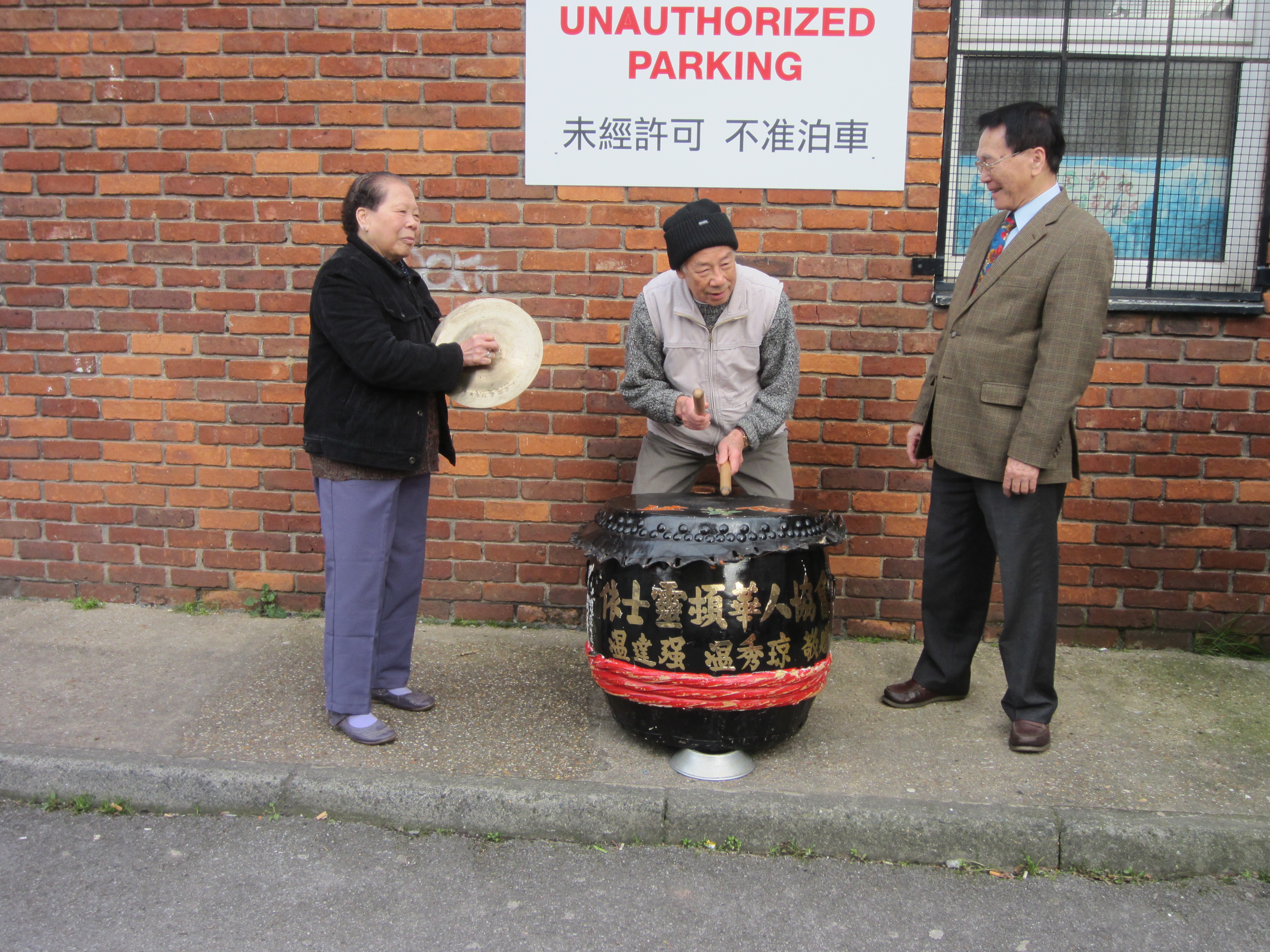
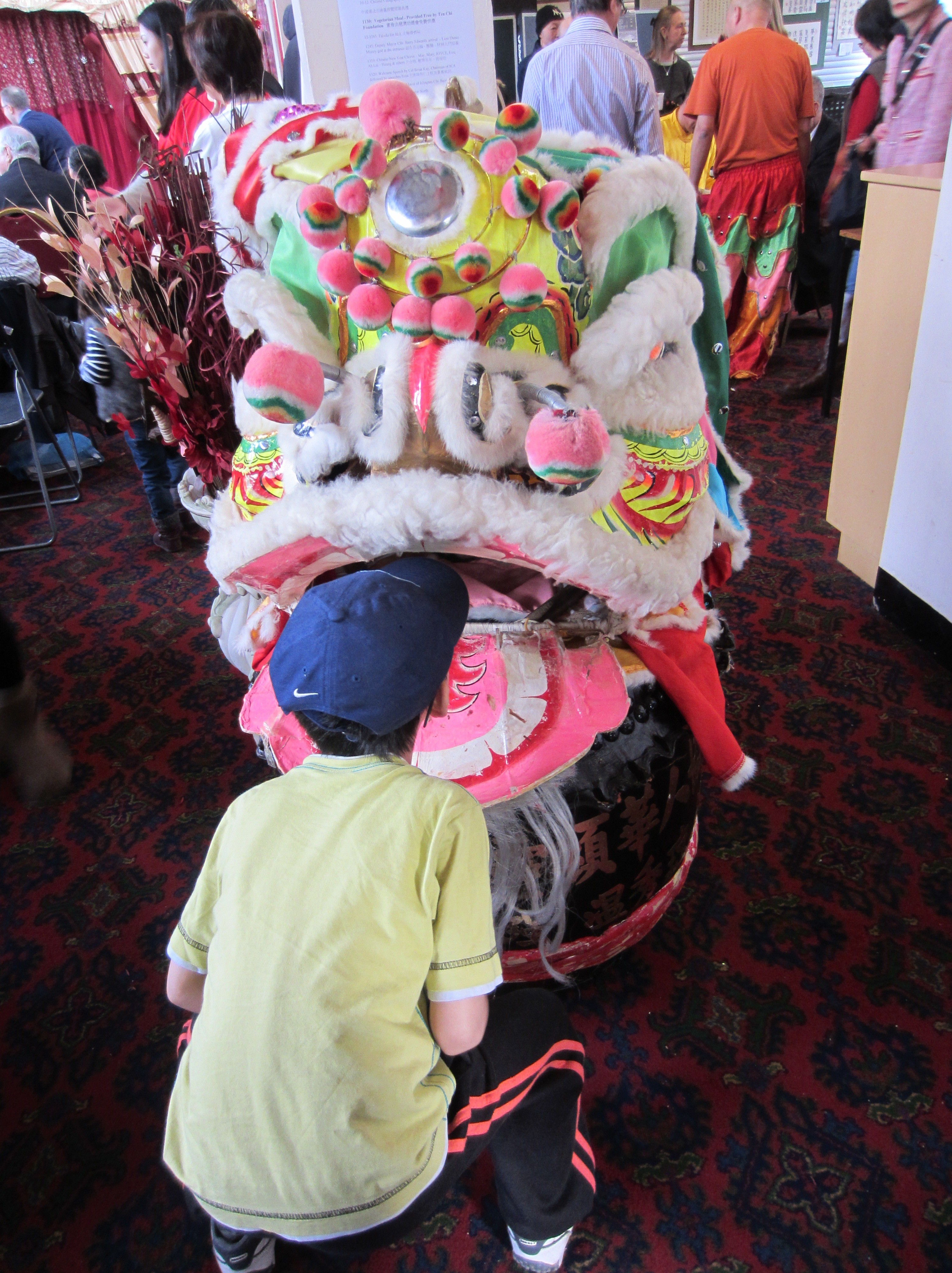
Those worries didn’t last long. We were soon distracted by an insistent beat and the clanging of cymbals. On a pavement outside, a round Chinese drum, its black lacquer gilded with golden characters, had been set up. Lion is approaching. boom-boom-boom The drum was extraordinarily loud, inducing a shiver in the pit of my stomach – a frisson I always feel when I know that the epic Lion Dance will follow. Neighbours peeked out of their windows as the Lion approached, bearing its multi-coloured head. This was a friendly beast, so friendly that at least one little boy was tempted to peer solemnly into its ravenous mouth. The Lion wagged cheeky pink tongue and tail in every corner, which I hope was enough to chase away any evil spirits lurking.

What's in there

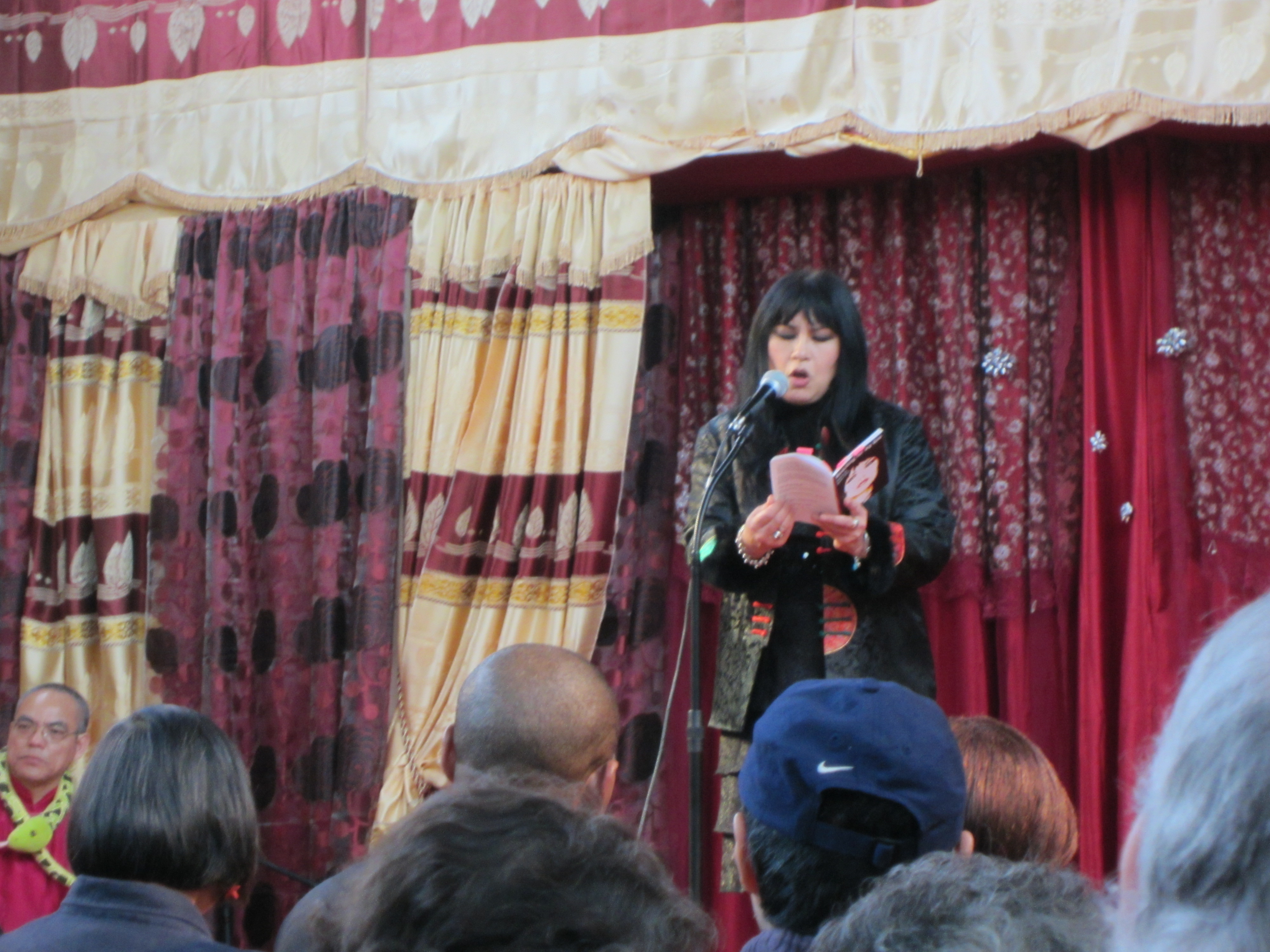
By the time I returned inside, the upper floor of the ICA had been transformed. In its place was a concert hall decked with rows of chairs. From the stage at the front came the dulcet tones of a Chinese flute, so lulling that even the children stopped squirming. When Anna Chen, poet and activist, took to the stage, she invigorated the crowd by half-reading and most astonishingly, half-singing, her poignant poems. The lyrical Anna May Wong must die was especially powerful – ‘a personal journey through the life and crimes of Hollywood’s first Chinese screen legend’, it says on Anna’s website. (I hope everyone reading this will have the opportunity to watch Anna perform). I could see that people listened, but you had to be able to hold their attention.Anna Chen reads her poetry

All too soon, it was my turn. I had been told I would go onstage after the fan dance. I waited in the wings, tense because I knew it would be the first novel reading at the ICA, afraid also that my story might not be regarded as ‘Chinese enough’ for a community event of this sort.

Indeed, the family in my novel is mixed, the woman who leads it being a Nyonya – part of the Chinese diaspora in South East Asia which dates back centuries. Many people today have never heard of the Nyonyas and Babas, even in Malaysia. This is a great shame, because the Nyonyas and Babas successfully created a unique fusion of Chinese and Malay culture long before globalisation existed. In their way of life, they have something to teach us, especially in present-day Malaysia where race drives your rights, or the lack of them (see blog-post The Malaysia We’ve Lost).

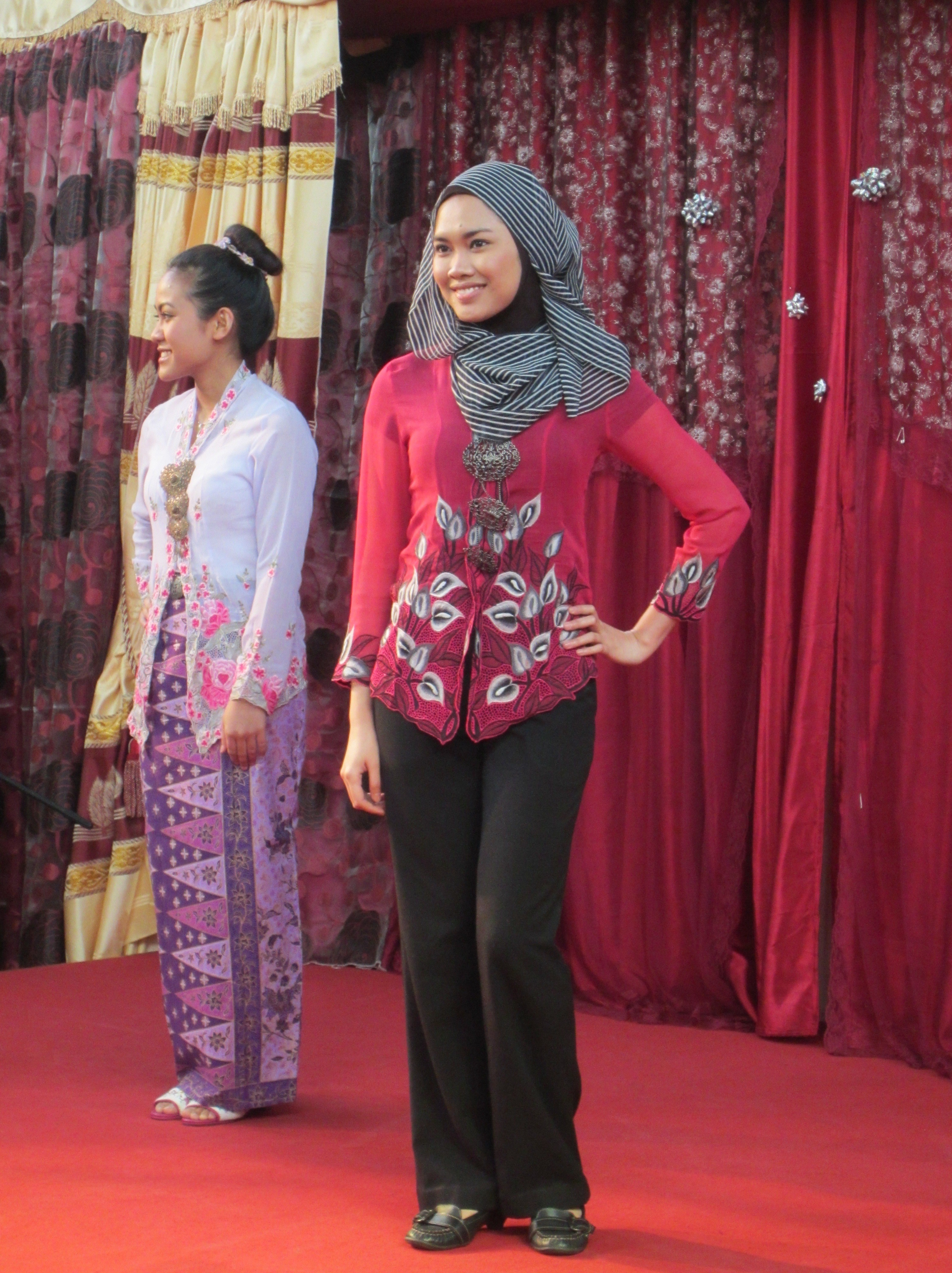
The first passage I read told the ancestral story of the Nyonyas and Babas. Selina introduces the Nyonya themeTo make my reading come alive, I had watched videos of actors and politicians speaking. I also enlisted the help of two Malaysian students, Wahidah and Aufa Dahlia, who gallantly came on stage modelling Nyonya costumes. Wahidah, her hair tied up in the famous Nyonya chignon, looked resplendent in a tailored vintage sarong kebaya.Demonstrating sarong kebaya Her blouse and sarong came from Aufa’s private collection, while her feet were adorned by a pair of hand-made Nyonya beaded slippers which had been purchased from a shop, Colour Beads, in Malacca. This beautiful town is arguably Malaysia’s most historic, and a large Nyonya-Baba community once lived there.

Wahidah was subsequently joined on stage by Aufa Dahlia, who showed off her modern Nyonya attire with great aplomb. The audience sat enraptured, so graceful were the kebaya ladies. Later, many went up to Aufa’s table, where she had placed a sample of the kebaya blouses she sells on her website as a hobby. If the kebaya ladies and I were to form an act, we would surely be hits on a reading circuit!

Modern NyonyaOther artistes followed, including the kung fu master whose rhythmic movements mesmerised everyone. Look at the picture below and you will see why he was a tough act to follow, especially by a writer reading her second passage late in the day. Kung-Fu masterFortunately, I was aided by the dramatic second scene I had chosen to read and by the prop I brought along: the Nyonya kueh (cakes) which feature in my novel. I had only two varieties with me – both from the Malaysia Hall Canteen in Bayswater – but they disappeared in seconds after being shared out!

Afterwards, people came up to say how much they had enjoyed my reading. One woman thanked me for opening her eyes to the diversity of the Chinese diaspora, a few even asked where they could buy my book. Alas, I had to say it was not yet published but I gave them my card nonetheless, as it has the address of this blog on the back.

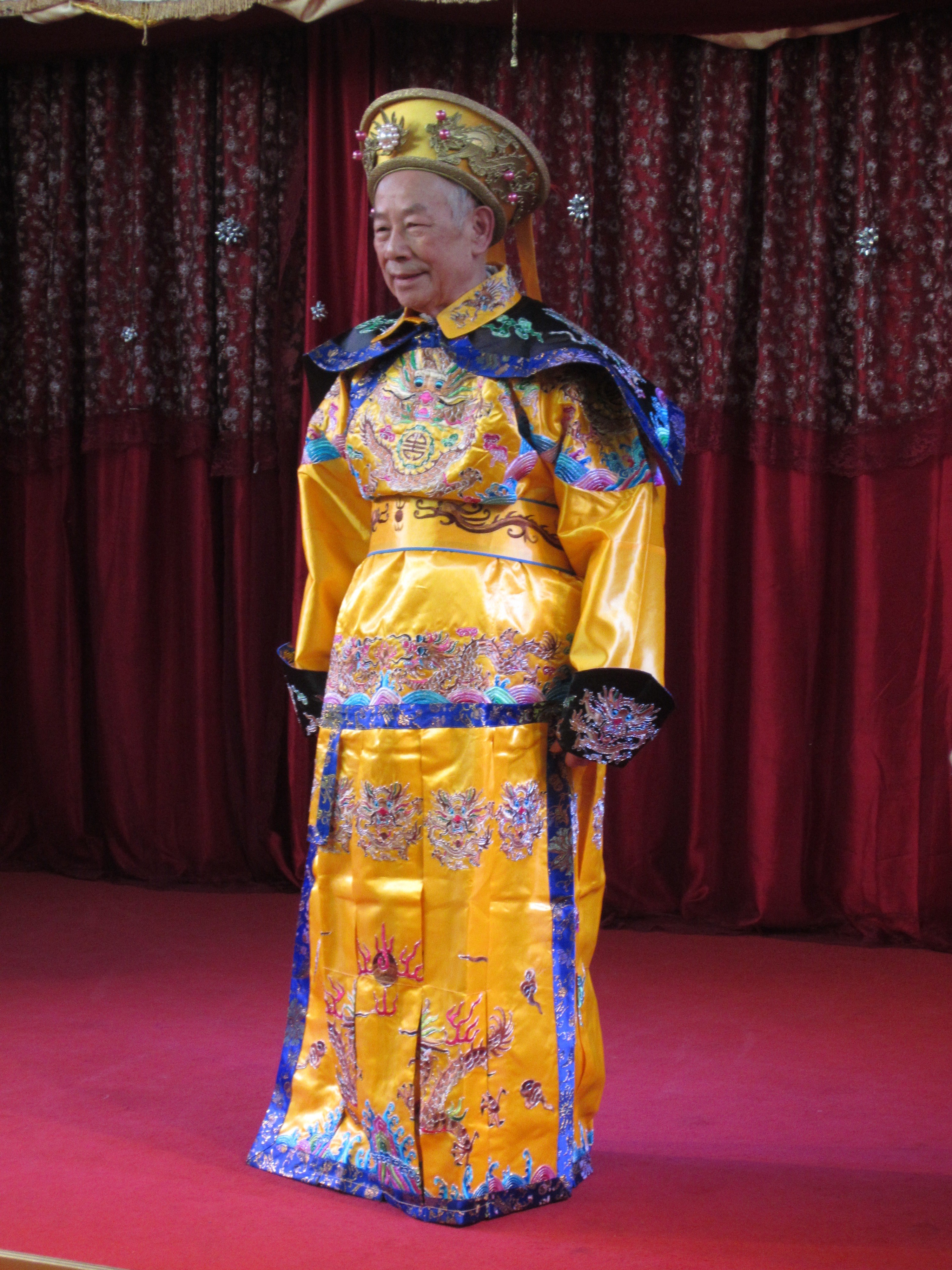
The grand finale of the afternoon was a Ching (Qing) Dynasty costume parade which starred a Mandarin, a Court Official, a Eunuch, the Empress and of course, the Emperor, all in borrowed robes which had never before been worn in the UK. Truly a fitting way with which to end such an uplifting day.

The EmperorAs we headed off, I thought of those who had come before us. It was not just Emperors and Empresses who made history but the coolies leaving in desperate circumstances, and before them, during the Ming Dynasty, the adventurer traders who left to settle elsewhere. These ancestors, all of them, have left their mark in the sands of history. And we their descendants are immensely fortunate, in having such a rich heritage to celebrate.

3 Comments

Filed under Cultural Identity, Identity, Malaysia, Novel, Nyonya

Trapped in Totleigh Barton!

The blurb had advertised Totleigh Barton as a ‘thatched, pre-Domesday manor house’. On looking up Wikipedia, I discovered that the Domesday Book was completed in 1086. Did I say 1086? Even modern British houses are cold, I find, especially their bathrooms. What was a house with a thatched roof built before 1086 going to be like? And in November…Totleigh Barton

Worse was what I had actually enrolled to do: learn new techniques for short stories, and actually write them. Short stories were not ‘my’ genre, I told myself, while wondering what the hell I was doing there.

But it was too late to turn back. Not least because we were in the middle of nowhere. Literally. Having tried to find Totleigh Barton on googlemaps beforehand, I realised we would be heading for a dot in the middle of an ocean of fields. The nearest town, Sheepwash, was two miles away. There was no wi-fi, not even mobile reception. To get mobile reception, you had to walk up a steep hill – which I couldn’t do because I was still using a crutch, thanks to an ankle sprain six weeks previously.

Then, there was the rain. We were in Devon after all, where rain falls in biblical proportions. devonI heard it in my slumber and would wake up with ready-made sentences. A short story I wrote began like this: “Winds like the dogs of Cantelabra howled through the night. Rain dropped in pellets, hitting the window panes of Sheepwash. The sheep in their pens were soaked; their clothes turned into mink, pink like the rain.

These aren’t my finest lines, but they are an example of what we were encouraged to do: let our imagination meander anywhere it cared to go . There are no rules in the short story, we were told. We gave ourselves permission to write whatever we wanted, in any way we wanted. Otherwise, I would never in a million years have come up with the dogs of Cantelabra or sheep in pink mink.

Our tutors, Tania Hershman and Adam Marek, were extraordinary. The whole course was extraordinary, as you would expect from Arvon, the UK’s premier writing foundation, which has perfected its recipe over many years. Our tutors’ seemingly crazy exercises undoubtedly produced results, because within ten minutes of our first session, we had all written a piece of flash fiction (a very short story of generally fewer than 500 words).

Equally important, we had great fun. So much so that on the last morning, when we were supposed to have free time, we asked for more writing exercises. How masochistic is that? We were simply hooked – not even the cold of the beautifully restored barn could stop us. When Tania and Adam complied, everyone came. We stretched out on sofas in the barn, then after a break, moved into the mediaeval dining room to huddle along benches, our shoulders hunched over a banqueting table the celebrity chef Heston Blumenthal would surely covet (see photograph below from the Arvon website, reproduced with their kind permission).

TotelighdiningroomSo just why had I been so afraid of going on an Arvon course?

A clue came in the middle of the week. That evening, we had a guest writer to visit. We were sitting at the mediaeval dining table, warmed by sips of wine and a roaring fire, when Oliver Meek, who with his wife Claire Berliner runs Totleigh Barton, mentioned that Arvon was thinking of ways to attract a more diverse audience. Arvon, he said, wanted to reach out into new communities. To do this, it had expanded its courses to certain cities; ethnic minorities, it seemed, were intimidated by secluded rural centres. As Oliver spoke, something clicked in my brain. I identified immediately with his words, which may sound strange to some. Fear of the countryside? Why would anyone be wary of sheep and rolling fields?

Only much later, after I had left the calm of Devon, was I able to reflect on this. I too, had been put off by where Totleigh Barton is situated. Though Sheepwash is beautiful, my mind associates seclusion with few people, all very similar but different from me, whose view is limited to a tiny piece of the world. I expect danger. And hostility. I didn’t fancy being stuck in such a place with strangers, unable to escape. Sweeping generalisations these may be, but they are the things we cannot rationalise away. Or even articulate to ourselves: until Oliver spoke, I wasn’t fully aware of what my fears had been about.

Such baggage may be stereotype and pre-conception, but it has power. I nearly didn’t book myself onto this Arvon course. And if I, with my privileged Oxford and City background, had been anxious, how much more would others be.

I’m so glad Arvon wants to reach beyond its traditional catchment. Oliver’s words made me stupidly happy. I walked on a high all evening. Perhaps it was also the Dunmore effect: the fabulous Helen Dunmore, prize-winning poet and novelist who spoke to us after dinner, is nothing if not breathtakingly eloquent. She could put anyone on a cloud. If you ever have a chance to hear her speak, grab it.

For anyone reading this who is hesitating over an Arvon course, especially if you come from an ethnic minority group – don’t be afraid, just do it. The magic will come. Arvon cares about everyone who comes through its doors. Its formula works. But you have to be open, and be prepared to give of yourself.

There was something in the air over Totleigh Barton, a magic which came precisely from being secluded in a beautiful place with others who loved words and stories. There was another kind of magic – the kind that comes from being cared for all day long. I had never expected to enjoy it so much. Even sleeping in a building which had once been home to pigs seemed exotic (see photograph below of my bedroom in the Pig Stiles, with windows on the other side overlooking green fields). The Pig Stiles

When it came time to leave, we discovered that Devon was covered in water and trains were only running from the next county. But I didn’t care. I had learnt about dribbles (micro stories of 50 words) and drabbles (micro stories of 100 words) and had finally found my short story voice. What did it matter that England was soggy?

7 Comments

Filed under Cultural Identity, Writing

An Open Letter to my Malay Friends and Anyone Who Cares Where Malaysia is Going

August 31 is Malaysia’s Independence (Merdeka) Day. On this day fifty five years ago, the Union Jack was lowered for the last time and a new country was born.

Malaysia (then called Malaya). 

She was to be a powerful narrative for multiculturalism. A place where many races – Malay, Chinese, Indian, Eurasian, Orang Asli (native indigenous people) – would live together, work together, as one, to move the country beyond the shadow of colonisation.

Malaysia remains a powerful idea. It’s one I believe in. But it has gone badly wrong. That’s why today, I’m writing this open letter to my Malay family and friends. I believe Malaysia is fast reaching a crossroad; where it goes next will be determined by you, my dear Malay friends. And where Malaysia goes is important to the world – because it remains one of the more tolerant Muslim countries.

First though, I want to say a big thank you. On this Merdeka day, I want to thank you, my Malay family and friends, and all fellow-Malaysians of Malay descent, for your historic generosity. Your ancestors welcomed mine when they arrived. You have shared the land with us, and this in turn, gave us opportunities we wouldn’t have had on mainland China. You provided us safe refuge from the turmoil of China. When I learn what happened there in the past century, I am so grateful my ancestors left. And that they found shelter in the beautiful land now called Malaysia.

My Malay friends, your own ancestors came from other places. They knew what it was like to be strangers in a new country. They treated my ancestors with that gracious hospitality which I myself have experienced countless times. All this I acknowledge, and thank you for.

But now I need to move on to something else: why I left Malaysia, and why I won’t be returning any time soon.

You may already know that 2 out of 10 Malaysian graduates live outside Malaysia. This is an astonishing fact for a middle-income country like Malaysia. It was revealed in a detailed study on Malaysia’s brain drain, carried out by the World Bank.

My Malay family and friends, do you not care about this exodus of talent? This isn’t just an abstract number: in our family, half those of my generation live abroad. We are the graduates this World Bank report identifies. We compete happily in the world economy and have no need to return.

Perhaps, my Malay friends, you think the brain drain irrelevant, since most of the people who have left are of Chinese and Indian descent? Certainly, this is what many Malays think, as Nurul Izzah Anwar, daughter of Anwar Ibrahim, has alluded to. (If you haven’t heard her speak, I recommend you watch this youtube clip. The opening is in Malay; the rest in English). 

“For me,” she says, “one Malaysian regardless of race, who has left the country…is a loss to us. They should be here celebrating, to improve the economy. I detest many people trying to singularly find out whether they are Malays, Chinese or Indians.”

My sentiments entirely. This fixation on race, race, race, in Malaysia is strangling the country. Yes, 88% of the one million Malaysians estimated to be living abroad are of Chinese and Indian descent. So what? My Malay friends, I ask you: does our race matter more than the fact that we have taken our talents elsewhere?

Yet, should I expect anything else? How could any Malaysian not be fixated on race, when you, my Malay family and friends, are accorded ‘special’ rights solely because of your race and religion?

Imagine if the United States had given ‘special’ privileges to the Pilgrim Fathers and Mothers and their descendants. Special rights to land, schools, gold mines and everything else – all because they sailed first; yes, just imagine! This is exactly what your special rights equate to. If the US had adopted such a policy, do you think it would have turned into a magnet for talent and skills?

Tell anyone about a Malaysian university reserved for people with ‘special’ privileges based on race, and you will see the reaction. What? People stare in disbelief. You must be kidding!

I’m not. And there have been demonstrations against opening the institute up to other Malaysians. Yet, Malaysians are so used to these oddities that we don’t bat an eyelid. We no longer notice the strange ideas plaguing our country.

Your ‘special’ rights, my Malay family and friends, alienate me. They make me feel unwelcome, unwanted and second-class. They are why I left. They are also why I won’t be back. Rights are a zero-sum game: for you to have more rights, others must necessarily have fewer. TalentCorp (the agency set up to attract Malaysians back) completely misses the point.

And when I see the culture of entitlement your ‘special’ privileges have led to, and the increasingly racist rhetoric this culture generates, I fear for Malaysia. Outrageous remarks are now commonplace, as former US ambassador John R. Malott outlined in his Feb 8 2011 op-ed in the Wall Street Journal.

Malaysia has once again been called Tanah Melayu (Malay Land). Malay Land was given airtime by none other than Mahathir Mohamed, former Prime Minister and rabble-rouser extraordinaire, who is himself from a family with Indian immigrants. Malay Land is more than just a name. His is a supremacist concept: a land for Malays, where Malays will be Lords, everyone else their subjects.

Some people say Mahathir no longer matters, but actually he does. I feel less welcome now in Malaysia than at any time in the past. The attitudes of Malay Land are creeping in, and Malay Land is completely the opposite of Malaysia. Malay Land excludes, while Malaysia embraces and includes – a country for all races.

My Malay family and friends, which is it you want: Malay Land, or Malaysia? You cannot have both; you must choose.

On this Merdeka Day, I urge you to think about that choice. Because you, my dear Malay friends, are the only people who can truly change the direction Malaysia takes. Know that we, your fellow-Malaysians who have voted with our feet, are rooting for Malaysia. We are no traitors. 68% of the Malaysians abroad who were surveyed by the World Bank expressed a strong sense of patriotism/attachment to Malaysia. I am among this 68%. I may have been away for thirty three years, but Malaysia continues to be in my dreams. I left with regret, and I stay away with sadness. I hope Malaysia will prevail. Assalamualaikum.

The above blog-post was published in its entirety, but without video or links, on Malaysia Kini on August 31 2012 (http://www.malaysiakini.com/letters/207623).

33 Comments

Filed under Cultural Identity, Identity, Malaysia